Tool discovery

What type of AI tool
are you looking for?

Search the active catalog with LambdaBase AI Search, or keep browsing the popularity-ordered directory below.

Submitted search queries and interaction metrics may be analyzed to improve result quality. Do not include personal or confidential information

Browse popular tools.

Screenshot of Agentic Mail | Hostinger
Agentic Mail | Hostinger
Email Unknown

Hostinger Agentic Mail is a managed email infrastructure service designed specifically for AI agents and automated workflows. It provides developers with programmatic APIs to send, receive, and manage email messages, eliminating the need to operate separate mail servers. The service focuses on reliable delivery, authentication, and handling of inbound messages for agent consumption. The platform supports webhooks for real-time notifications of incoming email, enabling AI systems to react to messages promptly. It also offers features for parsing email content, managing mailboxes, and integrating with common agent frameworks and automation tools. By leveraging Hostinger's global hosting infrastructure, Agentic Mail aims to provide scalable and secure email capabilities for AI applications. It is positioned as a building block for developers creating AI copilots, customer support bots, and other agents that need to communicate via email.

Solves

Setting up and maintaining email infrastructure for automated AI agents is complex, involving server configuration, deliverability tuning, and spam compliance. Hostinger Agentic Mail solves this by offering a managed API that handles the underlying email plumbing, allowing developers to focus on agent logic and user interactions.

Screenshot of Fathom 3.0
Fathom 3.0
LLM Unknown

Fathom is an AI-powered meeting assistant that automatically joins scheduled video conferences to record, transcribe, and summarize discussions. It produces concise meeting notes, highlights key decisions, and extracts action items, allowing participants to focus on the conversation instead of taking manual notes. Version 3.0 is marketed as a bot-free solution, suggesting that meetings are captured without a visible bot participant, and it integrates with AI assistants like ChatGPT and Claude to enable conversational queries and workflow automation around meeting content. The service typically supports popular video conferencing platforms such as Zoom, Google Meet, and Microsoft Teams, and offers a searchable library of past calls for reference and follow-up.

Solves

Fathom eliminates the need for manual meeting note-taking by automatically capturing, transcribing, and summarizing video calls, ensuring accurate records of decisions and action items without requiring a human scribe or dedicated note-taker.

Screenshot of Plurai
Plurai
Fine-tuning Unknown

Plurai is a fine-tuning evaluation and guardrails platform designed to help machine learning practitioners ensure their models meet specific quality and safety requirements. The platform focuses on providing tailored evaluations, referred to as 'vibe-train evals', which allow users to assess model outputs based on subjective criteria such as tone, style, and appropriateness for their unique use case. This approach goes beyond standard metrics by capturing nuanced aspects of model behavior that are critical for real-world deployment. In addition to evaluations, Plurai offers a comprehensive guardrails system that enables users to define and enforce constraints on model outputs. These guardrails can be customized to prevent harmful, off-brand, or irrelevant responses, making the platform suitable for applications where safety and compliance are paramount. The combination of evaluation and guardrails streamlines the fine-tuning workflow, allowing teams to iterate quickly while maintaining control over model behavior. Plurai is built to be flexible and adaptable, supporting a wide range of fine-tuned models and use cases. It abstracts away the complexity of setting up evaluation pipelines and safety layers, providing a user-friendly interface that caters to both technical and non-technical stakeholders. By focusing on the specific needs of each project, Plurai helps organizations accelerate their AI development without compromising on reliability or safety. Although detailed technical specifications are not publicly available, the platform appears to integrate with common machine learning workflows, enabling continuous monitoring and regression testing for model updates. This makes it a valuable tool for teams that frequently fine-tune models and need to maintain consistent performance over time.

Solves

Fine-tuning models often results in unpredictable outputs that can fail to align with a use case's specific tone, safety requirements, or quality standards. Manually evaluating these outputs and implementing guardrails is time-consuming and error-prone. Plurai addresses this by providing a streamlined, customizable evaluation and guardrails system tailored to each use case, enabling teams to quickly identify issues and enforce desired behavior in fine-tuned models.

Screenshot of DoMyWork
DoMyWork
AI/ML Freemium

DoMyWork is an AI-powered automation platform that replaces manual work across over 1,500 applications. It allows users to delegate tasks through natural language chat, set up recurring automation on autopilot, and create interactive playbooks that embed executable blocks. The platform requires no servers, no setup, and no complex workflow builders, making automation accessible to non-technical users. Key features include Chat for one-off tasks (e.g., 'Create a weekly email action items spreadsheet'), Autopilot for event-driven automation (e.g., when a new lead is created in HubSpot, send a custom email via Gmail), and Playbooks—documents where each block has a play button, allowing forms, AI, code, and API calls to execute seamlessly. It integrates with popular tools like Gmail, Google Sheets, HubSpot, Salesforce, Slack, and many more, enabling users to offload grunt work and focus on higher-value activities.

Solves

Business professionals and teams often waste time on repetitive manual tasks across multiple apps, such as moving data between systems, sending follow-up emails, or generating reports. Traditional automation tools require technical expertise to build and maintain workflows, creating a barrier for non-technical users. DoMyWork solves this by providing a natural language interface and pre-built integrations, allowing anyone to automate complex sequences by simply describing what they want in chat or by using ready-made playbooks, thereby reducing manual effort and accelerating productivity without any technical overhead.

Screenshot of Unabyss
Unabyss
AI/ML Unknown

Unabyss is a MCP-native (Model Context Protocol) context layer designed to provide a self-updating, persistent memory for AI applications. It acts as an intermediary that continuously ingests, organizes, and serves contextual information from various data sources, ensuring that AI models always have access to the most current and relevant data. By leveraging the MCP standard, Unabyss seamlessly integrates with a wide range of AI tools and frameworks, allowing developers to enhance their models with real-world context without manual intervention. The self-updating mechanism automatically refreshes context as underlying data changes, reducing the need for constant retraining or manual context injection. The platform works by connecting to multiple data sources such as databases, APIs, knowledge bases, and user interactions, then transforming this raw data into structured context that AI models can understand. Unabyss maintains a dynamic context store that evolves over time, learning from new information and user feedback. This approach enables AI applications to deliver more accurate, personalized, and up-to-date responses, whether it's a chatbot remembering user preferences, an assistant pulling real-time company data, or a recommendation engine adapting to changing trends. Key features of Unabyss include native support for the Model Context Protocol, automated context refresh cycles, context versioning and rollback, fine-grained access controls, and integration with popular AI platforms and APIs. Its self-updating nature means that developers can set up context pipelines once and let Unabyss handle the ongoing maintenance, freeing them to focus on building core AI logic. The layer can be deployed as a cloud service or integrated into existing infrastructure, offering flexibility for different project scales. Overall, Unabyss addresses a critical gap in AI development: the ability to maintain a living, breathing context that grows with the application. By standardizing how context is managed and updated, it reduces complexity, improves model performance, and accelerates time-to-value for AI-driven products.

Solves

AI models often operate with static training data and lack ongoing awareness of real-world changes, leading to stale, generic, or incorrect outputs. Developers face the challenge of continuously feeding fresh context to their models, which is time-consuming and error-prone. Unabyss solves this by providing a self-updating context layer that automatically ingests, updates, and serves relevant data to AI systems. This ensures that models always operate with current, accurate context, improving relevance and reliability while reducing manual intervention.

Screenshot of Finest: AI Routing That Cuts Costs, Not Quality

Finest is a model routing platform that automatically directs each AI request to the lowest-cost LLM configuration that still meets a user-defined quality bar. It acts as an AI gateway: applications use a single base URL and existing SDK, while Finest measures traffic, evaluates which model or team of models is sufficient, and serves the cheapest valid route. The service advertises no markup on provider pricing; instead, it charges 25% of verified savings, so if no savings are proven, no fee is owed. Finest offers both an API for standard LLM calls and a product called Finest Code designed to reduce costs on coding-agent API usage. The platform continuously re-verifies routes whenever model versions change, using a 'gate' mechanism to ensure quality bars remain satisfied. Marketing materials emphasize twelve optimization techniques, including splitting calls, disabling reasoning, capping outputs, shrinking context, setting cache breakpoints, and using disagreement between models as an error detector. The project includes research material such as a 'Request Compiler' paper, a challenge, comparison guides, and public documentation. It is a commercial SaaS product intended for teams that want to reduce LLM spend without changing their application code or quality expectations.

Solves

Finest solves the problem of LLM API bills growing faster than application usage. It automatically routes each request to the cheapest model configuration that still meets a specified quality bar, while monitoring model releases and verifying quality continuously, so engineering teams reduce spending without manually managing routes or sacrificing output quality.

Screenshot of Swayclip
Swayclip
Dev Tools Freemium

Swayclip is a browser-based AI creative workspace that consolidates video, image, and music generation. It allows users to create assets from text prompts or reference images using multiple leading AI models, with model selection and credit costs displayed before generation. The platform is video-first, offering text-to-video workflows with cinematic quality and support for various aspect ratios and durations. It also includes text-to-image and text-to-music tools, enabling creators to produce posters, product shots, and soundtracks within the same interface. Swayclip operates on a freemium pricing model, allowing users to start for free and access a range of models that are continuously expanded. It supports both text and image inputs, with video remaining the primary surface and image and music workflows available alongside.

Solves

Swayclip addresses the need to juggle separate AI tools for video, image, and music creation by providing one browser workspace where users can generate assets from prompts or reference images, choose among multiple leading AI models, and see credit costs upfront.

Screenshot of Flow Video
Flow Video
Videos Unknown

Flow Video is an online AI video generator that transforms text prompts and static images into short video clips. It is designed for marketers, content creators, and business users who need video assets for advertising, ecommerce, and social media without traditional filming or editing. The platform supports multiple AI video models, including Seedance 2.0, Seedance 2.5, and Veo, and offers workflows for image-to-video, text-to-video, product videos, and short-form social content. Users can upload product photos, portraits, property images, illustrations, or app screens and animate them with camera movement and visual motion. Alternatively, they can describe a scene, action, setting, lighting, and style in text to generate a video from scratch. The resulting clips can be reused across product pages, landing pages, paid ads, email campaigns, presentations, and social channels such as TikTok, Instagram Reels, and YouTube Shorts. Flow Video emphasizes speed and accessibility, allowing users to create multiple video variations and test creative directions before committing to a full production. The service runs entirely in the browser on desktop and mobile, eliminating the need for heavy software installations. It also offers free credits for new users and a limited launch offer with 50% off annual plans, though detailed pricing is not publicly listed.

Solves

Flow Video solves the need for quick, production-ready video content without filming or complex editing, by converting text prompts and existing images into AI-generated videos for ads, ecommerce, and social media.

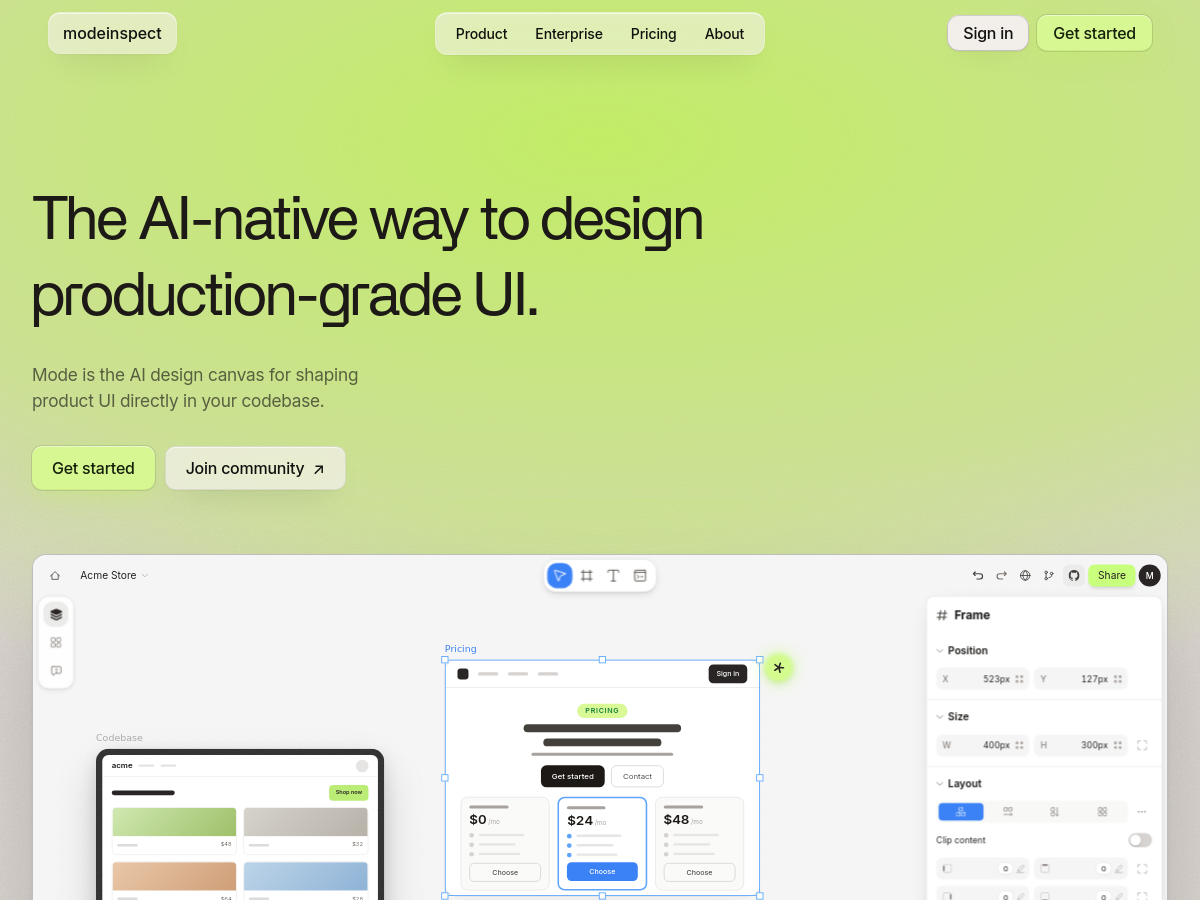
Screenshot of Modeinspect
Modeinspect
UI design Free

Modeinspect is a production-grade AI design tool that runs inside a team's codebase. It combines a visual design canvas with coding agents, allowing teams to design high-fidelity features directly against real product components, styles, and data. The tool is designed to eliminate the traditional design-to-code handoff: anything placed or edited on the canvas is built back as clean, scoped diffs with the existing design system enforced. It also supports capturing any element of a live product onto the canvas, pixel-perfect and fully editable, so designers and engineers can start from the actual shipped UI rather than from mockups. Modeinspect is built for design engineers and product teams that want a unified workflow. It provides 1:1 components with all variants and states, token-based styling for colors, spacing, and text, native breakpoint layouts, and support for dynamic states such as hover, focus, error, empty, loading, and success. The tool also includes AI exploration features for generating variants, restyling sections, adjusting copy, or applying a design direction, while keeping human control. Because it works with live data and real user flows, designs can be validated against long names, empty states, and edge cases before they ship. Modeinspect is offered as a SaaS product with a free tier and paid plans at $24/month and $48/month. It is positioned for teams that want to move from throwaway design mockups to production design in code, and it is used by design engineers at companies such as Deepnote, Apify, and others. The platform emphasizes collaboration by allowing teams to share a link, leave comments, and open a pull request in one click, without localhost setup or branch wrangling.

Solves

Modeinspect solves the design-to-code handoff problem by letting teams design high-fidelity UI directly in their codebase. It connects a visual canvas to real components, design tokens, and live data, so designs are production-ready and changes can be merged as clean, scoped diffs without handoff or throwaway mockups.

Screenshot of ChatCut
ChatCut
LLM Unknown

ChatCut is an AI-powered video editor that enables users to edit videos through natural language commands. It is accessible via multiple platforms: as a plugin within ChatGPT, as a standalone desktop application, and through a web interface. The tool leverages large language models to interpret user intentions and perform video editing tasks such as trimming, cropping, adding effects, and combining clips. By integrating with ChatGPT, it provides a conversational editing experience, allowing users to describe desired changes in plain English. The desktop and web versions offer a more traditional interface with AI-assisted features, aiming to simplify video production for creators of all skill levels. While detailed technical specifications and pricing are not publicly disclosed, the tool positions itself as a versatile solution for quick, AI-assisted video editing across different environments.

Solves

ChatCut addresses the steep learning curve and time-consuming nature of traditional video editing software by enabling users to edit videos using simple natural language instructions, making video editing more accessible and efficient.

Screenshot of AgentKey
AgentKey
AI Agents Unknown

AgentKey is a one-stop live data marketplace designed specifically for AI agents. It provides a centralized platform where developers can discover, connect, and integrate a wide variety of real-time data feeds into their autonomous agents. By aggregating live data sources across multiple domains, AgentKey enables agents to access up-to-date information for more accurate and context-aware decision-making. The platform aims to simplify the process of enriching agent capabilities with external data, reducing the need for custom integrations and manual data pipeline management. AgentKey likely offers APIs or connectors that allow seamless data streaming into agent workflows, supporting use cases from financial analysis to IoT monitoring. While detailed technical specifications are not publicly available, the service positions itself as a key infrastructure component for building data-driven AI agents that require continuous access to live information.

Solves

AI agents often rely on static training data or limited built-in knowledge, which can become outdated or insufficient for real-world tasks. AgentKey solves this by providing a marketplace of live data sources, allowing agents to dynamically pull current information and make better, more timely decisions without developers having to individually source and maintain each data feed.

Screenshot of Velo
Velo
Video Unknown

Velo is a video messaging tool that enables users to share anything as video messages. It focuses on asynchronous communication, allowing individuals and teams to record and send video clips instead of relying on text or scheduled meetings. The service appears to be web-based or product-led, with a Product Hunt listing indicating its availability as a video category product. While specific technical details such as backend language, licensing, or deployment model are not disclosed, Velo likely provides a straightforward interface for capturing screen, webcam, or uploaded content and generating shareable video links. By positioning itself around 'sharing anything as video messages,' Velo targets remote work, sales, support, and personal communication use cases. Users can convey tone, demonstrate workflows, and provide visual context that text-based messages cannot capture, reducing the need for real-time meetings.

Solves

It addresses the need for quick, personal, asynchronous communication by enabling users to share video messages instead of text, reducing meeting fatigue and improving clarity through visual and verbal context.

Screenshot of Fuzzy AI
Fuzzy AI
AI/ML Unknown

Fuzzy AI is a sales engagement tool that uses artificial intelligence to warm up prospects before direct outreach. It automates personalized touchpoints across multiple channels, such as email and social media, to build familiarity and increase receptiveness. The platform likely leverages behavioral signals and predictive analytics to determine optimal timing and messaging for each lead. By nurturing leads automatically, Fuzzy AI helps sales teams improve their efficiency and conversion rates without manual effort.

Solves

Fuzzy AI addresses the low response rates and inefficiency of cold outreach by pre-warming leads through automated, AI-driven nurturing sequences, making prospects more likely to engage when contacted.

Screenshot of Picmovi - Photo to Video Generator

Picmovi is a web-based AI photo-to-video generator that turns a single still image into a short MP4 clip, typically in about a minute. Users upload a photo, add a text prompt describing the desired motion, and choose from a roster of third-party generative video models hosted through the service, including Seedance 2.5, Veo 3.1, Kling 2.5 Turbo, MiniMax H3, Wan, and Hailuo. The result is a prompt-driven animated clip rather than a slideshow or simple pan-and-zoom effect. The platform bundles several related image utilities alongside the core video feature, such as an AI image generator, an image describer, and an image-to-prompt tool. A prompt gallery shows example first frames together with the text prompts used to animate them, covering styles like cinematic camera moves, action sequences, and character motion, so new users can copy a prompt and adapt it to their own photo. Picmovi offers free starter credits to try the workflow, with a paid tier advertised through a limited-time discount, and exports HD video. An MCP endpoint is offered for agent-based or programmatic access, positioning the tool for both interactive web use and integration into automated pipelines. The service is delivered entirely in the browser with no local installation required.

Solves

Turning a still photograph into motion footage traditionally requires animation skills, video editing software, or expensive production time. Picmovi removes that barrier by letting anyone upload a photo, describe the motion in plain language, and receive a short generated video clip in roughly a minute using hosted AI video models.

Screenshot of Connector | Hostinger
Connector | Hostinger
Server management Unknown

Hostinger Connector is a tool that integrates Hostinger's hosting platform with popular IDEs, enabling developers to deploy and manage websites directly from their coding environment. It eliminates the need to switch between the IDE and Hostinger's control panel or use separate FTP clients. The connector provides streamlined workflows for uploading files, syncing changes, and performing common server management tasks, all within the familiar interface of the IDE. It is designed to improve productivity for web developers who host their sites on Hostinger. While specific features may vary, the tool generally supports file deployment, remote file management, and possibly configuration of hosting settings. It connects to Hostinger accounts via API or authentication, allowing developers to push local changes to production with minimal friction. The tool aims to reduce deployment complexity and accelerate the development cycle for Hostinger users.

Solves

It solves the problem of manually uploading files via FTP or using a separate control panel to deploy and manage websites. By bringing these capabilities into the IDE, it reduces context switching and streamlines the deployment process.

Screenshot of Yinso
Yinso
Music Freemium

YinsoAI is an AI-powered music creation platform that enables users to generate original songs from textual ideas or lyrics. The platform's YS model interprets descriptive prompts—ranging from "bright funk pop track about baking burnt cookies" to "ethereal house track about doing yoga at home"—to produce full tracks in a wide array of genres and styles. Beyond generation, YinsoAI provides a single studio environment for exploring music, separating stems, and analyzing prompts to refine output quality. The platform features a discover page where users can browse trending and featured AI-generated tracks, listen to covers, and find inspiration from the community. A library section helps organize created assets, while a dedicated tools page offers utilities such as stem separation and prompt analysis. The workflow is designed to support both quick experimentation and iterative production, with activity notifications and help center resources to guide users. YinsoAI operates on a freemium pricing model, making it accessible for hobbyists and content creators while offering premium capabilities for more demanding use cases. It is primarily a web-based SaaS, requiring no installation, and is positioned for anyone looking to create royalty-free or custom music without traditional production skills.

Solves

YinsoAI solves the problem of creating original, high-quality songs without requiring musical expertise or expensive studio equipment. It combines text-to-music generation, stem separation, and prompt analysis in one accessible online platform, allowing users to turn ideas into polished tracks quickly.

Screenshot of PNGMaker
PNGMaker
Prompt Engineering Freemium

PNGMaker is an AI-powered online tool that generates high-quality transparent PNG images from text prompts. Users describe an image, choose from styles such as Kawaii, 3D cartoon, flat illustration, or pixel art, and the AI produces a PNG with a transparent background in seconds. It is designed to be fast and easy, requiring no image editing software. The platform also includes a background remover for existing images, a public gallery of user creations, and free PNG downloads. It operates on a freemium model, allowing users to try generation at no cost and access premium options via pricing plans. The tool emphasizes clean transparent output, high quality, and accessibility for designers, creators, and developers. PNGMaker is particularly useful for quickly producing icons, logos, stickers, game art, and other graphics that require transparency. Its selection of preset styles and prompt-based workflow lowers the barrier for non-designers while offering enough variety for creative projects.

Solves

PNGMaker solves the need for creating transparent PNG images quickly without manual background removal or advanced design skills. It uses AI to generate high-quality transparent images from text prompts, offering multiple styles and a gallery for free downloads.

Screenshot of Replay QA
Replay QA
AI/ML Freemium

Replay QA is an AI-powered quality assurance platform designed to automatically detect regressions in web applications after code changes, particularly those introduced by AI-generated code. It works by recording real user interactions and browser sessions, then replaying them against new versions of the application to compare behavior and visual output. Using advanced machine learning models, Replay QA identifies differences that indicate broken functionality, layout shifts, or unexpected changes, and presents them in an intuitive dashboard with root-cause analysis capabilities. The platform integrates seamlessly with CI/CD pipelines, enabling teams to catch bugs early in the development cycle without manual testing effort. By focusing on the common pain point of AI-written code introducing subtle errors, Replay QA provides a safety net that speeds up development while maintaining product quality.

Solves

Developers and QA teams face the challenge of manually verifying that AI-generated code changes haven't broken existing functionality or user interfaces. Replay QA solves this by automating the regression testing process: it captures real user sessions, replays them against updated builds, and uses AI to pinpoint any behavioral or visual discrepancies, thus reducing the risk of shipping broken features and saving countless hours of manual testing.

Screenshot of RankSpot
RankSpot
AI/ML Unknown

RankSpot is an AI-powered SEO blogging platform described on its Product Hunt listing as driven by deep competitor intelligence. It appears designed to help users create blog content that is optimized for search engines by analyzing competitors' content strategies and identifying opportunities. The tool likely automates research into competitor keywords, topics, and content structures to generate or suggest blog posts that can rank higher. While specific features are not detailed in the available snippet, the emphasis on 'deep competitor intelligence' suggests capabilities such as content gap analysis, topic clustering, and automated brief generation. RankSpot is positioned for content creators and marketers who want to produce SEO-driven articles without spending extensive time on manual competitive research. The listing does not disclose pricing or technical implementation details, so evaluation of its exact feature set requires further investigation.

Solves

RankSpot addresses the challenge of creating SEO-optimized blog content by leveraging competitor intelligence, reducing the need for manual analysis of competing pages and helping users produce content aligned with what is already ranking.

Screenshot of Prelint
Prelint
Code Unknown

Prelint is a tool designed to address the challenge of product drift in AI-written code. As AI coding assistants become more prevalent, there is a risk that generated code may deviate from the intended product specifications, coding standards, or architectural decisions. Prelint acts as a specialized linter or analyzer that compares AI-generated code against predefined rules or expectations to ensure consistency and alignment with product goals. It can be integrated into development workflows to automatically flag code that introduces drift, enabling teams to maintain codebase integrity even when leveraging AI tools extensively. The tool likely operates by allowing users to define custom rules or by using a set of built-in checks that focus on semantic and functional consistency, rather than just stylistic linting. While specific implementation details are not publicly available, its core promise is to provide a safety net for teams adopting AI-assisted coding, reducing the burden of manual code review for AI-generated contributions.

Solves

AI-written code can inadvertently diverge from intended product features, coding standards, or architectural patterns, leading to 'product drift.' Prelint helps prevent this by automatically detecting and flagging such deviations, ensuring that AI-generated code remains aligned with the product's specifications and quality requirements.

Screenshot of OpenHuman
OpenHuman
AI/ML Unknown

OpenHuman is described as an open-source AI harness built with the human in mind. It appears to target AI/ML practitioners who need a structured way to run, evaluate, or interact with AI models while keeping human oversight central. Specific capabilities, interfaces, and supported model types are not detailed in the available ProductHunt listing. The tool is categorized under AI/ML and is distributed as an open-source project, although its exact license, primary language, and repository activity could not be confirmed from the provided sources. The homepage currently presents a challenge page, suggesting the main site may be protected or temporarily unavailable. Because the description is minimal, potential users should consult the official repository or documentation for setup, integration, and usage details. OpenHuman may be relevant for teams exploring human-in-the-loop AI, model evaluation harnesses, or ethical AI tooling.

Solves

OpenHuman aims to provide an open-source AI harness that places human needs at the center of AI development and evaluation, potentially addressing the gap between raw model outputs and human-aligned, controllable AI workflows.

Screenshot of Open Wearables
Open Wearables
AI/ML Unknown

Open Wearables is described as open infrastructure for wearable-powered health products. The project aims to provide a foundation for building health applications that leverage data from wearable devices such as fitness trackers, smartwatches, and medical sensors. By offering an open approach, it may reduce the complexity of integrating multiple proprietary wearable APIs and data formats, allowing developers to focus on product features rather than connectivity. However, detailed specifications are limited because the official website is currently inaccessible and only a brief product description is available. The tool is categorized under AI/ML, suggesting it may incorporate or support machine learning workflows applied to wearable data, such as activity recognition, health prediction, or anomaly detection. As open infrastructure, it likely targets developers and startups building consumer health or remote monitoring products, but exact features, supported devices, licensing, and pricing remain undisclosed. Without a public repository or documentation, the maturity and adoption of Open Wearables cannot be independently verified.

Solves

Open Wearables solves the challenge of building health products that rely on data from multiple wearable devices by providing open infrastructure, potentially reducing integration overhead, vendor lock-in, and time-to-market for wearable-powered applications.

Screenshot of remio: Your Personal ChatGPT

remio is a personal AI assistant designed to capture and unify your work context. It automatically saves web pages, meeting recordings, emails, and files, turning them into a searchable knowledge base. The AI then uses this memory to provide tailored, context-aware answers to your questions, eliminating the need to switch between tools or manually gather information. Beyond question answering, remio offers a suite of productivity features including AI presentation generation, AI Excel data table creation, free meeting recording, deep research, YouTube summarization, and podcast transcription. It acts as an agentic assistant that can generate research reports, slide decks, and data tables directly from your own content. The application runs as a desktop app on Windows 10+ (x64) and M-chip Macs, with mobile apps available on iOS and Android. It is positioned for a variety of roles including product managers, engineers, sales, marketing, HR, and students, helping them work smarter with an AI that knows their context.

Solves

remio solves the problem of fragmented information across web pages, meetings, emails, and files. Generic AI assistants lack context about your specific work, forcing you to copy-paste and switch tabs. remio unifies all these sources into a searchable knowledge base and provides context-aware AI answers, saving time and improving productivity.

Screenshot of Unabyss for Claude
Unabyss for Claude
LLM Unknown

Unabyss for Claude is a tool designed to provide a shared memory layer that works across various applications and large language models, with a focus on integration within the Claude ecosystem. It acts as a persistent knowledge repository, allowing users to store and retrieve context, notes, and data that can be accessed during interactions with Claude and potentially other LLM-based tools. By centralizing memory, it aims to reduce repetitive prompting and maintain continuity across sessions. The tool likely functions as a browser extension or a companion app that captures and organizes information from web browsing, conversations, and other sources. This centralized memory can then be queried or automatically referenced by Claude to provide more personalized and context-aware responses. It may support features such as automatic saving of conversation summaries, user-defined memory snippets, and cross-platform synchronization. Unabyss for Claude addresses the common limitation of stateless LLM interactions by maintaining a user-controlled memory that persists independently. This enables more efficient workflows, especially for tasks that require long-term context, such as research, project management, or creative writing. The integration with Claude suggests tight coupling with Anthropic's model, but the mention of 'all apps and LLMs' implies broader compatibility aims. While specific technical details remain sparse, the tool appears positioned to enhance productivity for heavy LLM users by bridging the gap between isolated chat sessions and the need for a unified, intelligent knowledge base. Its development reflects the growing demand for tools that make AI assistants more continuous and adaptive to individual user histories.

Solves

Unabyss for Claude solves the problem of fragmented context across multiple applications and LLM interactions by providing a shared, persistent memory that follows the user, enabling more coherent and personalized AI assistance without manual repetition of past information.

Screenshot of Branda
Branda
AI/ML Freemium

Branda is an AI-powered brand creation and management platform that makes it easy for anyone to design a professional brand identity. Using machine learning algorithms, Branda generates logos, color palettes, typography combinations, and full brand guidelines based on user preferences and industry. The tool offers a fun and intuitive interface where users can input their brand name, select styles, and receive multiple design options instantly. It also provides brand asset management, allowing users to store and edit their brand materials in one place. Branda is currently in beta, with a freemium pricing model that lets users start for free and upgrade for advanced features. The platform aims to democratize branding, making high-quality design accessible to non-designers.

Solves

Small business owners, startups, and content creators often lack the budget or design skills to create a cohesive and professional brand identity. Hiring a designer is expensive and time-consuming, while DIY tools can be complex or produce low-quality results. Branda solves this by using AI to automate brand creation, enabling users to quickly generate logos, color schemes, and brand assets that look polished, without needing design expertise.

Screenshot of Dune
Dune
AI/ML Unknown

Dune is a context-aware keypad application for macOS that automates repetitive workflow tasks and meeting controls. It uses AI to understand the active application, ongoing meeting, or user behavior, then dynamically presents relevant buttons and shortcuts on a on-screen or physical keypad interface. The tool integrates with macOS system events, calendar, and communication apps to offer contextual actions such as muting audio, sharing screen, inserting meeting notes, or executing complex macros. Its machine learning engine adapts to individual usage patterns to prioritize frequently used actions. By replacing static keyboard shortcuts with adaptive controls, Dune reduces cognitive load and helps users focus on high-value work. It is positioned as a productivity enhancer for professionals who spend significant time in meetings and creative or technical workflows.

Solves

Dune addresses the inefficiency of managing multiple keyboard shortcuts and manual meeting controls across different applications. It provides a single context-aware interface that surfaces relevant actions automatically, saving time and reducing errors.

Screenshot of Cursor for iOS
Cursor for iOS
AI Agents Unknown

Cursor for iOS is a mobile application that brings the AI-powered coding experience of Cursor IDE to Apple's iOS devices, enabling developers to build, edit, and collaborate on code from anywhere. It integrates AI coding agents that assist with code generation, completion, debugging, and automation tasks directly from an iPhone or iPad. The app is designed to extend the desktop development workflow to mobile, allowing users to quickly review code changes, manage version control, and trigger AI-driven tasks while on the go. The application provides a streamlined interface for coding projects, leveraging cloud-based AI models to understand context and generate suggestions. It likely supports multiple programming languages and frameworks, offering a mobile-friendly editor with features like syntax highlighting and smart completions. Users can interact with AI agents to write functions, refactor code, or explain complex logic, all within a touch-optimized environment. Cursor for iOS emphasizes productivity away from the desk, catering to modern developers who need to handle urgent fixes, monitor CI/CD pipelines, or respond to code reviews in real-time. The app may synchronize with the desktop version of Cursor or other IDEs via cloud storage, ensuring a seamless transition between devices. It aims to make coding more accessible and flexible, empowering developers to contribute from anywhere with an internet connection. By leveraging AI coding agents, Cursor for iOS reduces the effort required for mobile coding, allowing sophisticated software development tasks to be performed with minimal typing. It represents an evolution in mobile development tools, combining the power of AI with the convenience of a native iOS experience.

Solves

Cursor for iOS solves the challenge of being unable to code effectively from mobile devices by providing a full-featured AI-assisted coding environment. It enables developers to write, edit, and manage code with the help of AI agents while away from their desktop, ensuring productivity and quick response to development tasks from anywhere.

Screenshot of Velo 3.0
Velo 3.0
Video Unknown

Velo 3.0 is an AI-powered video infrastructure platform designed to accelerate the creation of video content for business communication. It enables users to produce explainer videos, training materials, and sales presentations quickly by leveraging artificial intelligence for tasks such as script generation, voiceover, and possibly avatar-based delivery. The platform targets organizations looking to scale video production without the need for extensive video editing expertise, thereby reducing time-to-market for video campaigns. Velo 3.0 integrates with existing workflows to automate repetitive aspects of video creation, allowing teams to focus on messaging and strategy rather than technical production details.

Solves

Velo 3.0 solves the problem of slow and resource-intensive video production, enabling businesses to explain concepts, train employees, and sell products faster by using AI to automate and streamline the entire video creation pipeline.

Screenshot of Velo 2.0
Velo 2.0
Video Unknown

Velo 2.0 is a screen and voice recording tool that lets users capture their screen and microphone directly from the browser. It is designed to produce short, shareable video messages without requiring video editing expertise or complex upload workflows. The tool transforms screen recordings into hosted videos with shareable links, making it suitable for asynchronous communication, product demos, and quick walkthroughs. The workflow emphasizes speed: users can start recording instantly, stop, and distribute the resulting video to colleagues or customers. Velo 2.0 positions itself as a lightweight alternative to traditional screen recording software, with a focus on accessibility and ease of use. Pricing details are not publicly disclosed on the Product Hunt listing.

Solves

Velo 2.0 solves the challenge of creating quick, contextual video explanations without time-consuming editing or file management. It enables users to capture their screen and voice in moments and share a link instead of scheduling live meetings or writing lengthy documentation.

Screenshot of FliesReplies
FliesReplies
Voice & Audio Freemium

FliesReplies is a Chrome extension designed to help professionals reply to LinkedIn and X posts faster while maintaining their authentic voice. It learns a user's writing style by importing past comments and improves tone matching with every edit. The extension works natively inside the social platforms, eliminating tab switching and copy-pasting. Key features include voice learning, instant reply suggestions, image and PDF reading, brand alignment, native integration, one-click reply insertion, and privacy protections. Suggestions appear directly in the comment box and can be used, edited, or regenerated in seconds. FliesReplies offers a freemium model with a 3-day free trial and no credit card required. It targets personal brand builders, agencies, and growth operators who want to stay visible without spending excessive time on engagement.

Solves

FliesReplies solves the time-consuming task of writing authentic social media replies by generating context-aware suggestions that match the user's own voice, reducing time per reply from minutes to seconds while increasing engagement on LinkedIn and X.

Screenshot of Prefactor
Prefactor
AI Agents Unknown

Prefactor is a real-time evaluation platform for AI agents. It enables developers and ML engineers to monitor, assess, and improve the performance of their AI agents by providing instant feedback on agent behavior. The tool likely collects metrics on response quality, latency, accuracy, and compliance, allowing teams to identify and address issues before they impact end-users. By integrating into the agent development lifecycle, Prefactor aims to streamline testing and debugging processes, reducing the risk of unexpected failures in production. While specific features are not detailed, its focus on real-time evaluation suggests a dashboard or API for continuous monitoring and alerting.

Solves

Evaluating AI agents is challenging due to their non-deterministic nature; Prefactor provides real-time assessment to ensure reliability and performance.

Screenshot of remio: Your Personal ChatGPT v3.2.5

remio is a personal AI assistant tool that provides tailored answers using ChatGPT-like language models. It aims to deliver personalized responses based on user preferences and context, enhancing the chat experience beyond generic AI interactions. The tool is offered as a freemium service, likely accessible via a web interface, and includes features such as tailored answers, chat history, and customization options. Version v3.2.5 indicates active development.

Solves

remio solves the problem of generic AI responses by providing personalized and tailored answers, making AI assistance more relevant to individual users.

Screenshot of MeshGPT
MeshGPT
LLM Free

MeshGPT is a free AI-powered 3D model generator that converts text prompts or images into production-ready 3D assets. It supports both text-to-3D and image-to-3D workflows, enabling users to create game-ready models, stylized characters, product prototypes, and printable meshes without prior 3D modeling experience. The platform accepts JPG, PNG, and WebP images for image-to-3D conversion and preserves original colors and details. For text-to-3D, users can describe any style, and the system generates models with auto-generated PBR materials and textures. MeshGPT emphasizes fast AI mesh processing, optimized topology, and clean UVs. Exports are available in multiple common formats including GLB, FBX, OBJ, and STL, ensuring compatibility with major 3D tools such as Blender, Unity, and Unreal Engine. Use cases highlighted on the site include game asset creation, anime character modeling, 3D printing, and product concept design. MeshGPT is offered as a free web-based service.

Solves

Traditional 3D modeling is time-consuming and requires specialized skills. MeshGPT addresses this by enabling instant 3D model generation from simple text descriptions or uploaded images, reducing production time and cost for game developers, designers, and hobbyists, and making 3D content creation accessible to non-experts.

Screenshot of RankAI
RankAI
AI Agents Unknown

RankAI is an autonomous AI agent designed to help businesses acquire customers through Google and AI-powered search engines. It aims to automate the process of creating and optimizing content to rank for buyer-intent queries, reducing the manual workload typically associated with SEO. The tool positions itself as a hands-off solution for improving organic visibility and driving conversions. Unlike traditional SEO tools that require extensive manual keyword research and content optimization, RankAI claims to autonomously generate strategies and content aligned with both traditional search rankings and emerging AI search platforms such as ChatGPT, Perplexity, and Google AI Overviews. This dual focus addresses the shift in how users discover products and services online. The platform likely integrates keyword research, content generation, and ranking monitoring into a single workflow, enabling users to target high-conversion search intents. Its goal is to turn organic search into a consistent customer acquisition channel without requiring deep technical SEO expertise. Specific technical details, pricing, and deployment options are not publicly disclosed. However, based on its positioning and category, RankAI appears to be a cloud-based SaaS product intended for businesses seeking to adapt to the evolving search landscape.

Solves

RankAI solves the challenge of acquiring customers from organic search by automating SEO and AI search optimization. It helps businesses identify buyer-intent keywords, generate optimized content, and improve visibility in both Google results and AI-generated answers without requiring deep SEO expertise or manual effort.

Screenshot of ListingKit
ListingKit
AI/ML Freemium

ListingKit is a web-based AI product image generator built for ecommerce sellers. It accepts product reference images and turns them into cleaner listing photos tailored for marketplaces such as Amazon, Shopify, Etsy, eBay, Walmart, and many others. The platform provides preset workflows for common seller tasks, including white background hero shots, lifestyle scenes, background replacement, and alt text generation. Users start with presets and can refine results through a chat interface when more control is needed. ListingKit supports consistency across product variants by keeping the same crop, angle, and finish across colorways and bundles. It also allows catalog refreshes without new photo shoots by reusing existing product references. The tool operates on a freemium model, letting sellers test core features before upgrading. It is designed to reduce manual editing time and avoid expensive photography for routine listing updates.

Solves

ListingKit solves the problem of creating clean, marketplace-compliant ecommerce product images from existing product photos. It eliminates the need for expensive photo shoots or manual editing by automating background cleanup, framing, and scene generation for multiple sales channels.

Screenshot of ExploreYC
ExploreYC
Database Unknown

ExploreYC is an open-source API that provides structured data about startups backed by Y Combinator and Andreessen Horowitz (a16z). It aggregates company profiles, founder information, funding rounds, and other relevant metadata into a queryable format, enabling developers and analysts to programmatically access this curated dataset. The API aims to simplify research and discovery within these prominent startup ecosystems without relying on proprietary or paywalled databases. As an open-source project, the underlying data collection and API code are transparent and can be self-hosted or extended.

Solves

Accessing up-to-date, structured data on Y Combinator and a16z portfolio companies typically involves manual web scraping, multiple scattered sources, or expensive commercial databases. ExploreYC offers a free, open-source alternative that consolidates this information into a single, easy-to-query API.

Screenshot of Figma for Agents
Figma for Agents
AI Agents Unknown

Figma for Agents is a solution from Figma that extends the design platform to AI agents, enabling them to create, modify, and manage designs programmatically while staying connected to an organization's design system. It provides interfaces and workflows that let AI agents leverage Figma's component libraries, styles, and variables, so generated designs adhere to existing brand guidelines. This helps teams integrate AI into design processes without sacrificing consistency. By connecting AI agents to Figma, teams can automate repetitive design tasks, accelerate prototyping, and enable non-designers to produce high-quality, on-brand interfaces through conversational or agent-driven interactions.

Solves

Figma for Agents solves the gap between AI-generated designs and established design systems by allowing AI agents to create and edit designs using Figma's components, styles, and variables, ensuring outputs remain on-brand and production-ready.

Screenshot of AdAnt AI
AdAnt AI
LLM Unknown

AdAnt AI is an artificial intelligence tool designed to generate compelling and effective social media advertisements. Leveraging advanced language models similar to Claude, it helps marketers and businesses create high-converting and viral ad copy tailored for platforms like Facebook, Instagram, Twitter, and others. The tool streamlines the creative process by providing data-driven suggestions and optimizing ad content for audience engagement and conversion. Users can input product details, target audience, and campaign goals to receive multiple ad variations. AdAnt AI aims to reduce the time and cost associated with traditional ad creation, enabling businesses of all sizes to launch effective campaigns quickly. By automating copywriting, it allows marketers to focus on strategy and creative direction.

Solves

Creating effective social media ads is time-consuming and requires copywriting expertise, often leading to low engagement and poor conversion rates. AdAnt AI automates the generation of viral, high-converting ad copy, simplifying the process for businesses and marketers.

Screenshot of mailX by mailwarm
mailX by mailwarm
AI Agents Unknown

mailX is an email deliverability toolkit created by mailwarm, designed for both human users and AI agents. It focuses on improving sender reputation and ensuring emails land in the inbox rather than spam. The toolkit likely includes automated email warm-up, deliverability monitoring, and actionable insights. As an AI agent-compatible tool, mailX may offer APIs or integrations for programmatic email reputation management. The product is listed on Product Hunt under the AI Agents category, indicating its positioning for modern automated workflows.

Solves

mailX solves poor email deliverability by providing tools to warm up email accounts, monitor sender reputation, and optimize inbox placement, helping businesses and AI agents avoid spam filters and maintain consistent communication.

Screenshot of Claude Code Routines
Claude Code Routines
LLM Unknown

Claude Code Routines is a utility designed to automate repetitive tasks within Claude Code, Anthropic's command-line interface for AI-assisted coding. It enables users to define smart routines—reusable sequences of prompts and commands that can be triggered automatically, reducing the need to manually type the same instructions each time. By putting Claude Code tasks on autopilot, the tool aims to streamline developer workflows, allowing common actions such as code generation, review, and repository analysis to be executed consistently and efficiently. The exact mechanism may involve configuration files or a library of pre-built routines, though details are limited from the listing. The product appears on Product Hunt with pricing unknown, suggesting it may be a new or community-driven offering. Users interested in automating their Claude Code interactions can explore the tool via the provided link for more information.

Solves

Reduces manual repetition and improves consistency in Claude Code workflows by enabling automated, reusable routines for common coding tasks, saving developers time and standardizing execution.

Screenshot of Hey Noah
Hey Noah
AI/ML Unknown

Hey Noah is a proactive AI executive assistant designed specifically for founders and startup leaders. It leverages artificial intelligence to handle routine administrative and operational tasks, enabling founders to focus on strategic growth and high-impact work. The tool operates autonomously, anticipating needs such as scheduling meetings, managing email communications, summarizing documents, and organizing daily priorities. By learning user preferences and context, Hey Noah aims to reduce the cognitive load of running a business. Unlike generic virtual assistants, Hey Noah is tailored to the fast-paced, multitasking environment of startup founders. It can integrate with common productivity tools and communication platforms to centralize task management. Its proactive nature means it not only responds to commands but also suggests actions based on upcoming deadlines, meeting requests, and workflow patterns. This allows founders to delegate repetitive work and stay organized with minimal manual input. Hey Noah positions itself as more than just a task executor; it acts as an operational partner that adapts to individual working styles. By automating scheduling, drafting responses, and providing daily briefings, it helps founders reclaim hours each week. The tool emphasizes security and privacy, ensuring sensitive business data remains protected while being accessible across devices.

Solves

Startup founders often struggle with time management and administrative overload, leaving less bandwidth for strategic decision-making and business development. Hey Noah alleviates this by acting as an AI-powered executive assistant that autonomously handles scheduling, communication, and task coordination, allowing founders to delegate operational busywork and focus on high-value activities.

Screenshot of NovaVoice
NovaVoice
Voice & Audio Unknown

NovaVoice is a voice-driven productivity tool that combines smart dictation, an AI assistant, and hands-free app control. It is designed to let users speak naturally to compose text, execute commands, and automate tasks across supported applications, reducing the need for typing and manual navigation. The tool is listed in the Voice & Audio category on Product Hunt and is positioned as a general-purpose solution for voice-first workflows. It aims to solve the friction of switching between keyboard, mouse, and different app interfaces by providing a unified voice interface. Users can dictate text, ask questions or request actions from an integrated AI assistant, and control other applications through voice commands. The exact set of supported apps, languages, and platforms is not specified in the available description. Because pricing information is not disclosed, it is unclear whether NovaVoice is free, paid, or subscription-based. The underlying technology—such as speech recognition engine, on-device vs cloud processing, and privacy safeguards—is also not detailed. Therefore, this metadata is limited to the high-level positioning and intended use cases inferred from the product description.

Solves

NovaVoice addresses the inefficiency of manual typing and mouse-based navigation by enabling voice-driven dictation, AI-assisted actions, and app control from a single interface. It helps users stay in flow and perform tasks hands-free, reducing repetitive physical input and context switching.

Screenshot of SKI
SKI
LLM Unknown

SKI is a free voice coding tool designed to work with AI coding assistants such as Claude Code, Codex, and similar tools. It enables developers to dictate code snippets, commands, and navigation instructions using natural speech, converting voice input into text that the AI assistant can process. By integrating with popular AI tools, SKI aims to streamline the coding workflow and reduce the need for manual typing. The tool appears to be command-line oriented, leveraging the terminal interfaces of these AI systems to facilitate a hands-free development experience. Although detailed documentation is scarce, SKI positions itself as a complementary layer for existing AI coding environments, potentially supporting multiple platforms and languages through voice recognition and text-to-code pipelines.

Solves

SKI addresses the productivity bottleneck of manual code entry by allowing developers to use voice commands to interact with AI coding assistants, enabling faster prototyping, accessibility for users with typing difficulties, and a more natural interface for code generation and editing.

Screenshot of Offsite
Offsite
AI Agents Unknown

Offsite is a tool listed on Product Hunt under the AI Agents category. Its core capability, as stated in the listing, is to let users build teams composed of human members and AI agents, then watch them work together. The platform appears to focus on orchestrating hybrid workflows where autonomous agents and people collaborate within a shared environment. Public information about Offsite is limited to its Product Hunt description. Pricing details are not disclosed, and no technical documentation, GitHub repository, or deployment information has been made available at the time of enrichment. The official website currently presents a Cloudflare challenge, preventing further inspection of features or architecture. Based on the provided description, Offsite targets users who need to coordinate and observe mixed teams of humans and AI agents. It may provide a dashboard or interface for monitoring agent activities and human contributions, though specific features remain unverified.

Solves

Offsite addresses the challenge of managing and observing teams that include both human workers and AI agents. It provides a platform to assemble such hybrid teams and monitor their work, potentially enabling users to delegate tasks to agents while maintaining human oversight.

Screenshot of Claude Opus 4.7
Claude Opus 4.7
LLM Unknown

Claude Opus 4.7 is Anthropic's most advanced large language model, purpose-built for cutting-edge reasoning and agentic coding tasks. As the flagship of the Claude family, it pushes the boundaries of what AI can achieve in complex problem-solving, autonomous software development, and multi-step reasoning. The model excels at understanding nuanced instructions, maintaining coherence over extremely long contexts, and producing highly accurate and actionable outputs. It integrates seamlessly into development workflows, enabling teams to accelerate coding, debugging, and system architecture design. With a focus on safety and alignment, Claude Opus 4.7 incorporates Anthropic's latest research in constitutional AI to provide reliable and helpful assistance while minimizing harmful outputs. Its architecture is optimized for handling intricate agentic workflows, where the model can iteratively plan, use tools, and execute code with minimal human intervention. This makes it an ideal choice for enterprises and research institutions tackling ambitious AI-driven projects. The model is accessible via Anthropic's API, allowing easy integration into applications, IDEs, and custom pipelines. Whether you're generating entire codebases from high-level specs, solving advanced mathematical proofs, or orchestrating multi-agent systems, Claude Opus 4.7 delivers state-of-the-art performance and robustness.

Solves

Software engineers, data scientists, and AI researchers often struggle with time-intensive coding, debugging, and complex reasoning tasks that demand deep domain expertise and careful attention to detail. Claude Opus 4.7 acts as an always-available expert collaborator, capable of autonomously generating, reviewing, and optimizing code, as well as solving abstract problems that require multi-step logic and planning. By handling heavy cognitive loads, it dramatically shortens development cycles and empowers teams to focus on high-level creative and strategic work.

Screenshot of Wispr Flow Notetaker
Wispr Flow Notetaker
AI/ML Unknown

Wispr Flow Notetaker is an AI-powered meeting notes application that automatically captures, transcribes, and summarizes conversations. It focuses on producing accurate details from meetings, ensuring that important points, decisions, and action items are not lost. The tool is designed to run during meetings, listening to the conversation and generating structured notes in real time or after the meeting. It aims to reduce the manual effort of note-taking and allow participants to engage fully in the discussion. While specific technical details and pricing are not publicly disclosed in the available source, Wispr Flow Notetaker positions itself as a solution for professionals who need reliable meeting documentation without distracting from the conversation. It is suitable for teams looking to improve meeting productivity and accountability.

Solves

It solves the problem of incomplete or inaccurate meeting notes by automatically capturing and summarizing discussions, ensuring key details, decisions, and action items are recorded accurately, so participants can focus on the conversation instead of writing notes.

Screenshot of Claude Code Desktop App Redesigned

Claude Code Desktop App Redesigned is a desktop application listed on Product Hunt under the LLM category. It is designed to let users run parallel coding agents from a single desktop workspace, providing a graphical interface for managing multiple AI coding sessions simultaneously. The tool appears to be a third-party or community-driven redesign of the Claude Code experience, focusing on desktop usability. The application is offered with unknown pricing and its technical details, such as supported programming languages, system requirements, and integration capabilities, are not specified in the available listing. It aims to streamline workflows for developers who need to orchestrate several coding agents concurrently. Further information from the official homepage is limited due to a challenge page, so the description is based solely on the Product Hunt listing and the tool's name and tagline.

Solves

It addresses the need for developers to manage multiple coding agents in parallel without switching between separate terminal sessions or browser tabs, centralizing agent orchestration in one desktop workspace.

Screenshot of Spellar 3.0
Spellar 3.0
AI/ML Unknown

Spellar 3.0 is an AI meeting companion designed to provide cross-meeting memory, enabling users to retain context and continuity across multiple discussions. The tool aims to automate meeting documentation and surface relevant insights from past meetings when needed. By leveraging AI, Spellar 3.0 can capture key points, decisions, and action items during or after meetings, reducing the manual overhead of note-taking. Its cross-meeting memory feature distinguishes it from simple transcription tools by connecting related information over time. The platform is positioned for professionals and teams who rely on recurring meetings, client interactions, or project discussions, helping them avoid repeating context and improve follow-through. As an AI/ML product, it likely uses natural language processing to summarize and structure spoken content, though specific technical details are not publicly documented.

Solves

Spellar 3.0 solves the problem of lost meeting context and manual note-taking by providing an AI companion that remembers information across meetings, enabling users to quickly retrieve past decisions, action items, and relevant discussion points without searching through notes or recordings.