Tool discovery

What type of AI tool
are you looking for?

Search the active catalog with LambdaBase AI Search, or keep browsing the popularity-ordered directory below.

Submitted search queries and interaction metrics may be analyzed to improve result quality. Do not include personal or confidential information

Browse popular tools.

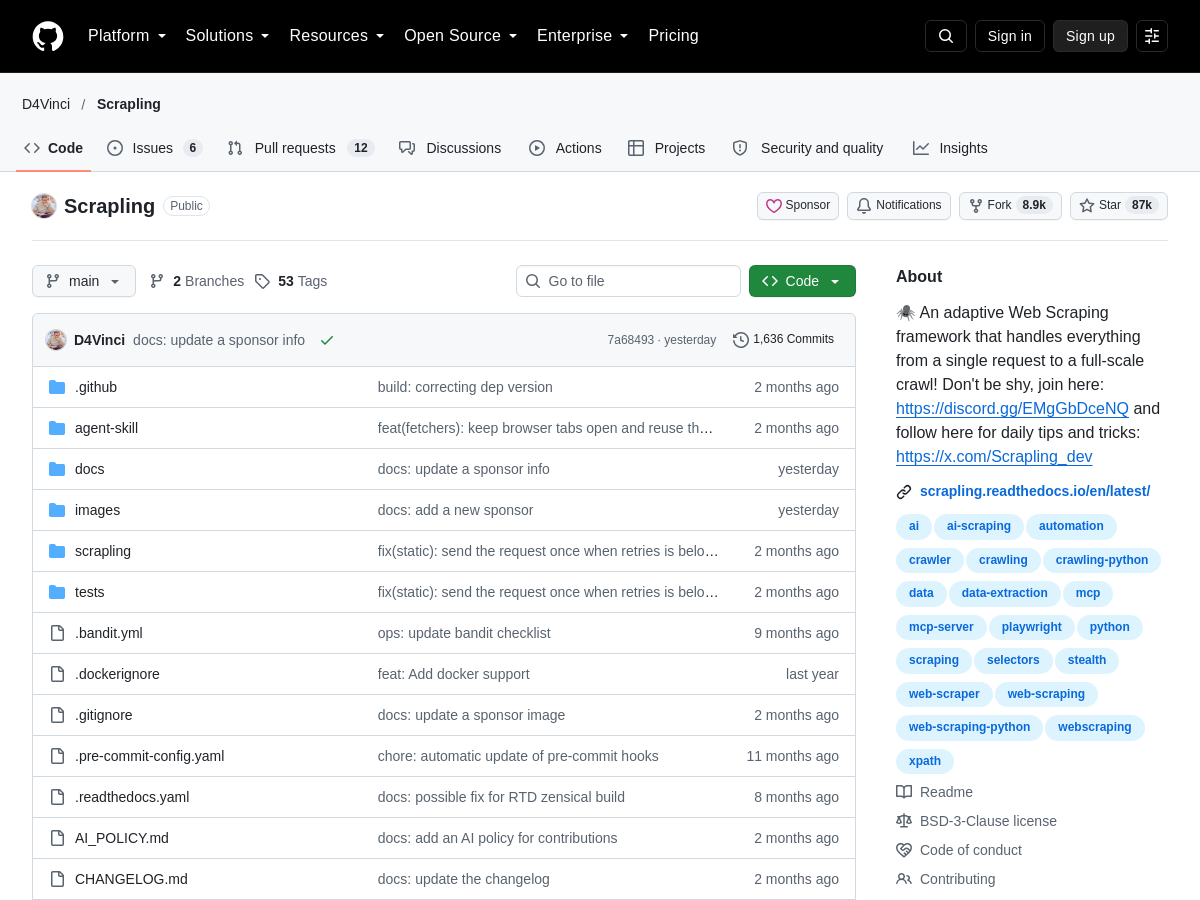
Screenshot of Scrapling
Scrapling
Framework Open Source

Scrapling is an adaptive Web Scraping framework designed to handle everything from a single request to a full-scale crawl. It provides a comprehensive solution for web scraping, allowing users to extract data from websites efficiently. The framework is built to be flexible and scalable, making it suitable for a wide range of use cases. With Scrapling, users can create custom scrapers to extract specific data from websites, and the framework handles the complexities of web scraping, such as handling different types of content, rotating proxies, and avoiding anti-scraping measures. Scrapling also provides a range of features, including support for multiple browsers, automatic retry mechanisms, and customizable workflows. The framework is open-source and has a large community of contributors, ensuring that it stays up-to-date with the latest web scraping techniques and best practices. Overall, Scrapling is a powerful tool for anyone looking to extract data from websites, whether for personal or professional use. The framework is well-documented, with a comprehensive README and extensive documentation, making it easy for users to get started and learn how to use the framework effectively. Additionally, Scrapling has a strong focus on community engagement, with a Discord channel and regular updates, ensuring that users can get help and support when needed. The framework is also highly customizable, allowing users to extend and modify it to suit their specific needs. With its flexibility, scalability, and comprehensive feature set, Scrapling is an ideal choice for anyone looking to extract data from websites. Furthermore, the framework is constantly evolving, with new features and improvements being added regularly, ensuring that it stays ahead of the curve in the rapidly changing landscape of web scraping. The large community of contributors and users also ensures that any issues or bugs are quickly identified and fixed, making Scrapling a reliable and trustworthy choice for web scraping tasks. In terms of technical details, Scrapling is built using Python and has a modular architecture, making it easy to extend and customize. The framework also supports a range of browsers, including Chrome, Firefox, and Safari, and has automatic retry mechanisms to handle common web scraping issues such as connection timeouts and proxy errors. Overall, Scrapling is a powerful and flexible web scraping framework that is well-suited to a wide range of use cases, from small-scale data extraction to large-scale web scraping tasks.

Solves

Web scraping can be a challenging and time-consuming task, especially when dealing with complex websites or large-scale data extraction. Scrapling solves this problem by providing a comprehensive and flexible framework for web scraping, allowing users to extract data from websites efficiently and effectively. With Scrapling, users can create custom scrapers to extract specific data from websites, and the framework handles the complexities of web scraping, such as handling different types of content, rotating proxies, and avoiding anti-scraping measures. This makes it an ideal solution for anyone looking to extract data from websites, whether for personal or professional use.

Screenshot of Adkit v1.1.0
Adkit v1.1.0
AI Agents Freemium

Adkit v1.1.0 is a freemium software tool categorized under AI Agents. Its tagline, 'Like Ahref but for advertising,' positions it as an advertising intelligence and research platform, analogous to SEO tool Ahrefs but focused on advertising data, and designed to be used by both humans and AI agents. The official website linked to the tool, ecombriefs.io, currently presents EcomBriefs.io, which offers an AI visibility diagnostic for ecommerce. It checks whether an online store appears in AI answer engines such as ChatGPT, Perplexity, and Gemini, and delivers a manual professional PDF report within 24-48 hours. Because public documentation is limited, the exact feature set of Adkit v1.1.0 is not fully detailed in available sources; however, the positioning suggests capabilities for competitive advertising analysis, ad campaign research, and integration with AI agents for automated workflows.

Solves

Helps businesses and AI agents understand advertising competitive landscapes and/or verify AI-driven visibility for ecommerce stores; reduces manual research by providing structured insights or diagnostic reports.

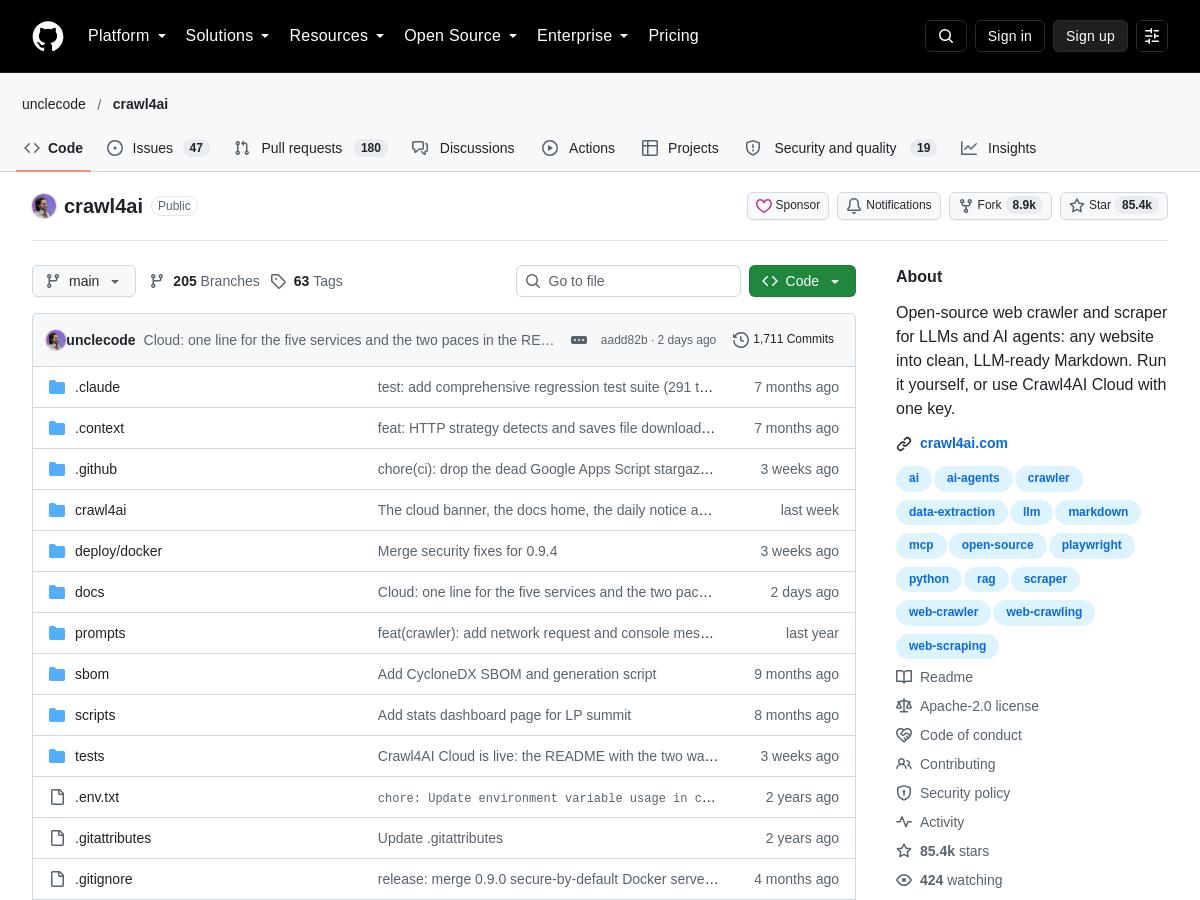
Screenshot of Crawl4ai
Crawl4ai
AI Agents Open Source

Crawl4AI is an open-source web crawler and scraper designed for Large Language Models (LLMs) and AI agents. It can turn any website into clean, LLM-ready Markdown. The tool offers two primary modes of operation: running it yourself as an open-source library or using the hosted Crawl4AI Cloud service with a single key. The library version allows for full control over the crawling and scraping process, including the ability to use custom browser profiles, proxies, and extraction strategies. On the other hand, the cloud version provides a simplified experience, handling complexities such as browser management and bot detection automatically. Crawl4AI supports various features, including Markdown generation, structured data extraction, browser control, and crawling and scraping capabilities. It also integrates with AI agents through the MCP (Model Control Protocol) and offers a REST API for self-hosting. The tool is highly customizable, with options for different extraction strategies, caching modes, and more. Crawl4AI is licensed under the Apache License 2.0 and is available on GitHub, where it has gained significant popularity as one of the most-starred crawlers. The project is actively maintained, with a roadmap for future developments and a community of contributors. For those interested in supporting the project, there are options for sponsorship and enterprise partnerships. Overall, Crawl4AI aims to provide a powerful, flexible, and accessible solution for web data extraction, catering to both individual developers and enterprise needs.

Solves

Crawl4AI solves the problem of extracting useful data from websites in a format that is readily usable by Large Language Models (LLMs) and AI agents. Many websites contain valuable information that could be leveraged by AI models for various applications, but this data is often not readily accessible due to the complexities of web scraping and the need for clean, structured data. Crawl4AI addresses this challenge by providing a straightforward and efficient way to crawl websites, extract relevant data, and convert it into a format that is easily consumable by LLMs. This enables developers, data scientists, and businesses to focus on building AI applications without being hindered by the difficulties of web data extraction.

Screenshot of Deer Flow
Deer Flow
AI Agents Open Source

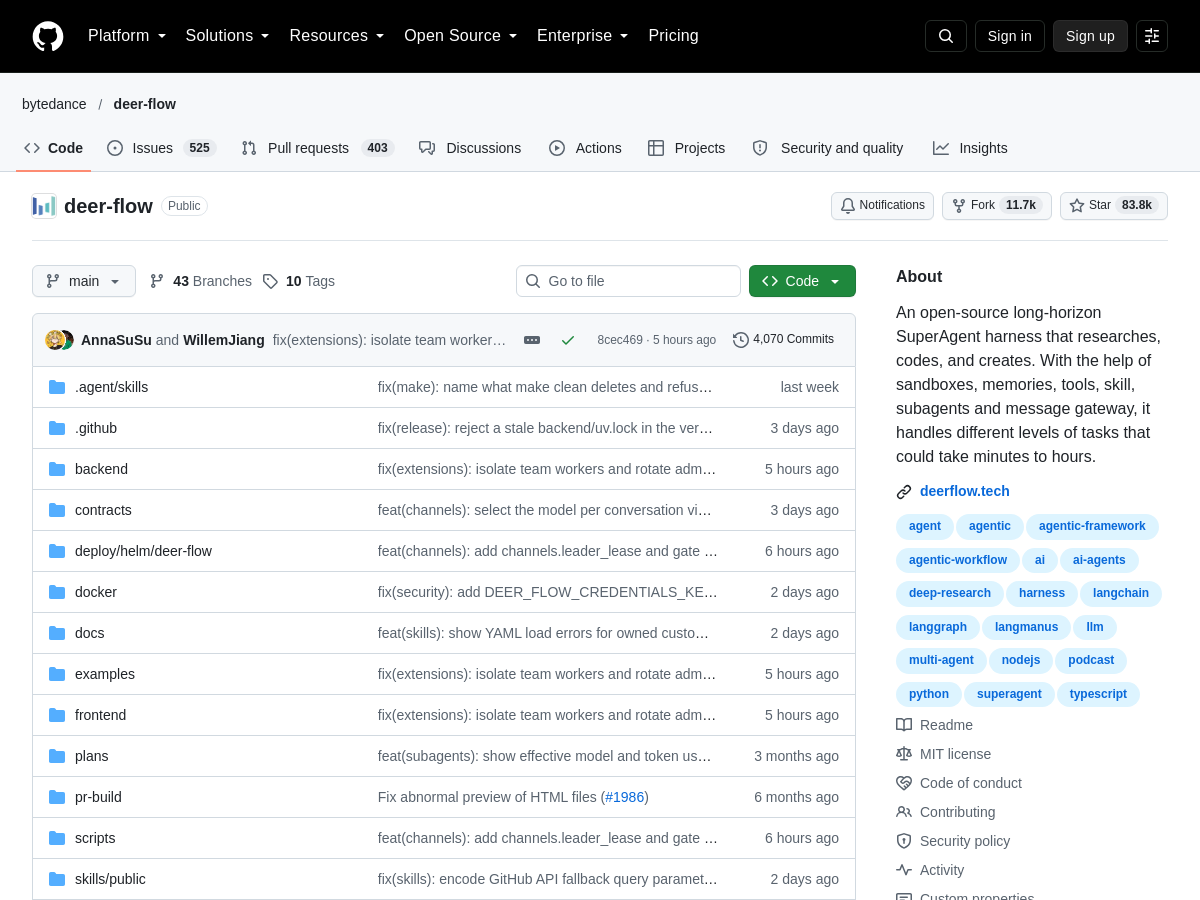
Deer Flow is an open-source long-horizon SuperAgent harness that researches, codes, and creates. With the help of sandboxes, memories, tools, skill, subagents, and message gateway, it handles different levels of tasks that could take minutes to hours. The project utilizes various technologies such as Node.js, Python, and TypeScript, and is designed to work with AI agents, agentic frameworks, and langchains. Deer Flow has a large community of contributors and users, with over 83,000 stars and 11,000 forks on GitHub. The project is licensed under the MIT license and has a code of conduct in place to ensure a positive and inclusive community. Deer Flow is a complex system that allows for the creation of custom agents, workflows, and tasks, making it a powerful tool for researchers, developers, and organizations. The project is constantly evolving, with new features and updates being added regularly. Overall, Deer Flow is a cutting-edge open-source project that has the potential to revolutionize the way we approach AI, research, and development. Deer Flow's architecture is designed to be modular and scalable, allowing users to easily integrate new components and agents into the system. The project also has a strong focus on security, with features such as secure authentication and authorization, as well as regular security audits and testing. With its robust feature set, active community, and commitment to security, Deer Flow is an ideal choice for organizations and individuals looking to leverage the power of AI and automation.

Solves

Deer Flow solves the problem of creating and managing complex AI workflows and tasks, which can be time-consuming and require significant expertise. By providing a modular and scalable architecture, Deer Flow allows users to easily create and manage custom agents, workflows, and tasks, making it an ideal solution for researchers, developers, and organizations. Additionally, Deer Flow's focus on security and community ensures that users can trust the project and collaborate with others to achieve their goals.

Screenshot of Cs Video Courses
Cs Video Courses
Video Free

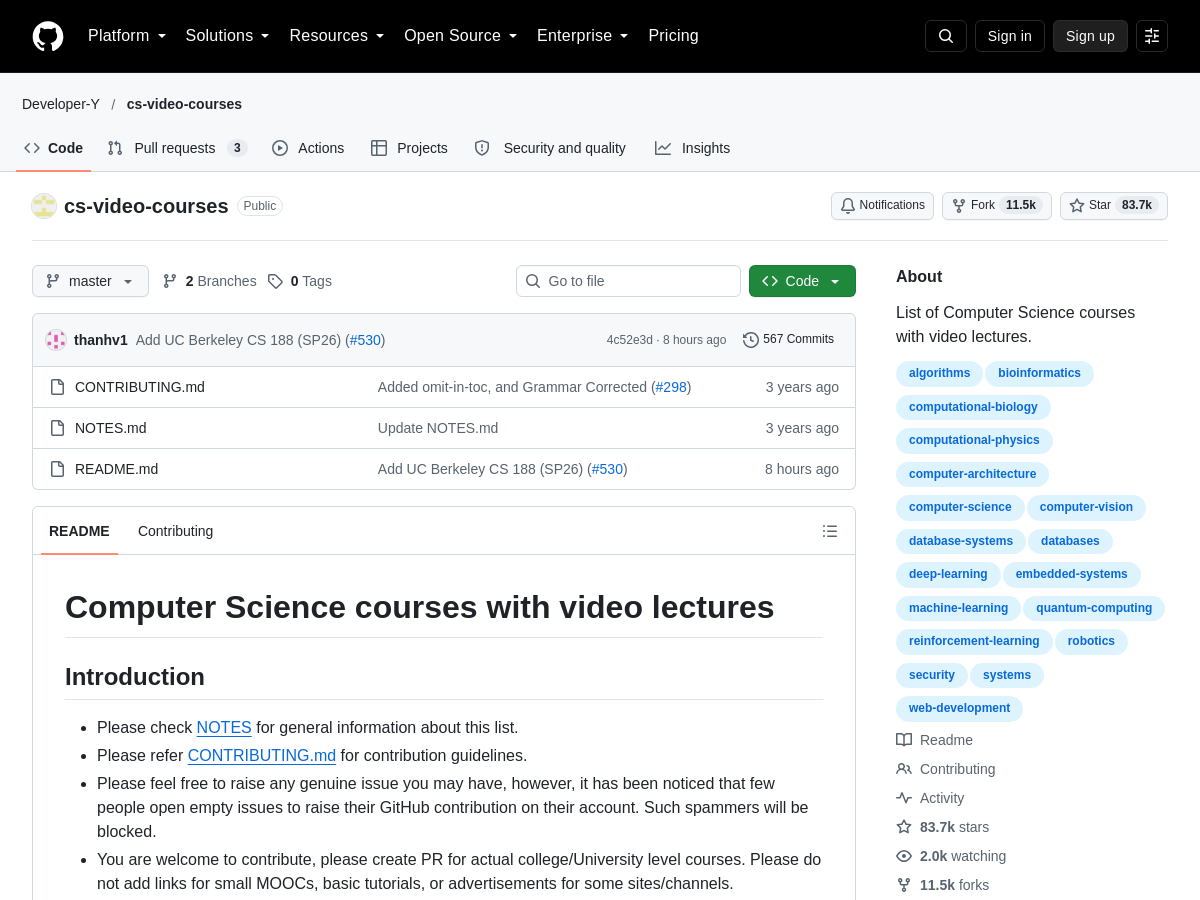
Cs Video Courses is an open-source repository on GitHub that provides a comprehensive list of computer science courses with video lectures. The repository is maintained by Developer-Y and has gained significant popularity with over 83.7k stars and 11.5k forks. The repository contains a wide range of courses covering various topics in computer science, including introduction to computer science, data structures and algorithms, systems programming, database systems, software engineering, artificial intelligence, machine learning, computer networks, and more. Each course is accompanied by a video playlist or a link to the course website, making it easily accessible to users. The repository also includes a contributing guide, which outlines the guidelines for contributing to the repository and adding new courses. The repository is constantly updated with new courses and improvements, making it a valuable resource for computer science students and professionals alike. The courses listed in the repository are from reputable universities and institutions, such as MIT, UC Berkeley, and UNSW, and are taught by experienced instructors. The video lectures are of high quality and provide a comprehensive understanding of the subject matter. Overall, Cs Video Courses is an excellent resource for anyone looking to learn computer science concepts and expand their knowledge in the field. The repository is well-maintained, and the community is active, with many contributors and users engaging with the repository. The repository's popularity is a testament to its usefulness and the demand for high-quality computer science educational resources. The repository's maintainer, Developer-Y, is committed to keeping the repository up-to-date and ensuring that the courses listed are relevant and useful to the community. The repository has also been recognized by the GitHub community, with many users starring and forking the repository. In addition to the courses, the repository also includes a notes section, which provides additional information and resources for users. The notes section includes information on how to contribute to the repository, how to use the repository, and other relevant details. The repository's documentation is thorough, and the contributing guide is clear and concise, making it easy for users to get involved and contribute to the repository. The repository's license is open-source, allowing users to freely use and distribute the content. The repository's GitHub page includes a table of contents, which makes it easy to navigate and find specific courses. The repository's search functionality is also useful, allowing users to quickly find courses by topic or keyword. Overall, Cs Video Courses is an excellent resource for computer science education, and its popularity and usefulness are a testament to the demand for high-quality educational resources in the field.

Solves

Cs Video Courses solves the problem of finding high-quality computer science courses with video lectures. Many students and professionals struggle to find comprehensive and well-taught courses that cover a wide range of topics in computer science. Cs Video Courses provides a curated list of courses from reputable universities and institutions, making it easy for users to find and access high-quality educational resources. The repository saves users time and effort in searching for courses and provides a one-stop-shop for computer science education. By providing a comprehensive list of courses, Cs Video Courses helps users to learn computer science concepts and expand their knowledge in the field, which can be beneficial for their academic and professional careers.

Screenshot of Rtk
Rtk
Dev Tools Open Source

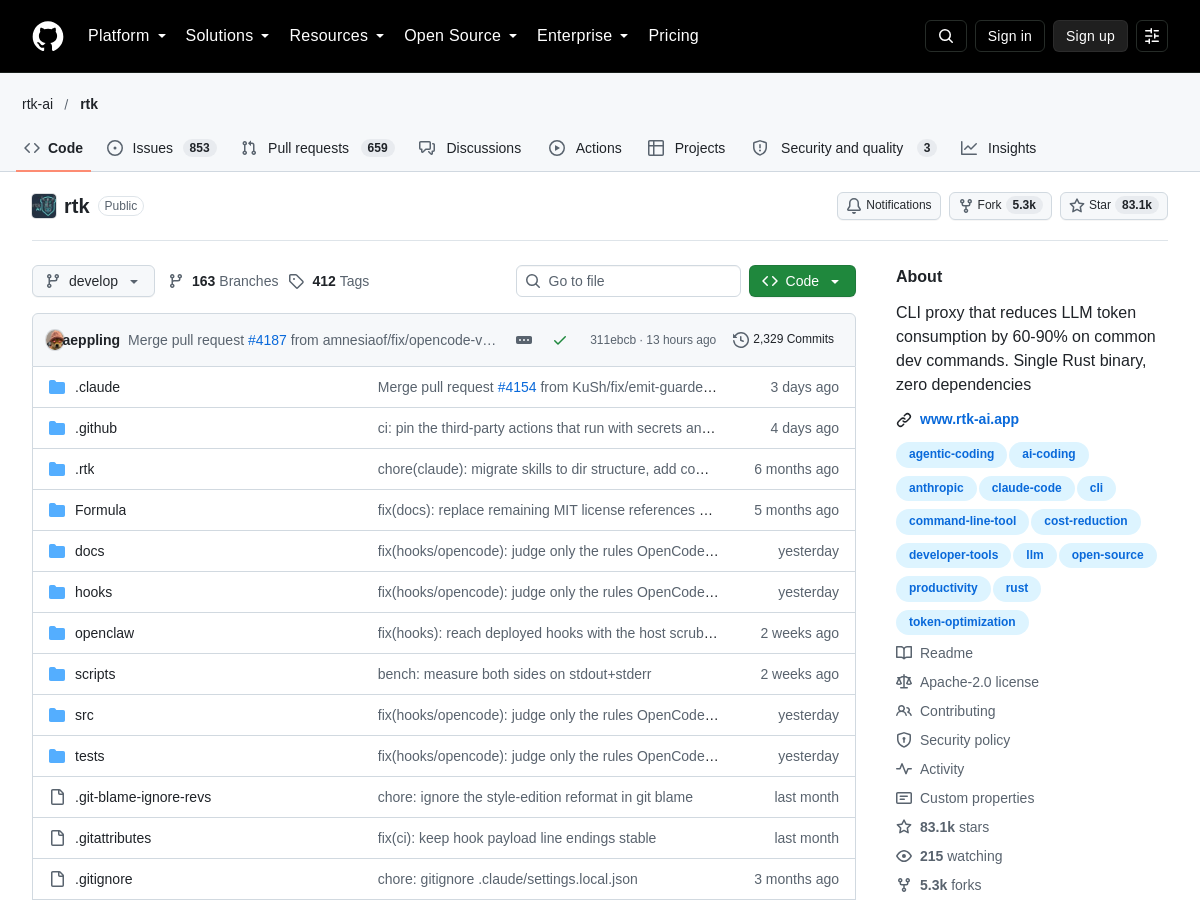
Rtk is a high-performance CLI proxy that reduces LLM token consumption by 60-90% on common dev commands. It is a single Rust binary with zero dependencies and supports over 100 commands. Rtk filters and compresses command outputs before they reach the LLM context, resulting in significant token savings. The tool has a simple and intuitive interface, with a range of features including smart filtering, grouping, truncation, and deduplication. Rtk also provides detailed analytics and insights into token usage, allowing users to optimize their workflows and reduce costs. The tool is highly customizable, with support for various configuration options and integrations with popular AI tools and platforms.

Solves

Developers and AI engineers face the problem of high LLM token consumption, which can lead to increased costs and reduced productivity. Rtk solves this problem by providing a efficient and effective way to reduce token consumption, resulting in cost savings and improved workflow efficiency.

Screenshot of Hello Agents
Hello Agents
LLM Open Source

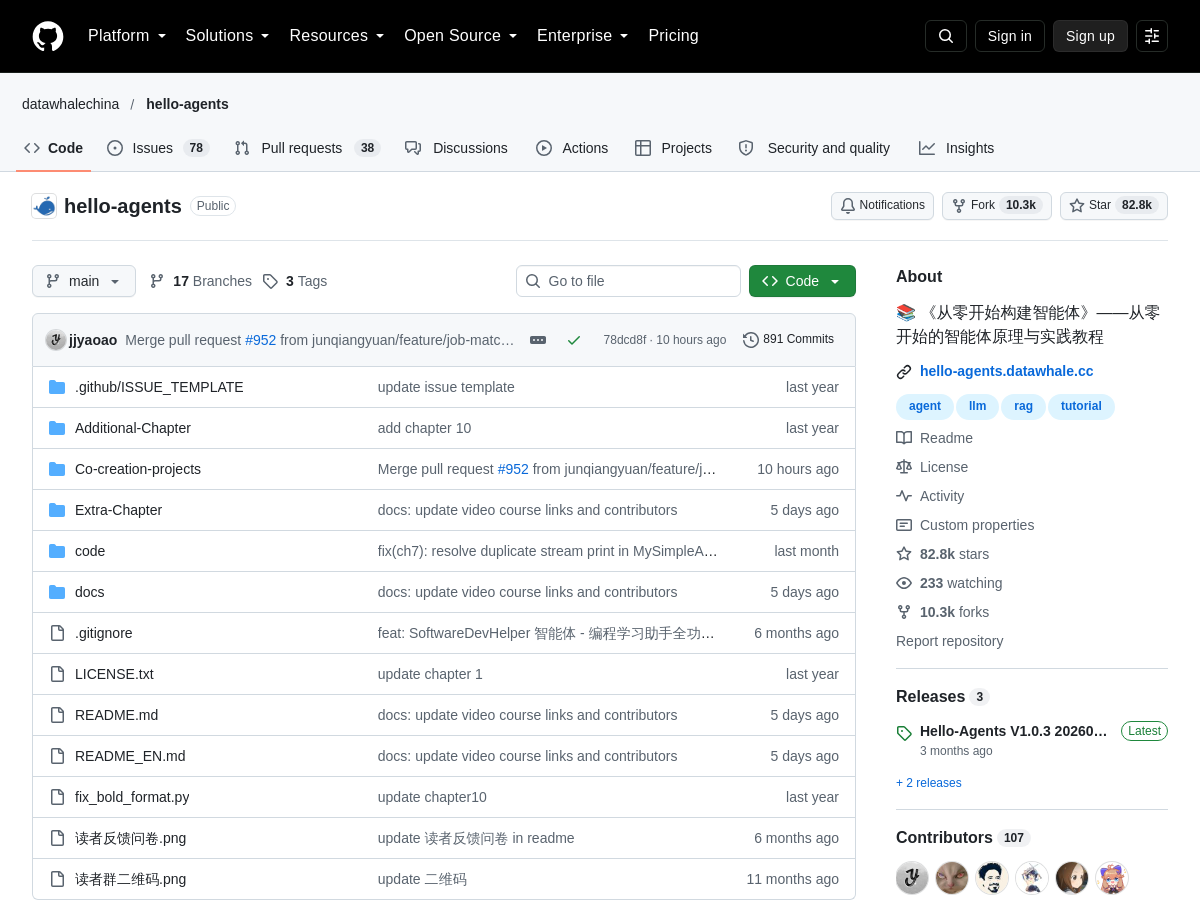
Hello-Agents is an open-source project that provides a comprehensive tutorial on building AI agents from scratch. The project covers the basics of intelligent agents, language models, and their applications. It includes a series of chapters that guide learners through the process of building their own AI agents, from understanding the core principles to implementing them in practice. The project also provides a range of resources, including code, videos, and community support, to help learners master the skills needed to build AI agents. Hello-Agents is designed for AI developers, software engineers, and students who want to learn about AI agents and their applications. The project is constantly updated with new content, including video courses, and has a strong community of contributors and learners.

Solves

Hello-Agents solves the problem of lacking comprehensive and practical resources for learning about AI agents and their applications. The project provides a structured approach to learning about AI agents, from the basics to advanced topics, and offers a range of resources to support learners. By using Hello-Agents, learners can gain a deep understanding of AI agents and their applications, and develop the skills needed to build their own AI agents.

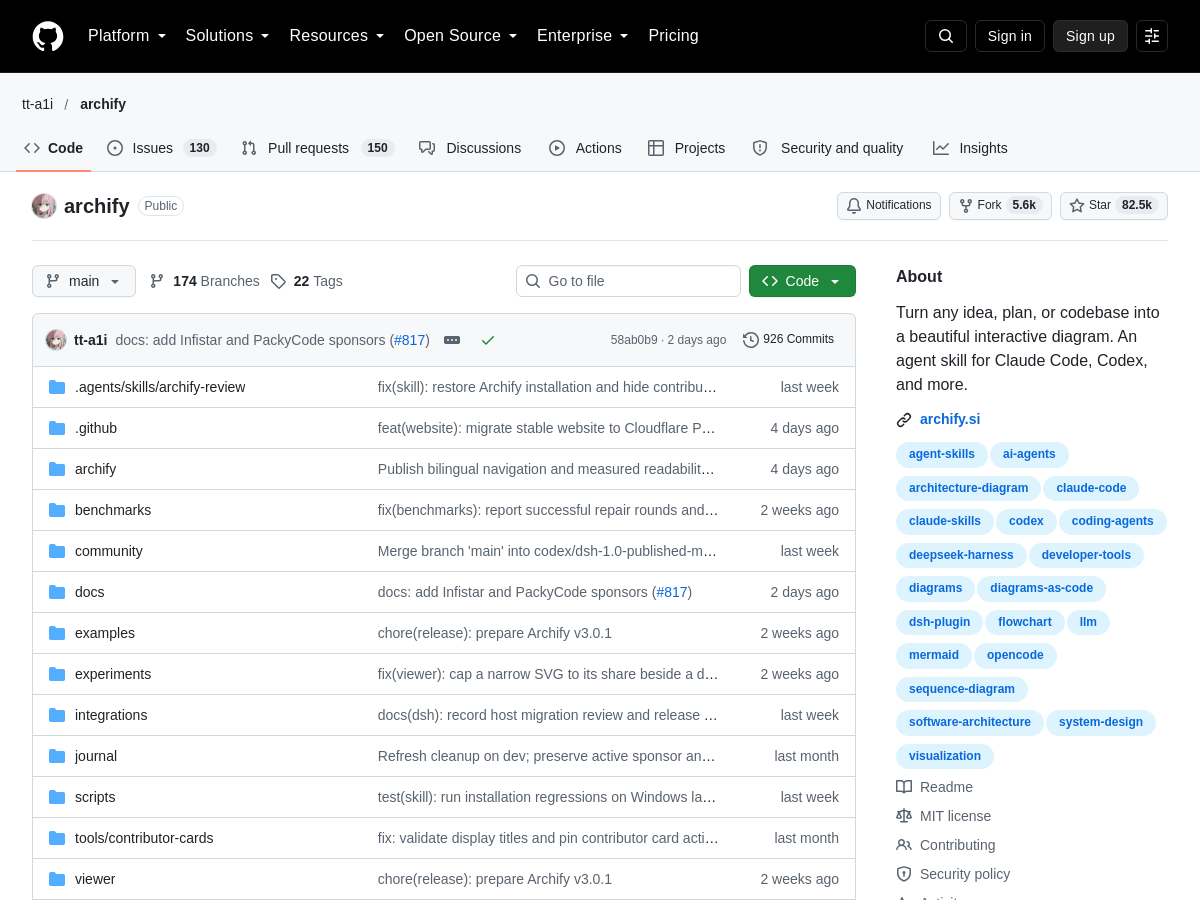
Screenshot of Archify
Archify
AI Agents Open Source

Archify is an open-source project that turns any idea, plan, or codebase into a beautiful interactive diagram. It is an agent skill for Claude Code, Codex, and more. The tool allows users to describe their idea or plan to an AI agent, which then generates an interactive HTML diagram that can be explored, customized, and shared. Archify supports various diagram types, including architecture, workflow, sequence, data flow, and lifecycle diagrams. It also provides features such as layout judgment, typed JSON IR, atomic validation, and truthful interaction. The tool is designed to be extensible, and its output is a self-contained HTML file that can be downloaded and opened in a browser.

Solves

Archify solves the problem of creating interactive diagrams from ideas, plans, or codebases. It helps users to visualize and understand complex systems, workflows, and relationships, making it easier to communicate and share knowledge with others. The tool is particularly useful for developers, architects, and designers who need to create diagrams to illustrate their ideas or plans.

Screenshot of Ragflow
Ragflow
AI Agents Open Source

RAGFlow is an open-source Retrieval-Augmented Generation (RAG) engine developed by InfiniFlow, designed to provide a high-quality context layer for large language models. It combines deep document understanding with RAG and agent capabilities, enabling users to build reliable AI applications that ground answers in authoritative sources. The engine excels at parsing complex documents, including tables, images, and multi-column layouts, using deep learning models to extract structured information. Unlike simple chunking approaches, RAGFlow employs template-based chunking and intelligent document comprehension to preserve context and improve retrieval accuracy. It supports a wide range of data sources such as PDFs, Word documents, web pages, and databases, and integrates with numerous LLMs and embedding models. The platform offers an intuitive web UI for managing knowledge bases, testing chats, and configuring pipelines, making it accessible to both technical and non-technical users. RAGFlow also includes agent capabilities, allowing developers to create autonomous agents that can plan, execute, and use tools to accomplish complex tasks. With features like grounded citations, multimodal support, and a flexible API, RAGFlow serves as a foundation for building production-grade RAG applications.

Solves

RAGFlow addresses the challenge of building accurate and trustworthy RAG applications by providing advanced document parsing, semantic chunking, and grounded generation. It reduces hallucinations and improves answer quality by ensuring that responses are based on relevant document context, making it easier to deploy LLM-powered assistants over enterprise knowledge.

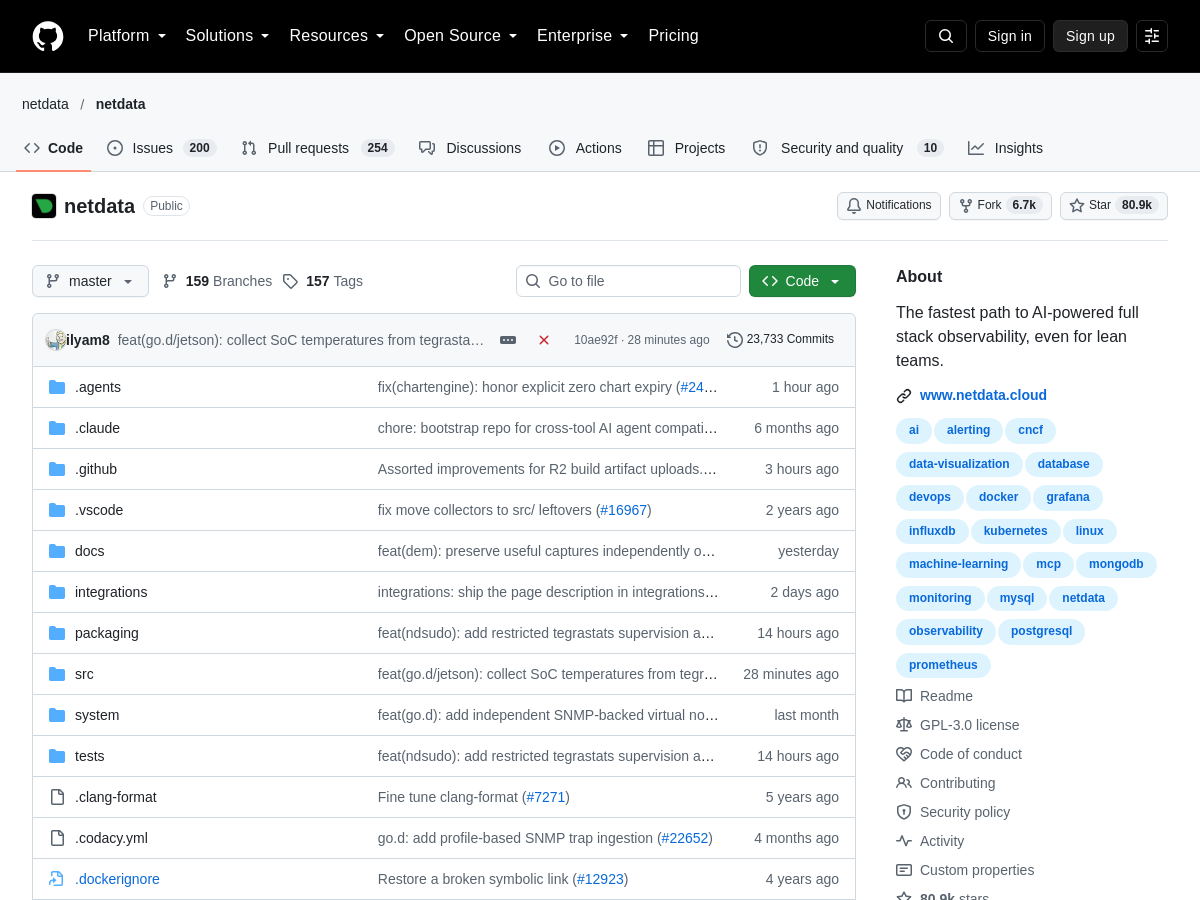
Screenshot of Netdata
Netdata
Model Serving Open Source

Netdata is an open-source, real-time infrastructure monitoring platform that provides instant insights, zero configuration, and ML-powered anomaly detection. It offers a comprehensive collection of metrics, performance and precision, edge-based ML, advanced log management, and automated visualization. The platform is designed to be highly scalable, secure, and extensible, with a modular architecture that allows for easy customization and integration with existing tools. Netdata provides a complete monitoring solution, including built-in ML, alerts, dashboards, and correlations, making it a powerful tool for monitoring and troubleshooting infrastructure. The platform supports a wide range of operating systems, including Linux, macOS, FreeBSD, and Windows, and can be used to monitor various components, such as system resources, storage, network, hardware, and applications. Netdata also offers a range of features, including real-time data collection, high-resolution metrics, anomaly detection, and alerting, making it a popular choice among developers, sysadmins, and DevOps professionals.

Solves

Netdata solves the problem of monitoring and troubleshooting complex infrastructure by providing a comprehensive, real-time, and scalable monitoring solution. It helps users to quickly identify and resolve issues, reducing downtime and improving overall system performance. Netdata's ML-powered anomaly detection and automated visualization capabilities also enable users to proactively detect and respond to potential issues, reducing the risk of system failures and improving overall system reliability.

Screenshot of Hoppscotch
Hoppscotch
Dev Tools Open Source

Hoppscotch is a free and open-source API development ecosystem designed to help developers build, test, and debug APIs with ease. It offers a lightweight and fast web-based interface as well as desktop applications for Windows, macOS, and Linux, along with a command-line interface (CLI) for automation. The tool supports a wide range of protocols including REST, GraphQL, WebSocket, Socket.IO, MQTT, and more, making it versatile for various API testing scenarios. With features like environment variables, collections, authentication helpers, pre-request scripts, and test automation, Hoppscotch streamlines the API development workflow. It can be used in the cloud at hoppscotch.io, self-hosted on your own infrastructure for enhanced privacy and control, or run entirely offline. The project is actively maintained and has a vibrant community, positioning itself as a compelling open-source alternative to proprietary tools like Postman and Insomnia.

Solves

API development and testing often require proprietary, paid tools that may limit flexibility and control over data. Hoppscotch provides a free, open-source solution that offers the core functionalities needed for API testing and debugging without vendor lock-in, and it can be self-hosted to ensure data privacy and compliance with internal policies.

Screenshot of Llm Course
Llm Course
LLM Open Source

Llm Course is an open-source educational repository on GitHub, created by Maxime Labonne, designed to help learners get into Large Language Models (LLMs). It provides structured roadmaps that outline a clear learning path from foundational concepts to advanced topics, along with practical Colab notebooks that allow hands-on experimentation. The course covers essential LLM concepts such as tokenization, embeddings, attention mechanisms, and the transformer architecture. It then progresses to more advanced subjects including fine-tuning, quantization, and reinforcement learning from human feedback (RLHF), enabling learners to build and deploy their own models. The repository is free and open for anyone to use, fork, and contribute to. It is well-suited for self-paced study, offering a blend of theoretical explanations and interactive code examples that leverage popular Python libraries like PyTorch and Hugging Face Transformers.

Solves

It solves the problem of scattered and unstructured learning resources for LLMs by providing a curated, step-by-step educational path with practical notebooks, making it easier for beginners and practitioners to master large language models.

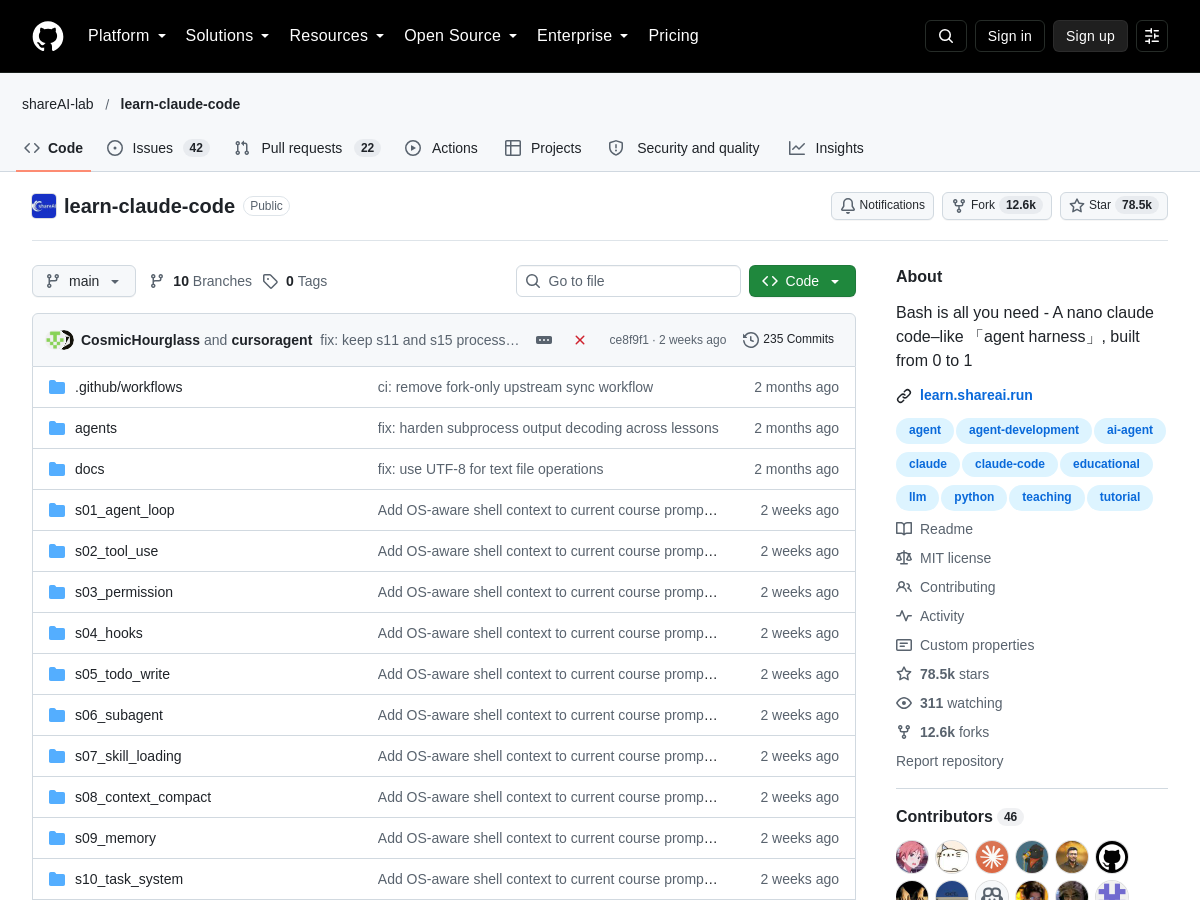
Screenshot of Learn Claude Code
Learn Claude Code
LLM Open Source

Learn Claude Code is an open-source project that teaches harness engineering for real agents. The project focuses on building a harness that gives a model an operational environment, allowing it to work effectively in a specific domain. The harness is everything an agent needs to work, including tools, knowledge, observation and action interfaces, and permissions. The project provides a 17-lesson course that covers various harness mechanisms, including agent loops, tool use, permission systems, and context compaction. Each lesson isolates one mechanism and provides a standalone runnable implementation. The project aims to help developers understand harness engineering from the inside out and provides two paths to turn that knowledge into product: the Kode Agent CLI and the Kode Agent SDK.

Solves

Developers and researchers who want to build effective agent products face the challenge of creating a harness that allows the model to operate in a specific domain. Learn Claude Code solves this problem by providing a comprehensive course on harness engineering, covering the key mechanisms and designs needed to build a successful agent harness.

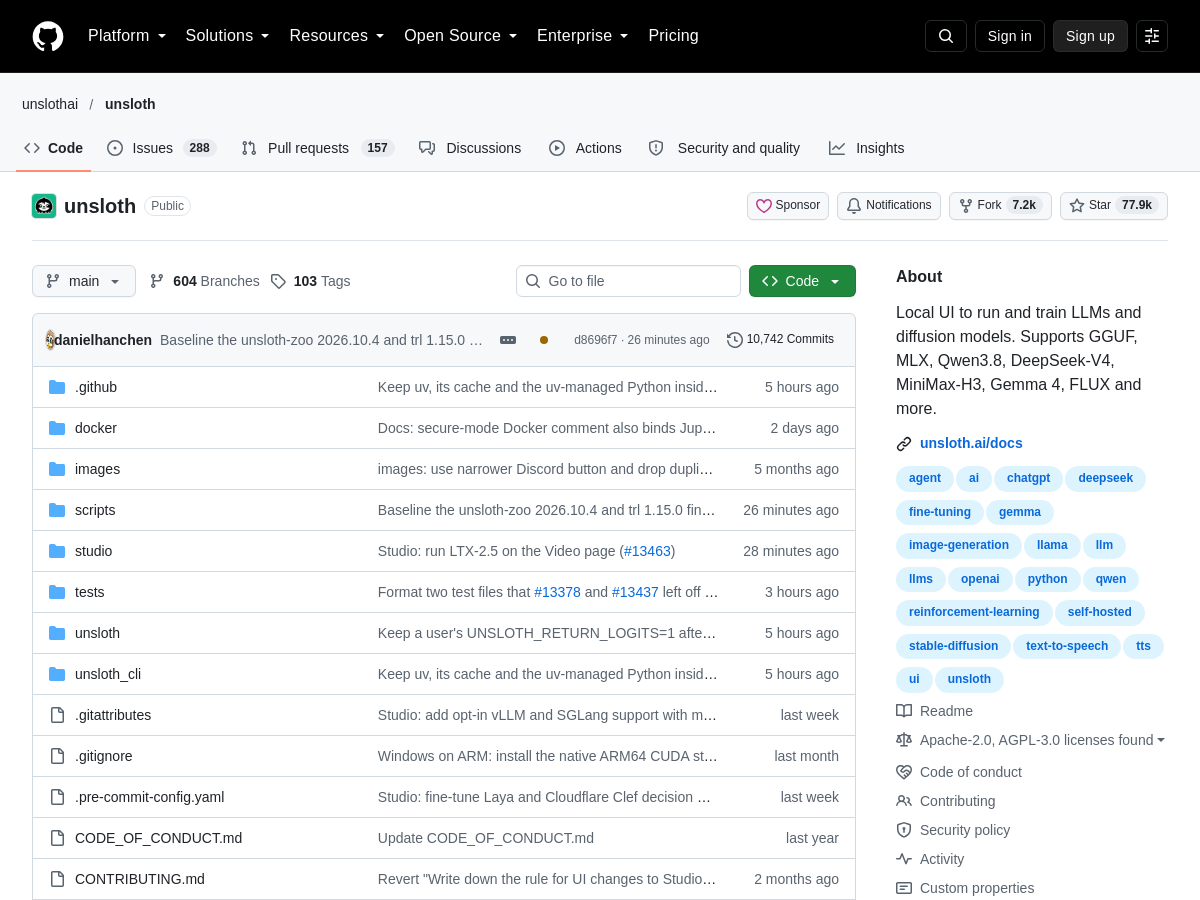
Screenshot of Unsloth
Unsloth
Fine-tuning Open Source

Unsloth is a self-hosted tool that allows users to run and train large language models (LLMs) and diffusion models locally on their own machines. It supports a wide range of models, including GGUF, MLX, Qwen3.8, DeepSeek-V4, MiniMax-H3, Gemma 4, and FLUX, among others. Unsloth provides a local UI for running and training these models, and it also supports remote access and secure deployment through Cloudflare. The tool is designed to be highly customizable and extensible, with support for multiple GPU setups, NVIDIA, AMD, and Intel GPUs, as well as the Vulkan backend. Unsloth also includes a range of features for fine-tuning, deploying, and serving models, including support for reinforcement learning, LoRA, QLoRA, and full fine-tuning. Additionally, Unsloth provides a web UI, called Unsloth Studio, which allows users to run and train models in a browser-based interface. Overall, Unsloth is a powerful tool for anyone looking to run and train large language models and diffusion models locally, with a high degree of customization and control. Unsloth can be installed in various ways, including through a desktop app, a web UI, or a code-based version. It also provides a range of advanced features, such as support for audio models, text-to-speech models, and embedding models. Unsloth is highly customizable, with support for multiple backends, including Vulkan, CUDA, and CPU. It also provides a range of advanced launch options, including support for custom llama.cpp backends and audio.cpp audio engines. Unsloth is designed to be highly extensible, with support for custom models, datasets, and workflows. It also provides a range of tools and features for debugging, testing, and optimizing models, including support for PyTorch, Torch AO, and NVIDIA's NeMo DataDesigner library.

Solves

Unsloth solves the problem of providing a self-hosted solution for running and training large language models and diffusion models, allowing users to maintain control over their data and models while still benefiting from the power of these advanced AI technologies. This is particularly important for users who require high levels of security, customization, and control over their AI workflows, such as researchers, developers, and enterprises. By providing a local UI and support for remote access and secure deployment, Unsloth makes it easy for users to run and train models on their own machines, without having to rely on cloud-based services or sacrifice control over their data and models.

Screenshot of Floot
Floot
Vibe coding Free

Floot is a SaaS platform that lets users build live web applications by describing requirements in natural language inside AI assistants such as Claude, ChatGPT, or Cursor. It connects to these assistants via an MCP connector, allowing the AI to create the complete application—backend, database, hosting, and domain—without requiring the user to write code, use Git, or access a terminal. The platform is positioned as a 'vibe coding' tool, meaning anyone with an AI subscription can turn ideas into functional products directly in a chat conversation. Floot includes built-in infrastructure: one-click publishing to a shareable URL, a managed database, user account authentication, recurring scheduled tasks, email sending, automated receipts and notifications, pre-built SEO features, and integrations with services such as Stripe, Google login, and thousands of other tools via connectors. The environment is designed to be all-in-one, so builders can launch and run a small business without juggling separate cloud services, databases, or hosting providers. The service is free to start and includes flat-rate plans that avoid per-token fees, unlike other AI app builders, with credits only applying to optional agent usage and AI image generation. Floot is backed by Y Combinator and emphasizes accessibility for non-technical users, though developers and hobbyists can also use it to rapidly prototype or ship MVPs. A gallery, documentation, and community Discord support the platform, and the company offers free tools like link-in-bio pages and niche calculators to showcase capabilities.

Solves

Floot removes the gap between conversational AI output and production-ready software. It enables users to build and deploy real apps with backend, database, hosting, authentication, and integrations entirely from a chat conversation, eliminating setup complexity, terminal work, and extra cloud services.

Screenshot of Tesseract
Tesseract
AI/ML Open Source

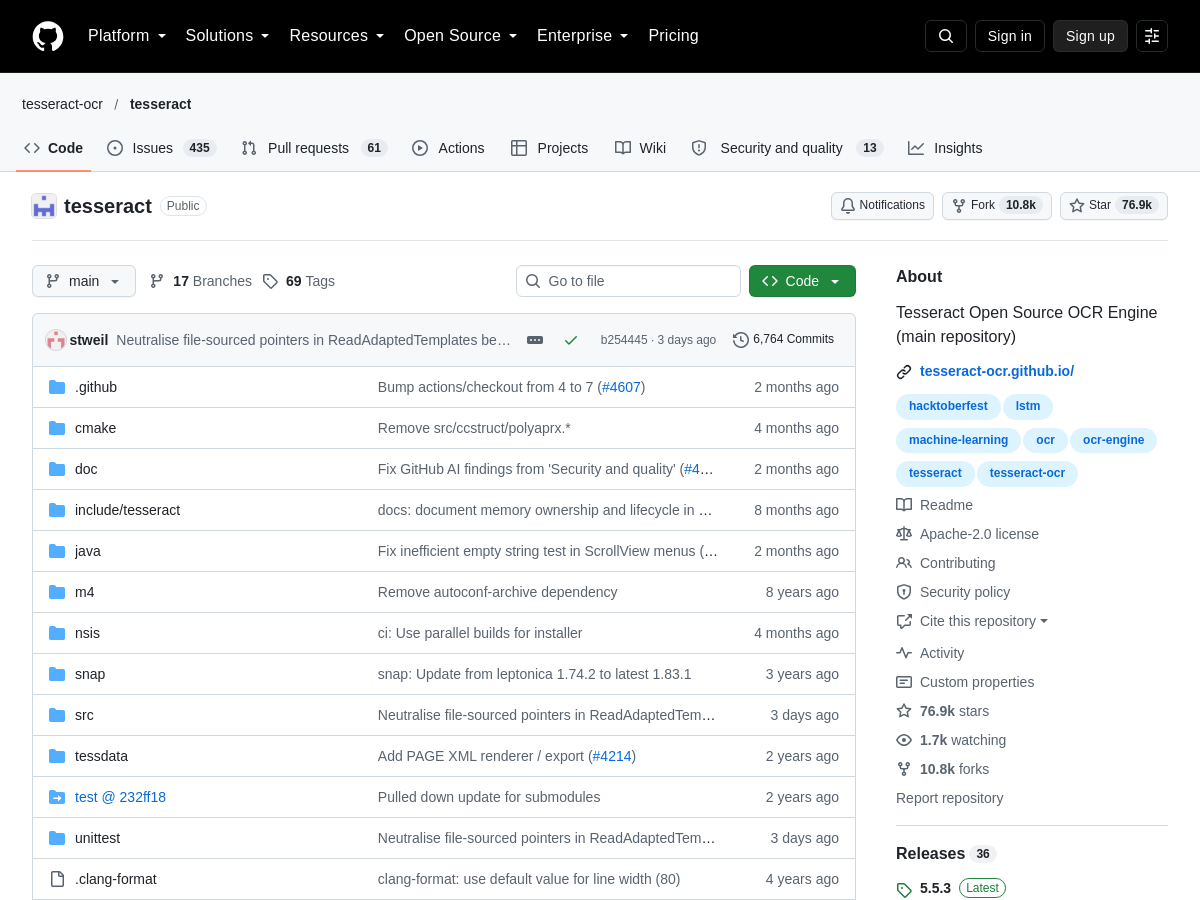
Tesseract is an open-source Optical Character Recognition (OCR) engine developed by Hewlett-Packard and now maintained by Google. It is capable of recognizing text in images and supports over 100 languages. Tesseract can be used as a command-line program or integrated into other applications using its API. The engine uses a combination of machine learning algorithms and traditional computer vision techniques to recognize text. It also supports various image formats, including PNG, JPEG, and TIFF, and can output text in several formats, including plain text, hOCR (HTML), PDF, and more. Tesseract has a long history, dating back to 1985, and has undergone significant improvements over the years, with the current stable version being 5.0.0. The project is actively maintained, with new releases and bug fixes being published regularly. Tesseract is widely used in various applications, including document scanning, text extraction, and language translation. It is also used in research and development, particularly in the fields of natural language processing and computer vision. The project has a large community of contributors and users, with many resources available, including documentation, tutorials, and forums. Tesseract is licensed under the Apache License, Version 2.0, and is available on GitHub. The project depends on other packages, including the Leptonica library, which is used for opening input images. Overall, Tesseract is a powerful and widely-used OCR engine that has many applications in various fields. It is highly customizable and can be integrated into other applications using its API. Tesseract is also constantly evolving, with new features and improvements being added regularly. The project has a strong community of contributors and users, which ensures that it will continue to be maintained and improved in the future. Tesseract's ability to recognize text in images makes it a valuable tool for many applications, including document scanning, text extraction, and language translation. Its support for over 100 languages also makes it a useful tool for applications that require text recognition in multiple languages. The project's long history and active maintenance ensure that it will continue to be a reliable and powerful tool for many years to come.

Solves

Tesseract solves the problem of recognizing text in images, which is a common task in many applications, including document scanning, text extraction, and language translation. It provides a powerful and customizable OCR engine that can be integrated into other applications using its API. Tesseract's ability to recognize text in images makes it a valuable tool for many applications, and its support for over 100 languages makes it a useful tool for applications that require text recognition in multiple languages. By using Tesseract, developers can build applications that can extract text from images, which can be useful in many scenarios, such as extracting text from scanned documents, recognizing text in images, and translating text from one language to another.

Screenshot of LlamaFactory
LlamaFactory
Fine-tuning Open Source

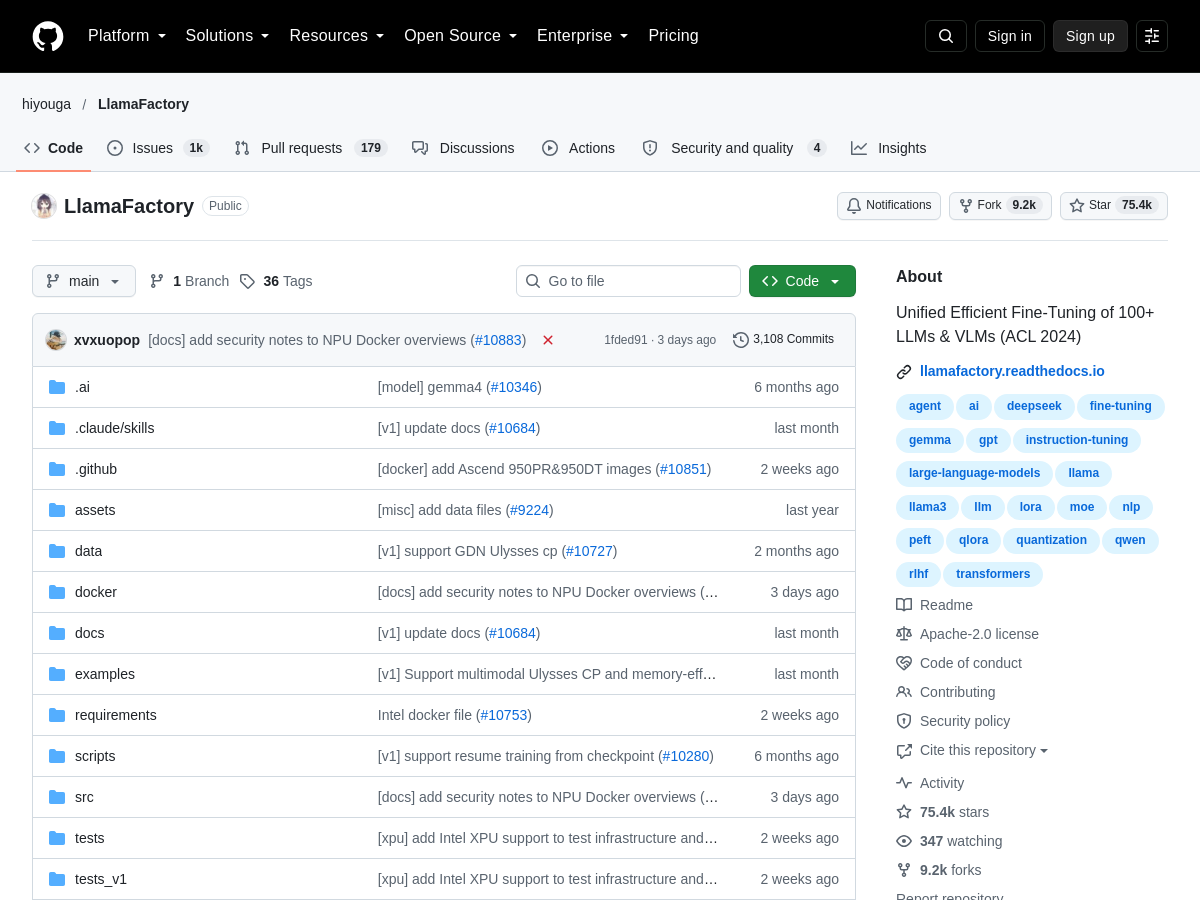
LlamaFactory is an open-source project that provides a unified efficient fine-tuning of 100+ LLMs (Large Language Models) and VLMs (Vision-Language Models). It is designed to simplify the process of fine-tuning these models, making it more accessible to developers and researchers. The project includes a range of tools and resources, such as Docker images, documentation, and example code, to help users get started with fine-tuning their models. LlamaFactory also includes support for various hardware platforms, including NVIDIA and Intel, and provides a range of features, such as quantization, pruning, and knowledge distillation, to help improve the performance and efficiency of the models. The project is actively maintained and has a large community of contributors, with over 75,000 stars on GitHub. LlamaFactory is a valuable resource for anyone looking to fine-tune LLMs and VLMs, and its unified approach makes it an attractive option for those looking to simplify their workflow. The project's documentation and example code provide a comprehensive guide to getting started with fine-tuning, and its active community ensures that any issues or questions are quickly addressed. Overall, LlamaFactory is a powerful tool for fine-tuning LLMs and VLMs, and its open-source nature makes it accessible to anyone. The project's focus on efficiency and performance makes it an ideal choice for developers and researchers looking to push the boundaries of what is possible with these models. With its unified approach and comprehensive resources, LlamaFactory is an essential tool for anyone working with LLMs and VLMs. The project's ability to support a wide range of models and hardware platforms makes it a versatile tool that can be used in a variety of applications, from natural language processing to computer vision. By providing a simplified and efficient way to fine-tune these models, LlamaFactory is helping to advance the field of AI and drive innovation in a range of industries.

Solves

LlamaFactory solves the problem of fine-tuning large language models and vision-language models, which can be a complex and time-consuming process. By providing a unified and efficient approach to fine-tuning, LlamaFactory makes it easier for developers and researchers to improve the performance and accuracy of these models, which is essential for a range of applications, from natural language processing to computer vision. The project's focus on efficiency and performance also helps to reduce the computational resources required for fine-tuning, making it more accessible to a wider range of users.

Screenshot of Prompt Engineering Guide
Prompt Engineering Guide
AI Agents Open Source

Prompt Engineering Guide is a comprehensive open-source repository curated by DAIR.AI that provides guides, research papers, lessons, notebooks, and other resources focused on prompt engineering, context engineering, retrieval-augmented generation (RAG), and AI agents. The project aims to serve as a central hub for practitioners and researchers to learn about and stay updated on the rapidly evolving field of prompting large language models. It includes a curated collection of academic papers, practical tutorials, and code examples that illustrate best practices and advanced techniques. The repository covers a wide range of topics, from basic prompt design to more specialized areas such as chain-of-thought prompting, context engineering, and building autonomous AI agents. It also includes notebooks that allow users to interactively experiment with different prompting strategies and integrate them into their own applications. The content is maintained by DAIR.AI and the open-source community, ensuring that it reflects current developments and practical insights. In addition to textual guides, the guide provides links to relevant research papers, benchmark datasets, and tools that can help users deepen their understanding. It is designed for both beginners who are new to prompt engineering and experienced developers looking to refine their skills. The resource is freely accessible and can be used for self-study, teaching, or as a reference for building production systems.

Solves

The tool addresses the lack of a centralized, structured, and continuously updated resource for learning prompt engineering and related techniques. It consolidates scattered information, research papers, and practical examples into one accessible location, saving users time and providing a trusted starting point for both learning and application.

Screenshot of Headroom
Headroom
LLM Open Source

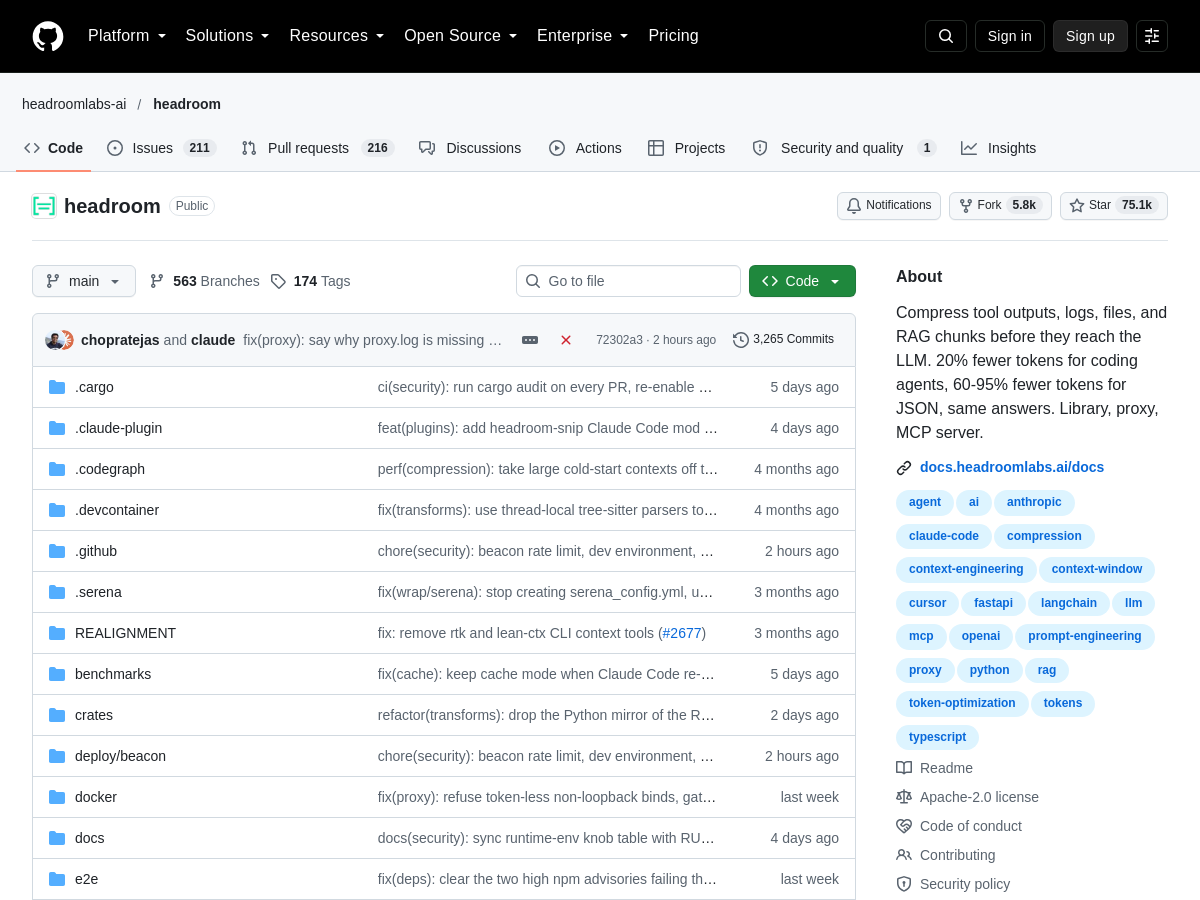
Headroom is a library designed to compress tool outputs, logs, files, and RAG chunks before they reach the Large Language Model (LLM). This compression results in 20% fewer tokens for coding agents and 60-95% fewer tokens for JSON, all while providing the same answers. Headroom operates as a proxy and MCP server, making it a versatile tool for optimizing LLM interactions. By reducing the token count, Headroom aims to improve the efficiency and performance of LLM-based applications. The library is open-source and has gained significant attention, with over 75,000 stars on GitHub. Headroom's functionality is particularly useful in scenarios where token limits are a concern, such as in coding agents and JSON data processing. The library's ability to compress data without compromising the accuracy of the LLM's responses makes it a valuable asset for developers working with LLMs. Headroom's documentation and community support are also noteworthy, with resources available for contributors and users alike. Overall, Headroom is a powerful tool for anyone looking to optimize their LLM workflows and reduce token usage. The library's compression capabilities and ease of use make it an attractive solution for a wide range of applications, from coding agents to data processing pipelines. With its open-source nature and active community, Headroom is likely to continue evolving and improving, making it a valuable resource for the LLM development community.

Solves

Developers and researchers working with Large Language Models (LLMs) often face the problem of token limits, which can hinder the performance and efficiency of their applications. Headroom solves this problem by compressing tool outputs, logs, files, and RAG chunks before they reach the LLM, resulting in fewer tokens and improved performance. This solution is particularly useful for coding agents and JSON data processing, where token limits can be a significant constraint. By using Headroom, developers can optimize their LLM workflows, reduce token usage, and improve the overall efficiency of their applications.

Screenshot of OpenBB
OpenBB
AI Agents Open Source

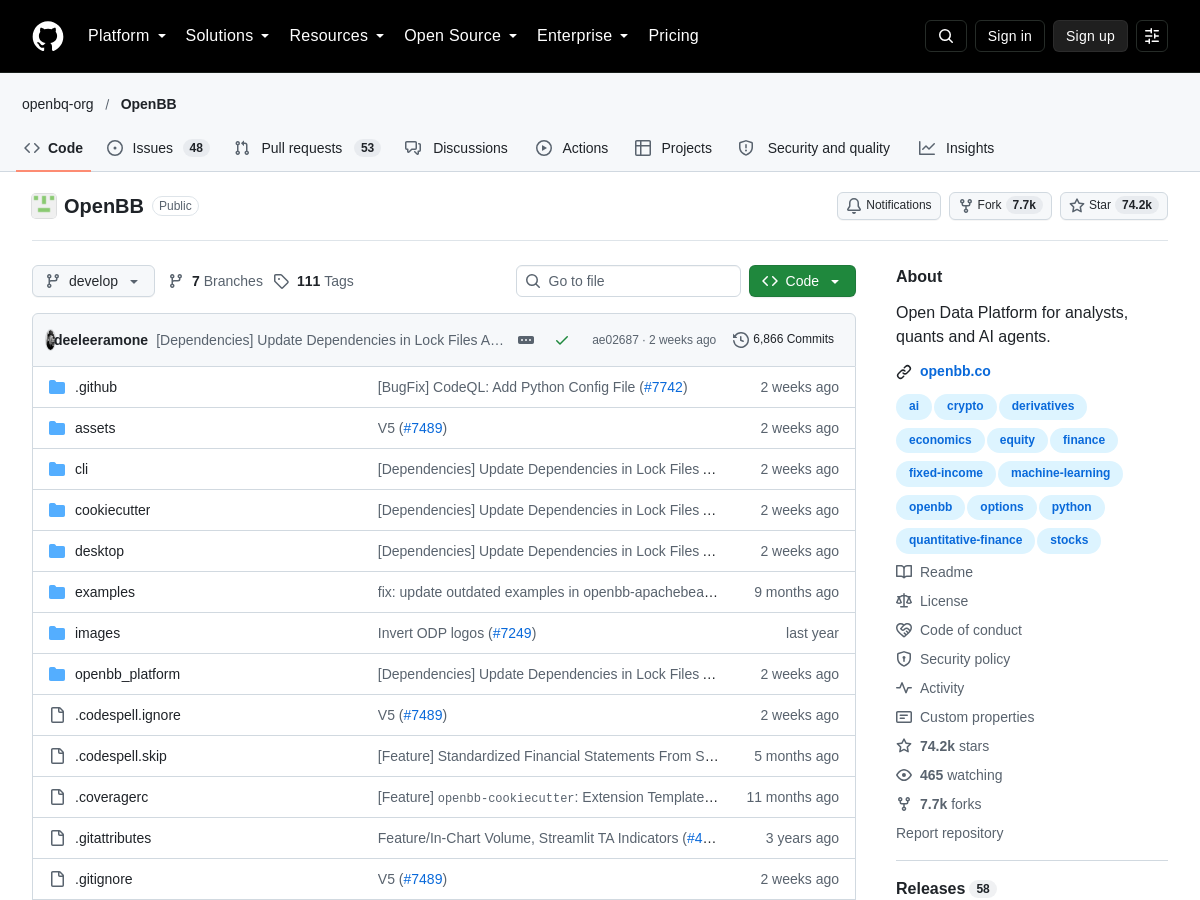
OpenBB is an open-source toolset that helps data engineers integrate proprietary, licensed, and public data sources into downstream applications like AI copilots and research dashboards. The Open Data Platform (ODP) operates as the 'connect once, consume everywhere' infrastructure layer that consolidates and exposes data to multiple surfaces at once, including Python environments for quants, OpenBB Workspace and Excel for analysts, MCP servers for AI agents, and REST APIs for other applications. The platform provides a range of features, including data integration, AI agents integration, and a command-line interface. OpenBB is designed to be highly customizable and extensible, with a range of APIs and tools available for developers to build on top of the platform. The project is actively maintained and has a large community of contributors, with a range of resources available for developers, including documentation, tutorials, and forums. OpenBB is licensed under the Apache License, Version 2.0, and is available for installation via PyPI or by cloning the repository directly. The platform has a range of use cases, including financial analysis, research, and data science, and is designed to be highly scalable and performant. Overall, OpenBB is a powerful and flexible toolset for data engineers and developers looking to integrate and analyze large datasets. The platform's 'connect once, consume everywhere' architecture enables seamless integration between different applications and services, making it a valuable resource for anyone working with data. With its range of features, customization options, and large community of contributors, OpenBB is an ideal choice for developers and data engineers looking to build scalable and performant data pipelines. The platform's documentation and resources are also highly comprehensive, making it easy for new users to get started and for experienced developers to dive deeper into the platform's features and capabilities. Whether you're working on a small-scale data project or a large-scale enterprise application, OpenBB has the tools and features you need to succeed. By providing a unified platform for data integration, analysis, and visualization, OpenBB is helping to democratize access to data and enable new use cases and applications. With its strong focus on community and collaboration, OpenBB is also helping to drive innovation and advancement in the field of data science and engineering.

Solves

OpenBB solves the problem of data fragmentation and integration for data engineers and analysts, providing a unified platform for integrating and analyzing large datasets from multiple sources. By consolidating and exposing data to multiple surfaces at once, OpenBB enables seamless integration between different applications and services, making it easier for users to access and analyze the data they need. This helps to reduce the complexity and cost associated with data integration, and enables users to focus on higher-level tasks such as analysis and decision-making. Additionally, OpenBB's 'connect once, consume everywhere' architecture helps to reduce the risk of data silos and ensures that data is consistent and up-to-date across all applications and services.

Screenshot of Front End Checklist
Front End Checklist
AI Agents Free

Front-End Checklist is a comprehensive, community-driven checklist for modern web development, designed to help developers, designers, and AI agents ensure that websites meet high standards across a wide range of areas. The project provides a structured list of best practices covering performance, accessibility, SEO, security, and general front-end code quality. The repository includes the checklist items in a machine-readable format, making it suitable for integration into automated workflows and AI agent tooling. The checklist is intended to be used before launching a website or web application to catch common mistakes and omissions. In addition to the raw checklist, the project offers a companion website that presents the checklist in a user-friendly interface, allowing users to filter and track their progress. The tool is open source and free to use, encouraging contributions from the community to keep the checklist up to date with evolving web standards.

Solves

Front-End Checklist helps developers and teams systematically audit their front-end code and project setup, reducing the risk of missing critical items in areas such as performance, accessibility, SEO, and security before launch.

Screenshot of Daytona
Daytona
AI Agents Open Source

Daytona is an open-source infrastructure project designed to provide secure and elastic environments for executing AI-generated code. It addresses the challenge of safely running untrusted code produced by AI agents, offering isolated sandboxes with resource management and scalability. The platform integrates with AI development workflows, allowing developers and AI systems to create, manage, and execute code in controlled environments. Its elasticity enables scaling compute resources up or down based on demand, ensuring efficient utilization. Daytona is available as a self-hosted solution, giving organizations full control over their infrastructure and data. It provides APIs and tooling to programmatically manage development environments, making it suitable for automation and CI/CD pipelines.

Solves

Daytona solves the problem of securely executing AI-generated code by providing isolated, elastic infrastructure that prevents untrusted code from affecting host systems while scaling to meet varying workloads.

Screenshot of X-Pilot AI
X-Pilot AI
Video Freemium

X-Pilot AI is a platform that transforms documents into accurate, chapter-aligned video course series. Users can upload PDFs, PowerPoint slides, URLs, plain text, or Markdown, and the AI automatically generates professional educational videos. The output renders every diagram, formula, and figure directly from the source material, ensuring no hallucinations or drift. There are no talking heads; the videos focus purely on the content. The platform includes a natural-language editor that lets users rewrite lines, swap visuals, or restructure chapters by simply describing the change, eliminating the need for traditional video editing skills. The process is streamlined into a five-step pipeline: upload, AI generation, natural-language editing, preview, and export. X-Pilot AI is designed for educators, trainers, L&D leads, and course creators who need to produce accurate instructional content quickly and at scale. It supports over 15,000 independent creators across 40+ countries, with reported cost reductions of up to 80% and turnaround times slashed from weeks to days.

Solves

Educators, trainers, and corporate L&D teams often struggle to create accurate, chapter-aligned video courses from existing documents. Traditional video production is time-consuming, expensive, and requires specialized skills. Even with generic AI video tools, the output can drift from the source material, introducing inaccuracies. X-Pilot AI solves this by automatically generating video course series that are deterministically bound to the uploaded documents, with every figure, formula, and diagram faithfully rendered. This eliminates manual video editing, reduces production costs by up to 80%, and accelerates turnaround from weeks to days, all while maintaining near-perfect accuracy to the original content.

Screenshot of Awesome Scalability
Awesome Scalability
AI/ML Open Source

Awesome Scalability is a curated list of patterns, principles, articles, books, and talks focused on building scalable, reliable, and performant large-scale systems. The repository is organized into sections covering scalability, availability, stability, performance, and other cross-cutting concerns. It aggregates high-quality resources from various sources, including engineering blogs, academic papers, conference talks, and open-source documentation. The list includes real-world case studies from companies like Google, Amazon, Netflix, and Facebook, offering insights into proven architectural patterns. The project is maintained by the open-source community and serves as a go-to reference for developers and architects preparing for system design interviews or designing distributed systems. It is not a software library but a knowledge base.

Solves

Helps engineers navigate the overwhelming amount of system design information by providing a curated, categorized list of high-quality resources on scalability, reliability, and performance, saving time and offering a structured learning path.

Screenshot of AI For Beginners
AI For Beginners
AI/ML Open Source

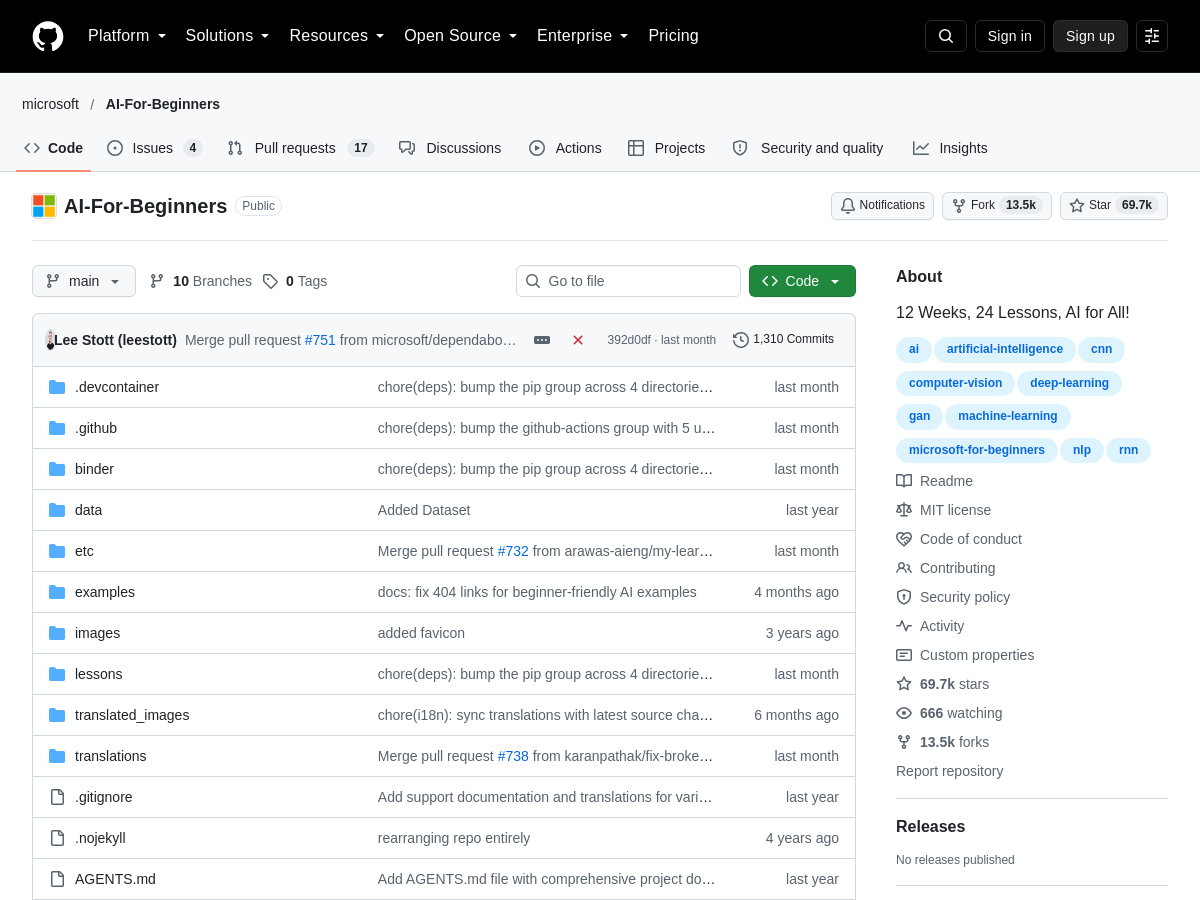
AI For Beginners is a 12-week, 24-lesson curriculum designed to introduce beginners to the world of Artificial Intelligence (AI). The curriculum covers various approaches to AI, including symbolic AI, neural networks, and deep learning. It also explores AI techniques such as computer vision, natural language processing, and generative models. The curriculum is designed to be beginner-friendly and includes practical lessons, quizzes, and labs to help learners gain hands-on experience with AI concepts. The curriculum is supported by Microsoft and is available on GitHub, where learners can access the lessons, quizzes, and labs, as well as contribute to the project by reporting issues or suggesting improvements. The curriculum is also translated into multiple languages, making it accessible to a broader audience. Overall, AI For Beginners provides a comprehensive introduction to AI and is suitable for learners who want to gain a solid understanding of AI concepts and techniques.

Solves

AI For Beginners solves the problem of providing a comprehensive and beginner-friendly introduction to Artificial Intelligence (AI). Many people are interested in learning about AI, but may not know where to start or may find existing resources to be too complex or overwhelming. AI For Beginners provides a structured and accessible curriculum that covers the basics of AI and provides hands-on experience with AI concepts and techniques. By providing a clear and concise introduction to AI, AI For Beginners helps learners to gain a solid understanding of AI and prepares them for further study or practical application of AI concepts.

Screenshot of System_prompts_leaks
System_prompts_leaks
AI Agents Open Source

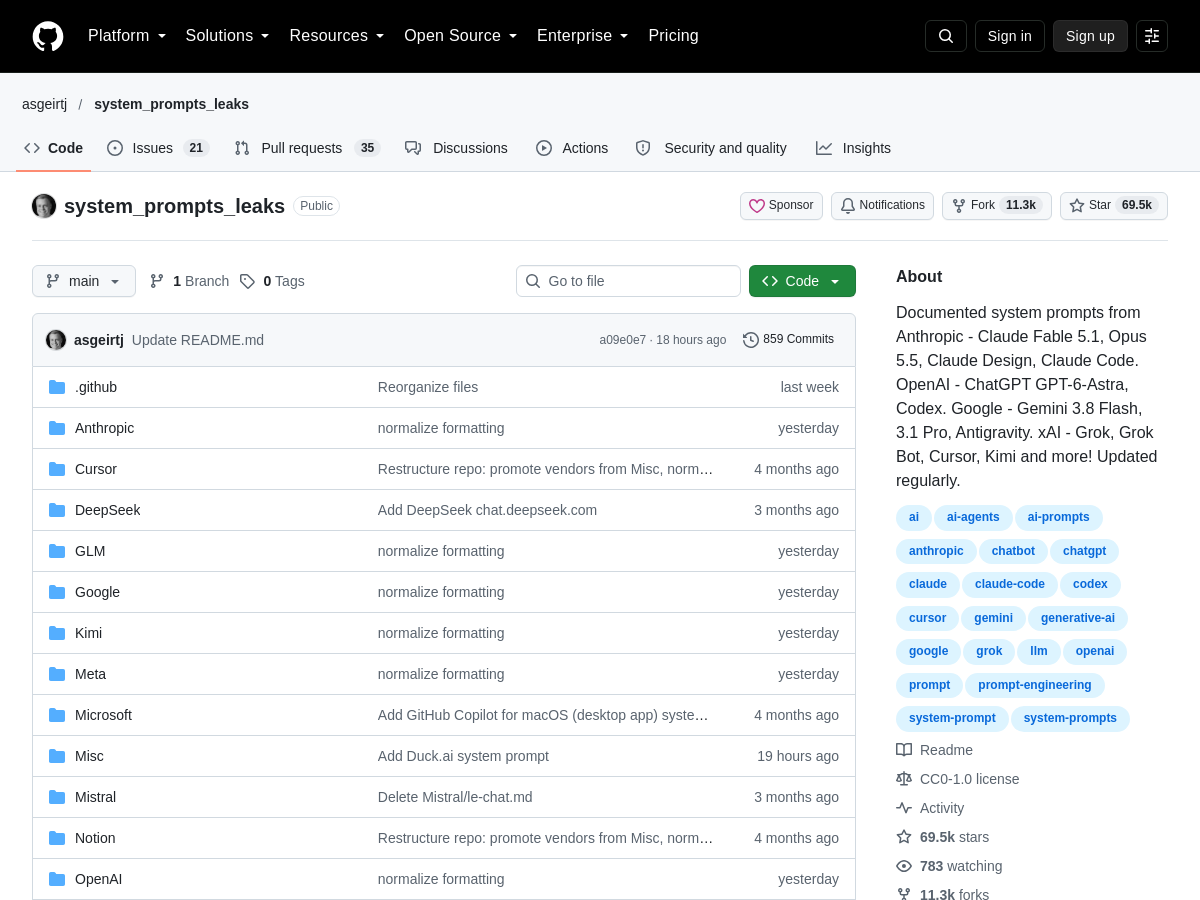
One of the key features of System Prompts Leaks is its comprehensive coverage of AI models and chatbots. The repository includes system prompts for a wide range of models, from general-purpose chatbots like ChatGPT to specialized models like Codex, which is designed for code generation. The repository also includes prompts for other AI applications, such as language translation and text summarization. Overall, System Prompts Leaks is a valuable resource for anyone interested in AI and natural language processing, providing a unique insight into the inner workings of AI systems and the system prompts that drive them.

Solves

System Prompts Leaks solves the problem of accessing and understanding system prompts for AI models and chatbots. By providing a comprehensive collection of documented system prompts, the repository makes it easier for developers, researchers, and others to understand how AI systems work and how to use them effectively. This can be particularly useful for those who are new to AI and natural language processing, as it provides a valuable resource for learning and experimentation. Additionally, the repository's focus on system prompts makes it a unique and valuable resource for anyone interested in the technical details of AI systems.

Screenshot of Docling
Docling
Dev Tools Open Source

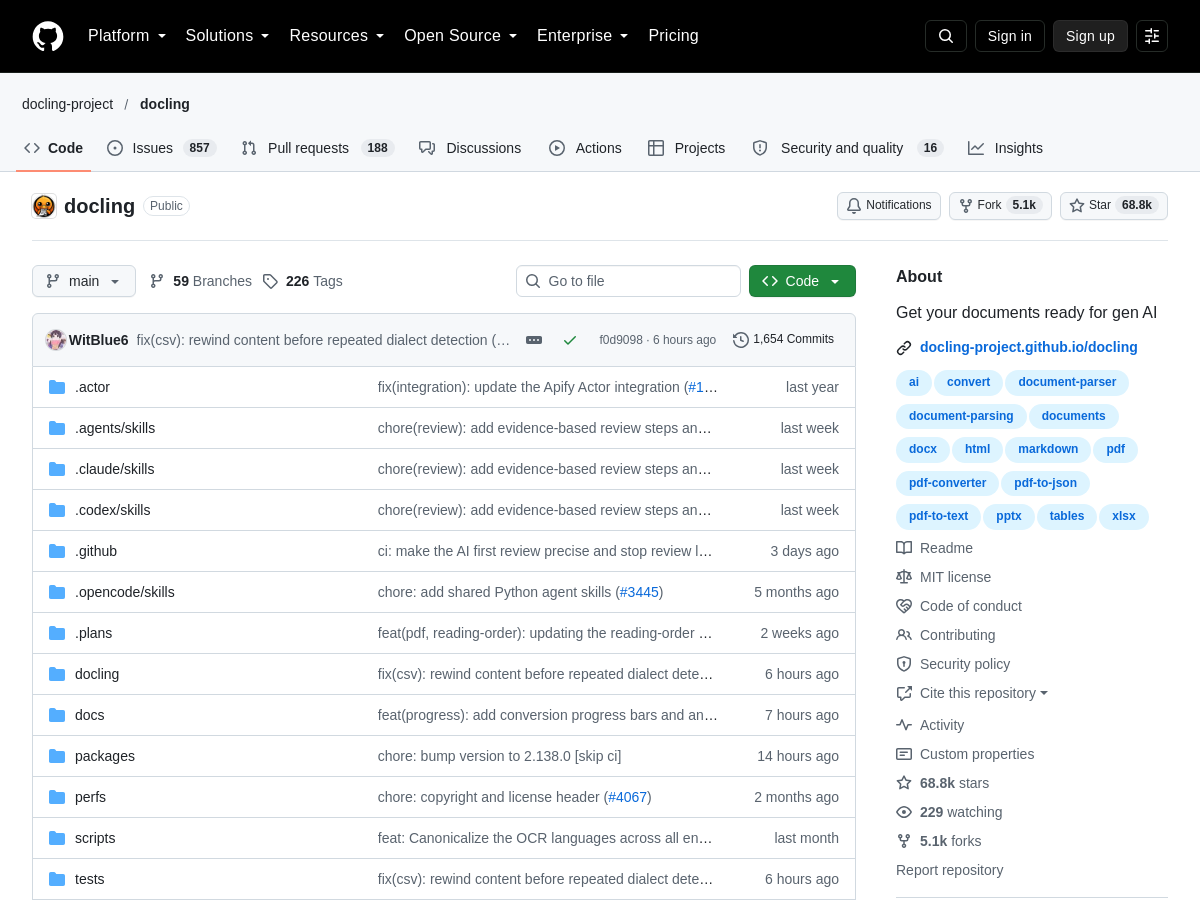
In terms of technical details, Docling is built using Python and supports various architectures, including x86_64 and arm64. The project has a simple and convenient CLI and provides detailed installation instructions and usage guides. Docling's documentation includes information on installation, usage, concepts, recipes, extensions, and more, making it easier for users to get started and address different application use cases. The project's examples demonstrate how to use Docling for various tasks, such as parsing documents, extracting metadata, and integrating with other tools and frameworks. Overall, Docling is a well-documented and well-maintained project that provides a powerful tool for document processing and AI applications.

Solves

Docling solves the problem of document processing and integration with generative AI ecosystems by providing a unified and expressive representation format, supporting various document formats, and offering plug-and-play integrations with popular frameworks and tools. It helps users to parse and process documents in a seamless and efficient manner, making it easier to extract insights and integrate with other AI applications. By providing local execution capabilities and extensive OCR support, Docling also addresses the needs of users who require sensitive data processing and air-gapped environments. Overall, Docling provides a comprehensive solution for document processing and AI applications, making it easier for users to work with documents and integrate with other tools and frameworks.

Screenshot of Ai Engineering From Scratch
Ai Engineering From Scratch
AI Agents Open Source

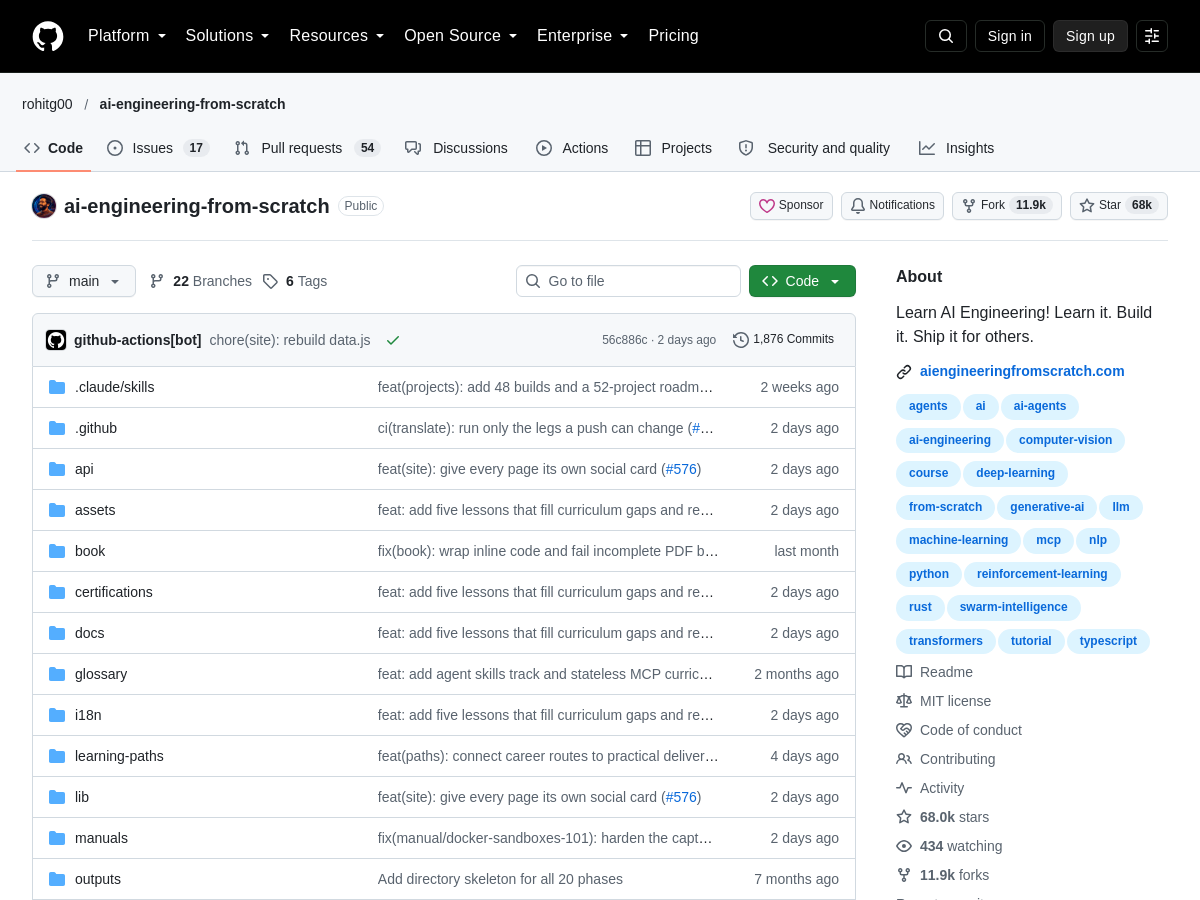
Ai Engineering From Scratch is an open-source project that aims to provide a comprehensive learning experience for AI engineering. The project covers a wide range of topics, including AI agents, computer vision, deep learning, generative AI, machine learning, natural language processing, and reinforcement learning. It provides a hands-on approach to learning AI engineering, allowing users to build and ship their own AI projects. The project is designed to be a one-stop-shop for AI engineering, providing a thorough understanding of the subject matter. With its extensive range of topics and hands-on approach, Ai Engineering From Scratch is an ideal resource for anyone looking to learn AI engineering from scratch.

Solves

Ai Engineering From Scratch solves the problem of limited resources for learning AI engineering. Many individuals and organizations struggle to find comprehensive and hands-on resources for learning AI engineering, which can lead to a lack of understanding and difficulty in applying AI concepts in real-world projects. Ai Engineering From Scratch provides a solution to this problem by offering a thorough and practical learning experience, allowing users to gain a deep understanding of AI engineering and apply their knowledge in real-world projects.

Screenshot of AI Builder | Hostinger Horizons

Hostinger AI Builder, part of Hostinger's website creation suite, enables users to create websites and web apps without writing code. Users describe their idea in natural language or choose from over 400 templates, and the AI generates a complete site with design, layout, and content. The platform supports various site types, including business sites, portfolios, blogs, landing pages, online stores, and AI apps. The builder includes an AI assistant for editing text, design, and functionality. Users can also fine-tune elements manually using a content editor. Once satisfied, users can publish with one click under a custom domain, with Hostinger providing fast and secure hosting, email, and ecommerce features on higher plans. Pricing is tiered: Premium, Unlimited, and Cloud Startup plans, with introductory discounts and a 30-day money-back guarantee. AI creation is metered through AI credits that vary by plan, and the platform targets individuals, small businesses, and creators who need an online presence without technical overhead.

Solves

Hostinger AI Builder solves the challenge of creating and launching a website or web app without coding, design skills, or separate hosting setup. It automates site generation from a text prompt or template, provides AI-assisted editing, and bundles hosting, domain, and email so users can go live quickly with minimal effort.

Screenshot of Metagpt
Metagpt
LLM Open Source

MetaGPT is an open-source multi-agent framework that simulates a software company, enabling users to generate entire software projects from natural language requirements. It orchestrates multiple role-based AI agents—such as product managers, architects, engineers, and testers—that collaborate according to standardized operating procedures (SOPs). Each agent leverages large language models to perform its designated tasks, from writing requirements documents and system designs to coding and testing. The framework transforms a single-line user prompt into a complete software output, including source code, documentation, and deployment scripts. MetaGPT’s design draws inspiration from real-world software development teams, assigning distinct responsibilities and workflows to each agent. For example, the product manager agent breaks down the high-level requirement into user stories and acceptance criteria; the architect designs system architecture and tech stacks; and the engineer implements the actual code. The framework supports iterative refinement, allowing users to intervene and provide feedback to steer the development process. It also offers built-in document generation, such as PRDs and technical designs, making it a full-cycle development assistant. The framework is implemented in Python and integrates with multiple LLM backends, including OpenAI’s GPT series and local open-source models. It comes with a CLI and programmatic API, allowing both interactive and scripted use. Configuration is handled via YAML files, and the system can be extended with custom roles and actions. MetaGPT also includes features like memory and knowledge management, enabling agents to maintain context across interactions and reuse previously acquired information. Since its release, MetaGPT has gained significant traction, accumulating tens of thousands of GitHub stars and an active community of contributors. It is designed to accelerate prototyping, reduce boilerplate coding, and serve as an educational tool for understanding software engineering processes. The project is actively maintained, with frequent updates and a growing ecosystem of plugins and examples.

Solves

Software development typically requires cross-functional teams working through lengthy cycles of planning, design, coding, and testing. MetaGPT solves the problem of high manual effort and long turnaround times by allowing anyone to describe a software idea in plain English and receive a structured, executable project—including documentation and code—generated automatically. It drastically reduces the time and expertise needed to go from concept to a working prototype, enabling developers, product managers, and even non-technical users to bootstrap applications, explore ideas, or learn software engineering practices.

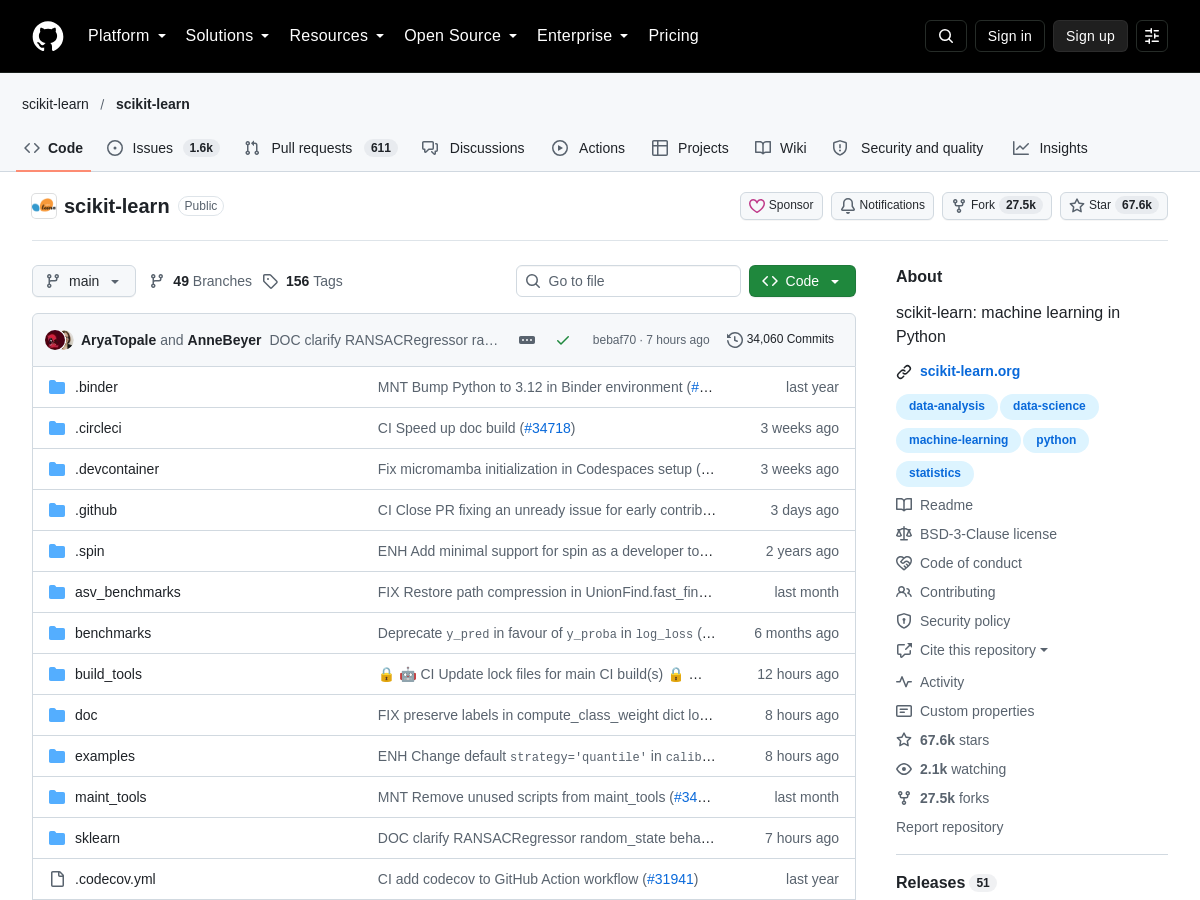
Screenshot of Scikit Learn
Scikit Learn
AI/ML Open Source

Scikit-learn is a Python module for machine learning built on top of SciPy and is distributed under the 3-Clause BSD license. The project was started in 2007 by David Cournapeau as a Google Summer of Code project, and since then many volunteers have contributed. Scikit-learn provides a wide range of algorithms for classification, regression, clustering, and other tasks, along with tools for model selection, data preprocessing, and feature selection. It is widely used in industry and academia for tasks such as predictive modeling, data analysis, and data science. Scikit-learn is designed to be highly extensible, allowing users to easily add new algorithms and features. It also includes tools for testing and validation, making it easier to ensure that models are working correctly. The library is well-documented, with a comprehensive user guide and API reference, making it easy for new users to get started. Scikit-learn is also highly customizable, allowing users to modify and extend the library to suit their specific needs. Overall, scikit-learn is a powerful and flexible library for machine learning in Python, suitable for a wide range of applications. Scikit-learn's plotting capabilities require Matplotlib, and some examples require scikit-image, pandas, seaborn, and Plotly. The library can be installed using pip or conda, and the documentation includes detailed installation instructions. Scikit-learn has a strong community of contributors and users, with a mailing list, GitHub discussions, and social media channels for support and discussion. The library is widely used in industry and academia, and is a popular choice for data science and machine learning tasks. Scikit-learn is designed to be easy to use, with a simple and intuitive API, making it accessible to users with varying levels of experience. The library is also highly performant, with optimized algorithms and data structures for fast computation. Overall, scikit-learn is a powerful and flexible library for machine learning in Python, suitable for a wide range of applications. The library is well-suited for tasks such as predictive modeling, data analysis, and data science, and is a popular choice among data scientists and machine learning practitioners. Scikit-learn is also widely used in industry, with applications in fields such as finance, healthcare, and marketing. The library is highly customizable, allowing users to modify and extend the library to suit their specific needs. Scikit-learn is also highly extensible, allowing users to easily add new algorithms and features. The library includes tools for testing and validation, making it easier to ensure that models are working correctly. Overall, scikit-learn is a powerful and flexible library for machine learning in Python, suitable for a wide range of applications.

Solves

Scikit-learn solves the problem of providing a wide range of algorithms for machine learning tasks, along with tools for model selection, data preprocessing, and feature selection. It provides a simple and intuitive API, making it accessible to users with varying levels of experience. Scikit-learn also provides a highly customizable and extensible framework, allowing users to modify and extend the library to suit their specific needs. The library is widely used in industry and academia, and is a popular choice for data science and machine learning tasks. By providing a comprehensive set of tools and algorithms for machine learning, scikit-learn helps users to build and deploy predictive models, and to analyze and understand complex data sets.

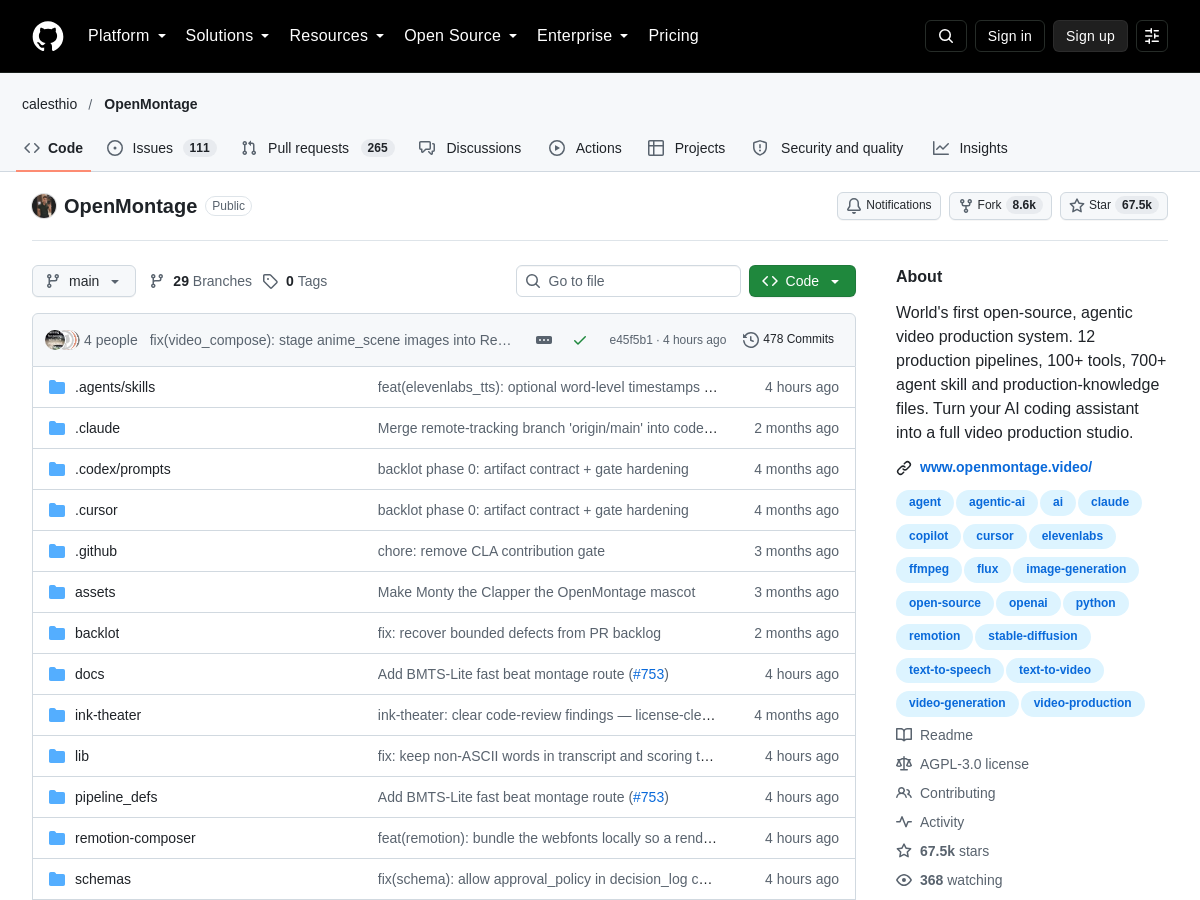
Screenshot of OpenMontage
OpenMontage
Image Gen Open Source

OpenMontage is the world's first open-source, agentic video production system. It features 12 production pipelines, over 100 tools, and more than 700 agent skill and production-knowledge files. This system allows users to turn their AI coding assistant into a full video production studio. OpenMontage integrates with various tools and services such as ElevenLabs for text-to-speech functionality, Remotion for video generation, and GitHub Copilot for AI-powered code completion. The project is highly customizable, with a wide range of configuration options and extensibility through its modular design. OpenMontage is designed to streamline video production workflows, enabling users to create high-quality videos efficiently. The system's agentic nature means it can adapt to different production scenarios, making it a versatile tool for various applications. With its open-source nature, OpenMontage encourages community involvement, allowing developers to contribute to its growth and improvement. Overall, OpenMontage represents a significant advancement in video production technology, leveraging AI and machine learning to simplify and enhance the creative process.

Solves

Video content creators, developers, and businesses face the challenge of producing high-quality videos efficiently and cost-effectively. OpenMontage solves this problem by providing an open-source, agentic video production system that integrates AI-powered tools and services, streamlining the production workflow and enabling users to create professional-grade videos without extensive resources or expertise. By automating many aspects of video production, OpenMontage saves time and reduces costs, making it an attractive solution for individuals and organizations looking to produce engaging video content.

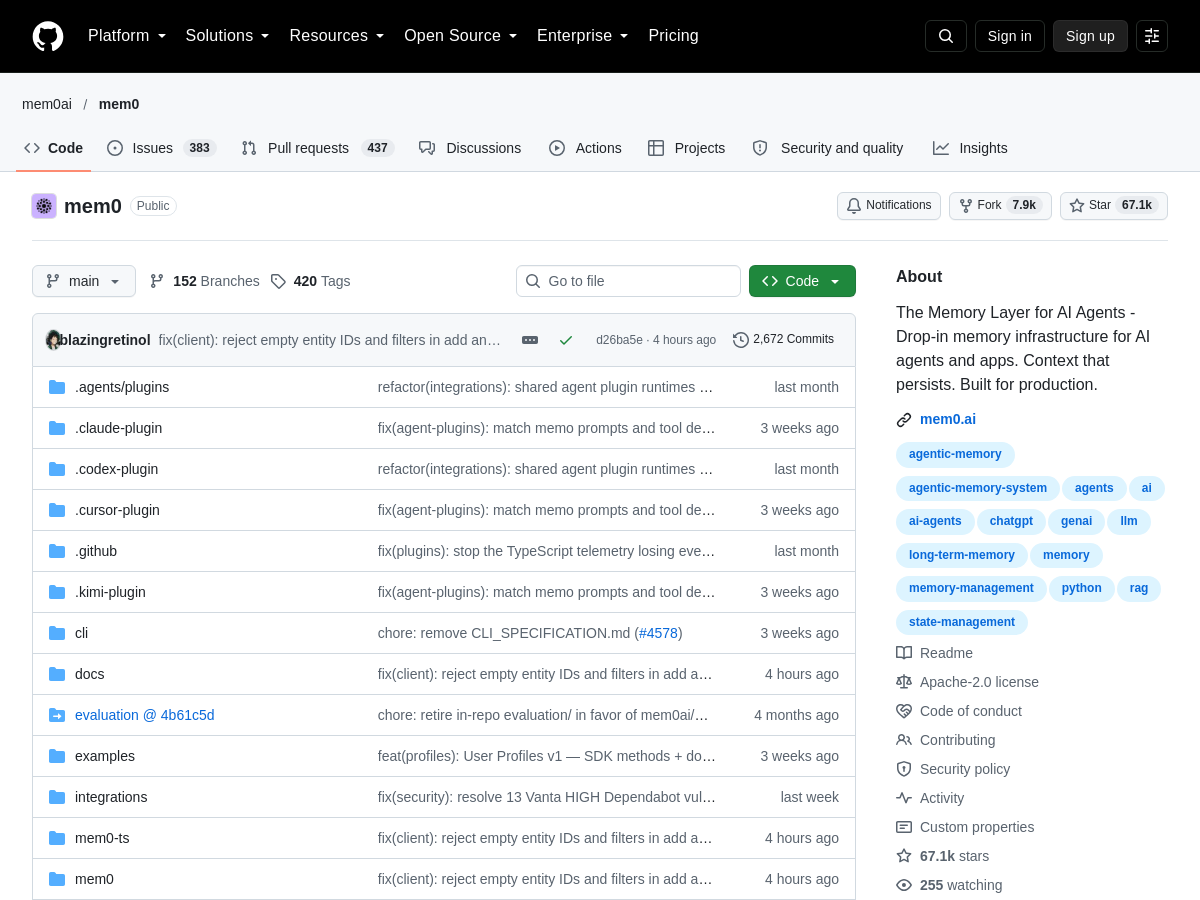
Screenshot of Mem0
Mem0
AI Agents Open Source

Mem0 is an open-source memory layer for AI agents and apps, providing a drop-in memory infrastructure that enables personalized AI interactions. It remembers user preferences, adapts to individual needs, and continuously learns over time, making it ideal for customer support chatbots, AI assistants, and autonomous systems. Mem0 offers a range of features, including multi-level memory, developer-friendly APIs, and a fully managed service option. It supports various large language models (LLMs) and embedding models, allowing for flexible and customizable integration. The project provides a quickstart guide, API reference, and documentation for easy setup and use. Mem0 has a strong focus on community engagement, with a Discord channel, Twitter presence, and contact email for support and feedback. The project is licensed under Apache 2.0 and has a research paper available for citation.
Solves

Mem0 solves the problem of AI agents and apps lacking a robust and scalable memory layer, which hinders their ability to provide personalized and context-rich interactions. By providing a drop-in memory infrastructure, Mem0 enables developers to build more sophisticated and user-friendly AI-powered applications, improving the overall user experience and increasing the effectiveness of AI assistants and chatbots.

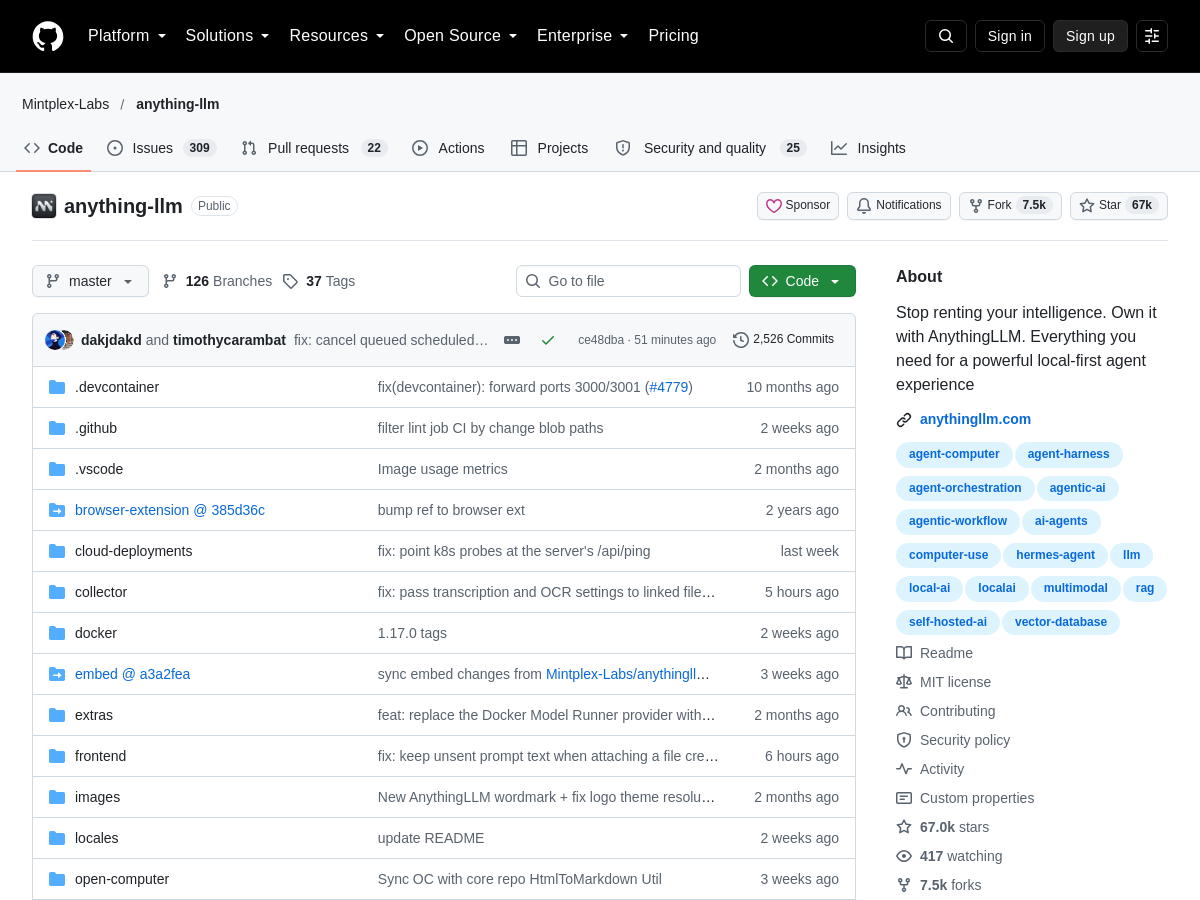
Screenshot of Anything Llm
Anything Llm
AI Agents Open Source

AnythingLLM is an all-in-one AI application that allows users to build a private, fully-featured ChatGPT-like experience without compromises. It supports multiple users, has built-in agents, multi-user support, vector databases, and document pipelines, all with no extra configuration required. The application is highly customizable, with features such as dynamic model routing, automatic and user-managed memories, scheduled tasks, intelligent skill selection, and a no-code AI agent builder. AnythingLLM also supports multiple LLM providers, embedder models, speech models, and vector databases, making it a versatile tool for various use cases. The application has a user-friendly interface, with a chat UI that allows for drag-and-drop uploads and source citations. AnythingLLM is production-ready for any cloud deployment and has a full developer API for custom integrations. The application is open-source, with a large community of contributors and sponsors, and is available for self-hosting, with various deployment methods and scripts available.

Solves

AnythingLLM solves the problem of users having to rely on third-party AI services that may have limitations, costs, and privacy concerns. By providing a self-hosted solution, AnythingLLM allows users to have full control over their AI experience, with the ability to customize and extend the application to meet their specific needs. This is particularly useful for individuals and organizations that require a high level of privacy and security, such as those working with sensitive data or in regulated industries.

Screenshot of Annotated_Deep_Learning_Paper_Implementations

The Annotated Deep Learning Paper Implementations repository, maintained by labml.ai, contains over 60 implementations of influential deep learning research papers. Each implementation is presented with side-by-side notes that explain the code in the context of the paper's equations and concepts. The collection spans a wide range of topics including transformers (original, XL, Switch, Feedback, ViT), optimizers (Adam, AdaBelief, Sophia), GANs (CycleGAN, StyleGAN2), reinforcement learning algorithms (PPO, DQN), capsule networks, and knowledge distillation. The implementations are written in Python using PyTorch, and the annotations follow a consistent format designed to bridge the gap between theoretical papers and practical code. The notes often include mathematical explanations, visualizations, and links to relevant sections of the papers. This makes it an excellent resource for anyone looking to understand how modern deep learning models work under the hood. The project is open source and freely available on GitHub. It serves as both an educational tool for self-study and as a reference for researchers and engineers who need to implement or adapt state-of-the-art architectures. The repository is actively maintained and contributions are welcome.

Solves

Understanding and implementing deep learning research papers is challenging due to complex mathematics, ambiguous notation, and missing implementation details. This repository solves that by providing annotated implementations with side-by-side notes that connect each code block to the paper's equations and concepts, making state-of-the-art models accessible to practitioners and learners.

Screenshot of Ai Agents For Beginners
Ai Agents For Beginners
AI Agents Open Source

AI Agents for Beginners is a comprehensive open-source curriculum developed by Microsoft to teach the fundamentals of building AI agents. The repository provides a structured set of lessons, currently 18 in number, covering key concepts such as agent architectures, planning, tool use, and multi-agent systems. Each lesson includes explanations, code examples, and hands-on exercises to facilitate practical learning. The course is designed for individuals with basic programming knowledge who are new to AI agents. It starts with foundational topics and gradually progresses to more advanced scenarios, enabling learners to build their own simple agents and understand how to integrate them with various tools and APIs. The content is freely accessible on GitHub, allowing learners to follow along at their own pace, contribute improvements, and engage with the community. It is an ideal starting point for developers, students, and enthusiasts looking to enter the field of AI agent development.

Solves

AI Agents for Beginners addresses the steep learning curve associated with building AI agents by offering a well-organized, beginner-friendly curriculum with clear explanations and practical examples, eliminating the need to piece together scattered resources.

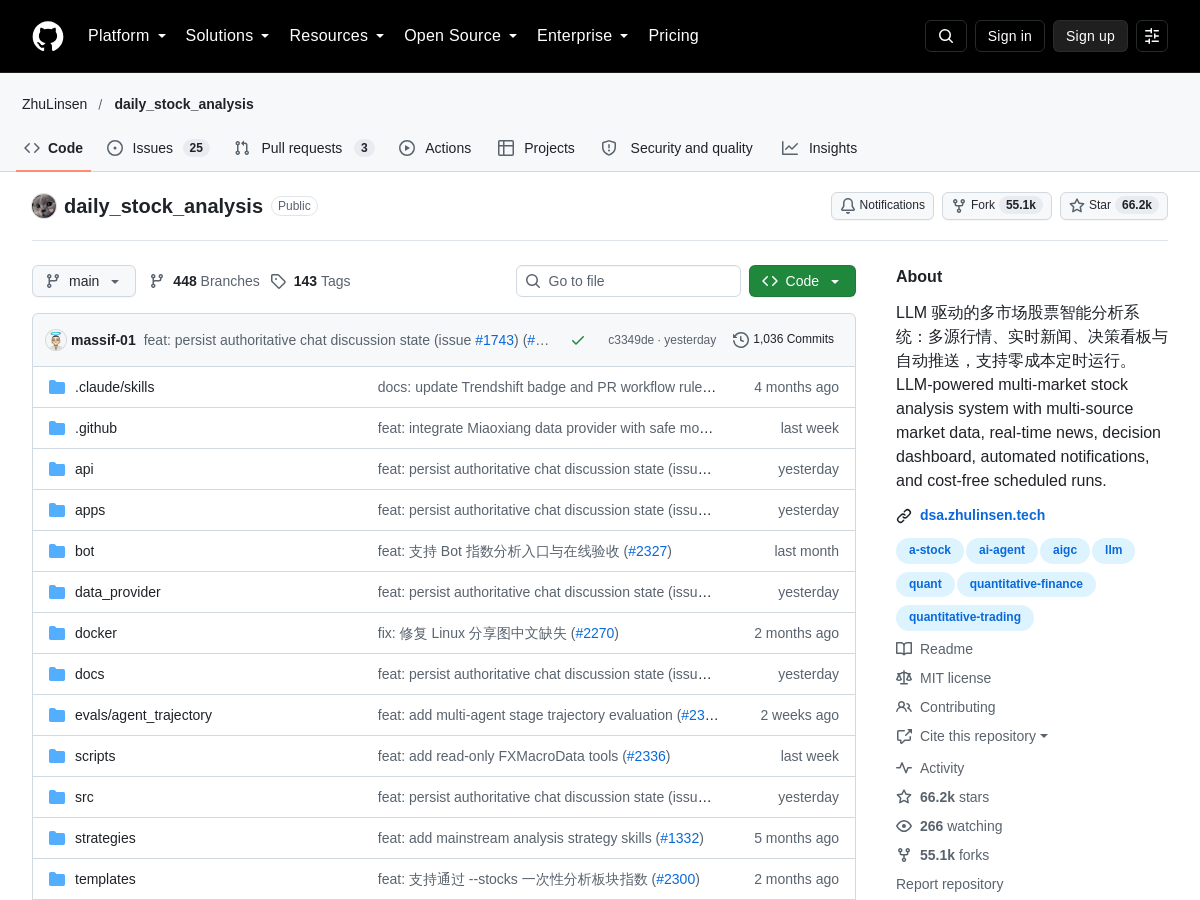
Screenshot of Daily_stock_analysis
Daily_stock_analysis
LLM Open Source

Daily Stock Analysis is an open-source project that provides a multi-market stock analysis system. It utilizes large language models (LLMs) to analyze stocks and provide decision-making dashboards. The system supports multiple data sources, including market data, real-time news, and technical indicators. It also offers automated notifications and cost-free scheduled runs. The project is designed to be highly customizable, with support for various AI models, data sources, and notification channels. The system can be deployed using GitHub Actions, Docker, or local deployment. The project provides a web interface for configuration management, task monitoring, manual analysis, and historical reporting. It also supports agent-based strategy inquiry, allowing users to ask questions and receive answers based on real-time market data and technical indicators.

Solves

The problem that Daily Stock Analysis solves is the need for a comprehensive and customizable stock analysis system. Many existing stock analysis tools are limited in their functionality and customization options, making it difficult for users to tailor the tool to their specific needs. Daily Stock Analysis addresses this problem by providing a highly customizable and extensible system that can be tailored to meet the specific needs of individual users. The system's use of LLMs and multiple data sources also provides a more accurate and comprehensive analysis of stocks, helping users to make more informed investment decisions.

Screenshot of Social Intents
Social Intents
AI/ML Unknown

Social Intents is a cloud-based customer communication platform that enables real-time support and sales conversations directly from popular messaging platforms like Slack, Microsoft Teams, and Discord. It allows businesses to engage with website visitors via live chat while agents can respond from the comfort of their existing team communication tools, eliminating the need to monitor a separate chat dashboard. The platform leverages AI-powered chatbots to automate routine inquiries, qualify leads, and route conversations to the appropriate team members. These bots can handle common questions, collect visitor information, and even schedule meetings, allowing human agents to focus on high-value interactions. Social Intents also offers proactive chat features that can be triggered based on user behavior, such as time spent on a page or exit intent, to increase conversion rates. In addition to live chat and chatbot automation, Social Intents provides integrations with CRM systems, help desk software, and analytics tools to streamline workflows and capture customer data. It supports customization of chat widgets to match brand aesthetics and offers detailed reporting on chat metrics and agent performance. The platform is designed to scale from small businesses to enterprise teams, providing a centralized solution for customer engagement across messaging channels.

Solves

Businesses often struggle to provide immediate, personalized support to website visitors because agents are juggling multiple tools or lack a dedicated chat interface. Social Intents solves this by integrating live chat directly into the messaging apps teams already use, such as Slack or Teams, reducing tool-switching and response times. Its AI chatbot handles repetitive inquiries automatically, ensuring 24/7 availability and freeing human agents for complex issues, ultimately improving customer satisfaction and sales conversions.

Screenshot of Localstack
Localstack
Dev Tools Open Source

LocalStack is a fully functional local AWS cloud stack that enables developers to develop and test cloud and serverless applications offline. It emulates a wide range of AWS services locally, including Lambda, S3, DynamoDB, SQS, SNS, and many others, providing a sandbox environment that closely mimics real AWS behavior. The tool is designed to be easy to set up and use, typically running as a Docker container on the developer's machine. It integrates with popular development workflows and CI/CD pipelines, allowing teams to run automated tests without incurring AWS costs or requiring internet connectivity. LocalStack provides both a free open-source edition and a paid Pro version with additional advanced features and enterprise support. LocalStack has gained widespread adoption in the developer community due to its ability to accelerate development cycles, reduce cloud spending, and improve test reliability. It supports multiple programming languages and is compatible with AWS SDKs, making it a drop-in replacement for many cloud-based development scenarios. The active open-source community continually contributes new service emulations and improvements.

Solves

Developers often face high costs, slow feedback loops, and dependency on internet when building and testing AWS cloud applications. LocalStack solves this by providing a local environment that emulates AWS services, allowing offline development, testing, and integration without incurring cloud charges or risking production resources.

Screenshot of Keras
Keras
AI/ML Open Source

Keras is a multi-backend deep learning framework that supports JAX, TensorFlow, PyTorch, and OpenVINO. It provides a high-level UX for building and training models, allowing for accelerated model development and state-of-the-art performance. Keras 3 is designed to be a drop-in replacement for tf.keras and can run on top of any framework, benefiting from the advantages of each. It also allows for writing custom components that can be used in low-level workflows in any framework, making ML code future-proof by avoiding framework lock-in. Keras 3 supports various applications, including computer vision, natural language processing, audio processing, timeseries forecasting, and recommender systems. It provides a simple and easy-to-use API for building and training models, and it is compatible with Linux and macOS systems, with Windows users recommended to use WSL2. Keras 3 is available on PyPI as 'keras' and can be installed using pip, with backend packages such as TensorFlow, JAX, or PyTorch also required. The OpenVINO backend is available for model inference only. Keras 3 provides a range of features, including accelerated model development, state-of-the-art performance, and datacenter-scale training. It also supports backwards compatibility with tf.keras and allows for custom components to be written. Overall, Keras 3 is a powerful and flexible deep learning framework that provides a high-level UX and state-of-the-art performance, making it a popular choice among developers and researchers. Keras 3 is designed to be highly customizable, with support for various backends and custom components. It also provides a range of tools and features for building and training models, including support for GPU acceleration and distributed training. With its high-level UX and state-of-the-art performance, Keras 3 is an ideal choice for developers and researchers looking to build and train deep learning models.

Solves

Keras 3 solves the problem of framework lock-in, allowing developers to write custom components that can be used in low-level workflows in any framework. It also provides a high-level UX for building and training models, making it easier to develop and deploy deep learning models. Additionally, Keras 3 provides state-of-the-art performance, allowing developers to benefit from the advantages of each framework. Keras 3 is designed to be a drop-in replacement for tf.keras, making it easy for developers to transition to the new framework. Overall, Keras 3 provides a flexible and powerful solution for building and training deep learning models, making it a popular choice among developers and researchers.

Screenshot of Awesome Claude Skills
Awesome Claude Skills
AI Agents Free

Awesome Claude Skills is a curated GitHub repository maintained by ComposioHQ that serves as a community-driven index of Claude Skills, resources, and tools. Claude Skills are modular, reusable capabilities that extend the functionality of Anthropic's Claude AI assistant, enabling customization of workflows for specific tasks. The repository aggregates links to pre-built skills, tutorials, integration guides, and examples contributed by developers and AI enthusiasts. The repository is organized to help users quickly find skills across various categories, such as automation, data analysis, coding assistance, and third-party integrations. It includes sections for official Anthropic resources, community-created skills, and tools for building and deploying custom skills. The list is free and open source, allowing anyone to contribute via pull requests, ensuring the collection stays up-to-date with the rapidly evolving Claude ecosystem. As an "awesome" list, it follows the standard format of curated lists on GitHub, providing a table of contents and categorized links. It is particularly useful for developers and ML engineers who want to leverage Claude's capabilities beyond out-of-the-box usage, whether for personal projects or enterprise workflows. The repository is actively maintained and has gained traction in the AI community as a go-to reference for Claude customization.

Solves

Discovering and organizing Claude Skills and related resources can be time-consuming and fragmented. Awesome Claude Skills solves this by providing a centralized, curated list that helps users find, evaluate, and adopt Claude Skills quickly, reducing the effort required to customize Claude for specific workflows and accelerating development of AI-powered applications.

Screenshot of Base44 Superagents
Base44 Superagents
Task automation Free

Base44 Superagents is an AI-powered tool that allows users to build their own personal AI agents in minutes. These agents can handle various tasks such as managing emails, follow-ups, reports, analytics, and more, 24/7, without requiring any setup or technical expertise. The agents can be configured to perform tasks through plain language descriptions, and they can connect to various tools and services such as Google Calendar, Gmail, Drive, Socials, Discord, Slack, and more. The agents are designed to work proactively, executing tasks and making decisions within the user's goals, rather than just responding to queries like traditional chatbots. They can also remember and evolve over time, learning from conversations and preferences to become more useful. The Superagents are secure by default, with permissions-based access and sandboxing, ensuring that they only touch what the user explicitly allows. Overall, Base44 Superagents aims to provide a hassle-free and intuitive way for users to automate tasks and workflows, freeing up time for more important activities.
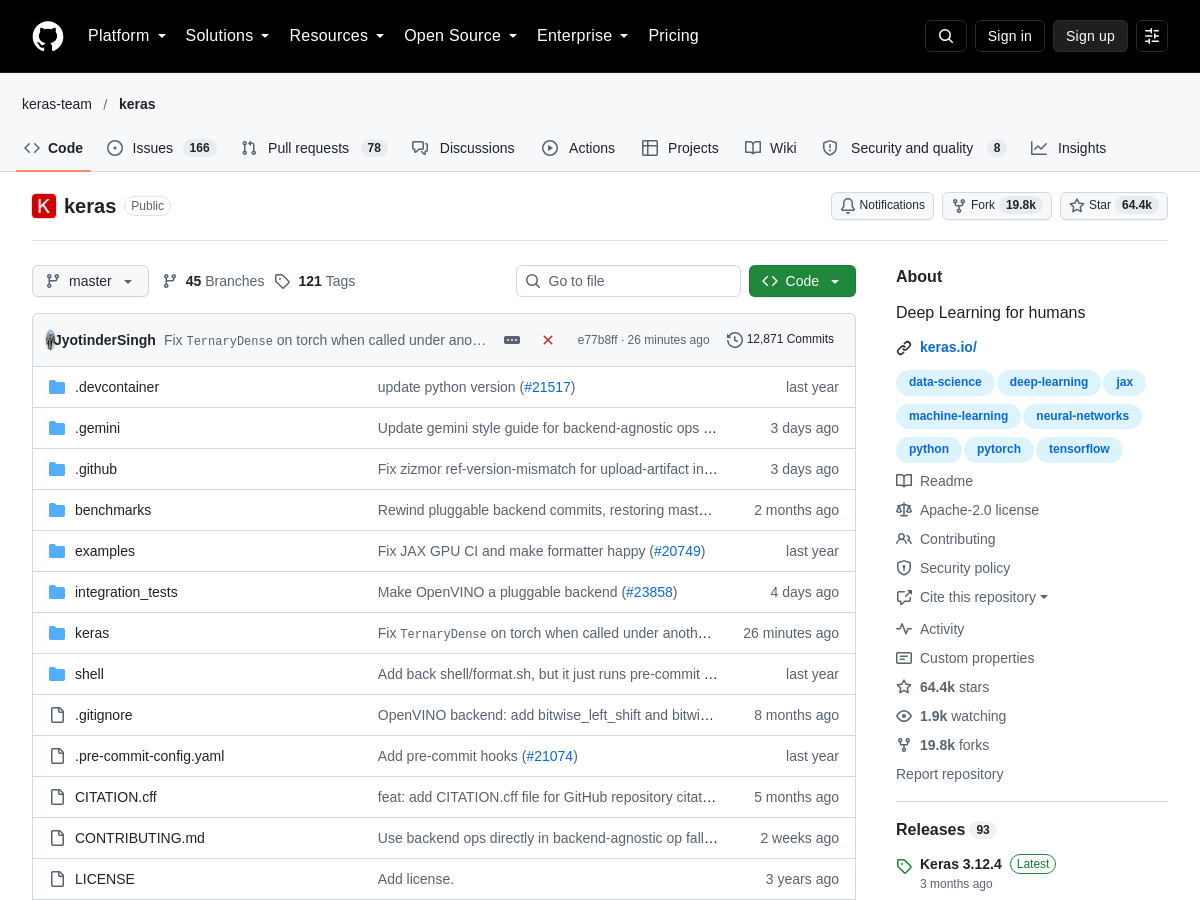
Solves

The problem that Base44 Superagents solves is the need for individuals and businesses to automate repetitive and time-consuming tasks, such as managing emails, follow-ups, and reports. Many people struggle with finding the time and resources to complete these tasks, which can lead to decreased productivity and efficiency. Base44 Superagents provides a solution to this problem by allowing users to create their own personal AI agents that can handle these tasks automatically, 24/7, without requiring any technical expertise or setup.

Screenshot of Context7
Context7
LLM Open Source

Context7 is an open-source platform designed to provide up-to-date code documentation for Large Language Models (LLMs) and AI code editors. It fetches the latest documentation and code examples directly from the source, eliminating the need for outdated or generic information. The platform works in two modes: CLI + Skills and MCP, allowing users to install a skill that guides their agent to fetch documentation using CLI commands or register a Context7 MCP server for native documentation tool calls. Context7 supports multiple libraries and provides features such as library ID specification, version specification, and rule addition for customized documentation retrieval. The platform also offers a range of tools, including CLI commands, MCP tools, and APIs, to facilitate seamless integration with various coding agents and libraries.

Solves

Developers and coding agents often struggle with outdated or generic documentation, leading to inefficient coding processes and potential errors. Context7 solves this problem by providing a platform that delivers up-to-date, version-specific documentation and code examples, enabling developers to work more efficiently and effectively.

Screenshot of TrendRadar
TrendRadar
LLM Open Source

TrendRadar is an AI-driven public opinion and trend monitor that aggregates multi-platform hot topics, supports RSS subscriptions, and provides smart alerts. It uses AI-powered news filtering, translation, and analysis to provide users with concise briefings on their mobile devices. The tool also supports integration with various channels, including WeChat, Telegram, email, and Slack, for intelligent push notifications. TrendRadar is built using Python and is deployed using Docker, with data stored locally or in the cloud. The project has a strong focus on natural language processing, sentiment analysis, and trend prediction, making it a valuable resource for those looking to stay informed about public opinion and trends.

Solves

TrendRadar solves the problem of information overload by providing users with a concise and personalized view of public opinion and trends. It helps users to stay informed about the latest developments in their areas of interest, without having to sift through large amounts of data. By using AI-powered filtering and analysis, TrendRadar is able to identify the most relevant and important information, and present it to users in a clear and concise manner.

Screenshot of Ultralytics
Ultralytics
Image Gen Open Source

Ultralytics is an open-source project that provides a range of computer vision models, including YOLO27, YOLO26, YOLO11, and YOLOv8. These models are designed for object detection, instance segmentation, semantic segmentation, image classification, pose estimation, and object tracking. The project is built using PyTorch and provides a range of tools and resources for developers, including a platform for deploying and managing computer vision models. The project has a strong focus on ease of use and provides a simple and intuitive API for integrating computer vision capabilities into applications. Ultralytics also provides a range of pre-trained models and a platform for fine-tuning and deploying custom models. The project is highly customizable and provides a range of options for optimizing performance and accuracy. Overall, Ultralytics is a powerful and flexible tool for building computer vision applications.

Solves

Ultralytics solves the problem of building and deploying computer vision models, which can be a complex and time-consuming task. By providing a range of pre-trained models and a simple and intuitive API, Ultralytics makes it easy for developers to integrate computer vision capabilities into their applications. This can be particularly useful for applications such as image classification, object detection, and tracking, where computer vision can be used to improve accuracy and efficiency. By providing a platform for deploying and managing computer vision models, Ultralytics also makes it easy for developers to scale and optimize their applications, which can be critical for applications that require high performance and accuracy.

Screenshot of Litellm
Litellm
LLM Open Source

Litellm is an open-source AI Gateway that enables users to call over 100 LLM APIs in OpenAI or native format. It features a Rust core with a Python SDK, providing cost tracking, guardrails, load balancing, and logging. The tool supports various platforms, including Bedrock, Azure, OpenAI, Anthropic, VertexAI, vLLM, and Nvidia NIM. Litellm is designed to be fast and lightweight, making it an ideal solution for developers and organizations looking to integrate AI capabilities into their applications. With its robust features and flexible architecture, Litellm can be used in a variety of use cases, from natural language processing to computer vision. The project is actively maintained on GitHub, with a large community of contributors and a comprehensive documentation set. Litellm's architecture is designed to be modular and scalable, allowing users to easily integrate it with their existing infrastructure. The tool also provides a range of customization options, enabling users to tailor it to their specific needs. Overall, Litellm is a powerful and versatile AI Gateway that can help organizations unlock the full potential of AI and machine learning. Litellm's documentation is extensive and includes a range of tutorials, guides, and API references. The project's community is active and supportive, with many contributors and users sharing their knowledge and expertise. Litellm is also highly customizable, with a range of configuration options and plugins available. This makes it an ideal choice for organizations with specific requirements or use cases. In addition to its technical features, Litellm is also designed with security and reliability in mind. The tool includes a range of security features, such as authentication and authorization, to ensure that user data is protected. Litellm is also designed to be highly available, with features such as load balancing and failover to ensure that the tool remains operational even in the event of hardware or software failures.

Solves

Developers and organizations often struggle to integrate AI capabilities into their applications, due to the complexity and cost of developing and maintaining AI infrastructure. Litellm solves this problem by providing a fast, lightweight, and scalable AI Gateway that enables users to easily call LLM APIs and integrate AI capabilities into their applications. With Litellm, users can avoid the costs and complexities of developing and maintaining their own AI infrastructure, and instead focus on building and deploying their applications. This makes it an ideal solution for organizations looking to unlock the full potential of AI and machine learning, without the need for significant investment in AI infrastructure.

Screenshot of VoiceStudio
VoiceStudio
Video Open Source

VoiceStudio is an open-source, fully-local alternative to ElevenLabs, offering a range of features including voice cloning, voice design, video dubbing, dictation, transcription, and audiobook creation in 646 languages. The project provides a desktop application built with Electron, allowing users to create and manage their own voice models, as well as integrate with other tools and services through a local API and MCP. VoiceStudio is designed to run on a variety of hardware configurations, including NVIDIA GPU, Apple Silicon, and Intel/AMD integrated graphics, with optional support for remote services and usage analytics. The project is licensed under AGPL-3.0 and is available for download on GitHub, with documentation and guides provided for setup, usage, and development.

Solves

VoiceStudio solves the problem of providing a fully-local, open-source solution for voice cloning, voice design, and other audio-related tasks, allowing users to maintain control over their data and models. It also addresses the issue of limited language support, with its ability to work with 646 languages. Additionally, VoiceStudio provides a flexible and customizable platform for developers and power users, with its API and MCP integrations, as well as its support for a range of hardware configurations.

Screenshot of CrewAI
CrewAI
AI Agents Open Source

CrewAI is an open-source Python framework designed for orchestrating role-playing, autonomous AI agents. It empowers agents to work together seamlessly, tackling complex tasks through collaborative intelligence. The framework provides high-level abstractions and low-level APIs for building production-ready multi-agent workflows. CrewAI offers two primary approaches: Crews, which are teams of AI agents with true autonomy and agency, and Flows, which are production-ready, event-driven workflows that deliver precise control over complex automations. By combining Crews and Flows, developers can create sophisticated automation pipelines that balance autonomy with explicit control. CrewAI is highly customizable, allowing developers to tailor prompts, tools, execution paths, state, and integrations without fighting the framework. It also supports various language models, including local ones, and provides tools for seamless integration. CrewAI is suitable for production environments, highly scalable, and offers advanced debugging and monitoring tools. It is primarily Python-based but can integrate with services and APIs written in any programming language.

Solves

CrewAI solves the problem of orchestrating multiple AI agents and workflows in a production-ready environment. It provides a framework for developers to build intelligent automations that can handle complex tasks and workflows, while also allowing for customization and scalability. CrewAI is particularly useful for use cases that require coordination of multiple agents, tool usage, structured outputs, human review, or workflows that combine autonomous reasoning with explicit business logic. By using CrewAI, developers can create powerful, adaptable, and production-ready AI automations that can transform complex business processes into efficient, intelligent workflows.