Tool discovery

What type of AI tool
are you looking for?

Search the active catalog with LambdaBase AI Search, or keep browsing the popularity-ordered directory below.

Submitted search queries and interaction metrics may be analyzed to improve result quality. Do not include personal or confidential information

Browse popular tools.

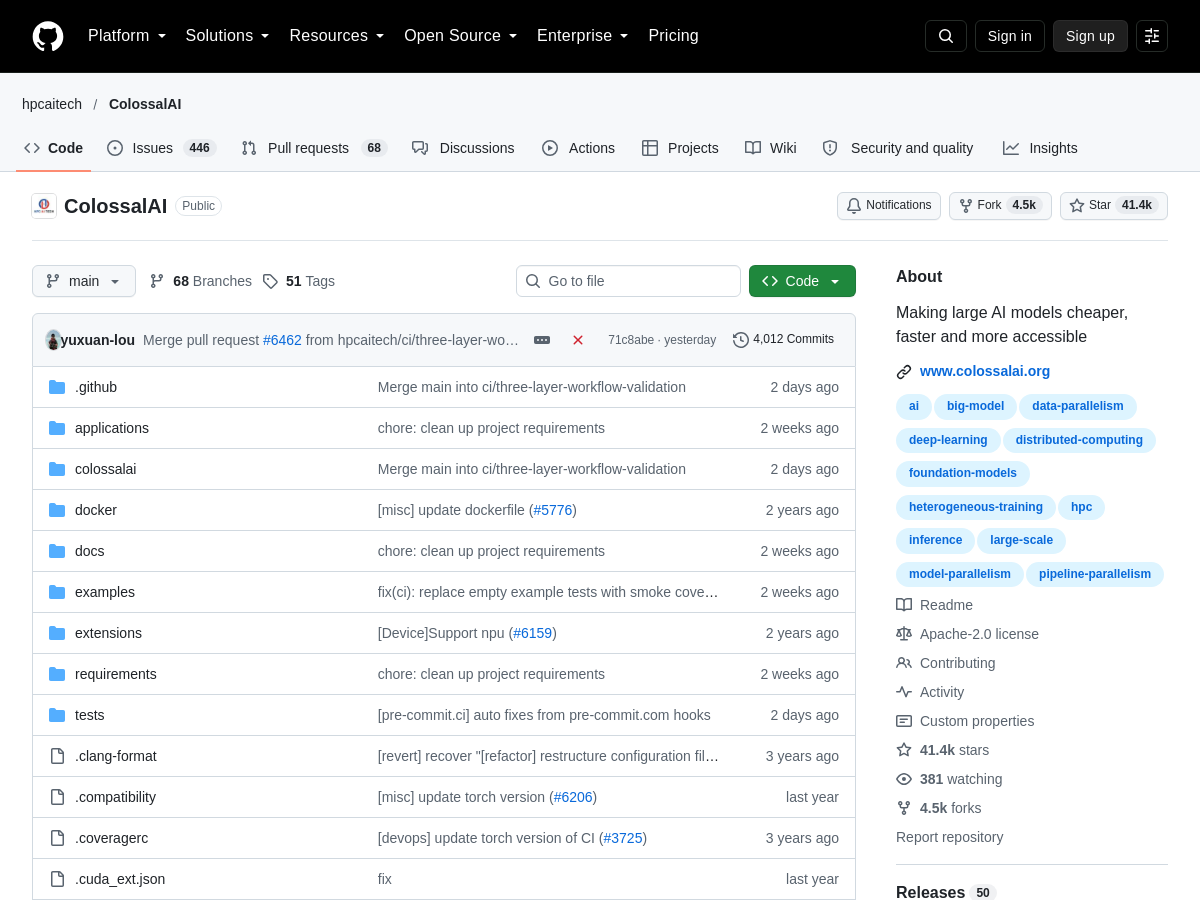
Screenshot of ColossalAI
ColossalAI
AI/ML Open Source

ColossalAI is an open-source project that aims to make large AI models cheaper, faster, and more accessible. It provides a framework for distributed computing and heterogeneous training, allowing users to train large models on multiple devices and platforms. The project includes a range of features, such as data parallelism, model parallelism, and pipeline parallelism, which enable efficient training and inference of large AI models. ColossalAI also supports various deep learning frameworks and provides a range of tools and libraries for building and deploying AI applications. The project is designed to be highly scalable and flexible, making it suitable for a wide range of applications, from research and development to production and deployment. With its focus on accessibility and ease of use, ColossalAI has the potential to democratize access to large AI models and enable a wider range of users to build and deploy AI applications. The project is actively maintained and updated, with a strong community of contributors and users. Overall, ColossalAI is a powerful tool for building and deploying large AI models, and its open-source nature makes it an attractive option for researchers, developers, and organizations looking to leverage the power of AI. ColossalAI's documentation and community resources provide a comprehensive guide for users to get started with the project, and its extensibility and customizability make it a versatile tool for a wide range of applications. The project's focus on distributed computing and heterogeneous training enables users to train large models on multiple devices and platforms, making it a valuable resource for organizations and individuals working with large AI models. Additionally, ColossalAI's support for various deep learning frameworks and its range of tools and libraries make it an ideal choice for building and deploying AI applications. The project's active maintenance and updates ensure that it stays up-to-date with the latest developments in the field of AI, and its strong community of contributors and users provides a valuable resource for support and collaboration.

Solves

ColossalAI solves the problem of making large AI models more accessible and affordable for a wider range of users. Many organizations and individuals are interested in building and deploying AI applications, but the cost and complexity of training large AI models can be a significant barrier. ColossalAI addresses this problem by providing a framework for distributed computing and heterogeneous training, which enables users to train large models on multiple devices and platforms. This makes it possible for users to build and deploy AI applications without requiring significant investments in hardware and infrastructure. Additionally, ColossalAI's focus on accessibility and ease of use makes it an attractive option for users who may not have extensive experience with AI or deep learning.
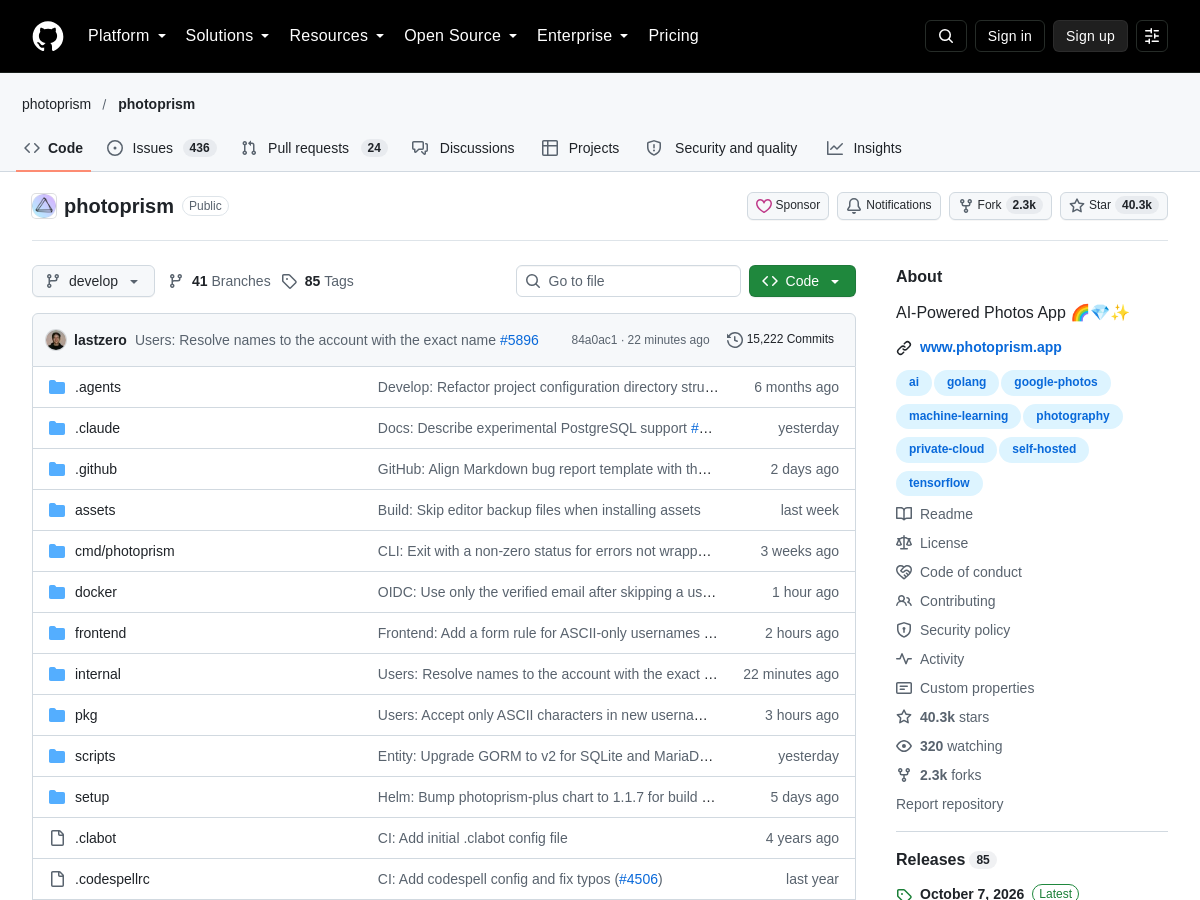
Screenshot of Photoprism
Photoprism
AI/ML Open Source

Photoprism is an AI-powered photos app that allows users to manage and organize their photos in a private cloud. The app is self-hosted, meaning that users have full control over their data and can host it on their own servers. Photoprism uses machine learning algorithms to automatically tag and categorize photos, making it easy to search and find specific images. The app also includes features such as facial recognition, object detection, and photo editing. Photoprism is built using Go and TensorFlow, and is designed to be highly scalable and performant. The app is open-source, which means that users can modify and customize the code to suit their needs. Overall, Photoprism is a powerful and flexible photo management solution that is ideal for users who want to take control of their photo data and have advanced features such as AI-powered tagging and search. The app is constantly being updated and improved by its active community of developers, which ensures that it stays up-to-date with the latest technologies and trends. With its self-hosted architecture and open-source code, Photoprism is a great option for users who value privacy and flexibility. The app's use of machine learning algorithms and AI-powered features makes it a great choice for users who want to get the most out of their photos. Whether you're a professional photographer or just a hobbyist, Photoprism has the features and functionality you need to manage and enjoy your photos. The app's scalability and performance make it suitable for large collections of photos, and its customization options allow users to tailor the app to their specific needs. With Photoprism, you can easily organize, search, and share your photos, and enjoy a range of advanced features that make photo management easier and more enjoyable. The app's private cloud hosting ensures that your photos are safe and secure, and the open-source code means that you can trust that your data is being handled responsibly. Overall, Photoprism is a great choice for anyone looking for a powerful and flexible photo management solution.

Solves

Photoprism solves the problem of managing and organizing large collections of photos. Many users struggle with finding and searching for specific photos, and may not have the time or expertise to manually tag and categorize their images. Photoprism's AI-powered features and self-hosted architecture make it an ideal solution for users who want to take control of their photo data and have advanced features such as automatic tagging and search. By using Photoprism, users can easily find and enjoy their photos, and have peace of mind knowing that their data is safe and secure.

Screenshot of Appsmith
Appsmith
Dev Tools Open Source

Appsmith is an open-source low-code platform that enables developers to rapidly build internal tools, admin panels, and dashboards. It provides a drag-and-drop UI builder, pre-built widgets, and the ability to connect to multiple data sources including databases, APIs, and third-party services. With Appsmith, users can write JavaScript to customize logic, create complex workflows, and deploy applications on their own infrastructure or use the cloud version. The platform supports collaboration features, role-based access control, and version control integration, making it suitable for teams of all sizes.

Solves

Building internal tools and admin panels traditionally requires significant backend and frontend development effort. Appsmith solves this by providing a low-code environment that abstracts away boilerplate, allowing developers to connect to data sources, design UIs visually, and write custom logic in JavaScript where needed. This accelerates the development of operational software, reduces maintenance overhead, and empowers non-developers to create simple tools.

Screenshot of Antigravity Awesome Skills
Antigravity Awesome Skills
AI Agents Open Source

Antigravity Awesome Skills (also known as AAS Core / agentic-awesome-skills) is an open-source, local, agent-first control plane for discovering, selecting, validating, and planning agentic skills across multiple AI coding agents. The repository provides a catalog of over 2,000 agentic skills (cited as 2,005+ in metadata, with earlier references to 1,500+) targeting Claude Code, Cursor, Codex CLI, Gemini CLI, Antigravity, and others, along with specialized plugins, an installer CLI, bundles, workflows, and official integrations. The local MCP server and CLI enable agents to query the catalog, own the selection of relevant skills, validate that selected stacks are compatible with the target environment, and generate plans for multi-step tasks. Workbench tooling supports interactive management, while bundles and workflows accelerate setup for common development stacks. As a GitHub-hosted open source project, it can be installed and run entirely locally, giving teams and individuals control over their agent skill infrastructure without reliance on a hosted service. The repository is actively developed and organized for extensibility, allowing custom plugin development and contribution of new skills.

Solves

It solves the fragmentation of agent-specific skills by providing a unified, locally-controlled catalog and selection tooling, so AI coding agents can reliably discover, compose, and validate skills instead of manually searching and configuring across Claude Code, Cursor, Codex CLI, Gemini CLI, and Antigravity.

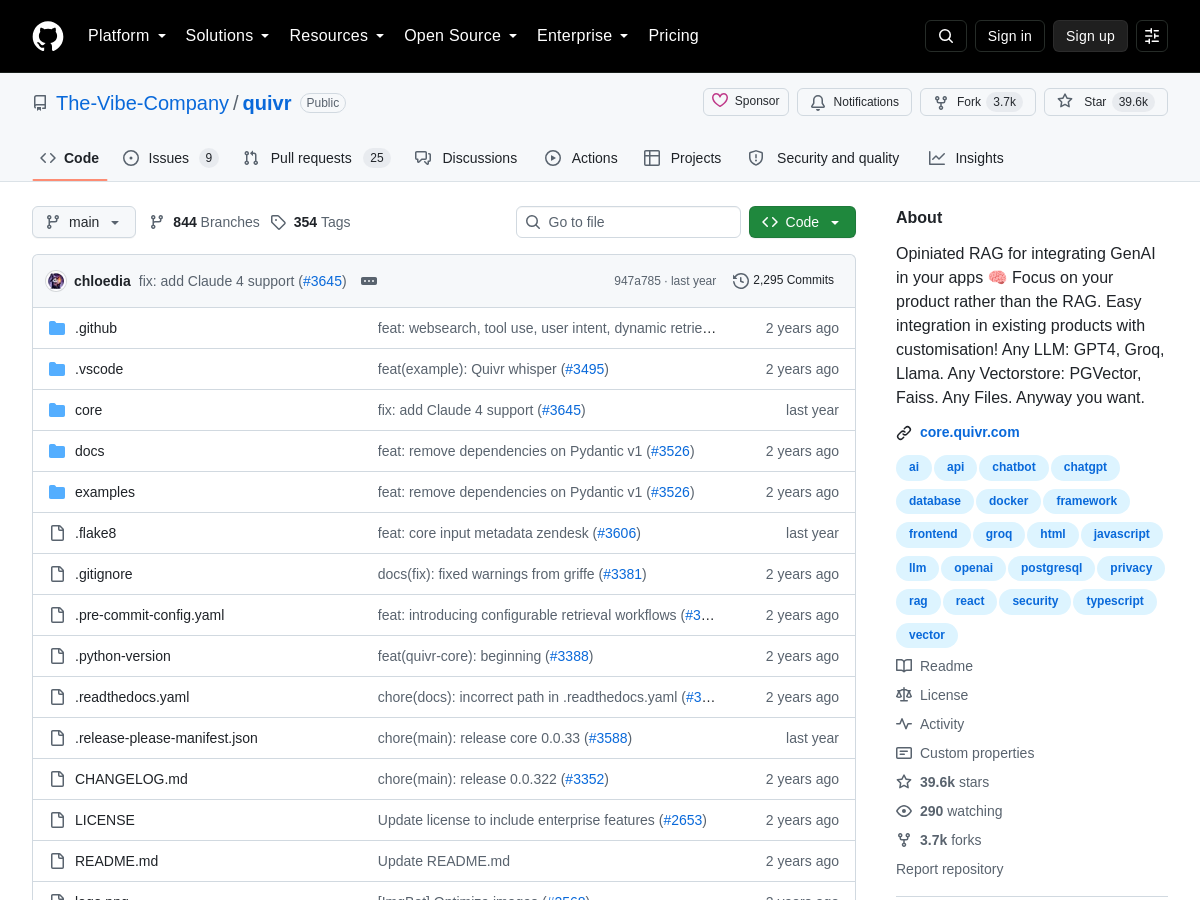
Screenshot of Quivr
Quivr
LLM Open Source

Quivr is an open-source project that provides an opinionated RAG (Retrieval-Augmented Generator) for integrating GenAI in applications. It allows users to focus on their product rather than the RAG, with easy integration in existing products and customization options. Quivr supports any LLM (Large Language Model), including GPT4, Groq, and Llama, and any vector store, such as PGVector and Faiss. The project provides a brain that can be used to ask questions and receive answers, with features like internet search, tool use, and user intent detection. Quivr is designed to be fast and efficient, with a simple installation process and a comprehensive documentation.

Solves

Quivr solves the problem of integrating GenAI in applications by providing a pre-built RAG that can be easily customized and integrated into existing products. This allows developers to focus on their product rather than building a RAG from scratch, saving time and resources. Quivr also provides a flexible and scalable solution that can be used with various LLMs and vector stores, making it a versatile tool for a wide range of applications.

Screenshot of Shellcheck
Shellcheck
Dev Tools Open Source

ShellCheck is a static analysis tool for shell scripts. It is designed to find common mistakes, errors, and potential pitfalls in scripts written for POSIX-compliant shells such as Bash and dash. The tool analyzes scripts without executing them and provides warnings and suggestions to improve correctness, robustness, and portability. ShellCheck can be used as a command-line utility, integrated into editors like Vim, Emacs, and VS Code, or run as part of CI/CD pipelines. It supports a wide range of checks, including syntax errors, quoting issues, unsafe variable expansions, and misuse of shell builtins. The project is open source and actively maintained, with a large community and comprehensive documentation. ShellCheck is written in Haskell and is available for multiple platforms, including Linux, macOS, and Windows. It can be installed via package managers or downloaded as a standalone binary. The tool is widely adopted by developers and system administrators to improve the quality of their shell scripts.

Solves

ShellCheck helps developers avoid common bugs and security vulnerabilities in shell scripts by identifying problematic patterns before the scripts are executed. It reduces debugging time and ensures scripts are portable across different shell environments, making them more reliable and maintainable.

Screenshot of ChatTTS
ChatTTS
LLM Open Source

ChatTTS is an open-source generative speech model optimized for daily dialogue. It is designed to produce natural and expressive speech that mimics human conversation, supporting both English and Chinese. The model incorporates fine-grained control over prosody, allowing users to inject laughter, pauses, and other conversational nuances into generated audio. This makes it particularly suitable for applications requiring lifelike, interactive voice output. The project is hosted on GitHub and can be run locally, providing developers and researchers with a flexible tool for speech synthesis tasks. It includes a Python library for easy integration and supports fine-tuning for specific voices or domains. Unlike traditional TTS engines that often sound robotic, ChatTTS focuses on conversational fluency, making it a valuable resource for building voice-enabled applications.

Solves

Traditional TTS systems often produce monotone or overly formal speech that lacks the natural rhythms of everyday conversation. ChatTTS addresses this by generating dialogue-style speech with appropriate intonation, timing, and emotional expression, enabling more human-like interactions in voice assistants, games, and other conversational AI applications.

Screenshot of Mindshub
Mindshub
AI/ML Open Source

Mindshub is an open-source project by MindsDB that serves as a hub for AI agents, allowing users to delegate complex tasks to autonomous AI assistants. Built on top of the MindsDB ecosystem, it provides a modular framework for creating, sharing, and executing AI-driven workflows. The platform aims to simplify the integration of large language models and other AI tools into everyday business processes, enabling non-technical users to automate tasks without writing code. Mindshub leverages a community-driven approach where developers can contribute custom agents, skills, and connectors, fostering a collaborative environment for building powerful AI applications. Its core philosophy is to handle task delegation from natural language instructions, transforming high-level goals into actionable steps and delivering results seamlessly.

Solves

Modern workflows often require juggling multiple tools and repetitive manual tasks which slow down productivity. Mindshub addresses this by offering a single interface to delegate complex, multi-step tasks to AI agents, automating execution and reducing the need for constant human oversight.

Screenshot of Minds
Minds
Model Serving Open Source

Minds is an open-source model serving platform developed by the MindsDB team that provides a general-purpose AI environment for knowledge workers including creators, strategists, and operators. It enables users to deploy, manage, and control AI models with full flexibility, making advanced AI accessible without deep technical expertise. The platform abstracts complex infrastructure, allowing individuals and teams to focus on integrating AI into their daily workflows. Built with a modular architecture, Minds supports a variety of model types and frameworks, offering both a graphical user interface and a command-line interface for management. It can be deployed on local machines or in cloud environments using Docker, ensuring scalability and easy integration with existing data sources and applications. The system emphasizes user control, giving knowledge workers the ability to tailor AI behavior to specific tasks and maintain data privacy. Key capabilities include model versioning, real-time inference endpoints, batch processing, and monitoring dashboards. Users can connect pre-trained models or build custom ones, then expose them via REST APIs for consumption by other services. Cooperation features allow teams to share models and track usage. The platform is designed with flexibility in mind, supporting popular ML frameworks and providing extensibility through plugins. It aims to lower the barrier for AI adoption within organizations by empowering non-engineers to leverage AI effectively, while still providing the power and configurability required by data scientists and ML engineers.

Solves

Many knowledge workers and creative professionals need to apply AI to their work but lack the technical skills or infrastructure to deploy and control AI models. Existing solutions often require deep ML engineering knowledge or lock users into specific cloud services. Minds solves this by providing an open, self-hosted platform that simplifies model serving, giving full control to users without sacrificing flexibility. It enables strategists, creators, and operators to integrate AI into their tasks, experiment with models, and build AI-powered tools while maintaining ownership and privacy of their data.

Screenshot of Minds Platform
Minds Platform
Model Serving Open Source

Minds Platform is an open-source foundation for applied AI, offering a unified workspace for building, serving, and managing machine learning models. It enables practitioners to deploy open-source models into production with full control over infrastructure and extensibility. The platform provides model serving capabilities, allowing users to expose models as APIs, integrate with existing data sources, and manage the lifecycle of AI applications. It supports deployment anywhere—on-premises, cloud, or edge—and is designed for reliability and scalability. By abstracting away common operational challenges such as scaling, monitoring, and versioning, Minds Platform reduces time-to-production for AI systems. Its open-source nature ensures transparency and community-driven improvements, making it suitable for enterprises and startups seeking to avoid vendor lock-in.

Solves

Minds Platform addresses the difficulty of moving AI models from experimentation to production. It provides a unified, open-source environment that simplifies model serving, integration, and management, allowing teams to deploy and control AI systems without being locked into a single cloud or proprietary service.

Screenshot of It Tools
It Tools
Dev Tools Open Source

IT Tools is an open-source collection of handy online utilities aimed at developers, emphasizing a clean and modern user experience. It consolidates a wide range of frequently needed tools—such as converters, encoders, formatters, and generators—into a single, easy-to-use web application. The project is built with Vue.js and TypeScript, offering a responsive interface with dark mode and keyboard shortcuts. It can be accessed through a public instance at it-tools.tech or self-hosted on your own infrastructure using Docker or static file hosting, giving users full control over their data and privacy. As an open-source project under the MIT license, IT Tools encourages community contributions and is actively maintained. Its modular architecture makes it easy to extend with new tools, and it has gained popularity among developers for its convenience and aesthetic appeal.

Solves

IT Tools addresses the need for quick, reliable, and ad-free access to common developer utilities without installing multiple desktop applications or visiting cluttered websites. It provides a centralized, privacy-friendly solution that works entirely in the browser and can be self-hosted for enhanced security.

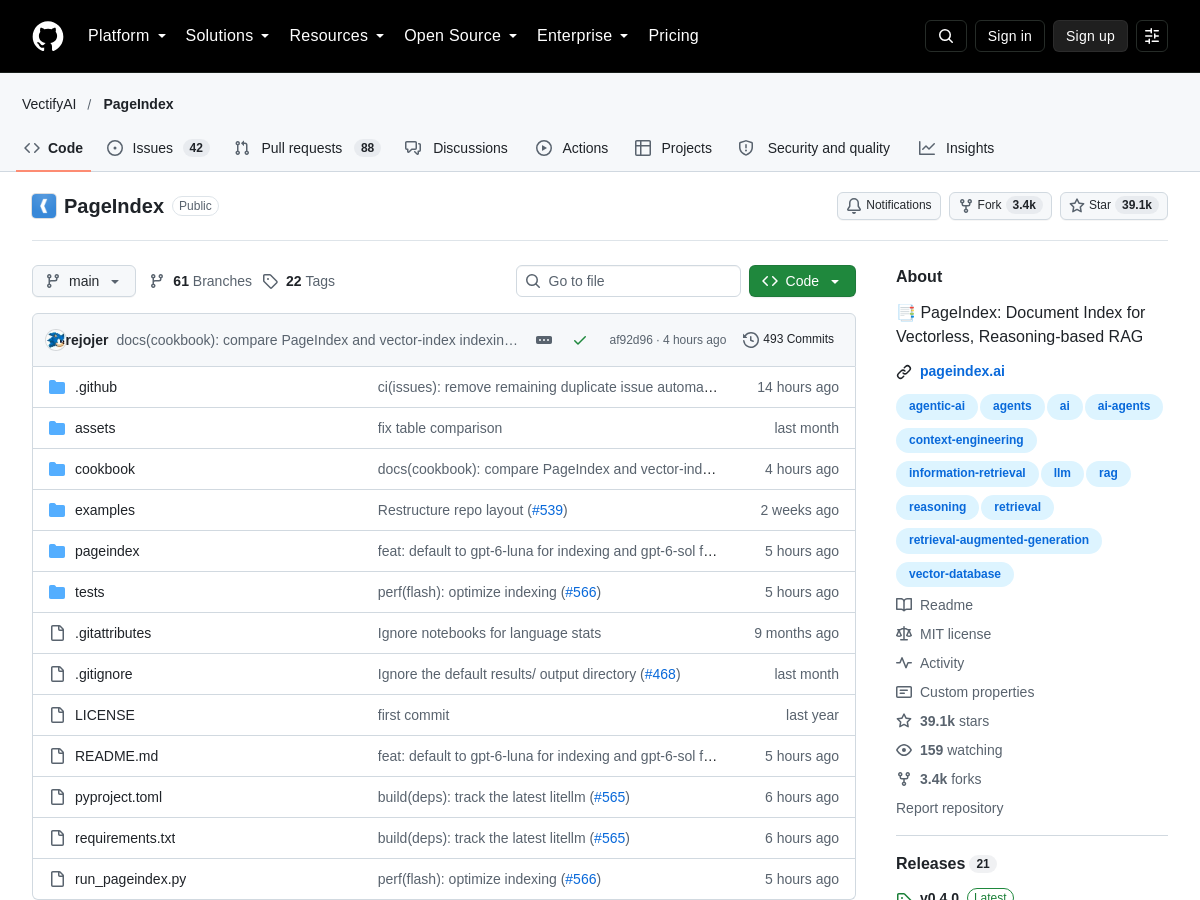
Screenshot of PageIndex
PageIndex
AI Agents Open Source

PageIndex is a vectorless, reasoning-based RAG engine that mirrors how humans read, delivering traceable, explainable, and context-aware retrieval, with no vector DBs or chunking. It replaces the vector index with a hierarchical tree index and lets an LLM reason its way through it, the way a human expert turns to and reads the right section of a long report. The engine is designed for long and complex professional documents, such as financial reports, legal documents, regulatory filings, technical manuals, medical literature, and academic textbooks. PageIndex provides a Python SDK for local and cloud-based document indexing and retrieval, with support for various LLM models and compatibility with the OpenAI Agents SDK and other frameworks.

Solves

PageIndex solves the problem of inaccurate retrieval in long and complex documents, where vector-based RAG methods often fail to provide relevant results due to their reliance on semantic similarity rather than relevance. By using a hierarchical tree index and LLM reasoning, PageIndex provides a more accurate and context-aware retrieval method, allowing users to efficiently search and retrieve information from large documents.

Screenshot of Yazi
Yazi
Dev Tools Open Source

Yazi is a terminal file manager written in Rust, designed for speed and efficiency by leveraging asynchronous I/O. It provides a modern, keyboard-driven interface for navigating and managing files directly from the command line. Yazi supports file previews, including images and text, and aims to be highly extensible through a Lua-based plugin system. Its performance-oriented architecture allows it to handle large directories and file operations without blocking the terminal. Yazi is cross-platform, running on Linux, macOS, and Windows, and integrates with common terminal multiplexers and shells. It is distributed as an open-source project under the MIT license and is actively developed on GitHub, with a growing ecosystem of plugins and themes contributed by the community.

Solves

Yazi solves the need for fast, efficient file management within a terminal environment without sacrificing functionality. Traditional file managers can be slow or lack extensibility, while existing terminal file managers may struggle with large directories or modern preview features. Yazi addresses these issues by offering asynchronous I/O, responsive UI, and plugin-based customization.

Screenshot of Novu
Novu
AI Agents Open Source

Novu is an open-source notification infrastructure designed to simplify the way developers build and manage notifications across multiple channels. It provides a unified API for sending email, SMS, push, chat, and in-app messages, abstracting away the complexity of integrating with different providers. With features like a visual workflow builder, template management, and user preference settings, Novu enables teams to create sophisticated notification flows without writing extensive code. Built with a modular architecture, Novu supports a wide range of providers through a single interface, allowing users to switch or combine services like SendGrid, Twilio, Firebase, and Slack seamlessly. The platform also includes a headless API, SDKs for popular languages, and a self-hosted option, making it suitable for both startups and enterprises that require data privacy and control. Its event-driven design ensures that notifications are triggered in real-time based on user actions or system events. Recently, Novu has expanded its vision to become the communication infrastructure for agents and products, addressing the growing need for AI agents to communicate with users across various touchpoints. This includes features for agent-to-human communication, multi-step messaging sequences, and integration with AI orchestration tools. The project has a vibrant open-source community and is actively maintained on GitHub, with regular updates and a clear roadmap.

Solves

Novu solves the problem of fragmented notification systems by providing a centralized, provider-agnostic platform. Developers no longer need to write custom integration code for each messaging channel; instead, they define notification workflows once and let Novu handle delivery, user preferences, and channel fallbacks. This reduces development time, minimizes errors, and ensures a consistent user experience across all communication channels.

Screenshot of Devdocs
Devdocs
Dev Tools Open Source

DevDocs is an open-source API documentation browser that consolidates documentation from multiple programming languages, frameworks, and libraries into a single, fast, searchable interface. It provides offline access to documentation, enabling developers to browse API references without an internet connection. The project is maintained by freeCodeCamp and is available both as a hosted service at devdocs.io and as a self-hosted application. It includes features like instant fuzzy search, keyboard navigation, dark mode, and the ability to customize the documentation set by enabling or disabling specific docs. DevDocs uses a scraper architecture to fetch and parse documentation from original sources, then serves them in a unified format. It supports a wide range of technologies including JavaScript, Python, Ruby, Go, and many others.

Solves

DevDocs solves the problem of fragmented and slow documentation lookup by aggregating multiple API references into one fast, offline-capable interface with powerful search, saving developers time and context switching.

Screenshot of BigIdeasDB
BigIdeasDB
Startup ideas Unknown

BigIdeasDB is an AI-powered tool designed to assist users in finding, validating, and building a winning product. The platform utilizes artificial intelligence to provide users with innovative startup ideas, helping them to identify potential opportunities and turn them into successful products. With BigIdeasDB, users can access a vast database of ideas, filter and validate them based on various criteria, and gain valuable insights to inform their product development decisions. The tool aims to streamline the product development process, reducing the time and effort required to find and validate ideas. By leveraging AI-powered tools, BigIdeasDB enables users to focus on building and refining their products, rather than spending countless hours researching and brainstorming ideas. The platform's goal is to empower users to create successful products that meet the needs of their target audience, and to provide them with the necessary tools and resources to achieve their goals. BigIdeasDB's AI-powered approach allows for a more efficient and effective product development process, enabling users to bring their ideas to life and turn them into winning products. The tool's features and capabilities are designed to support users throughout the entire product development journey, from idea generation to launch and beyond. By providing users with access to a vast database of ideas, BigIdeasDB helps to stimulate creativity and innovation, and enables users to stay ahead of the curve in today's fast-paced and competitive startup landscape. With its user-friendly interface and robust features, BigIdeasDB is an ideal solution for entrepreneurs, startups, and businesses looking to develop innovative and successful products. The platform's AI-powered tools and resources are designed to help users navigate the complex and often challenging process of product development, and to provide them with the support and guidance they need to achieve their goals. Overall, BigIdeasDB is a powerful tool that has the potential to revolutionize the way we approach product development, and to empower users to create innovative and successful products that meet the needs of their target audience.

Solves

Entrepreneurs and startups often struggle to find and validate innovative ideas for their products, which can lead to wasted time and resources on unsuccessful projects. BigIdeasDB solves this problem by providing users with a vast database of AI-powered startup ideas, helping them to identify potential opportunities and turn them into successful products. By leveraging BigIdeasDB, users can reduce the time and effort required to find and validate ideas, and focus on building and refining their products. This enables them to bring their ideas to life and turn them into winning products, increasing their chances of success in the competitive startup landscape.

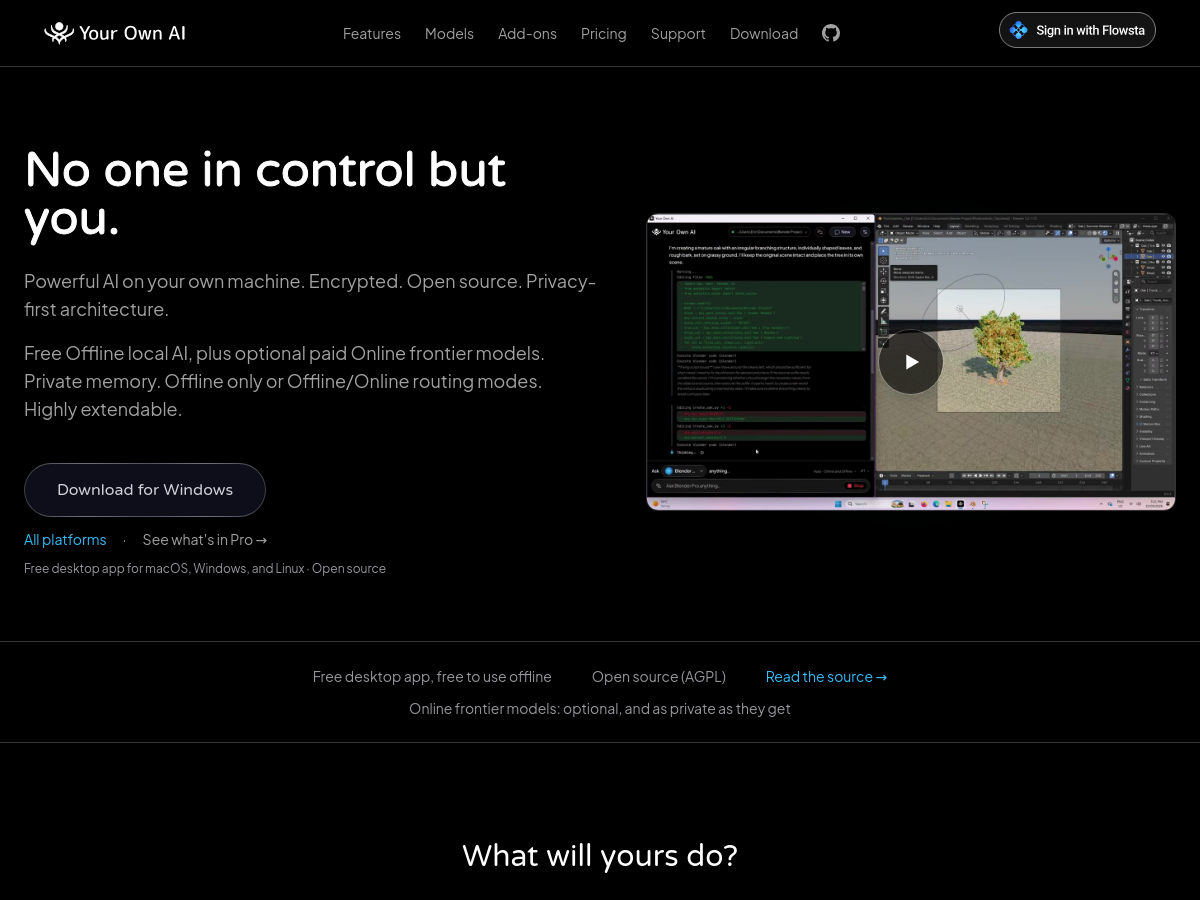
Screenshot of Your Own AI
Your Own AI
Private ChatGPT Free

Your Own AI is a free, open-source desktop application for macOS, Windows, and Linux that runs AI models locally on your machine. It provides a private, offline-capable AI assistant with optional online frontier models. The application emphasizes privacy-first architecture, ensuring that conversations and data do not leave your device unless you explicitly choose to send them online. It includes features such as private memory, character creation, document interaction, and an OpenAI-compatible endpoint for integration with other tools. The app is licensed under AGPL and is designed to be highly extendable. It supports both offline-only and offline/online routing modes, allowing users to balance local privacy with access to frontier models when needed. Online models are accessed through Flowsta's relay, which strips identity and does not store messages. The application also provides cryptographically signed conversation records for verifiability. Your Own AI targets users who require strict data control, such as those handling sensitive documents, health information, or proprietary code. It also caters to developers and researchers who want to run AI models locally and integrate them into their workflows via an OpenAI-compatible API. The free tier is fully functional offline, with paid plans offering online frontier models and live web search.

Solves

Privacy-conscious users and organizations struggle to use powerful AI assistants without exposing sensitive data to third-party cloud services. Your Own AI solves this by running AI models locally on the user's own hardware, ensuring that conversations, documents, and memories remain private and under user control. It eliminates reliance on external servers for everyday tasks while offering optional, privacy-preserving access to frontier models when needed.

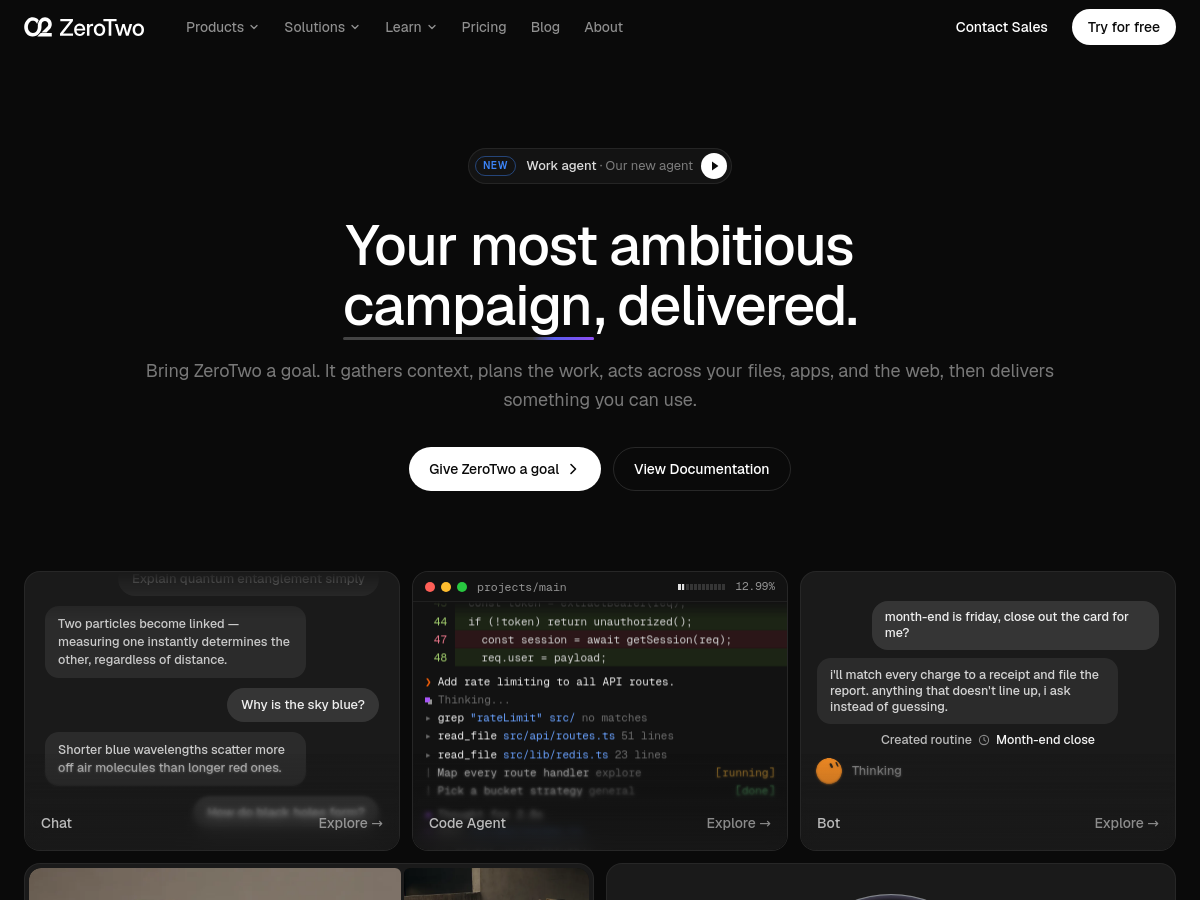
Screenshot of ZeroTwo
ZeroTwo
Productivity Free

ZeroTwo is an AI agent platform marketed as 'Go Beyond Answers' and positioned as a ChatGPT alternative for real-world work. Instead of merely returning chat responses, the service claims users can give it a goal, and it gathers context, plans the work, acts across files, apps, and the web, then delivers usable outputs. The homepage highlights specialized agents for chat, coding, and image and voice generation, and demonstrates generation of documents, spreadsheets, PDFs, and presentations. The platform includes a code agent that can inspect and edit source files for tasks like migrating authentication systems or adding rate limiting, as well as a ThinkingBot that handles scheduled workflows, such as preparing a month-end expense report by matching charges to receipts. It also offers general chat and exploration modes and appears designed for individuals and teams who want autonomous assistance beyond simple Q&A. ZeroTwo lists a free pricing tier and a signup flow. While the marketing language is ambitious, specific technical details about models and infrastructure are not fully disclosed on the homepage. Users can try the product directly through the website or consult its documentation for more granular capabilities and limitations.

Solves

ZeroTwo aims to reduce the gap between AI conversation and actual task completion by providing an agent that can autonomously plan and execute multi-step work across web, files, and applications, resulting in final deliverables rather than only textual answers.

Screenshot of Google Research
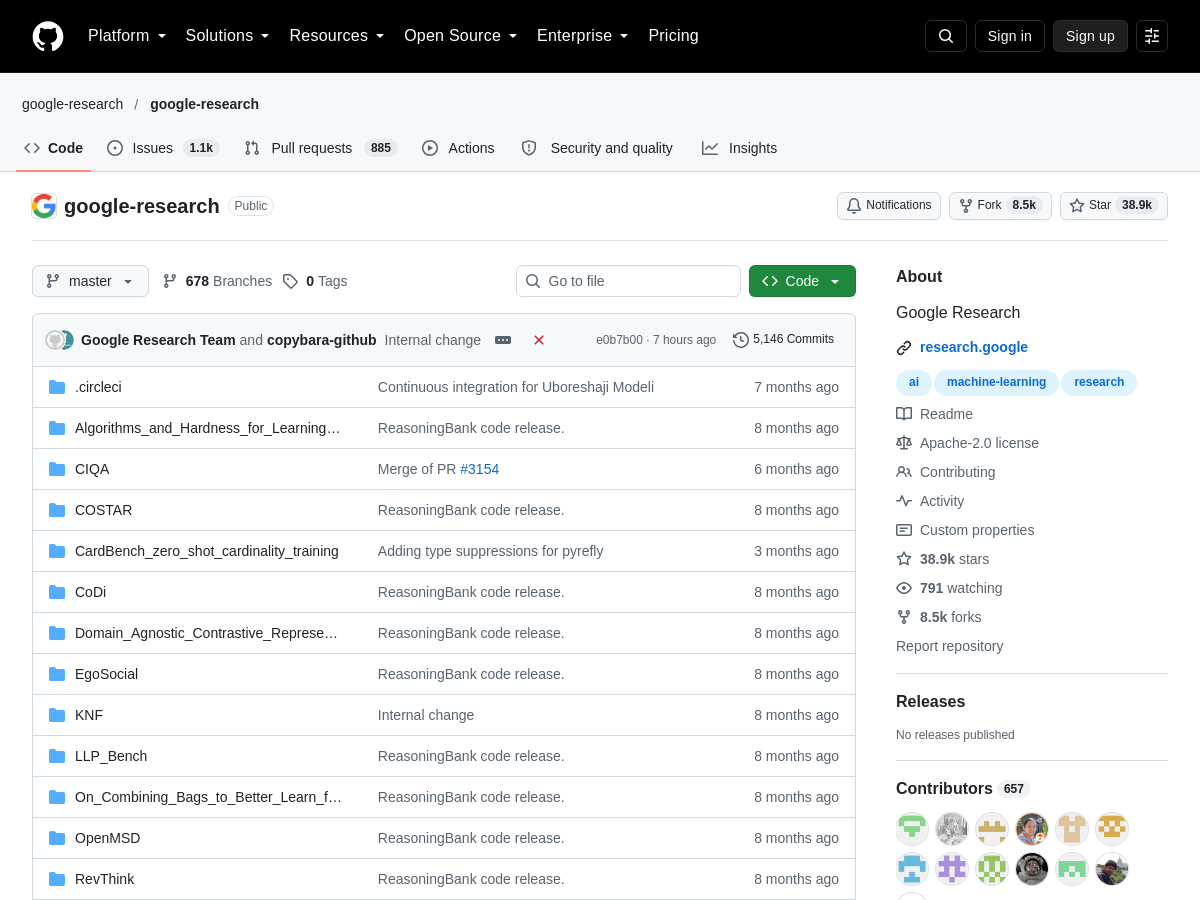
Google Research
Search Open Source

Google Research is an open-source repository that contains code released by Google Research. The repository includes a wide range of projects and datasets, all of which are released under open-source licenses. The datasets are released under the CC BY 4.0 International license, while the source files are released under the Apache 2.0 license. The repository is large, and users are recommended to download only the subdirectory of interest. The repository includes projects such as Algorithms and Hardness for Learning Linear Thresholds from Label Proportions, CIQA, COSTAR, and many others. The repository is updated regularly, with the latest update being in 2023. The code in the repository is intended to be used for research purposes, and users are encouraged to submit pull requests to contribute to the projects. Overall, Google Research is a valuable resource for researchers and developers looking to explore and contribute to open-source projects in the field of artificial intelligence and machine learning.

Solves

Google Research solves the problem of providing a centralized repository for open-source code and datasets in the field of artificial intelligence and machine learning. By making this code and data available, Google Research enables researchers and developers to build upon existing work and accelerate the development of new technologies. This repository is particularly useful for researchers who are looking for open-source implementations of various algorithms and techniques, as well as for developers who are looking to integrate these technologies into their own projects.

Screenshot of Lapce
Lapce
Dev Tools Open Source

Lapce is a lightning-fast, powerful code editor built from the ground up in Rust. It aims to deliver a snappy, responsive editing experience even when working with large files and complex projects. The editor features a modern, GPU-accelerated user interface that feels native on Windows, macOS, and Linux. It includes standard developer amenities such as syntax highlighting, code completion, and support for multiple cursors, along with deeper integrations like Language Server Protocol (LSP) for intelligent language features. An extension system is planned or nascent, allowing users to customize and enhance functionality. As an open-source project, Lapce invites community contributions and promises a transparent development process. The tool positions itself as a competitor to established code editors by emphasizing raw performance and a clean, distraction-free workflow.

Solves

Many code editors suffer from latency, high memory usage, and sluggishness when dealing with large codebases or performing real-time operations like linting and completion. Lapce addresses this by leveraging Rust's performance and safety to create an editor that remains fast and fluid under load, catering to developers who value responsiveness and efficiency without sacrificing modern features.

Screenshot of Ai Engineering Hub
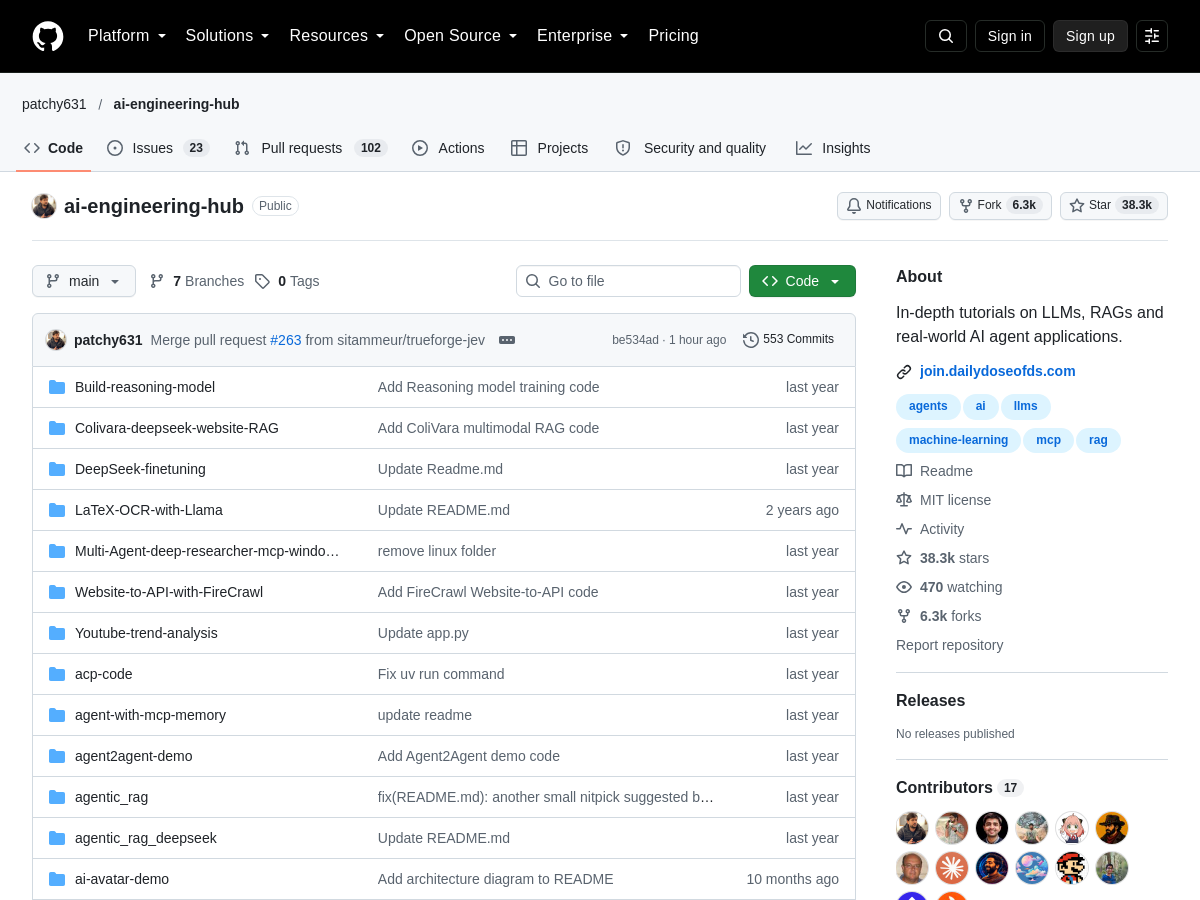
Ai Engineering Hub
LLM Open Source

The AI Engineering Hub is a comprehensive resource for learning and building with AI. It provides in-depth tutorials on LLMs, RAGs, and real-world AI agent applications, as well as 93+ production-ready projects across all skill levels. The hub is designed to help beginners, practitioners, and researchers experiment and succeed in AI engineering. It covers a wide range of topics, including OCR, chat interfaces, basic RAG, multimodal and media, and advanced RAG. The hub also includes a variety of tools and resources, such as the AI Engineering Roadmap, which provides a comprehensive learning path for AI engineering. Additionally, the hub offers a range of projects, including beginner, intermediate, and advanced projects, that allow users to practice and apply their skills. The AI Engineering Hub is licensed under the MIT License and is open to contributions from the community.

Solves

The AI Engineering Hub solves the problem of providing a comprehensive and accessible resource for learning and building with AI. It addresses the needs of beginners, practitioners, and researchers who want to experiment and succeed in AI engineering, but may not have the necessary resources or expertise. By providing in-depth tutorials, production-ready projects, and a range of tools and resources, the AI Engineering Hub helps to bridge the gap between theory and practice in AI engineering.

Screenshot of AdMake AI
AdMake AI
Ads Unknown

AdMakeAI is an AI-powered ad generator designed for small businesses and e-commerce brands. It allows users to input their brand information, product photos, and website URL to automatically generate a steady stream of high-quality ads suitable for platforms like Meta, TikTok, Pinterest, and Shopify. The platform aims to help small businesses compete with larger brands by enabling them to produce a high volume of ad creatives without needing an in-house creative team or agency. The tool also includes a competitor ad spying feature, allowing users to analyze ads from other brands for inspiration and strategy. According to the homepage, AdMakeAI has generated over 19,400 ads in a month and offers a free tier with 24 credits, with paid plans starting at $39 per month. The service focuses on simplifying ad creation for non-designers.

Solves

Small businesses and e-commerce brands often struggle to produce enough ad creatives to compete with larger competitors who have dedicated creative teams. This leads to lower ad performance and reduced market visibility. AdMakeAI solves this by automating the generation of high-quality ads from simple inputs, enabling businesses to increase their ad volume and quality without hiring designers or agencies.

Screenshot of Coursera ML AndrewNg Notes

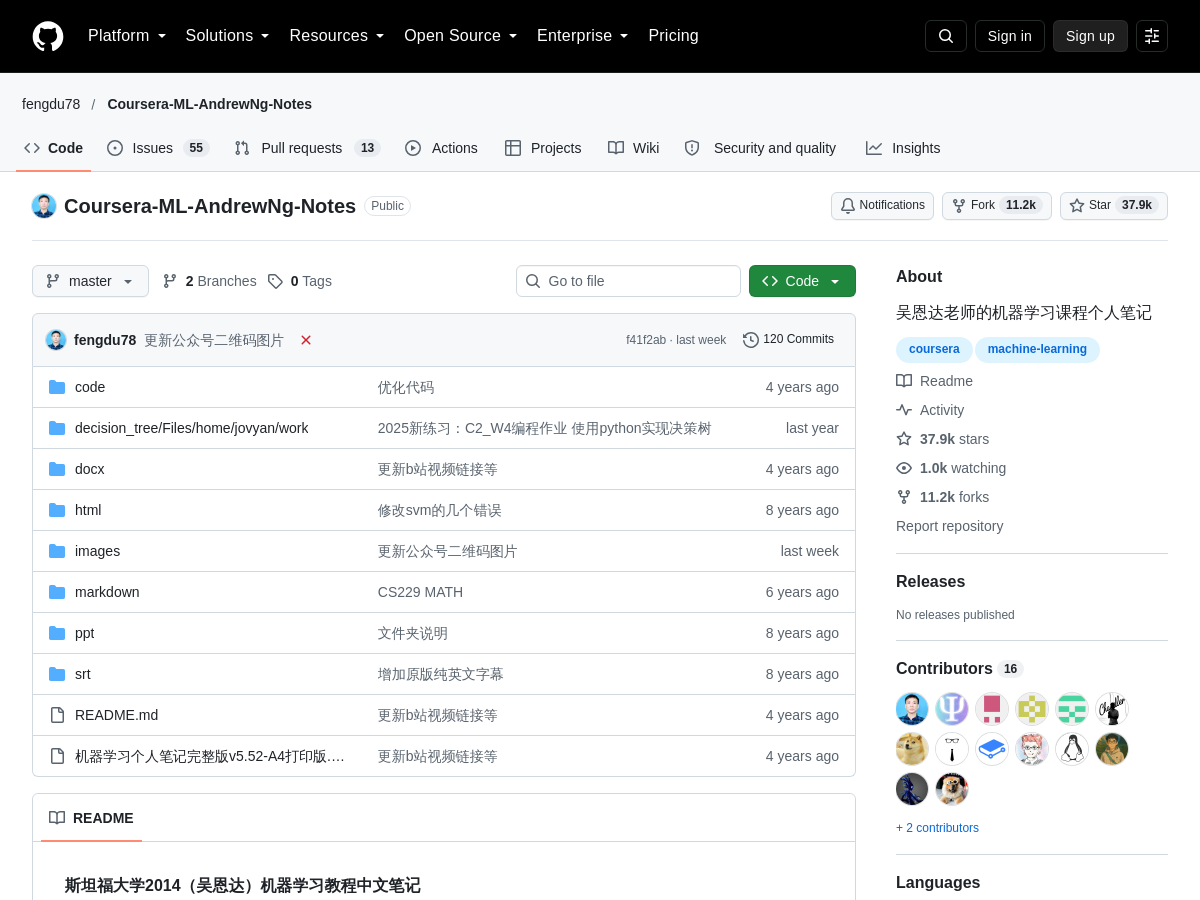
Coursera ML AndrewNg Notes is an open-source project that provides personal notes for Andrew Ng's Machine Learning course on Coursera. The project contains a comprehensive set of notes, including code, markdown files, and HTML files, that cover various topics in machine learning, such as supervised and unsupervised learning, linear regression, logistic regression, neural networks, and more. The notes are written in Chinese and are available for free on GitHub. The project also includes a repository of resources, including links to the original course materials, videos, and other relevant resources. The notes are well-organized and easy to follow, making it a valuable resource for anyone interested in learning machine learning.
Solves

The problem that Coursera ML AndrewNg Notes solves is providing a comprehensive and accessible set of notes for Andrew Ng's Machine Learning course, which can be challenging for some students to follow. The notes are particularly useful for Chinese-speaking students who may struggle with the English-language course materials. By providing a detailed and well-organized set of notes, the project helps students to better understand the course materials and complete the course successfully.

Screenshot of Khoj
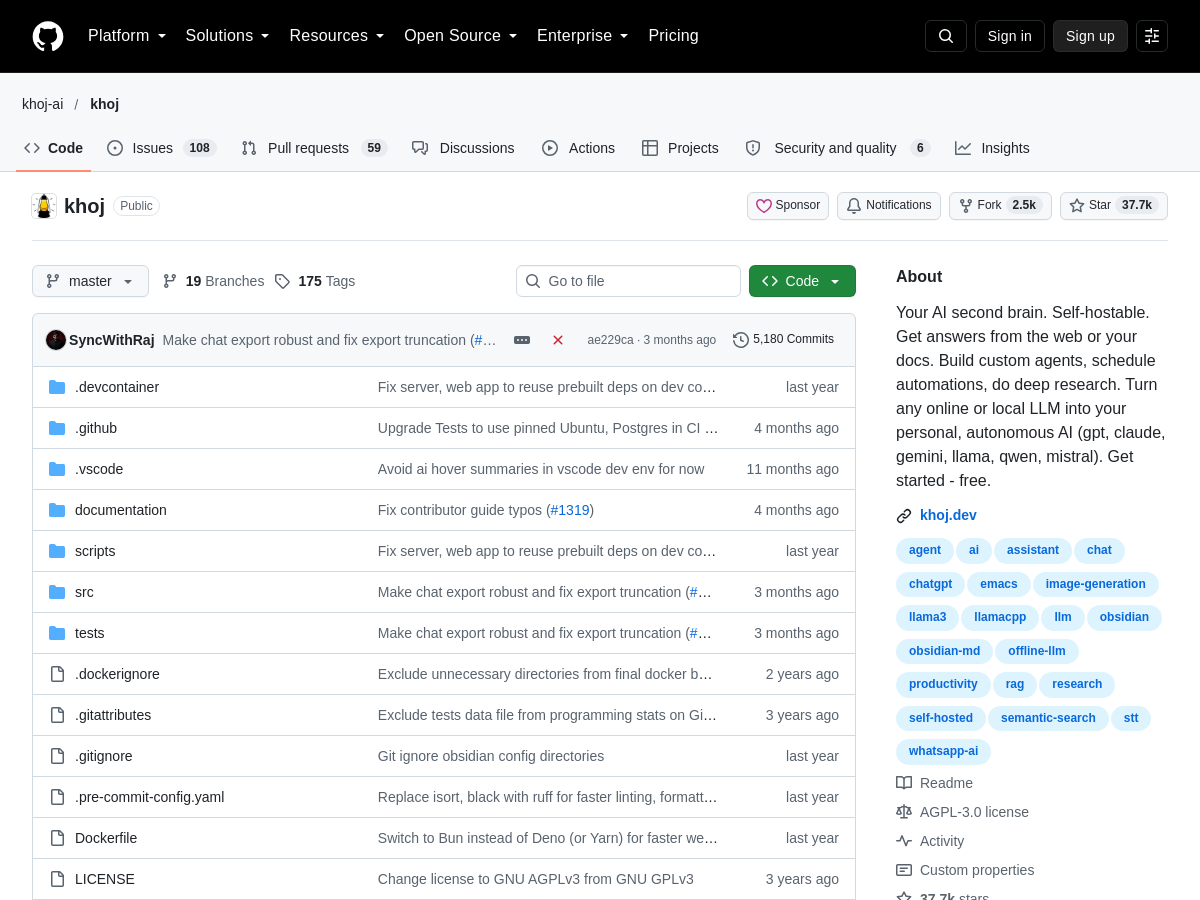
Khoj
Image Gen Open Source

Khoj is a personal AI app designed to extend users' capabilities by providing a range of features such as chatting with local or online LLMs, getting answers from the internet and personal documents, creating custom agents, automating repetitive research, and generating images. It can be accessed from various platforms including browsers, Obsidian, Emacs, desktop, phone, or Whatsapp. Khoj is open-source and self-hostable, allowing users to run it privately on their computer or try it on the cloud app. The app supports a wide variety of document types, including PDFs, Markdown, Notion, Word docs, and org-mode files. Users can create their own custom agents with specific knowledge, persona, chat model, and tools, and automate tasks such as research and newsletter delivery. Khoj also features advanced semantic search, allowing users to quickly find relevant documents. The app is available as a cloud service, on-premises, or as a hybrid solution, and has a community-driven development process with contributors welcome to join and help improve the tool.

Solves

Khoj solves the problem of information overload and difficulty in finding relevant information by providing a personal AI assistant that can help users find answers, automate tasks, and generate content. It also addresses the issue of limited access to AI technology by making it self-hostable and open-source, allowing users to run it on their own devices. Additionally, Khoj helps users to boost their productivity by automating repetitive research and providing smart notifications.

Screenshot of AnyAPI
AnyAPI
Dev Tools Unknown

AnyAPI is described as a unified API that gives developers access to more than 400 AI models through a single integration. Instead of managing separate provider SDKs, authentication flows, and request formats, teams can call one endpoint and route requests to supported models. This can simplify building applications that use language, vision, audio, and other AI capabilities without committing to a single vendor. The service is positioned for developer teams that need flexibility across model providers, whether for experimentation, cost optimization, or fallback routing. Because pricing is listed as unknown and no public GitHub repository is available in this listing, specific technical details such as available SDKs, rate limits, and supported providers cannot be independently verified from the provided information.

Solves

AnyAPI reduces the friction of integrating many AI models by offering a single API abstraction over 400+ models, so developers can avoid vendor lock-in and write provider-agnostic code.

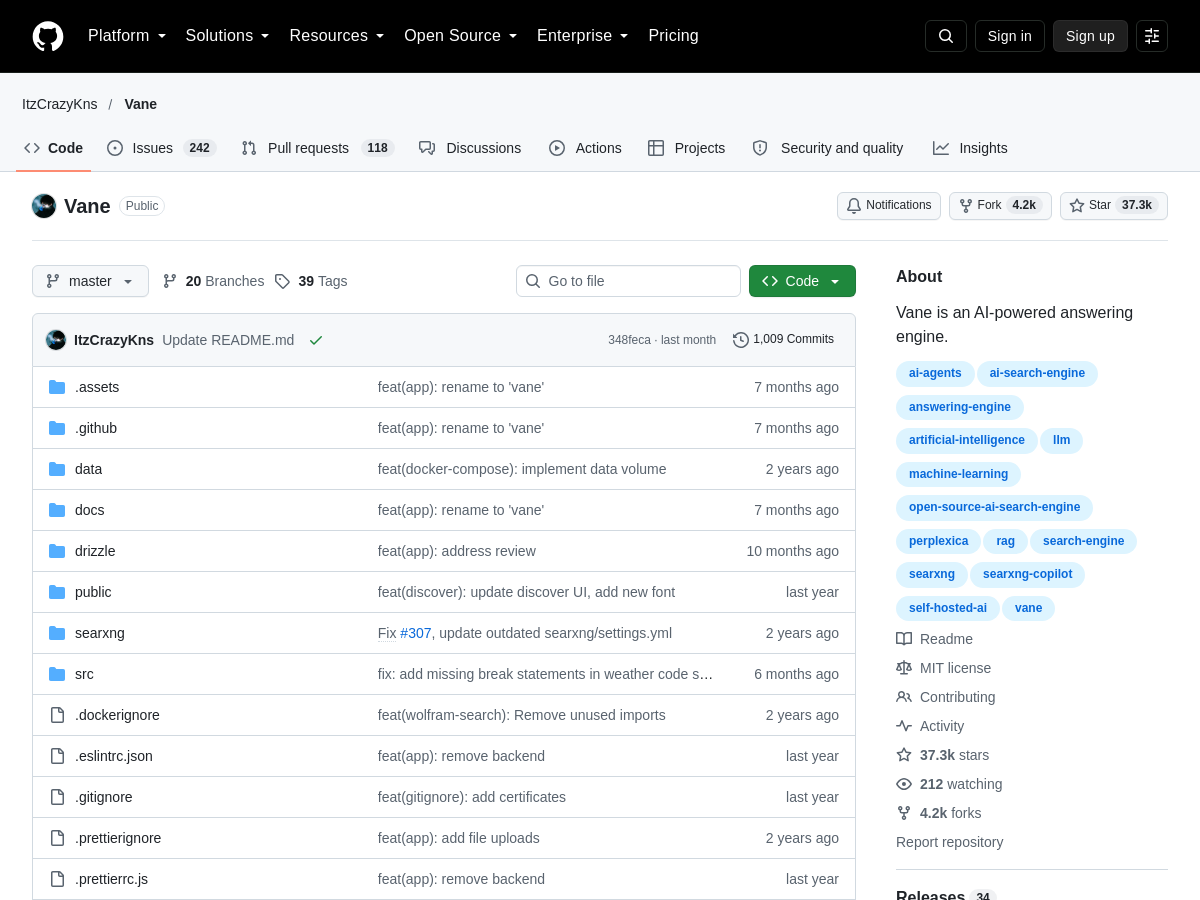
Screenshot of Vane
Vane
AI Agents Open Source

Vane is an AI-powered answering engine that runs entirely on the user's own hardware, providing a privacy-focused solution for searching the internet. It combines knowledge from the internet with support for local LLMs (Ollama) and cloud providers (OpenAI, Claude, Groq), delivering accurate answers with cited sources while keeping searches completely private. The tool offers various features such as support for all major AI providers, smart search modes, the ability to pick sources, widgets for quick lookups, web search powered by SearxNG, image and video search, file uploads, search specific domains, smart suggestions, discover, and search history. Vane can be easily installed using Docker or without Docker, and it provides an API for developers to integrate its powerful search engine into their own applications.

Solves

Vane solves the problem of privacy concerns associated with traditional search engines by providing a self-hosted, AI-powered answering engine that keeps searches completely private. It also addresses the issue of limited control over search results by allowing users to pick their sources, use local LLMs, and configure their settings. Additionally, Vane helps users to find accurate answers with cited sources, making it a reliable tool for research and information gathering.

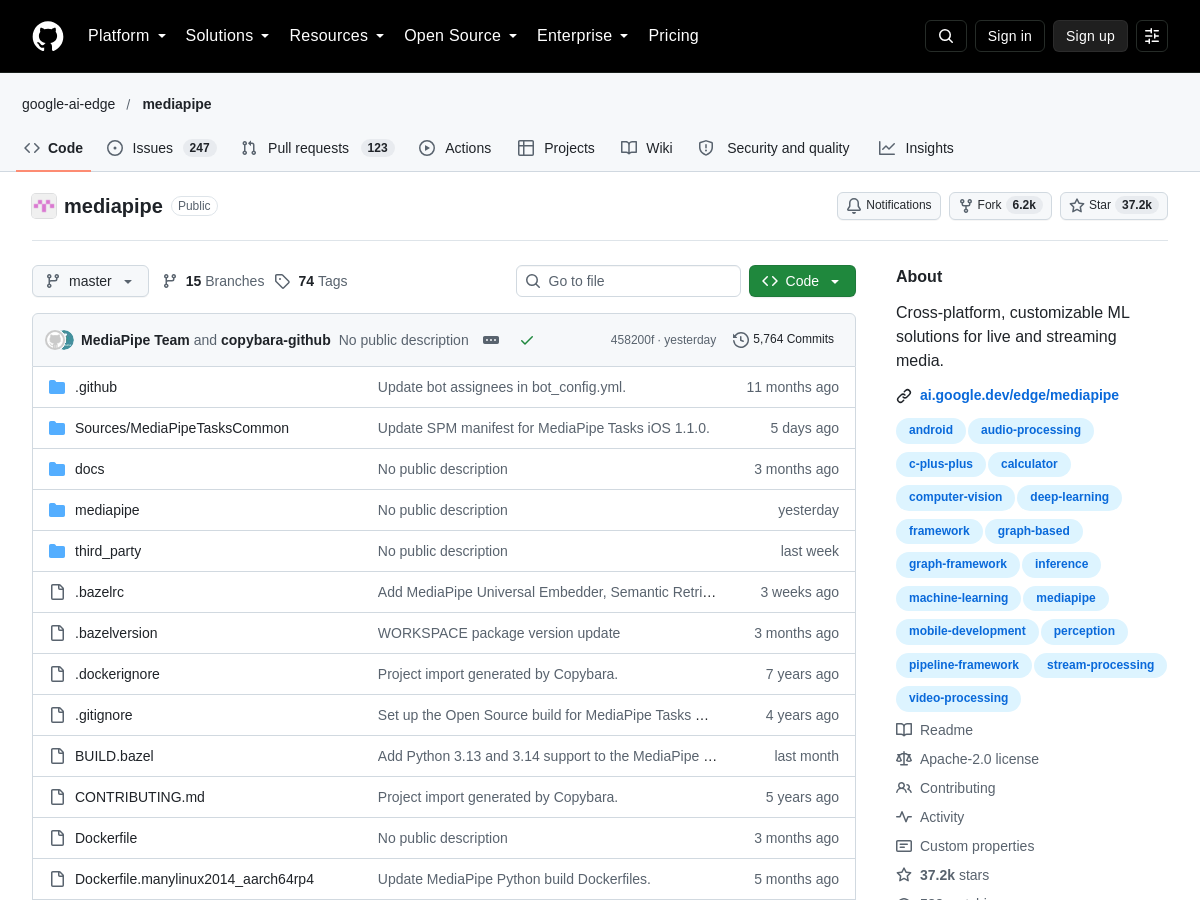
Screenshot of Mediapipe
Mediapipe
Dev Tools Open Source

Mediapipe is a cross-platform, customizable ML solution for live and streaming media. It provides a framework for building machine learning pipelines and has a wide range of applications, including computer vision, audio processing, and mobile development. Mediapipe is designed to be highly customizable, allowing developers to create tailored solutions for their specific use cases. The project is open-source and has a large community of contributors, ensuring that it is constantly evolving and improving. Mediapipe supports a variety of platforms, including Android, iOS, and Linux, making it a versatile tool for developers. The project also has a strong focus on performance, with optimized builds for different architectures and platforms. Overall, Mediapipe is a powerful tool for building machine learning applications, particularly those involving media processing. It has a wide range of features, including support for various media formats, real-time processing, and customizable pipelines. Mediapipe is also highly extensible, with a large collection of pre-built components and a robust API for building custom components. With its strong community support and constant updates, Mediapipe is an ideal choice for developers looking to build innovative media processing applications. Mediapipe's architecture is designed to be modular and scalable, allowing developers to easily integrate new components and features into their applications. The project also has a strong focus on testing and validation, ensuring that the code is reliable and stable. Additionally, Mediapipe has a wide range of tools and resources available, including documentation, tutorials, and example code, making it easy for developers to get started and build their own applications.

Solves

Mediapipe solves the problem of building and deploying machine learning models for media processing applications. Many developers struggle with building and optimizing machine learning pipelines, particularly for real-time media processing. Mediapipe provides a pre-built framework and a wide range of customizable components, making it easy for developers to build and deploy their own machine learning models. This saves developers a significant amount of time and resources, as they do not have to build everything from scratch. Additionally, Mediapipe's focus on performance and optimization ensures that the resulting applications are fast and efficient, providing a high-quality user experience.

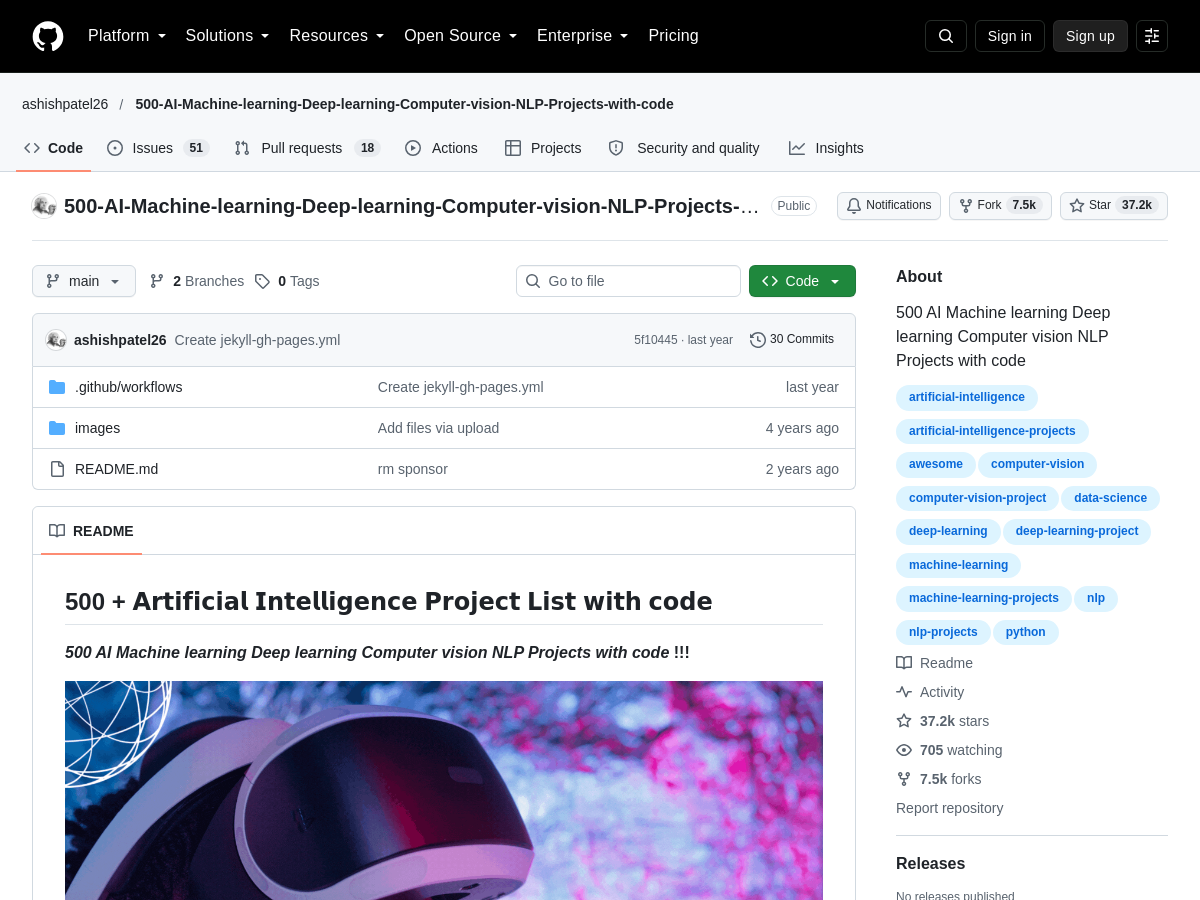
Screenshot of 500 AI Machine Learning Deep Learning Computer Vision NLP Projects With Code

The 500 AI Machine Learning Deep Learning Computer Vision NLP Projects with Code repository is a collection of projects and resources related to artificial intelligence, machine learning, deep learning, computer vision, and natural language processing. The repository contains a list of over 500 projects, each with a link to the project's code and description. The projects cover a wide range of topics, including computer vision, NLP, and machine learning. The repository is continuously updated with new projects and resources. The repository also includes a list of resources for learning computer vision, NLP, and machine learning, including courses, tutorials, and books. The repository is a valuable resource for anyone interested in AI, machine learning, and data science. It provides a comprehensive list of projects and resources that can be used to learn and practice AI and machine learning concepts. The repository is also a great way to stay up-to-date with the latest developments in the field of AI and machine learning. The projects and resources in the repository are well-organized and easy to access, making it a great resource for both beginners and experienced practitioners. Overall, the 500 AI Machine Learning Deep Learning Computer Vision NLP Projects with Code repository is a valuable resource for anyone interested in AI, machine learning, and data science.

Solves

The problem of finding and accessing high-quality projects and resources for learning and practicing AI, machine learning, and data science is solved by this repository. It provides a comprehensive list of projects and resources that can be used to learn and practice AI and machine learning concepts, making it easier for individuals to get started with AI and machine learning. The repository also helps to stay up-to-date with the latest developments in the field of AI and machine learning, which is a significant problem for many practitioners.

Screenshot of CodeWhale
CodeWhale
LLM Open Source

CodeWhale is an open-source, community-driven agent harness that provides a coding agent directly in the terminal. It integrates the DeepSeek and MiMo language models to deliver AI-assisted coding capabilities from the command line. The project is hosted on GitHub and encourages community contributions and customization. As a terminal-based tool, CodeWhale aims to streamline developer workflows by enabling natural language interaction with code, generating snippets, and assisting with analysis and refactoring without leaving the shell environment.

Solves

CodeWhale solves the problem of accessing AI coding assistance without disrupting the terminal-centric workflow of developers. It provides a lightweight harness to leverage large language models for code generation, explanation, and debugging directly from the command line.

Screenshot of Kick
Kick
Accounting Free

Kick is a self-driving bookkeeping platform designed for modern entrepreneurs and accountants. It acts as an agentic ledger that automatically categorizes business transactions in real time, surfaces commonly missed deductions such as home office, vehicle, and travel expenses, and lets users customize rules to fit their business. The platform provides revenue insights, spending monitoring, and supports unlimited entities, allowing users to track all accounts and businesses in one place. Kick includes accounting features such as a general ledger, multi-entity journal entries, tax-ready profit and loss statements, and balance sheets that can be shared with an accountant. The product is free to use and is used by over 5,000 business owners and accountants according to its homepage. Kick has raised $20 million to build the future of accounting.

Solves

Kick eliminates manual bookkeeping by automating transaction categorization, deduction discovery, and financial reporting. This saves business owners and accountants time, reduces errors, and ensures financial records are tax-ready without the need for traditional bookkeeping services.

Screenshot of MockingBird
MockingBird
Voice & Audio Open Source

MockingBird is an open-source voice cloning tool that enables users to clone any voice from as little as 5 seconds of audio and generate arbitrary speech in real-time. Built with deep learning, the system allows for highly realistic synthesized speech that mimics a target speaker's timbre, tone, and inflections. The project provides a complete pipeline including a pre-trained encoder for speaker embedding extraction, a synthesizer that generates mel-spectrograms from text, and a vocoder to convert spectrograms into audio waveforms. The tool supports both quick voice cloning from short samples and more accurate cloning through fine-tuning on user-provided datasets. It features a modular architecture with separate components for models, control logic, and data handling, making it extensible and customizable. A web interface (using web.py) and Docker support facilitate ease of use and deployment. The project is implemented primarily in Python and leverages popular deep learning frameworks for training and inference. Key features highlighted in the repository include the ability to clone a voice in seconds, real-time speech generation, and a simple command-line and web-based interface. Pre-trained models are provided to get started quickly without the need for extensive training. The repository has a large community, evidenced by over 36k stars and 5.2k forks, indicating strong adoption and ongoing development.
Solves

Creating a high-quality text-to-speech system that sounds like a specific person typically requires hours of clean recordings and specialized expertise. MockingBird solves this by enabling quick voice cloning from a tiny audio sample, drastically reducing the data and effort needed. It benefits developers, content creators, and researchers who need personalized voices for applications such as virtual assistants, audiobooks, dubbing, or accessibility tools, without the prohibitive cost and time of traditional voice modeling.

Screenshot of Langextract
Langextract
LLM Open Source

Langextract is an open-source Python library developed by Google that leverages large language models (LLMs) to extract structured information from unstructured text with precise source grounding. It enables users to define extraction schemas and then processes input documents, using LLMs to identify and pull relevant entities, relations, or facts while providing verifiable provenance by linking each extracted piece back to its original location in the text. This grounding ensures transparency and trust in the extracted data, making it suitable for applications where auditability is critical. The library includes an interactive visualization component that allows users to explore extracted results directly within the source documents, facilitating validation and refinement of extraction schemas. Langextract supports multiple LLM backends, including commercial APIs like Gemini and open-source models via Ollama, giving users flexibility in model choice. It is designed with performance in mind, featuring optimized algorithms for speed and accuracy, as demonstrated by recent improvements to its fuzzy aligner that drastically reduced processing times for long documents. Langextract is designed to be modular and extensible, with a focus on ease of integration into existing data processing pipelines. It can be installed via pip and used programmatically or through its command-line interface. The library aims to bridge the gap between raw text and structured databases, empowering developers and data scientists to build reliable extraction workflows with minimal effort. Key features include schema-driven extraction, multi-provider LLM support, efficient source grounding using a novel alignment algorithm, and built-in visualization tools for iterative development. The project is actively maintained with a growing community and extensive documentation.

Solves

Organizations often have vast amounts of unstructured text data—such as reports, articles, or logs—from which they need to extract structured information for analysis, databases, or automation. Manual extraction is slow, and existing solutions lack reliable source verification, leading to errors and hallucinated data. Langextract solves this by using LLMs to automatically pull structured data while anchoring each extracted field to its exact text fragment, ensuring accuracy and traceability. This enables teams to rapidly convert free-form text into verified, structured records without extensive custom development.

Screenshot of Frigate
Frigate
AI/ML Open Source

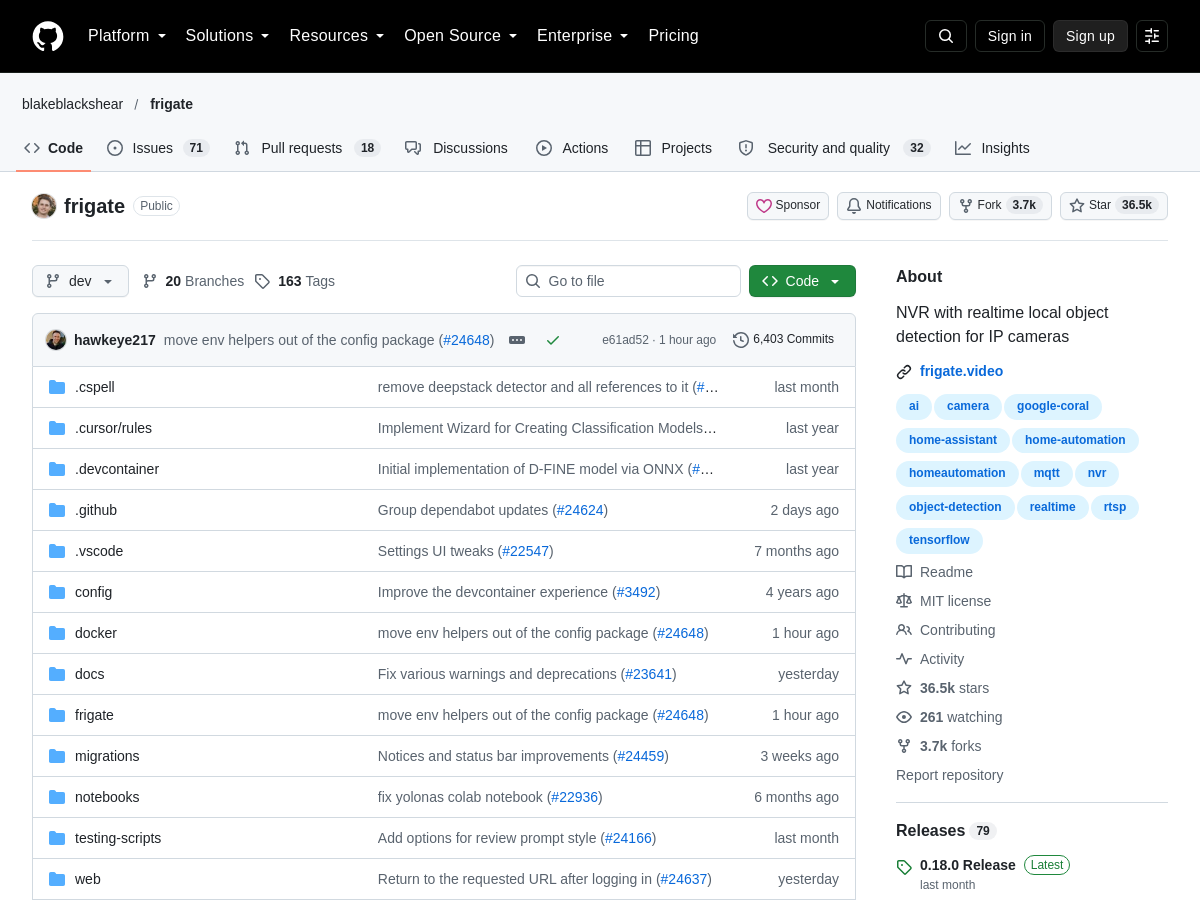
Frigate is a complete and local NVR designed for Home Assistant with AI object detection. It uses OpenCV and Tensorflow to perform real-time object detection locally for IP cameras. The tool is highly optimized for performance and resource usage, leveraging multiprocessing and a low-overhead motion detection system to determine where to run object detection. Frigate also features tight integration with Home Assistant via a custom component, support for MQTT communication, and a web-based interface for live viewing and configuration. The project is licensed under the MIT License and is available for modification and distribution. Frigate's key features include real-time object detection, 24/7 recording, re-streaming via RTSP, and WebRTC & MSE support for low-latency live view. The tool also includes a built-in mask and zone editor, multi-camera scrubbing, and a streamlined review workflow. Frigate is designed to work with a variety of object detectors, including those supported by TensorFlow. Overall, Frigate is a powerful and flexible tool for home security and surveillance applications. The tool's documentation is available at https://docs.frigate.video, and donations to support development can be made through Github Sponsors. Frigate's source code, configuration files, and documentation are available under the MIT License, while the 'Frigate' name, 'Frigate NVR' brand, and Frigate logo are trademarks of Frigate, Inc. The project uses Weblate to support language translations, and contributions are always welcome.

Solves

Frigate solves the problem of providing a complete and local NVR solution with real-time object detection for IP cameras, which is particularly useful for home security and surveillance applications. The tool addresses the need for a highly optimized and resource-efficient solution that can integrate seamlessly with Home Assistant and other systems. By providing a robust and customizable platform for object detection and video recording, Frigate helps users to enhance their home security and surveillance capabilities.

Screenshot of WriteABookAI
WriteABookAI
AI/ML Unknown

WriteABookAI is an AI-native book writing platform that empowers professionals to structure, draft, and publish non-fiction books with intelligent AI assistance. Built on the latest generation of Google Gemini models, it offers specialized features for book creation, including AI-generated smart outlines, chapter-aware drafting, real-time smart autocomplete, and intelligent rewriting suggestions. The platform supports 10 languages and allows users to maintain full control by accepting, modifying, or rejecting AI suggestions. Once writing is complete, users can export their professionally formatted manuscript to EPUB, PDF, Word, or Markdown, ready for self-publishing, traditional publishers, or corporate distribution. The service operates on a one-time payment model, granting lifetime access to the platform and permanent storage of work. With a claimed 97% user completion rate and 20x faster writing, WriteABookAI reduces the typical 6-8 week book creation process to manageable daily sessions.

Solves

Many subject matter experts—consultants, executives, researchers, and coaches—possess valuable knowledge but lack the time, writing skills, or structural guidance to write a book. Traditional book writing is daunting and slow, often taking years. WriteABookAI solves this by providing a dedicated AI-assisted environment that generates structure, drafts, and real-time suggestions, enabling experts to focus on conveying their expertise while the AI handles writing mechanics. This dramatically reduces the barrier to publishing, allowing professionals to become authors in weeks rather than years.

Screenshot of LightRAG
LightRAG
LLM Open Source

LightRAG is a simple and fast retrieval-augmented generation (RAG) framework introduced at EMNLP 2025. It leverages graph-based knowledge indexing to provide efficient, accurate retrieval for large language models (LLMs). Unlike traditional RAG pipelines that rely solely on vector similarity, LightRAG constructs a lightweight graph structure from the input documents, enabling more contextual and multi-hop retrieval. The framework is designed with simplicity in mind, offering a clean Python API that can be integrated into existing LLM applications with minimal effort. It supports multiple LLM backends and embedding models, and provides flexible storage options including local files, vector databases, and graph databases. The core innovation is its ability to capture relational information between text chunks, which improves answer quality on complex queries that require reasoning across multiple pieces of information. Despite its advanced capabilities, LightRAG maintains low overhead, making it suitable for both research prototypes and production deployments. The project is actively developed by the HKUDS lab with a growing community and frequent updates.

Solves

Developers and researchers often struggle with RAG systems that are either too complex to configure (e.g., LangChain) or too slow for interactive use. LightRAG solves this by providing a straightforward, fast, and effective RAG framework that uses a novel graph-based retrieval mechanism to improve retrieval accuracy without the heavy engineering overhead.

Screenshot of Preuve AI - Startup Idea Validator
Preuve AI - Startup Idea Validator
Startup idea validation Free

Preuve AI is a startup validation tool that scans 60+ live data sources to generate a viability score, map up to 15 competitors with funding and pricing data, and surface blind spots before you build. The tool uses 10 AI agents to pull real data on competitors, funding, and trends, and filter out junk. The scoring model runs multiple times, and when runs disagree, the system reruns until the verdict converges. Every claim links to a source. Preuve AI is designed for first-time and serial founders, vibe coders, and solo builders who need a reality check on what they should ship. The tool provides a comprehensive analysis, including viability scoring, founder-market fit, competitor mapping, market sizing, business plans, investor-ready docs, and an audio pitch. Preuve AI also offers a free scan, which takes about 60 seconds, and a full Founder Report, which costs $29 one-time and includes a 14-day satisfaction guarantee. The tool is powered by Claude Opus 5.5, Anthropic's most capable model, and is independently bootstrapped and run by a solo founder.

Solves

Preuve AI solves the problem of startup founders wasting time and resources on ideas that are not viable. According to CB Insights, 42% of startups fail because there is no market need, and Preuve AI helps founders identify this problem before they start building. The tool provides a brutal verdict backed by live data, which helps founders make informed decisions about their ideas. By using Preuve AI, founders can avoid building the wrong thing and save months of time and resources.

Screenshot of Dokploy
Dokploy
AI/ML Open Source

Dokploy is an open-source deployment platform that serves as a self-hosted alternative to popular services like Vercel, Netlify, and Heroku. It enables developers to deploy and manage web applications, APIs, and databases on their own servers or cloud infrastructure, offering full control over data and environment. With a user-friendly dashboard, Dokploy simplifies the deployment process by integrating with Git repositories for automatic builds and deployments. It supports custom domains, SSL certificates, environment variables, and scalable infrastructure, making it suitable for projects of various sizes. The platform aims to provide the simplicity and developer experience of modern cloud platforms while eliminating vendor lock-in. It supports a range of application types, from static sites and serverless functions to containerized services, making it a versatile tool for development teams and individual creators.

Solves

Dokploy addresses the lack of privacy and control in popular cloud deployment platforms by providing a self-hosted solution. It allows developers and teams to deploy and manage web applications with full ownership of their data and infrastructure, free from vendor lock-in.

Screenshot of Reply
Reply
AI/ML Freemium

Reply is an AI-powered sales engagement platform designed to help sales teams generate leads, automate outreach, and book more meetings. It provides a suite of tools for prospecting across multiple channels including email, LinkedIn, WhatsApp, SMS, and phone calls, all orchestrated through intelligent sequences that adapt based on prospect behavior. The platform uses artificial intelligence to personalize communication at scale, drafting unique messages for each recipient using AI variables and research agents that gather prospect-specific data. This ensures outreach feels tailored and relevant, increasing the chances of engagement. Reply also includes capabilities for audience discovery, leveraging real-time data and intent signals such as hiring activity, tech stack changes, and website visits to identify the right accounts to target. Its unified inbox centralizes all conversations, while built-in meeting scheduling syncs with calendars and CRMs to streamline the booking process. Trusted by over 3,000 businesses and rated 4.6/5 on G2, Reply positions itself as a comprehensive solution for modern sales teams looking to scale their prospecting efforts with AI.

Solves

Sales teams and SDRs often struggle with manual and time-consuming tasks like lead research, cold outreach, and follow-ups across multiple channels. Reply solves this by automating these processes with AI, enabling users to discover high-intent prospects, engage them through personalized, multi-channel sequences, and handle responses and meeting scheduling automatically. This reduces the manual workload, increases efficiency, and helps fill the sales pipeline more effectively.

Screenshot of VidFlux - Image to Video AI

VidFlux.ai is an all-in-one AI platform that transforms static images into dynamic, professional-quality videos. It aggregates over six industry-leading image-to-video models—including Google Veo 3, Sora 2, Kling AI, Runway, Seedance, Wan AI, and Grok Imagine—into a single, unified interface. Users can upload an image (JPG, PNG, WEBP up to 10MB, minimum 300px), optionally provide a text prompt describing desired motion or scene, select an AI model, choose aspect ratio (16:9 or 9:16), and generate a video with audio. The platform supports processing up to three images simultaneously, and aims to eliminate the need to juggle multiple tools by providing centralized access to top-tier video generation AI. The platform caters to a variety of visual styles and use cases. It can animate portraits with natural facial expressions and subtle gestures, bring illustrations and digital art to life while preserving original style, add cinematic camera movements like pans, zooms, and depth-of-field effects to still photos, and generate themed or seasonal videos from holiday or festive images. The generated videos include audio, enhancing the final output for social media, marketing, or personal projects. VidFlux offers a pay-per-use credit system (e.g., 120 credits for a generation), and includes a free tier that allows users to test the service. Models are available in different versions (e.g., Veo 3.1 standard and fast), giving users control over quality and speed. The web-based platform requires no software installation and is designed for ease of use, guiding users through a three-step process: upload, prompt, generate. By consolidating multiple AI engines, VidFlux provides versatility and convenience, but the output quality and behavior depend on the underlying third-party models. The platform is continually updated with new models and features, positioning itself as a comprehensive solution for anyone needing to convert images to video quickly and creatively.

Solves

Content creators, marketers, and designers often want to turn static images into engaging video content but face fragmentation across multiple AI tools, each with its own interface, pricing, and learning curve. VidFlux solves this by offering a single platform that integrates many of the best image-to-video AI models, allowing users to generate professional videos from images without technical expertise or the need to switch between different services. This streamlines the workflow, reduces costs of managing multiple subscriptions, and lowers the barrier to creating high-quality video content from simple images.

Screenshot of Qdrant
Qdrant
Vector DB Open Source

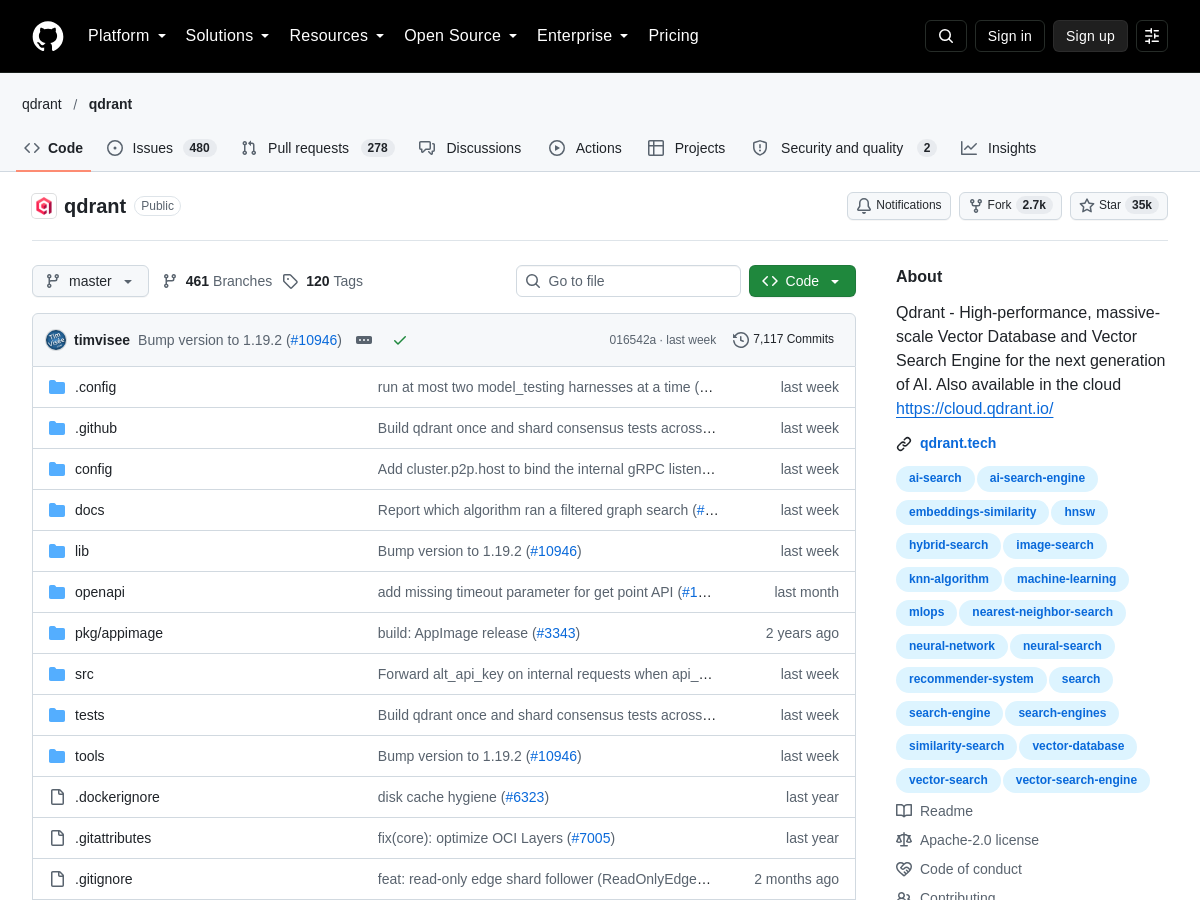
Qdrant is a high-performance, massive-scale Vector Database and Vector Search Engine designed for the next generation of AI. It is available in the cloud at https://cloud.qdrant.io/. Qdrant is built to handle large-scale vector data and provides a robust search engine for finding similar vectors. The project is open-source and has a large community of contributors. Qdrant supports various algorithms for similarity search, including HNSW and ACORN, and provides a simple API for indexing and searching vectors. The project is written in Python and has a permissive Apache-2.0 license. Qdrant has a wide range of applications, including image and video search, recommender systems, and natural language processing. The project has a strong focus on performance and scalability, making it suitable for large-scale deployments. Qdrant also provides a range of tools and features for managing and optimizing vector databases, including data ingestion, indexing, and query optimization. Overall, Qdrant is a powerful and flexible vector database and search engine that is well-suited for a wide range of applications in AI and machine learning. Qdrant's vector database is designed to store and manage large amounts of vector data, and its search engine is optimized for fast and accurate similarity search. The project's open-source nature and permissive license make it an attractive choice for developers and organizations looking to build custom AI and machine learning applications. Qdrant's community of contributors is active and engaged, and the project has a strong track record of innovation and improvement.

Solves

Qdrant solves the problem of efficient and scalable vector search and management for large-scale AI and machine learning applications. Many organizations and developers struggle with the challenge of storing and searching large amounts of vector data, which can be time-consuming and computationally expensive. Qdrant provides a solution to this problem by offering a high-performance, scalable, and flexible vector database and search engine that can handle large amounts of data and provide fast and accurate search results. By using Qdrant, developers and organizations can build custom AI and machine learning applications that require efficient and scalable vector search and management, such as image and video search, recommender systems, and natural language processing.

Screenshot of Obsidian Skills
Obsidian Skills
AI Agents Open Source

Obsidian Skills is a collection of agent skills that teach AI agents (like Claude Code, Codex, and Open Code) how to interact with Obsidian vaults using its native CLI and open formats. It follows the Agent Skills specification, making it compatible with any skills-compatible agent. The repository includes skills for Obsidian Flavored Markdown (creating and editing .md files with wiki-links, tags, and other Obsidian-specific syntax), Obsidian Bases (querying and manipulating .base files, which are database-like tables within Obsidian), JSON Canvas (building and editing visual knowledge graphs in .canvas format), and the Obsidian CLI (automating tasks via the command-line interface). Installation is flexible: via a plugin marketplace command, using npx, or manually copying files into the agent's skills directory. Once installed, the agent can understand and execute complex operations like generating daily notes, summarizing Base queries, creating Canvas visualizations, and batch-updating metadata. The skills are defined as structured Markdown prompts, providing clear instructions to the agent on how to leverage Obsidian's open formats and tools.

Solves

Obsidian users, especially knowledge workers, researchers, and developers, often want to automate or enhance their note-taking workflows using AI. However, generic AI agents lack the specific knowledge to interface with Obsidian's unique file formats (Flavored Markdown, Bases, Canvas) and its CLI. Obsidian Skills solves this by providing ready-made skill definitions that teach agents how to read, write, and manipulate Obsidian data, enabling seamless AI-assisted vault management without users having to craft complex prompts or write custom integration code.

Screenshot of Refine
Refine
Dev Tools Open Source

Refine is a React-based framework designed to accelerate the development of internal tools, admin panels, dashboards, and B2B applications. It provides a set of headless hooks and components that handle common data-driven tasks such as CRUD operations, authentication, access control, and routing, allowing developers to focus on business logic rather than boilerplate code.

Solves

Building internal tools and admin panels often involves repetitive implementation of data fetching, form handling, and user management. Refine solves this by providing a unified, hook-based abstraction over these concerns, significantly reducing development time and complexity.

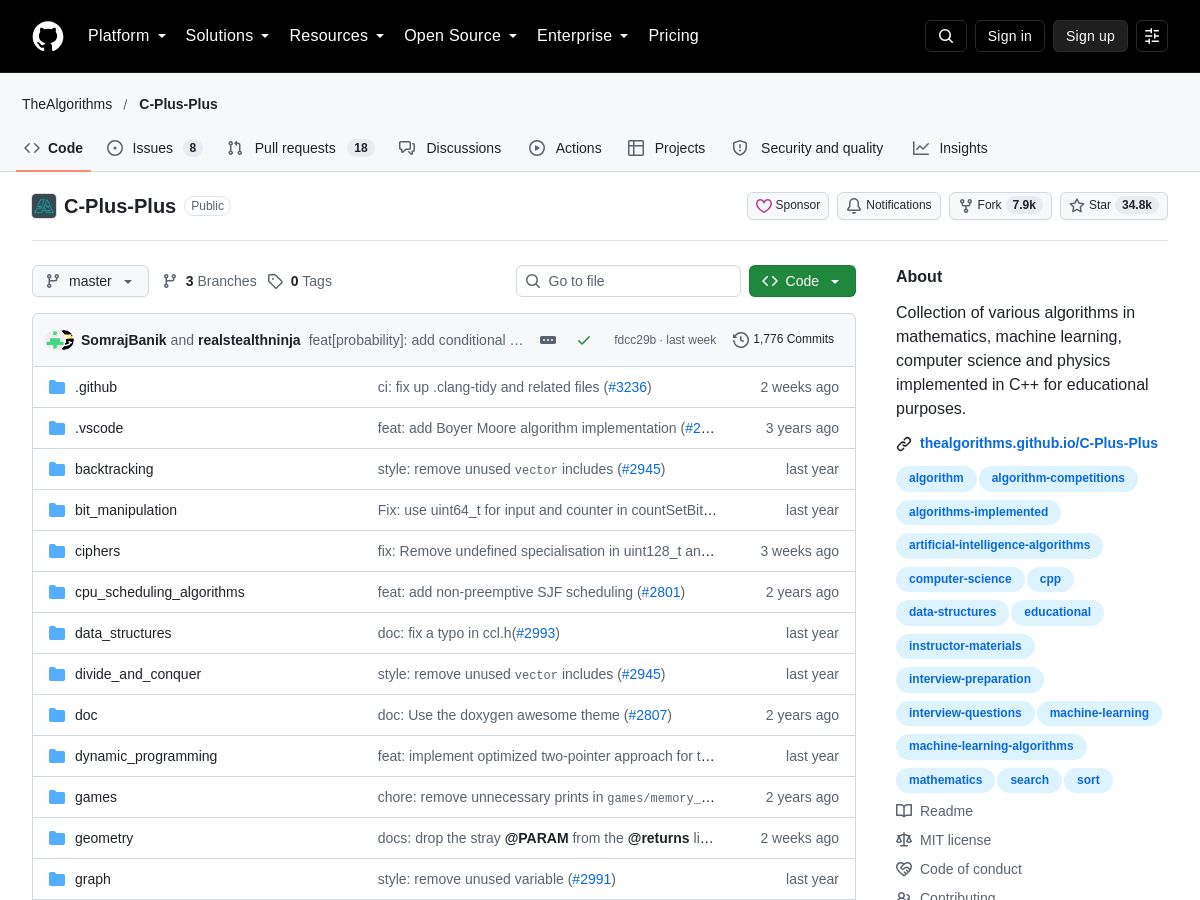
Screenshot of C Plus Plus
C Plus Plus
AI/ML Open Source

C Plus Plus is a collection of various algorithms in mathematics, machine learning, computer science, and physics implemented in C++ for educational purposes. The project provides a comprehensive repository of algorithms, including data structures, sorting, and searching algorithms, as well as machine learning algorithms. The algorithms are implemented in C++ and are designed to be used for educational purposes, allowing students and developers to learn and understand the underlying concepts. The project is open-source and is hosted on GitHub, where it has gained a significant following and contributions from the community. The repository includes a wide range of algorithms, including Boyer Moore algorithm, conditional probability algorithm, and other algorithms related to mathematics, machine learning, and computer science. The project is constantly updated with new algorithms and improvements, making it a valuable resource for anyone interested in learning and implementing algorithms in C++.

Solves

The problem that C Plus Plus solves is the lack of a comprehensive and well-maintained collection of algorithms in C++ for educational purposes. Many students and developers struggle to find reliable and efficient implementations of algorithms, which can hinder their learning and development process. C Plus Plus provides a solution to this problem by offering a wide range of algorithms that are well-documented, efficient, and easy to understand. By using C Plus Plus, developers can focus on learning and implementing algorithms without having to worry about the underlying implementation details.

Screenshot of Awesome Copilot
Awesome Copilot
Prompt Engineering Open Source

Awesome Copilot is a community-curated repository hosted by GitHub that aggregates instructions, agent configurations, skills, and other resources to enhance the GitHub Copilot coding assistant. It serves as a central hub where developers can discover and share effective ways to interact with Copilot, from simple prompt templates to complex, task-specific agent setups. The project is structured as a 'cookbook' of recipes, each providing a proven set of prompts and configurations to accomplish common development tasks like code generation, testing, documentation, and refactoring. The repository includes schemas for validating contributions, ensuring consistency and usability. Users can browse recipes by categories, languages, and tags, and apply them directly in their IDEs like VS Code. The project encourages community participation, allowing anyone to submit new recipes or improve existing ones via pull requests. It also supports external recipes from other repositories, enabling a broader ecosystem. Recent commits show active maintenance, with features like a website rendering for the cookbook and integration of community samples. By leveraging Awesome Copilot, developers can accelerate their workflow, reduce trial-and-error in prompt engineering, and adopt best practices from experienced Copilot users. It is an essential resource for both newcomers seeking to learn effective Copilot usage and advanced users looking to push the boundaries with custom agents and skills.

Solves

Many developers find it challenging to craft prompts that consistently yield accurate and useful code from GitHub Copilot. Without guidance, they waste time on ineffective interactions and may not realize the full capabilities of the tool. Awesome Copilot addresses this by providing a vetted collection of prompt templates, agent configurations, and usage patterns. It lowers the barrier to effective Copilot usage, enabling developers to quickly adopt proven strategies and focus on building software rather than experimenting with prompts.

Screenshot of Format Magic - The Automated Document Formatter

Format Magic is a web-based AI document formatter that turns plain text, AI-generated output, and existing Word or PDF files into polished, professionally laid out documents. The service provides templates for proposals, reports, résumés, and other business documents, and lets users paste text or upload files for reformatting. It is designed for desktop browsers and also works on mobile. Users can choose a base, designed, or formal template; paste raw text or extract text from DOCX, PDF, or text files; and optionally preserve source emphasis such as bold, italic, underline, headings, lists, and tables. Format Magic does not change the content itself—it transforms presentation by applying styles to headings, lists, paragraphs, and tables. Output can be downloaded as Word or PDF, with PDF described as a legacy feature that will not receive new updates. Formatting options include cover pages, table of contents, page numbers, portrait or landscape orientation, and page size. The platform can automatically extract images from documents and place them into the final output, with free sign-up permitting extraction of the first five images and paid plans up to 100. Usage limits are tracked through a dashboard, and the homepage indicates a free tier with premium paid plans.

Solves

Format Magic addresses the time-consuming and error-prone work of manual document formatting in word processors. It helps users fix inconsistent styles, reformat messy or unstructured AI output, and turn plain text into clean, professional documents without hand-editing every heading, list, table, or page element.

Screenshot of QwenPaw
QwenPaw
AI Agents Open Source

QwenPaw is an open-source personal AI assistant designed for easy installation and deployment on local machines or cloud environments. It supports integration with multiple chat applications, allowing users to access AI capabilities across their preferred messaging platforms. The assistant is built with extensibility in mind, enabling developers to add custom capabilities through plugins or extensions. As part of the AgentScope AI ecosystem, it leverages agent-oriented architecture to provide a flexible and powerful personal assistant experience. Users maintain full control over their data by running the assistant on their own infrastructure.

Solves

It addresses the need for a private, customizable AI assistant that can be self-hosted to ensure data privacy and can be extended to work with various chat interfaces and tasks.

Screenshot of SpaCy
SpaCy
AI/ML Open Source

SpaCy is a modern natural language processing (NLP) library for Python. It is designed to be highly efficient and flexible, allowing developers to easily integrate NLP capabilities into their applications. SpaCy provides a wide range of features, including tokenization, entity recognition, language modeling, and text classification. It also includes pre-trained models for many languages, making it a popular choice for NLP tasks. The library is highly customizable, allowing developers to fine-tune models for specific use cases and domains. SpaCy is widely used in industry and academia for tasks such as text analysis, sentiment analysis, and information extraction. It is known for its high performance and ease of use, making it a popular choice for developers and researchers alike. SpaCy is also highly extensible, with a large community of contributors and a wide range of plugins and extensions available. This makes it an ideal choice for developers who need to perform complex NLP tasks or who want to customize the library to meet their specific needs. Overall, SpaCy is a powerful and flexible NLP library that is well-suited to a wide range of applications and use cases. It is highly efficient, customizable, and extensible, making it a popular choice for developers and researchers who need to perform complex NLP tasks. SpaCy is also highly scalable, making it suitable for large-scale NLP applications. The library is well-documented and has a large community of users and contributors, making it easy to get started and find help when needed. SpaCy is widely used in many industries, including healthcare, finance, and technology, and is a popular choice for NLP tasks such as text analysis, sentiment analysis, and information extraction.

Solves

SpaCy solves the problem of natural language processing (NLP) for developers and researchers who need to analyze and understand human language. It provides a wide range of features and pre-trained models that make it easy to perform tasks such as text analysis, sentiment analysis, and information extraction. SpaCy is particularly useful for developers who need to integrate NLP capabilities into their applications, as it provides a highly efficient and flexible way to do so. The library is also highly customizable, allowing developers to fine-tune models for specific use cases and domains. This makes it an ideal choice for developers who need to perform complex NLP tasks or who want to customize the library to meet their specific needs.

Screenshot of Gpt Pilot
Gpt Pilot
Dev Tools Open Source

GPT Pilot is an open-source AI developer tool designed to automate the process of building software applications. It leverages large language models (LLMs) such as GPT-4 and Claude to generate code, debug issues, and refactor existing codebases. Unlike simple code completion tools, GPT Pilot aims to function as a full-fledged AI developer that can take a high-level project description and produce a working application through iterative interaction with the user. The tool operates by breaking down the development process into smaller tasks, asking clarifying questions when necessary, and then generating and testing code. It supports multiple programming languages and frameworks, and can be extended with custom prompts and integrations. GPT Pilot runs locally via a command-line interface, giving developers full control over the generated code and the ability to review and modify it at any stage. As an open-source project, GPT Pilot encourages community contributions and customization. It is particularly useful for rapid prototyping, MVP development, and automating repetitive coding tasks. While it is not a replacement for human developers, it significantly reduces the time and effort required to go from idea to functional software.

Solves

GPT Pilot solves the challenge of manual software development by automating code generation and application building. It reduces the time and cost associated with writing boilerplate code, debugging, and iterating on features, allowing developers to focus on higher-level design and problem-solving.