Tool discovery

What type of AI tool
are you looking for?

Search the active catalog with LambdaBase AI Search, or keep browsing the popularity-ordered directory below.

Submitted search queries and interaction metrics may be analyzed to improve result quality. Do not include personal or confidential information

Browse popular tools.

Screenshot of Obsess AI
Obsess AI
E-commerce content Freemium

Obsess AI is an AI marketing team for Shopify stores. It analyzes your store's theme, products, copy, and Search Console history to understand your brand voice and catalog. Then it automatically creates marketing assets, including designed collection and landing pages, blog articles, rewritten product descriptions, and social media videos. Obsess AI works inside the Shopify admin. It produces drafts that appear on your real storefront at real URLs, so you can review them just as customers would. You can publish or discard everything. Every published job is measured against a day-28 baseline, giving you a clear verdict on whether the content improved performance — even when it didn't work. The platform also identifies keyword conflicts and offers one-click fixes, supports content creation in 10 languages, and lets you set a cadence for new articles. Pricing is freemium, with 100 free credits and no credit card required, and paid plans start at $9 per month. Obsess AI is positioned as an alternative to expensive marketing agencies and generic AI tools that lack store-specific context.

Solves

Shopify store owners often lack the time, team, or budget to execute effective marketing. ObsessAI acts like an in-house AI marketer that studies the store and delivers high-effort work such as on-theme page design, daily blog writing, product copy optimization, social video creation, and SEO improvements — all with measurable results and the ability to undo everything.

Screenshot of Graphiti
Graphiti
AI Agents Open Source

Graphiti is an open-source Python library that enables AI agents to build and maintain real-time knowledge graphs. It ingests unstructured and structured data, extracts entities and relationships using language models, and incrementally updates a graph structure to reflect evolving information. The library is designed to integrate seamlessly with AI agent frameworks, providing persistent, queryable memory that enhances reasoning and decision-making. At its core, Graphiti processes incoming data streams—such as chat conversations, documents, or API responses—and converts them into nodes and edges in a graph database. It supports incremental updates, meaning new information is merged without requiring complete reprocessing of existing data. This real-time capability allows agents to stay up-to-date with minimal latency. Graphiti offers a developer-friendly API, likely installable via pip, and includes examples for common use cases. It abstracts away the complexity of entity extraction, relation classification, and graph management, letting developers focus on agent logic. The library is backed by a strong open-source community, evidenced by over 26,000 GitHub stars and frequent contributions. Given its focus on real-time knowledge graph construction, Graphiti is particularly suited for applications requiring dynamic memory, such as conversational AI, research assistants, and enterprise knowledge management. It aims to bridge the gap between raw data and structured knowledge, empowering AI agents with context-rich, interconnected information.

Solves

AI agents often struggle with maintaining a coherent, up-to-date understanding of context over time, leading to inconsistent responses and limited reasoning. Graphiti solves this by providing a real-time knowledge graph layer that agents can use to store and retrieve structured facts, relationships, and historical context as they interact with data, improving accuracy and personalization.

Screenshot of Cli
Cli
AI Agents Open Source

Google Workspace CLI is a unified command-line tool that provides direct access to numerous Google Workspace services, including Drive, Gmail, Calendar, Sheets, Docs, Chat, Admin, and more. It is designed to streamline interactions with these services from the terminal, enabling automation and scripting without the need for custom API integration code. The tool is dynamically built from the Google Discovery Service, meaning its commands and capabilities are generated based on Google's official API definitions, ensuring broad and up-to-date coverage of Workspace functionality. This approach allows users to discover and execute a wide range of operations using a consistent CLI syntax. Additionally, the project includes AI agent skills, making it suitable for integration with AI-driven workflows and autonomous agents that need to interact with Google Workspace data and services.

Solves

It simplifies access to Google Workspace APIs by providing a single command-line interface for multiple services, eliminating the need to write separate client code for each API and reducing the overhead of managing authentication and API discovery.

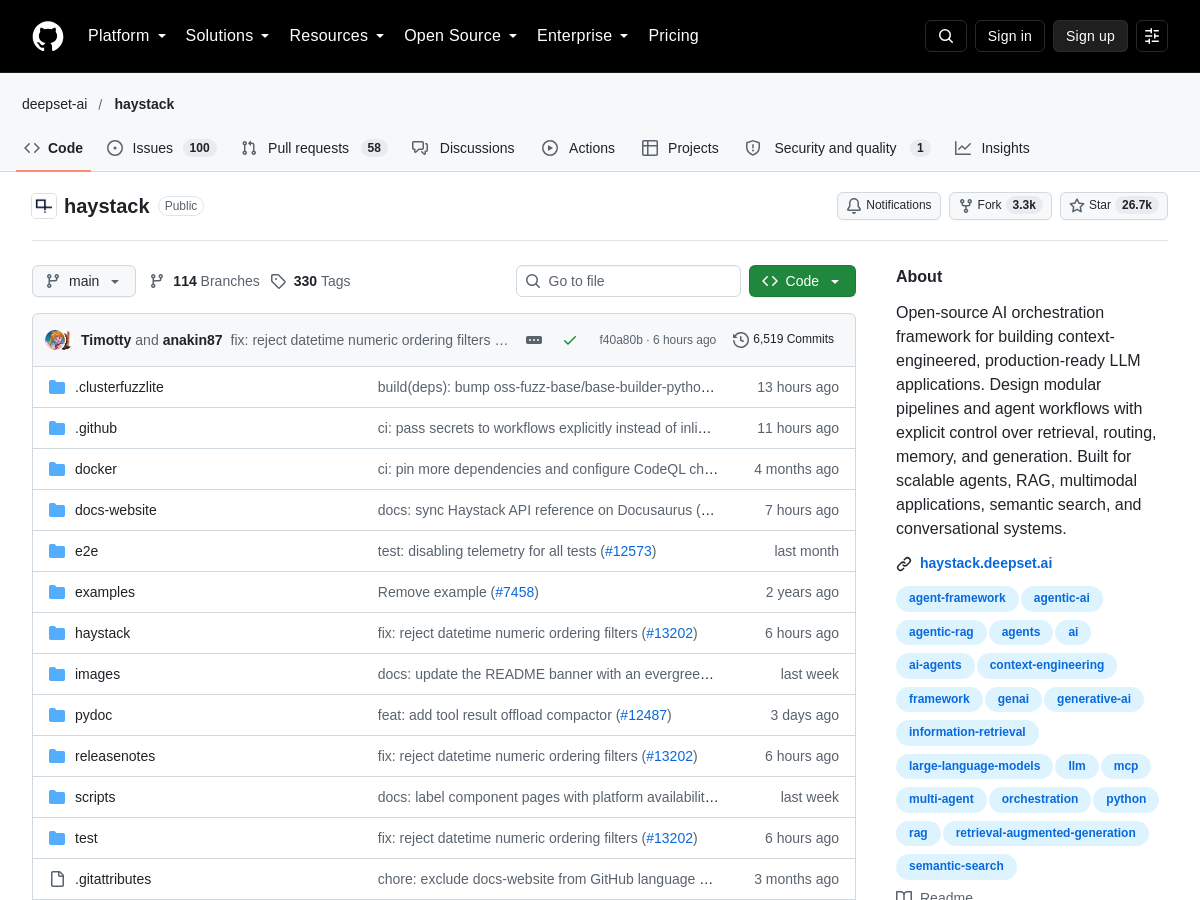
Screenshot of Haystack
Haystack
AI Agents Open Source

Haystack is an open-source AI orchestration framework for building production-ready LLM applications in Python. It allows users to design modular pipelines and agent workflows with explicit control over retrieval, routing, memory, and generation. The framework is built for scalable RAG systems, multimodal applications, semantic search, question answering, and autonomous agents, all in a transparent architecture that lets users experiment, customize deeply, and deploy with confidence. Haystack provides features such as agents built for production, context engineering, native async support, modular and customizable components, model- and vendor-agnostic integration, and an extensible ecosystem. It also offers Haystack Enterprise: Support & Platform, which provides expert support, enterprise-grade templates, and deployment guides for cloud and on-prem environments. Additionally, Haystack collects anonymous usage statistics of pipeline components, which can be opted out of in the Haystack docs. The framework has a strong community, with regular checks on GitHub issues, GitHub Discussions, Discord channel, Twitter, and Stack Overflow. Contributions to Haystack are also welcome, with several ways to contribute, including contributing to the main Haystack project, contributing an integration, or contributing to the documentation.

Solves

Haystack solves the problem of building production-ready LLM applications by providing a flexible and customizable framework for designing modular pipelines and agent workflows. It addresses the needs of developers, ML engineers, and data scientists who want to build scalable and efficient AI systems. Haystack's transparent architecture and extensible ecosystem make it an ideal solution for teams building production AI systems across industries.

Screenshot of Qwen Code
Qwen Code
Dev Tools Open Source

Qwen Code is an open-source AI coding agent designed to operate directly in the terminal. Developed by the QwenLM team, it provides developers with an intelligent assistant capable of generating, explaining, and refactoring code through natural language interactions. By integrating with a command-line interface, it eliminates the need to switch between different tools, allowing for a more streamlined development workflow. The agent leverages the Qwen family of large language models to interpret user commands and perform tasks such as code completion, debugging, and file manipulation. As an open-source project, users have full control over their data and can customize the agent to fit their specific needs, including the ability to run models locally for enhanced privacy.

Solves

Qwen Code solves the challenge of integrating AI coding assistance into terminal-based workflows, enabling developers to get instant, context-aware help without leaving the command line or relying on external IDE plugins.

Screenshot of CL4R1T4S
CL4R1T4S
Prompt Engineering Open Source

CL4R1T4S is an open-source GitHub repository that aggregates systematically leaked system prompts from major AI assistant platforms, including ChatGPT, Claude, Gemini, Grok, Perplexity, Cursor, Lovable, and Replit. The repository aims to provide transparency into the hidden initial instructions that govern the behavior of these AI systems. The repository contains text files or documentation that expose the system prompts used by these AI models, which are typically not disclosed by their providers. By collecting these leaked prompts, CL4R1T4S allows researchers, developers, and enthusiasts to study the underlying rules, constraints, and ethical guidelines embedded in commercial AI assistants. The project is maintained by the user elder-plinius and is presented as a resource for AI systems transparency. It highlights the importance of open access to information about how AI models are instructed and controlled, fostering discussions about accountability, bias, and the hidden design choices in AI products. Although the repository primarily serves as a dataset of leaked prompts, it has become a reference point for prompt engineering research and for understanding the differences and similarities between AI assistant configurations across various platforms.

Solves

CL4R1T4S addresses the lack of transparency in AI systems by exposing the system prompts that control their responses. This enables researchers and developers to understand underlying biases, restrictions, and design choices, contributing to more informed discussions about AI ethics and accountability.

Screenshot of Repomix
Repomix
LLM Open Source

Repomix is an open-source command-line tool that bundles an entire code repository into a single, AI-friendly text file. It intelligently includes file contents with clear separators, respects .gitignore, and automatically excludes binary files. The output is optimized for consumption by large language models (LLMs) such as Claude, ChatGPT, DeepSeek, Gemini, and others, making it easy to provide full codebase context. Repomix supports multiple output formats including plain text, XML, and Markdown, and it can apply token-aware minification to compress the output for better fit within LLM context windows. It can be run locally via npx or installed globally, and it integrates well with CI/CD pipelines for automated repository processing. The tool is implemented in TypeScript and distributed under the MIT license. It is actively maintained and widely used by developers who need to share codebases with AI assistants, create training data, or generate comprehensive code documentation.

Solves

When working with large language models, providing the entire codebase as context is challenging due to token limits and the need to manually copy multiple files. Repomix solves this by consolidating all relevant source files into a single structured file, reducing manual effort and improving AI comprehension.

Screenshot of Pumpkin Book
Pumpkin Book
AI/ML Open Source

Pumpkin Book is an open-source companion guide to the popular Chinese machine learning textbook 'Machine Learning' (often called the Watermelon Book) by Zhou Zhihua. It provides detailed, step-by-step derivations and explanations of the mathematical formulas and equations found in the textbook, helping readers overcome the mathematical barriers commonly encountered when studying machine learning theory. The project is maintained by Datawhale, an open-source learning community, and hosted on GitHub. The content is primarily written in LaTeX and Markdown, and organized by chapters corresponding to the original book. It covers a wide range of topics including linear models, decision trees, neural networks, support vector machines, Bayesian classifiers, clustering, and more. The guide is intended for students, researchers, and practitioners who are using the Watermelon Book as their primary learning resource. It aims to make complex derivations accessible by breaking down each formula into smaller steps, adding annotations, and referencing additional materials where necessary. Because the original textbook is in Chinese, the Pumpkin Book is also primarily in Chinese, which may limit its audience to Chinese-speaking learners. As an open-source project, the Pumpkin Book encourages community contributions, corrections, and discussions. It has become a popular reference among Chinese-speaking machine learning learners and is often used in conjunction with university courses and self-study.

Solves

The Pumpkin Book addresses the common challenge of understanding the rigorous mathematical derivations in Zhou Zhihua's 'Machine Learning' textbook. By providing detailed formula explanations and step-by-step derivations, it helps readers who are stuck on complex equations to grasp the underlying principles and proceed with their learning.

Screenshot of Strix
Strix
AI/ML Open Source

Strix is an open-source AI penetration testing tool designed to automatically identify and remediate vulnerabilities in applications. It leverages artificial intelligence to simulate attacks and provide fix recommendations, aiming to streamline security assessments and reduce the manual effort required for vulnerability discovery. The tool is hosted on GitHub and can be self-hosted or run locally, making it accessible for developers and security teams. By integrating AI into penetration testing, Strix offers a modern approach to application security, potentially catching issues that traditional scanners might miss. It is intended to be used in development workflows and CI/CD pipelines to ensure continuous security validation. The project is community-driven and open for contributions.

Solves

Strix addresses the challenge of identifying and fixing application vulnerabilities by automating penetration testing with AI, reducing the need for manual security audits and enabling faster remediation of security flaws.

Screenshot of Blender Mcp
Blender Mcp
LLM Open Source

Blender MCP is an open-source tool that bridges large language models (LLMs) and Blender, the popular 3D creation suite. By acting as a Model Context Protocol (MCP) server, it enables any compatible LLM to directly control Blender's 3D environment through natural language commands. This allows users to generate, modify, and animate 3D scenes using conversational AI. The project integrates seamlessly with Blender, providing a set of tools that an LLM can invoke to perform operations like creating objects, setting materials, and rendering. Built with Python, Blender MCP uses the MCP standard to expose Blender's functionality as tool calls, making it easy to set up and use. It works with any LLM client that supports MCP, such as Claude Desktop, enabling a hands-free 3D modeling experience. Blender MCP lowers the entry barrier for 3D content creation, allowing artists, developers, and hobbyists to iterate quickly by describing their intentions rather than manually navigating Blender's complex UI. The server runs locally, ensuring low-latency interaction while leveraging the power of modern LLMs.

Solves

Blender MCP addresses the challenge of interfacing language models with professional 3D software, enabling non-expert users or automated pipelines to create and edit complex 3D scenes via natural language, thus lowering the barrier to 3D content creation.

Screenshot of Handson Ml
Handson Ml
AI/ML Open Source

Handson Ml is the official code repository for the first edition of the book 'Hands-On Machine Learning with Scikit-Learn and TensorFlow' by Aurélien Géron. It contains a comprehensive set of Jupyter notebooks that cover fundamental machine learning concepts, including classification, regression, support vector machines, decision trees, ensemble methods, dimensionality reduction, and an introduction to neural networks with TensorFlow. The repository is now deprecated and should not be used for new learning; users are directed to the newer repositories handson-ml3 and handson-mlp for updated content.

Solves

It provides a practical, code-driven complement to the textbook, allowing readers to experiment with and understand machine learning algorithms by running the same examples used in the book.

Screenshot of Shap
Shap
AI/ML Open Source

SHAP (SHapley Additive exPlanations) is a Python library that provides a unified approach to explain the output of any machine learning model using game theoretic Shapley values. It connects optimal credit allocation with local explanations, offering both global and local interpretability. The library supports a wide range of model types including tree-based models (XGBoost, LightGBM, CatBoost, scikit-learn trees), deep learning models (TensorFlow, PyTorch), and arbitrary black-box models via model-agnostic kernel explainers. SHAP introduces several explainer types, each optimized for different model classes, and includes powerful interactive visualizations such as summary plots, dependence plots, force plots, and decision plots to help users understand feature contributions. The library is designed to be both fast (with optimized C++ backend using nanobind) and flexible, allowing for additive feature attribution methods that satisfy local accuracy, missingness, and consistency properties. It also provides tools for model monitoring, feature selection, and hypothesis testing, making it a comprehensive suite for model interpretation and transparency.

Solves

Many machine learning models, especially complex ensembles and neural networks, operate as black boxes, making it difficult to understand why a particular prediction was made. This lack of transparency hinders trust, debugging, and compliance with regulations. SHAP solves this by computing Shapley values, which fairly distribute the prediction among the input features based on their contributions, providing consistent and locally accurate explanations. It thus enables practitioners to audit models, detect bias, explain individual predictions to stakeholders, and improve model performance through better feature understanding.

Screenshot of Fastmcp
Fastmcp
Model Serving Open Source

Fastmcp is a Python library that provides a fast, Pythonic way to build Model Context Protocol (MCP) servers and clients. It abstracts away the low-level protocol details, allowing developers to define tools, resources, and prompts as simple Python functions using decorators and type hints. The library handles communication transports (such as stdio and HTTP) and provides a clean API for both server and client implementations. Fastmcp is designed for speed and minimal boilerplate, making it easy to integrate AI models with external tools and data sources. It includes features like automatic schema generation, async support, and built-in tool composition. The project is actively maintained by PrefectHQ and has a growing community with extensive documentation and examples.

Solves

AI application developers need to expose tools, resources, and prompts to language models using the standardized Model Context Protocol (MCP), but implementing the protocol from scratch is complex and time-consuming. Fastmcp solves this by providing a high-level, Pythonic framework that simplifies server and client creation, reducing boilerplate and enabling rapid integration of AI models with external capabilities.

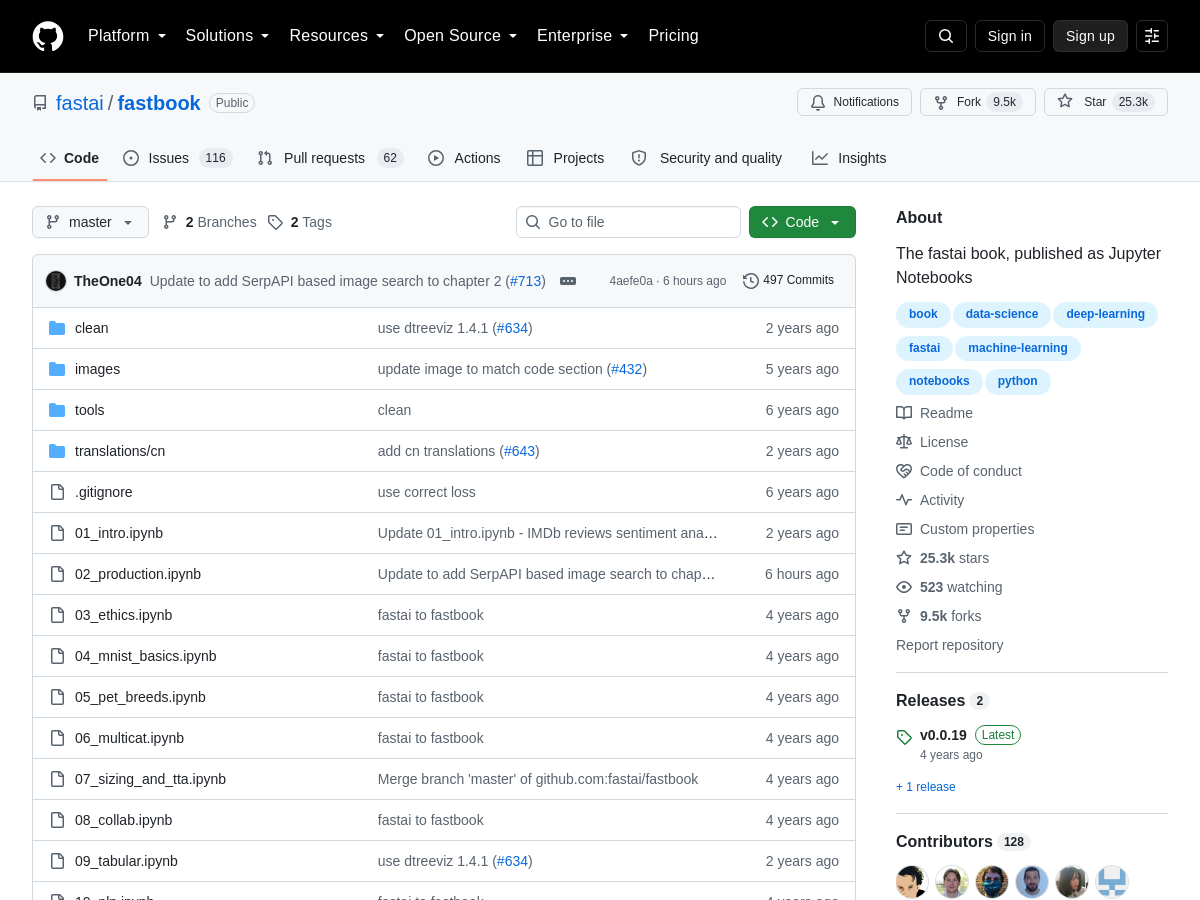
Screenshot of Fastbook
Fastbook
AI/ML Open Source

Fastbook is the official GitHub repository containing the full set of Jupyter notebooks for the book "Deep Learning for Coders with fastai and PyTorch: AI Applications Without a PhD" by Jeremy Howard and Sylvain Gugger, published by O'Reilly Media. The notebooks mirror the chapters of the printed book, walking readers from training a state-of-the-art image classifier in the first chapter through to deeper topics such as stochastic gradient descent from scratch, neural network foundations, NLP, tabular data, collaborative filtering, and model deployment. Each notebook is self-contained and runnable in Jupyter, Google Colab, or Kaggle Notebooks, and relies on the fastai library built on top of PyTorch. The repository is intended as a practical, code-first learning resource: readers execute and modify the code rather than only reading theory. Markdown cells in the notebooks summarize explanation and point back to the corresponding book chapters. The project is maintained by the fastai organization and is released as open source, with the notebooks freely available on GitHub alongside the commercial book. It is frequently used in study groups, university courses, and self-directed machine learning curricula, and the community files corrections and improvements via issues and pull requests. Because it is a teaching resource rather than a packaged library, Fastbook does not ship installable software of its own; users install the fastai library and PyTorch separately and then run the notebooks locally or in a hosted notebook environment.

Solves

Fastbook addresses the difficulty of learning modern deep learning in a practical, top-down way. Many learners find theory-first courses hard to apply or lack GPU-ready, runnable code. Fastbook solves this by pairing a complete, freely available set of executable notebooks with an accompanying book, so readers can train real models on real datasets from the first chapter without needing a PhD-level mathematical background.

Screenshot of WaveFunctionCollapse
WaveFunctionCollapse
Code Open Source

WaveFunctionCollapse is an open-source implementation of the Wave Function Collapse algorithm, originally introduced by Maxim Gumin. The repository contains a C# program that generates bitmap images and tilemaps from a single input example, using constraints derived from local patterns. It supports both the Simple Tiled Model, which works with predefined tiles and adjacency rules, and the Overlapping Model, which extracts patterns directly from an input image. The algorithm treats the output grid as a superposition of possible states for each cell and repeatedly collapses cells to concrete states based on the constraints, propagating information to neighboring cells to maintain consistency. This produces outputs that are locally similar to the input but globally novel, making it suitable for procedural content generation. The project includes a Windows desktop application with a graphical interface for loading inputs, adjusting parameters, and viewing results. It has been widely adopted and ported to many other languages and game engines, serving as a reference implementation for the technique.

Solves

WaveFunctionCollapse solves the problem of generating large, non-repetitive textures, tilemaps, and patterns from a single small example. It automates the creation of locally consistent content, significantly reducing manual design effort in games, art, and procedural generation.

Screenshot of Responsively App
Responsively App
Dev Tools Open Source

Responsively App is an open-source desktop application designed to streamline responsive web development. It provides a modified browser environment where developers can preview a website across multiple simulated device viewports simultaneously, such as phones, tablets, and desktops. The tool offers synchronized interactions, so actions like scrolling, clicking, or navigating are mirrored across all devices in real time, reducing the need for manual repeated testing. Built with web technologies and available for Windows, macOS, and Linux, Responsively App includes features like custom device profiles, screenshot capture, and an integrated device inspector. It is actively maintained on GitHub and distributed free of charge under an open-source license. The application is aimed at web developers, UI/UX designers, and anyone who needs to ensure a consistent user experience across different screen sizes.

Solves

Testing a website's responsive design typically requires resizing browser windows or using separate device emulators, which is time-consuming and error-prone. Responsively App solves this by showing many device frames at once and mirroring user interactions, letting developers quickly identify layout issues across breakpoints without switching between tools.

Screenshot of Mastra
Mastra
Chatbots Open Source

Mastra is an open-source TypeScript framework designed to simplify the development of AI-powered applications and autonomous agents. Created by the team behind Gatsby, it provides a modern, type-safe developer experience for building complex AI systems with features like agent orchestration, workflow management, and integration with large language models. The framework offers a modular architecture that includes tools for defining agents, managing conversational memory, executing tool calls, and evaluating agent performance. It is built to work with popular LLM providers and supports building applications that can handle multi-step reasoning and interactive dialogues. Mastra aims to reduce the boilerplate and complexity typically associated with AI application development by providing a batteries-included approach. Developers can focus on business logic while the framework handles model routing, state management, and tool integration.

Solves

Mastra addresses the challenge of building production-ready AI agents and applications by offering a unified TypeScript framework that provides essential building blocks such as agent definitions, memory, tool calling, and workflow orchestration, reducing the need to piece together multiple libraries.

Screenshot of Ai
Ai
AI Agents Open Source

Vercel AI SDK is an open-source TypeScript toolkit designed to simplify the development of AI-powered applications and agents. Created by the team behind Next.js, it provides a unified interface for interacting with multiple large language model providers, including OpenAI, Anthropic, Google, Mistral, and many others. The SDK abstracts away provider-specific APIs, enabling developers to switch between models without significant code changes. Key features include first-class streaming support, React and Next.js hooks for building chat and completion UIs, generative UI components, and robust tool calling for agent workflows. The library also includes utilities for handling structured outputs, managing conversation state, and orchestrating multi-step agent reasoning. It is framework-agnostic at its core but offers deep integrations with React, Vue, Svelte, and Node.js. The AI SDK is distributed via npm and is licensed under Apache 2.0. It has a large and active community, with contributions from Vercel and the broader open-source ecosystem. The project continues to evolve rapidly, adding support for new providers and agentic patterns as the AI landscape changes.

Solves

Building AI applications in TypeScript often requires integrating multiple proprietary SDKs, handling streaming and state management manually, and dealing with provider-specific quirks. Vercel AI SDK solves this by offering a single, provider-agnostic API that standardizes streaming, tool calling, and UI integration, significantly reducing development time and complexity for AI-powered web and server-side applications.

Screenshot of Cs249r_book
Cs249r_book
AI/ML Open Source

Cs249r_book is an open source textbook developed as part of Harvard University's CS249r course on Machine Learning Systems. The book provides a comprehensive guide to building, deploying, and managing ML systems at scale, covering both foundational concepts and cutting-edge practices. It is written using Quarto and maintained collaboratively on GitHub by the Harvard Edge research group, with contributions from the broader community. The book is organized into multiple volumes and chapters that address various aspects of ML systems, including hardware accelerators, software frameworks, distributed training, model serving, monitoring, and responsible engineering. It integrates code examples, case studies, and interactive elements to facilitate learning. The project employs rigorous CI/CD pipelines for building and testing, ensuring the content remains accurate and current. One of the key strengths of Cs249r_book is its practical orientation, bridging the gap between theoretical ML and real-world system implementation. It is designed to be accessible to students, practitioners, and researchers who want to understand the engineering challenges and solutions in modern ML. The book also emphasizes reproducibility, ethical considerations, and efficiency. With over 24,000 stars and 2,900 forks, the repository has gained significant traction in the ML community, reflecting its value as a collaborative knowledge base for ML systems education.

Solves

Many machine learning courses and textbooks focus primarily on algorithms and theoretical foundations, neglecting the practical systems engineering aspects needed to deploy ML models in production. Cs249r_book addresses this gap by providing a structured, comprehensive resource on the design and implementation of ML systems, covering hardware, software, and operational considerations. It empowers learners to build efficient, scalable, and responsible ML infrastructure.

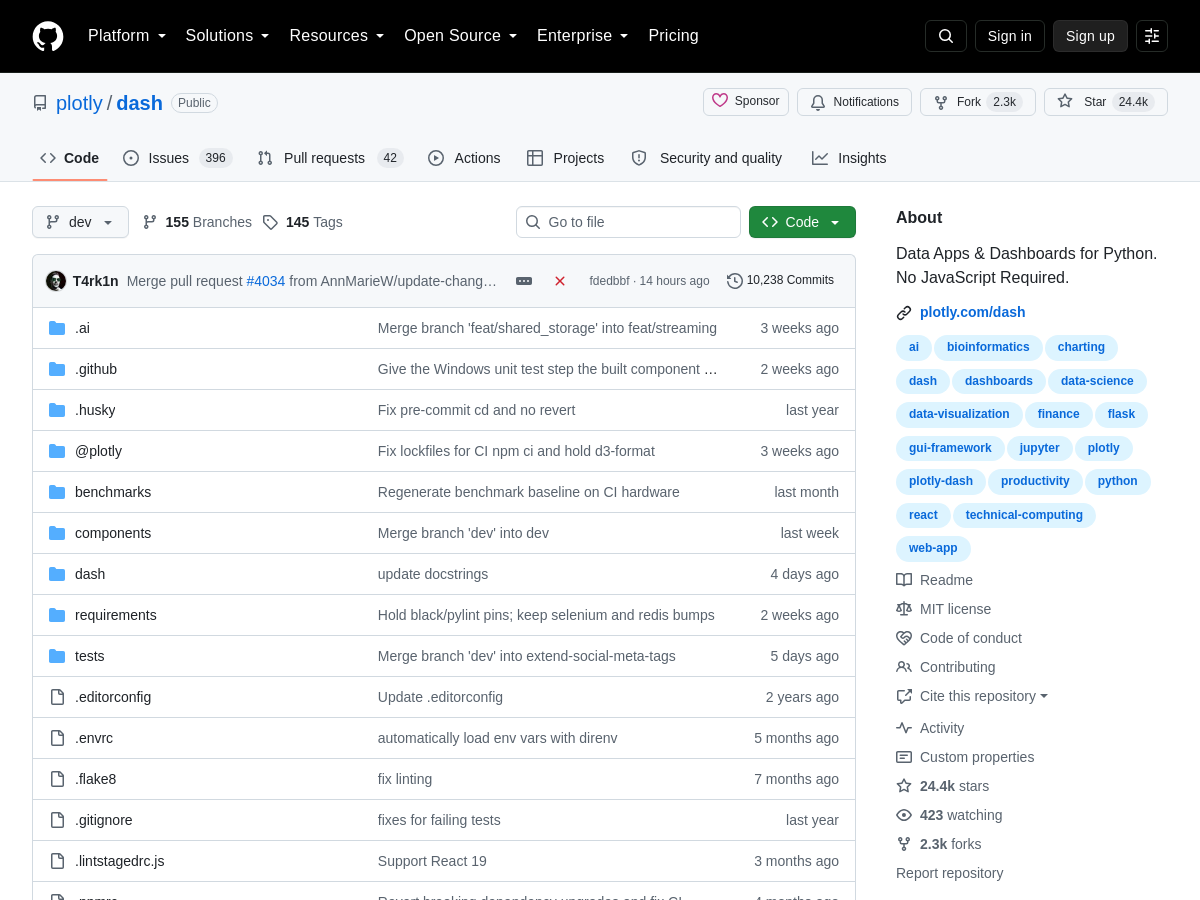
Screenshot of Dash
Dash
Productivity Open Source

Dash is a Python library that allows users to build data apps and dashboards without requiring JavaScript knowledge. It provides a simple and intuitive way to create web-based applications that can be used to visualize and analyze data. With Dash, users can create custom dashboards with a variety of components, including graphs, tables, and images. The library is highly customizable and can be used to create a wide range of applications, from simple data visualizations to complex data analysis tools. Dash is built on top of popular Python libraries such as Flask and React, and it provides a high-level interface for building web applications. It also includes a number of pre-built components and tools that make it easy to get started with building data apps and dashboards. Overall, Dash is a powerful and flexible library that can be used to create a wide range of data-driven applications. It is particularly well-suited for data scientists and analysts who want to create custom data visualizations and dashboards without requiring extensive JavaScript knowledge. Dash is also highly extensible, with a large community of developers who contribute to the library and create new components and tools. This makes it easy to find help and resources when building Dash applications. In addition to its technical features, Dash also has a number of benefits that make it an attractive choice for building data apps and dashboards. For example, it allows users to create custom applications that can be tailored to their specific needs and use cases. It also provides a high-level interface that makes it easy to build and deploy applications quickly. Overall, Dash is a powerful and flexible library that can be used to create a wide range of data-driven applications. Its simplicity, customizability, and extensibility make it an attractive choice for data scientists and analysts who want to create custom data visualizations and dashboards. Dash has a number of key features that make it useful for building data apps and dashboards. These include its ability to create custom dashboards with a variety of components, its high-level interface for building web applications, and its large community of developers who contribute to the library and create new components and tools. Additionally, Dash is highly customizable, allowing users to tailor their applications to their specific needs and use cases. It also provides a number of pre-built components and tools that make it easy to get started with building data apps and dashboards. Overall, Dash is a powerful and flexible library that can be used to create a wide range of data-driven applications.

Solves

Data scientists and analysts often struggle with creating custom data visualizations and dashboards that can be used to analyze and visualize data. They may not have the necessary JavaScript knowledge to create complex web applications, and they may not have the time or resources to learn. Dash solves this problem by providing a simple and intuitive way to create web-based applications that can be used to visualize and analyze data. With Dash, users can create custom dashboards with a variety of components, including graphs, tables, and images, without requiring extensive JavaScript knowledge. This makes it easy for data scientists and analysts to create custom data visualizations and dashboards that can be used to analyze and visualize data, without requiring a lot of time or resources.

Screenshot of Beads
Beads
AI Agents Open Source

Beads is an open-source memory upgrade designed for coding agents, enabling them to retain and recall contextual information across interactions. It aims to solve the problem of stateless AI agents by providing persistent memory that can be queried and updated programmatically. The project is hosted on GitHub and is intended to be integrated into agent workflows to improve continuity and efficiency in coding tasks. The tool offers a lightweight, flexible approach to augmenting coding agents with long-term memory, allowing developers to store code-related facts, user preferences, and project-specific details. By leveraging Beads, agents can accumulate knowledge over time, reducing repetitive explanations and enabling more personalized assistance. Beads is suited for developers and teams building AI-powered coding assistants or autonomous agents that require persistent state beyond a single session. Its open-source nature allows customization and self-hosting, providing control over data and integration with existing toolchains.

Solves

Coding agents lack memory between sessions, causing repetitive context loss and inefficient assistance. Beads provides a memory backend that agents can read from and write to, enabling persistent recall of project-specific information and user interactions.

Screenshot of Ppt Master
Ppt Master
Image Gen Open Source

Ppt Master is an open-source AI tool that converts documents or topics into fully editable PowerPoint presentations in the native .pptx format. Unlike some generators that produce static slide images, it creates real PowerPoint elements such as shapes, charts, tables, transitions, and animations. The tool can generate data-backed charts and tables on demand, and it can synthesize audio narration from speaker notes, embedding it into the presentation. Users can also supply their own .pptx template to maintain brand consistency. The project is available on GitHub and is open source, allowing developers and businesses to run it locally or integrate it into workflows. It aims to automate slide creation while preserving editing flexibility.

Solves

Manually creating PowerPoint presentations from documents is time-consuming. Ppt Master automates this by converting text, topics, or documents into native, editable PowerPoint decks, saving effort while allowing further customization.

Screenshot of A2A
A2A
AI Agents Open Source

A2A (Agent2Agent) is an open protocol designed to enable communication and interoperability between opaque agentic applications. It provides a standardized framework for different AI agents to discover each other, exchange messages, share capabilities, and coordinate tasks without requiring knowledge of each other's internal implementations. The protocol abstracts agent internals behind a common interface, allowing heterogeneous agents built on different platforms or by different vendors to collaborate seamlessly. The project is hosted on GitHub under the a2aproject organization and is released as open source, with the goal of fostering a multi-agent ecosystem where agents can be composed into larger systems. A2A defines message formats, capability advertisement, and negotiation mechanisms, reducing integration complexity and promoting composability in agent-based systems.

Solves

Agentic applications are often designed as opaque silos, making it difficult to integrate them into larger workflows or enable collaboration between agents from different sources. A2A addresses this fragmentation by providing an open protocol that standardizes agent-to-agent communication, allowing heterogeneous agents to interoperate without requiring custom adapters or deep integration.

Screenshot of D2
D2
Dev Tools Open Source

D2 is a modern, open-source diagram scripting language that enables users to define diagrams using a simple, readable text syntax. It is designed to be easy to learn while providing the power to create professional-quality diagrams for software architecture, network topology, flowcharts, and more. D2 compiles text into SVG or PNG images, making it suitable for both interactive viewing and static export. The language emphasizes clarity and expressiveness, with features like automatic layout, themes, and support for complex nested structures. D2 is written in Go and is distributed as a single binary, making it lightweight and easy to install across platforms. It also includes a language server protocol (LSP) implementation for editor integration. D2 is open source and community-driven, hosted on GitHub under the Terrastruct organization. It aims to provide a better alternative to existing tools by offering a balance of simplicity, performance, and visual quality. The project is actively maintained and has gained popularity among developers for creating diagrams as code.

Solves

Creating diagrams manually with drag-and-drop tools is time-consuming and difficult to version control. D2 solves this by allowing users to define diagrams as code, enabling automation, reuse, and consistency across documentation and system designs.

Screenshot of Paddle
Paddle
Framework Open Source

PaddlePaddle (PArallel Distributed Deep LEarning) is an open-source deep learning framework developed by Baidu, originating from industrial practice. It provides a complete ecosystem for building, training, and deploying machine learning models at scale, covering a wide range of domains such as computer vision, natural language processing, speech recognition, and recommendation systems. PaddlePaddle supports both dynamic and static computational graphs, allowing flexibility and performance optimization, and includes high-performance operators for efficient computation on various hardware accelerators like GPUs and specialized AI chips. PaddlePaddle excels in distributed training scenarios with its efficient communication strategies and scalability to thousands of nodes, making it suitable for large-scale industrial applications. The framework integrates a variety of tools and components, including PaddleDetection, PaddleSeg, PaddleOCR, and PaddleSpeech, which offer state-of-the-art pre-trained models and pipelines. For deployment, it provides Paddle Inference for server-side deployment, Paddle Lite for mobile and IoT devices, and Paddle Serving for flexible model serving, along with model compression techniques to optimize model size and speed. The framework is designed to bridge the gap between research and production, emphasizing usability and performance. It features a rich API set similar to PyTorch but also inherits the static graph advantages from the earlier PaddlePaddle versions. PaddlePaddle's ecosystem supports both academic researchers and industry practitioners with comprehensive documentation, tutorials, and community resources, although primarily in Chinese. It is a key alternative to TensorFlow and PyTorch, especially within Chinese enterprises and AI communities.

Solves

PaddlePaddle addresses the need for an efficient, scalable, and production-ready deep learning platform that can handle massive industrial datasets and support seamless deployment across servers, mobile devices, and edge environments, reducing the complexity of building and deploying AI solutions at scale.

Screenshot of Distilly
Distilly
AI Agents Open Source

Distilly is an open-source project hosted on GitHub under the repository titanwings/distilly. Formerly known as Colleague Skill (原同事 Skill), it is positioned in the AI Agents category. The project's stated purpose is to distill how people think into reusable Skills that can be used by any agent or bot. This positions Distilly as a knowledge-capture and skill-packaging tool for AI-driven workflows. At a high level, Distilly aims to take the reasoning, decision-making patterns, or problem-solving approaches of an individual or an AI system and turn them into portable, reusable Skills. These Skills can then be applied across different agents and bots, reducing the need to recreate prompts or workflows from scratch. The project appears to target teams and individuals who want to preserve expertise and make it available to AI systems in a structured way. Because Distilly is open source, it is freely available for inspection, modification, and integration. The repository is publicly accessible on GitHub, and the project's former name suggests it evolved from an earlier concept focused on colleague skills. While detailed usage instructions are not included in the available summary, the project's focus on reusable Skills aligns with broader efforts to make AI agents more maintainable and knowledge-driven.

Solves

Distilly addresses the challenge of capturing and reusing expertise in AI agent workflows. Instead of letting valuable reasoning remain in individual prompts, documents, or people's heads, Distilly provides a way to distill that thinking into reusable Skills. This makes it easier for agents and bots to consistently apply proven approaches and for teams to share knowledge across different AI systems.

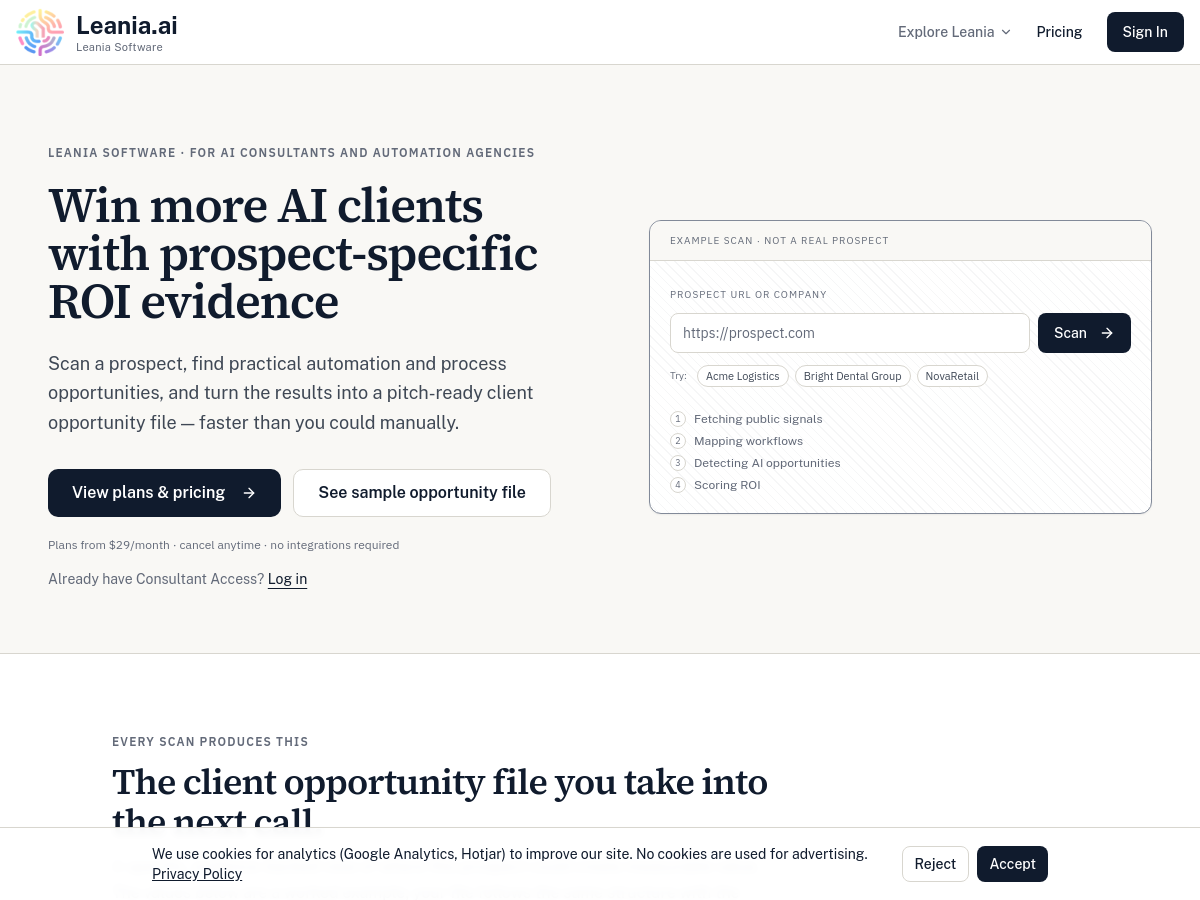
Screenshot of AI agency Copilot
AI agency Copilot
B2B sales Unknown

AI agency Copilot is a SaaS product from Leania.ai designed for AI consultants and automation agencies that want to win clients with evidence-backed recommendations. It scans a prospect's website and public signals to map workflows, tools, and bottlenecks, then identifies practical automation and process opportunities. The output is a client opportunity file containing a top issue, pitch angle, ROI ranges, discovery questions, and next steps, which consultants can take directly into sales conversations. Leania.ai positions the tool as a way to move beyond generic AI pitches. Instead of saying 'we help businesses adopt AI,' consultants can show a prospect specific workflow inefficiencies and estimated time savings. The platform uses a fixed verdict vocabulary — Keep, Cut, Replace, Validate — so reports remain consistent across prospects. Optional add-ons include a pitch deck builder, ROI evidence pack, and proposal builder, each priced per client. The product is offered as a subscription with plans starting at $29 per month, and it requires no integrations. It also includes free growth tools: an opportunity widget for a consultant's website to capture inbound leads, and a Chrome extension for evaluating SaaS tool fit while browsing. The tool is aimed at B2B sales for AI services, helping consultants qualify prospects and prepare proposal-ready materials faster.

Solves

AI consultants and automation agencies often struggle to differentiate themselves with generic pitches. AI agency Copilot solves this by scanning a prospect's public signals, mapping workflows and tools, and producing evidence-backed ROI estimates and opportunity files that consultants can use in discovery calls, pitches, and proposals.

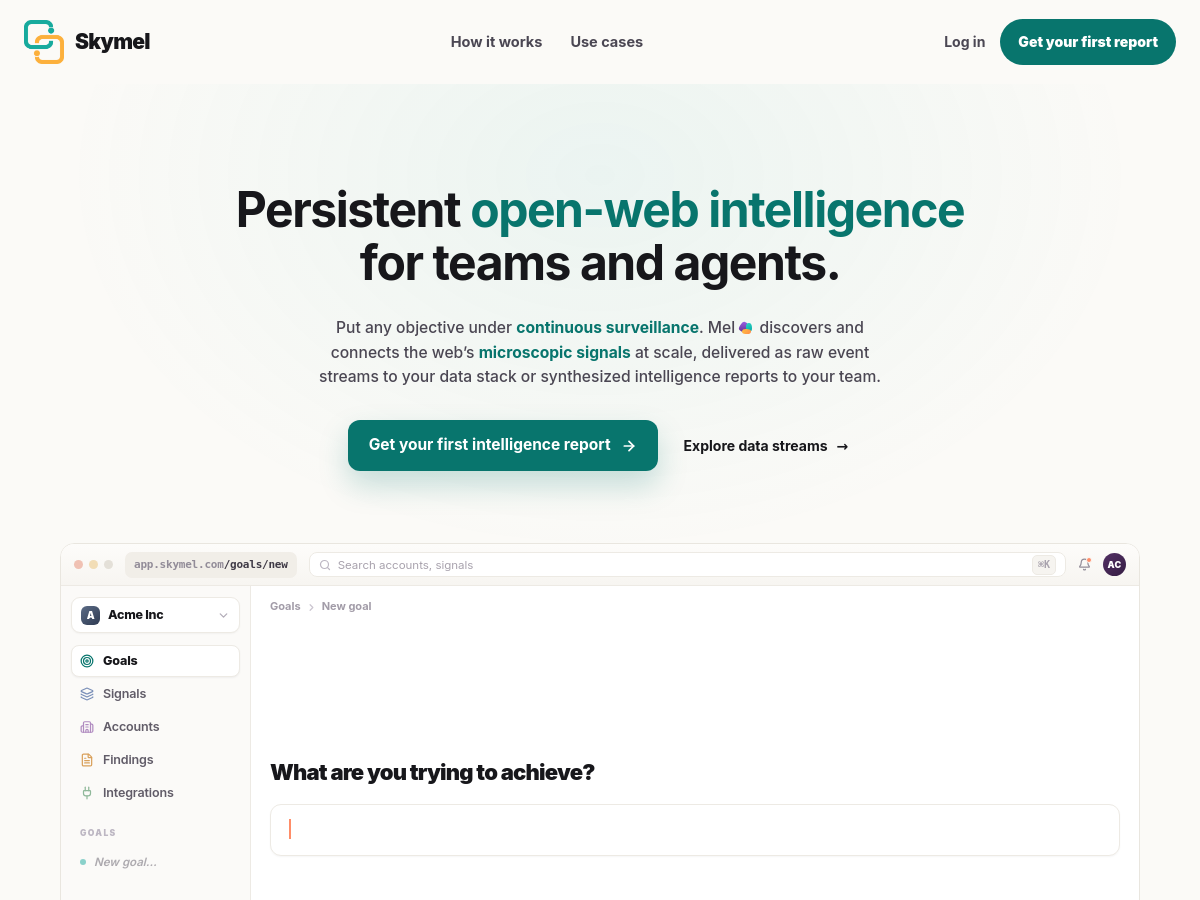
Screenshot of Mel by Skymel- Persistent Open-Web intelligence Infra

Skymel is a persistent open-web intelligence infrastructure that continuously monitors public sources to track any objective. It ingests microscopic signals from sources such as LinkedIn, GitHub, Reddit, Hacker News, Stack Overflow, Glassdoor, YouTube, Medium, Crunchbase, Discord, and G2, then connects fragments into a live knowledge graph. The platform delivers changes either as raw event streams for data stacks and agents or as synthesized intelligence reports for teams.

Solves

Teams and agents lack persistent, automated visibility into the open web's weak signals relevant to their goals. Skymel solves this by continuously monitoring fragmented public information, connecting it into a live knowledge graph, and delivering actionable changes as raw event streams or synthesized intelligence reports.

Screenshot of Best Of Ml Python
Best Of Ml Python
AI/ML Open Source

Best of ML Python is a curated, ranked list of popular machine learning Python libraries hosted on GitHub. It is generated automatically using a best-of generator that collects metadata from GitHub and PyPI, computing a quality score based on metrics like stars, forks, activity, and documentation. The list is updated weekly via scheduled GitHub Actions, ensuring it reflects current trends in the ML ecosystem. It covers a wide range of categories such as computer vision, natural language processing, reinforcement learning, and model interpretability, making it a comprehensive resource for discovering top-tier tools. The project serves as a starting point for developers and researchers looking to navigate the vast landscape of Python ML libraries without manual scouring.

Solves

Best of ML Python solves the challenge of discovering, comparing, and selecting high-quality machine learning Python libraries by providing an automatically curated, ranked list that aggregates community metrics and project metadata, saving practitioners time and effort.

Screenshot of WebsitePublisher AI
WebsitePublisher AI
AI/ML Freemium

WebsitePublisher AI is a platform that bridges conversational AI assistants like ChatGPT, Claude, and Mistral with live web publishing. Users describe the website or application they want in natural language, and the AI constructs and deploys it instantly using WebsitePublisher’s structured building blocks and hosting infrastructure. Unlike generating raw HTML code, the platform provides a full end-to-end solution: hosting on a real URL, built-in integrations for forms, payments (Stripe, Mollie), email, and spam protection, professional image handling, and secure API key storage. It includes a visual editor for post-generation refinements and a persistent task history that maintains context across different AI models and sessions. With 92 integrations, no lock-in, and live publishing in minutes, it abstracts away the entire technical stack of CMS, hosting, DNS, and backend configuration.
Solves

Non-technical creators and small businesses often struggle to turn a website idea into a live, functional site. Even using AI to generate HTML leaves them with the burden of self-hosting, setting up forms, payment gateways, and ongoing maintenance. WebsitePublisher AI solves this by enabling any AI assistant to act as a full-stack publisher: the user simply describes their need, and the AI uses the platform’s infrastructure to create, host, and integrate everything in one conversation. This eliminates hosting, DNS, backend coding, and platform lock-in, making professional web publishing accessible through natural chat.

Screenshot of OpenCLI
OpenCLI
AI Agents Open Source

OpenCLI is an open-source tool that turns any website into a command-line interface (CLI). It enables users to interact with web services directly from the terminal, removing the need for manual browser navigation. The tool integrates an AI agent that operates within the user's logged-in browser session, allowing it to perform actions on websites as the authenticated user. This makes it possible to automate tasks that require login credentials without exposing passwords or building custom API integrations. OpenCLI is designed for developers and automation enthusiasts who need to script interactions with web applications that lack public APIs or to streamline repetitive web-based workflows. The project is hosted on GitHub and welcomes community contributions.

Solves

OpenCLI addresses the challenge of programmatically interacting with websites that do not provide public APIs or require authentication. By leveraging an existing logged-in browser session and an AI agent, it enables users to automate web tasks and build CLI interfaces for any web service without writing complex browser automation code.

Screenshot of Planning With Files
Planning With Files
AI Agents Open Source

Planning With Files is an open-source framework that provides persistent, file-based planning for AI coding agents and long-running agentic tasks. It addresses the challenge of context loss in LLM-based agents by storing agent plans as markdown files on disk, ensuring that progress survives crashes, context windows resets, or commands like /clear. The core idea is to give an agent a structured set of files (typically plan.md, status.md, and completion gates) that act as external memory, allowing deterministic recovery and continuation of complex multi-step tasks. The system implements a deterministic completion gate using JSON files with check-fields that must be explicitly passed to mark a task as done, preventing false completions. This makes the agent's workflow auditable and reliable. The framework is designed to be agent-agnostic via the SKILL.md standard, which has been adopted by over 60 different AI coding assistants including Claude Code, Codex, OpenCode, and Continue.dev. It includes plugins and skill definitions for seamless integration into various coding environments. Key technical features include non-blocking stop signals, PreCompact parity to optimize context usage before compactions, and robust handling of control characters in gate JSON. Version 3.1.0 introduced significant stability improvements such as stop_hook_active detection and refusal of unattested plan injection in autonomous modes. The project is actively maintained with a large community (23.2k GitHub stars, 2k forks) and receives frequent updates. The framework is particularly suited for autonomous coding agents that need to execute long sequences of operations—such as refactoring, code generation, or multi-file edits—without human intervention. It also supports multi-agent coordination by providing a shared, file-based planning layer that agents can read and update, enabling complex orchestrations of agentic workflows.

Solves

AI coding agents frequently lose their context when sessions are reset, leading to incomplete tasks or repetitive work. This is especially problematic for autonomous agents that must operate over extended periods without human oversight. Planning With Files solves this by providing a crash-proof, file-based planning mechanism. The agent's plan, progress, and completion state are stored in simple markdown and JSON files, which survive context clears, crashes, and even agent restarts. A deterministic completion gate ensures that tasks are not mistakenly marked as finished, making long-running agentic workflows robust and trustworthy.

Screenshot of Watermarks Remover
Watermarks Remover
AI/ML Open Source

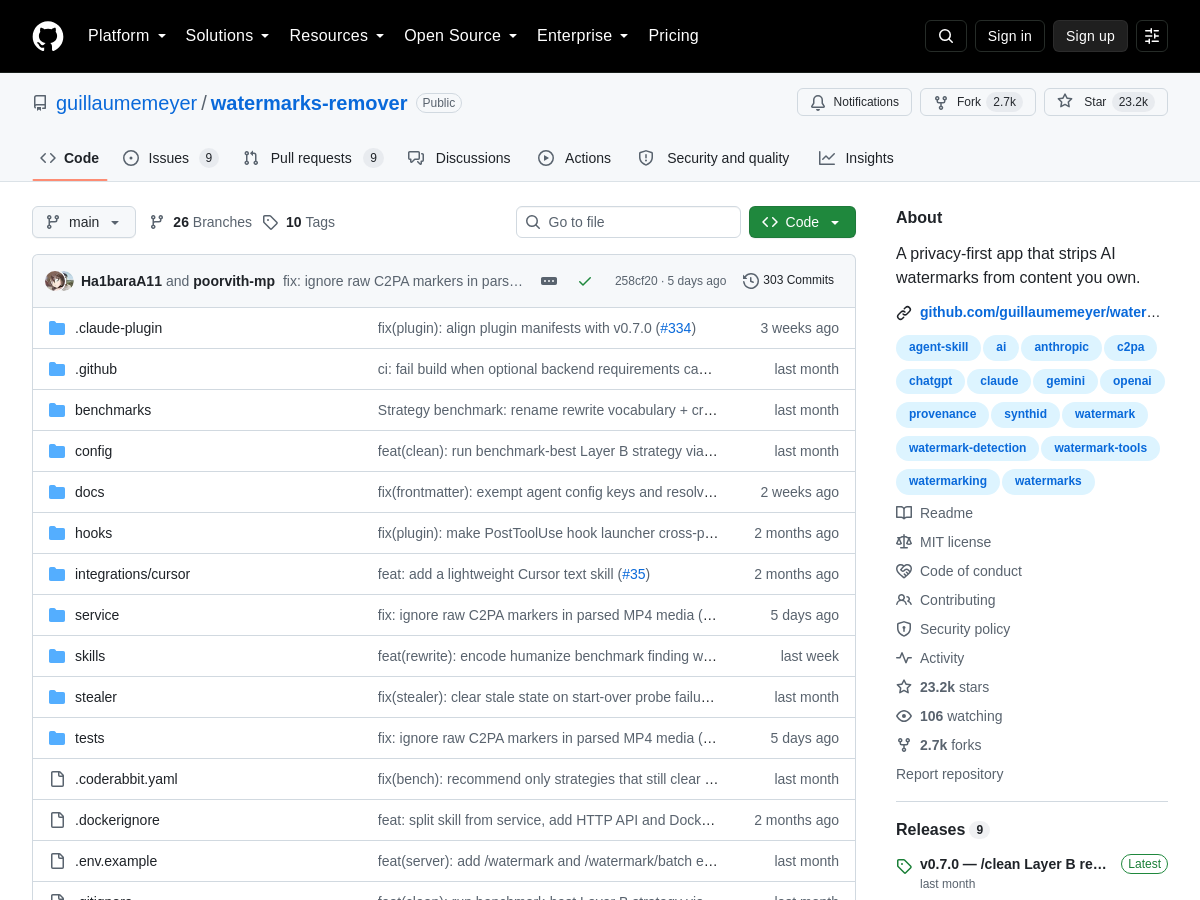
Watermarks Remover is a privacy-first app that strips AI watermarks from content you own. The project is hosted on GitHub and has gained significant attention with over 23,000 stars. The tool is designed to remove watermarks from AI-generated content, ensuring that users have control over their own creations. The project has a strong focus on community involvement, with multiple contributors and a transparent development process. The codebase is well-organized, with clear documentation and a robust testing framework. The tool supports various input formats and provides a range of configuration options, making it a versatile solution for users who want to remove AI watermarks from their content. The project's commitment to privacy and user control has resonated with the open-source community, and it continues to evolve with new features and improvements. The development team is active, and the project has a clear roadmap for future development. Overall, Watermarks Remover is a powerful tool that empowers users to take control of their AI-generated content and ensures that their creations are free from unwanted watermarks. The project's open-source nature and strong community involvement make it an attractive solution for users who value transparency and collaboration. With its robust feature set and active development, Watermarks Remover is an excellent choice for anyone looking to remove AI watermarks from their content. The tool's documentation is comprehensive, and the codebase is well-maintained, making it easy for users to get started and for developers to contribute to the project. The project's focus on privacy and user control has significant implications for the future of AI-generated content, and Watermarks Remover is poised to play a key role in shaping this landscape.

Solves

The problem of AI watermarks being embedded in user-generated content is a significant concern for many creators. These watermarks can be used to track and identify the source of the content, potentially infringing on the user's privacy and intellectual property rights. Watermarks Remover solves this problem by providing a simple and effective way to remove these watermarks, giving users control over their own creations and ensuring that their content is free from unwanted tracking or identification. By removing AI watermarks, users can protect their privacy and maintain ownership of their content, which is essential for creators who rely on their intellectual property to make a living.

Screenshot of Letta
Letta
AI Agents Open Source

Letta is an open-source platform for building stateful AI agents with advanced memory management. Originally released as MemGPT, it introduces a virtual context management system that allows large language models to store and retrieve long-term memory beyond their fixed context windows. This enables agents to maintain persistent state, recall past interactions, and self-improve over time. The platform includes a Python SDK, a REST API server, and a CLI for defining agents with custom memory blocks, tools, and multi-step workflows. Developers can connect various LLM providers, integrate external APIs and vector databases, and deploy agents as services. Letta supports scheduling, human-in-the-loop interruptions, and hierarchical memory tiers for efficient context handling. Letta can be self-hosted entirely via Docker or Kubernetes, or used through the hosted Letta Cloud service. The open-source core is actively developed and suitable for experimentation and production deployments. Its architecture decouples agent logic from model context, enabling more reliable long-running autonomous tasks.

Solves

Traditional LLM applications are stateless and limited by context windows, making it hard to build agents that remember users, learn from history, and execute long tasks. Letta solves this by providing persistent memory, virtual context management, and a framework for stateful agents that can accumulate knowledge and adapt over time.

Screenshot of Skyvern
Skyvern
LLM Open Source

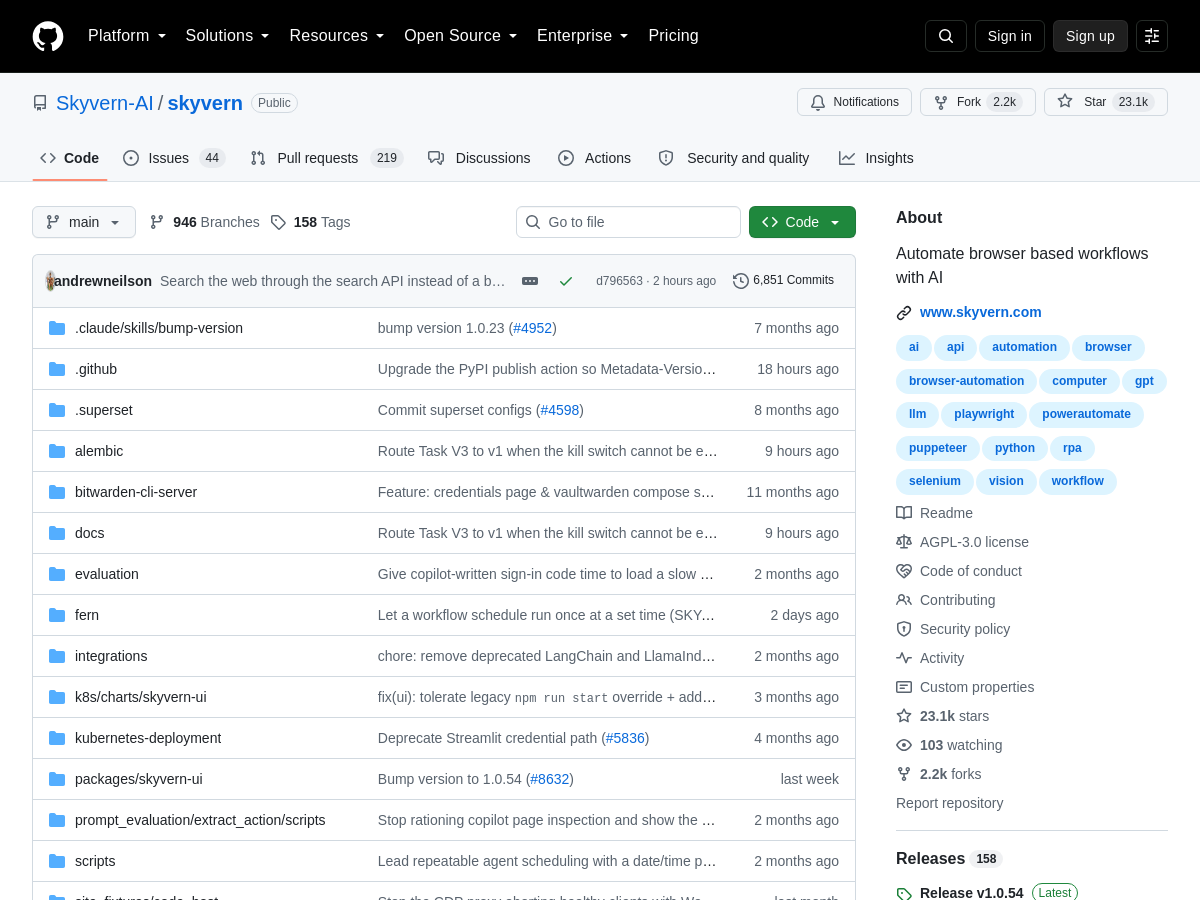
Skyvern is an open-source project that enables users to automate browser-based workflows with AI. The project is hosted on GitHub and has gained significant attention, with over 23,000 stars. Skyvern's primary goal is to simplify the process of automating tasks on the web by leveraging the power of artificial intelligence. The project provides a range of features, including workflow automation, browser-based interactions, and AI-driven decision-making. Skyvern's architecture is designed to be modular and extensible, allowing developers to easily integrate new features and functionalities. The project's community is active, with numerous contributors and maintainers working together to improve and expand Skyvern's capabilities. Overall, Skyvern has the potential to revolutionize the way we interact with the web, making it easier and more efficient to automate tasks and workflows. Skyvern's documentation and codebase are well-organized, making it easier for new contributors to get started. The project's maintainers are committed to ensuring that Skyvern remains a stable and reliable tool for automating browser-based workflows. With its strong community and robust feature set, Skyvern is an excellent choice for anyone looking to automate tasks on the web. Skyvern's use of AI enables it to learn from user interactions and improve its performance over time, making it an increasingly valuable tool for automating complex workflows. The project's open-source nature also ensures that it remains transparent and customizable, allowing users to modify and extend Skyvern to meet their specific needs.

Solves

Skyvern solves the problem of manually performing repetitive and time-consuming tasks on the web. By automating browser-based workflows with AI, Skyvern saves users time and effort, allowing them to focus on more complex and creative tasks. Additionally, Skyvern's AI-driven decision-making capabilities enable it to make informed decisions and take actions on behalf of the user, further increasing productivity and efficiency. Overall, Skyvern provides a powerful solution for anyone looking to automate tasks on the web, making it an essential tool for developers, businesses, and individuals alike.

Screenshot of ComicInk
ComicInk
Comics Freemium

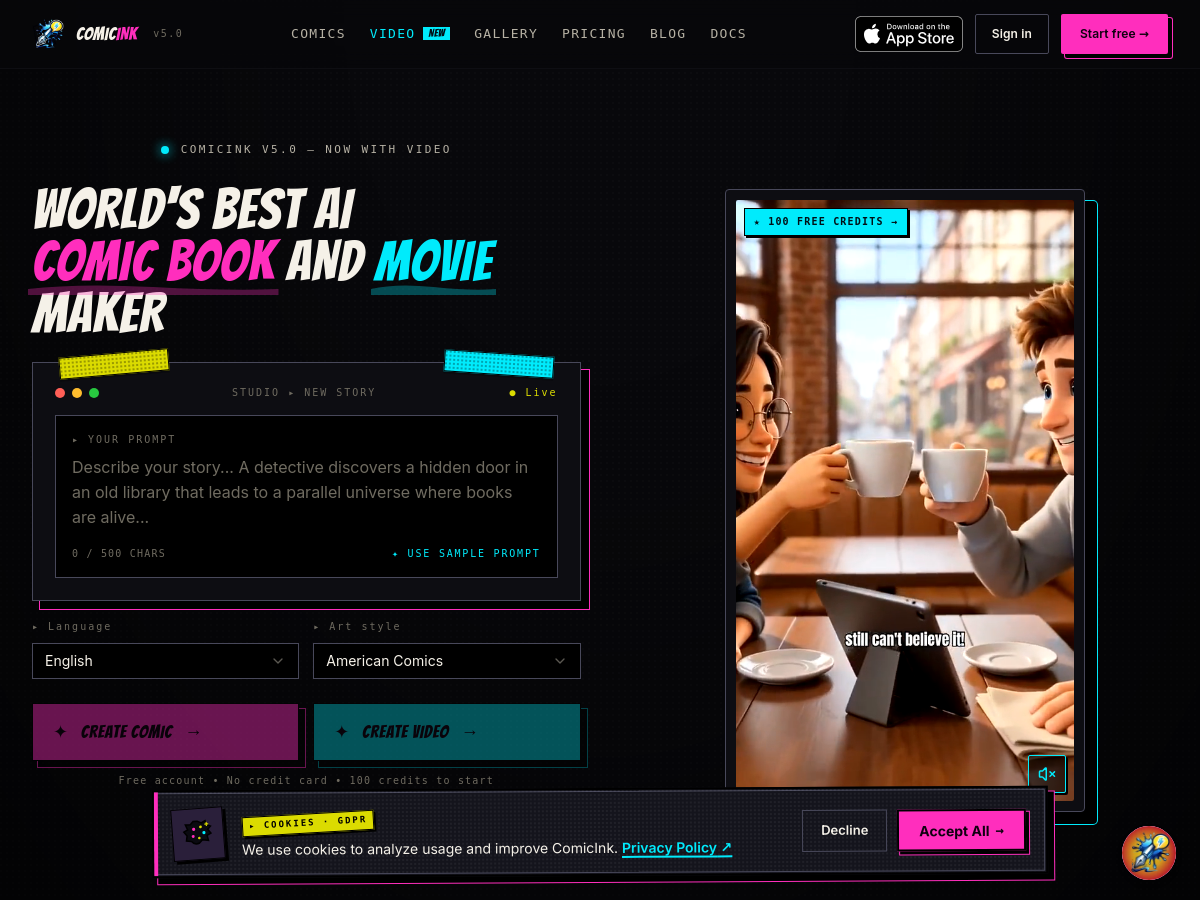
ComicInk is a freemium AI creative studio for generating comic books and narrated story videos from text prompts. The homepage describes it as the “World's best AI comic book and movie maker” and states that it turns words into printable comics and narrated films. Users provide a prompt (up to 500 characters), choose a language and an art style, and can create either a comic issue or a video. The platform advertises 12 art styles, including American Comics, Cartoon, European BD, Digital Art, and Chibi. Version v5.0 introduced video support, allowing a single prompt to generate a multi-scene film. ComicInk offers a free account with 100 credits and no credit card required. The site includes a public gallery of user-created comics and films, pricing, blog, help docs, and an iOS app available on the App Store. It is positioned for storytellers and creators who want to produce illustrated narratives or animated story videos without manual drawing or animation. The homepage shows example outputs such as personal stories, educational comics, and short films. It also lists support for multiple languages and several visual styles. The service is cloud-based and accessible through the web and iOS.

Solves

ComicInk reduces the skill and production barriers of creating comics and animated story videos by using AI to generate illustrated panels and narrated films from text prompts. It helps users avoid manual drawing, lettering, storyboarding, and animation work, making comic and video creation accessible to non-artists.

Screenshot of Grok
Grok
Productivity Free

Grok is a conversational AI assistant developed by xAI, designed to provide answers and engage in dialogue on a wide range of topics. It is integrated with the X platform (formerly Twitter) to access real-time information, allowing it to reference current events and social media trends. Grok is noted for its 'rebellious' and humorous personality, aiming to answer questions with wit and a touch of irreverence. The model is trained to be helpful and entertaining, with fewer restrictions than some competing assistants. As of the available public information, Grok is available to X Premium subscribers and has also been offered through a standalone chatbot interface. It represents xAI's effort to create AI systems that are curious and grounded in real-time knowledge. The service is consumer-facing, with potential API access for developers, though specifics are not confirmed. Grok is a closed-source commercial product, and its exact technical specifications are not publicly detailed.

Solves

Grok solves the problem of generic AI responses by providing a conversational assistant that incorporates real-time context from the X platform, delivering timely and context-aware answers. It also aims to address the demand for AI with a distinctive personality and fewer safety constraints, appealing to users seeking a more candid interaction.

Screenshot of 1-Click OpenClaw | Hostinger

1-Click OpenClaw by Hostinger is a managed AI assistant service that lets users deploy an always-on, private AI agent with a single click. It is designed for everyday automation, handling daily tasks around the clock with zero configuration and no hidden steps. Hostinger manages the underlying infrastructure, including security, updates, and backups, so users do not need to maintain servers or containers. OpenClaw includes built-in tools such as access to AI models, web browsing capabilities, and an agentic mailbox, enabling it to perform tasks like email drafting, research, and workflow automation. The service is positioned within Hostinger's agentic AI ecosystem, where users can choose from multiple automation apps on a single plan and switch anytime. The platform targets both technical and non-technical users by eliminating jargon and complexity. With more than 100,000 agents already deployed, Hostinger promotes OpenClaw as a fast, low-maintenance way to adopt AI agents for personal or small business productivity.

Solves

OpenClaw removes the complexity of setting up and maintaining an always-on AI agent. Users can deploy a private AI assistant in 60 seconds with zero configuration, and Hostinger handles security, updates, and backups, letting them automate daily tasks without DevOps expertise.

Screenshot of Stagehand
Stagehand
AI Agents Open Source

Stagehand is an open-source software development kit (SDK) designed to simplify the creation of AI-powered browser agents. It provides a high-level, natural language interface that allows developers to instruct agents to perform tasks on web pages without writing detailed DOM manipulation code. The SDK abstracts away the complexities of browser automation, enabling agents to navigate, click, type, and extract data using simple commands. Developed and maintained by Browserbase, Stagehand is built on top of robust browser automation technologies, likely leveraging Playwright for cross-browser support. It is intended for developers building intelligent agents that need to interact with the web, such as automated research assistants, data extraction pipelines, or end-to-end testing bots. The SDK is written in TypeScript and can be integrated into Node.js projects. Stagehand allows agents to understand and execute natural language instructions like "find the top news headlines and summarize them" or "fill out the contact form with the given details". It handles the translation of these instructions into low-level browser actions, including waiting for elements, handling dynamic content, and managing page state. The result is a significant reduction in development time for browser-based AI applications. The project is open source, encouraging community contributions and transparency. It is part of Browserbase's ecosystem, which offers additional cloud infrastructure for browser automation at scale. Stagehand can be used independently or in conjunction with other AI frameworks and language models, making it a flexible choice for developers exploring agentic web automation.

Solves

Stagehand addresses the challenge of building AI agents that can reliably interact with web pages. It provides a natural language abstraction over browser automation, eliminating the need for brittle selectors and manual scripting. Developers can quickly create agents that perform complex web tasks, reducing time-to-market for automation solutions.

Screenshot of Free Llm Api Resources

Free LLM API Resources is a curated list hosted on GitHub that aggregates free API endpoints for accessing large language models. It aims to help developers find no-cost options for LLM inference without needing to self-host models. The list includes various providers that offer free tiers or trial credits for their LLM APIs. The repository likely contains entries with details such as provider name, API endpoint, authentication method, rate limits, and supported models. It serves as a convenient reference for quickly locating free LLM services for experimentation, prototyping, and small-scale applications. By centralizing this information, the project lowers the barrier to entry for developers who want to integrate LLM capabilities into their projects but have budget constraints. It is community-maintained and open for contributions.

Solves

Finding free LLM inference APIs can be time-consuming and scattered across the web. This curated list solves that by providing a centralized, up-to-date resource where developers can quickly discover free options for LLM access without cost.

Screenshot of Nocobase
Nocobase
AI Agents Open Source

NocoBase is an open-source AI + no-code platform designed to build business systems rapidly. It combines a WYSIWYG no-code interface with AI capabilities that operate on top of production-proven infrastructure, allowing users to create applications without writing code while maintaining reliability. The platform focuses on accelerating development by leveraging AI to assist in building business applications, rather than generating everything from scratch, which ensures that the result is based on stable, tested foundations. NocoBase is self-hosted and distributed as an open-source project, giving organizations full control over their data and deployment. It targets teams that need to quickly deliver internal tools, management systems, and custom business software with minimal coding effort. The project is actively maintained on GitHub and encourages community contributions.

Solves

NocoBase addresses the challenge of slow and complex custom business software development by offering a no-code platform that uses AI to speed up creation while relying on proven infrastructure for reliability.

Screenshot of Activepieces
Activepieces
AI Agents Open Source

Activepieces is an open-source automation platform designed to help users connect various applications and services to automate workflows without writing code. It offers a visual builder with a drag-and-drop interface, making it accessible to business users and developers alike. The platform supports a wide range of integrations and can be self-hosted for full data control. In addition to traditional workflow automation, Activepieces has embraced AI agents and the Model Context Protocol (MCP). It provides a curated collection of approximately 400 MCP servers that enable AI agents to interact with external tools and services. This allows users to build AI-powered automations and agents that can perform complex tasks by leveraging multiple tools. Activepieces is designed to be extensible and developer-friendly, with support for custom code steps and webhooks. It competes with tools like Zapier, Make, and n8n by offering an open-source alternative that can be deployed on-premises or used as a cloud service. The project is actively maintained on GitHub with a growing community.

Solves

Activepieces solves the problem of manual, repetitive tasks by enabling users to automate workflows across different applications without needing to write code. It also addresses the need for AI agents to have access to a wide range of tools through MCP servers, simplifying the integration of AI into business processes.

Screenshot of GenAI_Agents
GenAI_Agents
AI Agents Open Source

GenAI_Agents is a comprehensive collection of over 50 tutorials and implementations for Generative AI agent techniques, ranging from basic conversational bots to complex multi-agent systems. The repository provides hands-on examples and code snippets that demonstrate various concepts such as retrieval-augmented generation (RAG), tool use, memory management, and agent collaboration. It serves as an educational resource for developers and researchers looking to build and understand modern AI agents. The project is structured to guide users through progressively advanced topics, covering both theoretical foundations and practical implementation details. Each tutorial includes runnable code and detailed explanations, making it suitable for self-study or as a reference for building custom agent-based applications. The repository is actively maintained and open to community contributions, reflecting the latest trends in generative AI and large language models. GenAI_Agents is ideal for those who want to move beyond simple chatbot APIs and explore the emerging field of autonomous agents, multi-agent orchestration, and tool-augmented language models. The examples often leverage popular frameworks like LangChain, AutoGen, and OpenAI APIs, providing a solid starting point for experimentation.

Solves

GenAI_Agents addresses the challenge of learning and implementing generative AI agent architectures by offering a curated set of practical tutorials and code examples. It bridges the gap between theoretical concepts and real-world implementation, enabling developers to quickly prototype and understand agent-based systems.

Screenshot of Openui
Openui
AI/ML Open Source

OpenUI is an open-source tool developed by Weights & Biases that allows users to describe user interfaces using natural language and instantly see them rendered live in the browser. The platform leverages large language models to interpret text descriptions—ranging from simple layout requests to detailed component specifications—and generates corresponding HTML, CSS, and JavaScript code in real time. This immediate feedback loop enables rapid iteration, making it easy to tweak the description and watch the UI update on the fly. Built with a Python backend and a modern frontend, OpenUI can be deployed locally or on a server, giving users full control over their data and environment. The tool supports a variety of UI frameworks and component libraries, and it can export clean, production-ready code for further development. Its interactive playground includes features like live preview, code editing, and version history to streamline the UI creation process. OpenUI is designed to bridge the gap between idea and implementation, empowering both technical and non-technical users to prototype interfaces without writing a single line of code. It integrates with the Weights & Biases ecosystem, allowing ML practitioners to quickly build monitoring dashboards or experiment tracking UIs. The project is actively maintained on GitHub, with a growing community contributing templates, models, and extensions.

Solves

Designers, product managers, and developers often struggle to quickly translate conceptual UI ideas into visual mockups, leading to slow iteration cycles and communication gaps. OpenUI solves this by enabling anyone to describe a desired interface in plain English and instantly see a rendered version, eliminating the need for manual coding or design tools during early-stage prototyping.

Screenshot of Archon
Archon
Dev Tools Open Source

Archon is an open-source harness builder designed for AI coding. It provides a structured environment that allows developers to define, manage, and execute AI-powered coding tasks. The goal is to make AI coding deterministic and repeatable, addressing the common challenge of inconsistent outputs from AI models. By offering a harness, Archon enables integration of AI coding into existing development workflows with more control. It is positioned as the first open-source tool of its kind, aiming to bring reliability and reproducibility to AI-assisted software development.

Solves

AI coding often produces non-deterministic results, making it difficult to use reliably in production or CI/CD pipelines. Archon solves this by providing a harness that structures AI coding tasks, ensuring deterministic and repeatable execution.

Screenshot of Recommenders
Recommenders
AI/ML Open Source

The Recommenders repository is an open-source project that provides a comprehensive collection of best practices for building recommendation systems. It includes ready-to-use implementations of state-of-the-art algorithms, ranging from traditional collaborative filtering to deep learning-based models. The project aims to help researchers and practitioners quickly evaluate and compare different approaches using standardized datasets and evaluation metrics. The repository is structured around practical examples, offering Jupyter notebooks that demonstrate how to load data, train models, and evaluate their performance. It covers various recommendation scenarios such as collaborative filtering, content-based filtering, and hybrid methods. Key algorithms include Alternating Least Squares (ALS), Singular Value Decomposition (SVD), Neural Collaborative Filtering (NCF), Variational Autoencoders (VAE), and more. Each algorithm is implemented with consistent APIs to facilitate easy experimentation. In addition to algorithms, the project provides utilities for data preprocessing, splitting, and evaluation. It includes common recommendation datasets like MovieLens, Criteo, and others, preprocessed and ready for use. The evaluation framework supports diverse metrics such as precision, recall, NDCG, and RMSE, enabling rigorous comparison between models. The code is well-documented and accompanied by tutorials, making it suitable for both beginners and experts in the field. The project is maintained by a team of contributors and has a large community, with extensive testing and continuous integration to ensure reliability. It supports multiple deployment options including Docker containers for reproducible environments, and is designed to run on various hardware, including GPUs for accelerated training of deep learning models.

Solves

Developers and data scientists often struggle to implement and benchmark recommendation algorithms due to the lack of standardized tools and best practices. This repository solves that by providing a well-tested, modular codebase that covers the end-to-end process of building and evaluating recommender systems, reducing development time and enabling fair comparisons.

Screenshot of Awesome Gpt Image 2
Awesome Gpt Image 2
Prompt Engineering Open Source

Awesome Gpt Image 2 is an open-source prompt engineering repository dedicated to GPT-Image2, a generative AI model for image creation. It presents a 'Prompt as Code' philosophy, treating prompts as structured, reusable code-like artifacts rather than ad-hoc text. The repository includes a comprehensive template library of over 20 industrial-grade prompt templates, designed to produce consistent and high-quality image outputs across various use cases such as marketing, design, and content generation. The project is built on the reverse engineering of more than 530 real-world GPT-Image2 cases, providing users with concrete examples and patterns that have been tested in practice. These examples are distilled into reusable 'Skills'—modular prompt components that can be combined to address specific image generation challenges. The repository is continuously updated, reflecting the evolving capabilities of GPT-Image2 and emerging best practices in prompt engineering. As a community-driven resource, Awesome Gpt Image 2 serves as both a learning hub for newcomers and a practical toolkit for professionals seeking to harness the full potential of GPT-Image2. It bridges the gap between experimental prompt crafting and systematic, reproducible prompt management, making complex image generation workflows more accessible and efficient.

Solves

This tool addresses the difficulty of crafting effective prompts for GPT-Image2, which often requires experimentation and domain knowledge. By providing a curated collection of reverse-engineered cases, standardized templates, and modular Skill components, it enables users to generate high-quality images consistently without starting from scratch, reducing trial-and-error and improving productivity.

Screenshot of Nnn
Nnn
Dev Tools Open Source

nnn is a full-featured terminal file manager designed for performance and efficiency. It is written in C with minimal dependencies, resulting in a lightweight and fast user experience. The tool is built to be keyboard-driven, allowing users to navigate, manipulate, and manage files directly from the command line without leaving the terminal. Beyond basic file operations, nnn includes advanced features such as fuzzy search, bookmarks, batch rename, disk usage analysis, and a plugin system for extensibility. It supports multiple platforms, including Linux, macOS, and Windows (via WSL or other Unix-like environments), and integrates well with other command-line tools by allowing files to be selected and passed to external commands. nnn emphasizes low resource usage and responsiveness, making it suitable for use on older hardware or in resource-constrained environments. Its "unorthodox" approach includes a minimal interface that prioritizes speed and scriptability, positioning it as a practical alternative to more heavyweight file managers.

Solves

nnn addresses the need for efficient, keyboard-centric file management within the terminal environment. It eliminates the overhead of graphical file managers and provides power users with a fast, scriptable tool to handle file operations without leaving the command line.