Tool discovery

What type of AI tool
are you looking for?

Search the active catalog with LambdaBase AI Search, or keep browsing the popularity-ordered directory below.

Submitted search queries and interaction metrics may be analyzed to improve result quality. Do not include personal or confidential information

Browse popular tools.

Screenshot of CV
CV
AI Agents Free

This GitHub repository is a comprehensive collection of deep learning notes written in Chinese. It is titled '超级全面的深度学习笔记' and is marked as completed (已完结), indicating that the author has finished compiling notes for all listed courses and tutorials. The repository is free to access and serves as a consolidated study resource for deep learning enthusiasts. The notes cover four main sources: Tudui PyTorch (土堆 PyTorch), a popular Chinese PyTorch tutorial series; Li Mu's Dive into Deep Learning (李沐 动手学深度学习); Andrew Ng's Deep Learning Specialization (吴恩达 深度学习); and Dafei's Large Model Agent (大飞 大模型Agent), which likely focuses on building agents with large language models. This combination provides a progression from foundational deep learning theory and PyTorch implementation to advanced topics in AI agents. The repository is intended for Chinese-speaking learners who wish to study deep learning systematically. The notes are expected to include summaries, key concepts, and possibly code snippets, making them useful for both initial learning and quick reference. As an open-source project, it can be freely downloaded, modified, and shared. Because this is a notes repository rather than a software tool, it does not provide executable functionality. Its value lies in organizing and condensing widely-used educational materials into one place. The completion status suggests that no further major updates are planned, but it remains a static resource.

Solves

It solves the problem of fragmented and scattered deep learning learning materials by providing a single, well-organized collection of notes covering multiple popular courses and tutorials, saving learners time and effort in consolidating information and offering a structured learning path from basics to advanced agent development.

Screenshot of Datasets
Datasets
Database Open Source

Hugging Face Datasets is an open-source Python library that provides a unified hub for accessing, sharing, and processing thousands of ready-to-use datasets for machine learning and AI. It simplifies the entire data pipeline by offering a consistent API to load datasets of various formats (text, image, audio, video, tabular, etc.) from a centralized repository—the Hugging Face Hub—or from local files. The library automatically handles downloading, caching, and versioning, ensuring reproducibility across experiments. Under the hood, Datasets leverages Apache Arrow for efficient, zero-copy reads and supports memory-mapping, allowing users to work with datasets larger than available RAM. It includes built-in features for data manipulation such as filtering, shuffling, splitting into train/test sets, and applying custom pre-processing functions in a batched, multi-processed manner. Integration with popular deep learning frameworks like PyTorch, TensorFlow, and JAX is seamless, enabling direct conversion to native data loaders. The library also supports streaming mode for massive datasets that cannot fit on disk, fetching and processing data on-the-fly. Beyond data access, it provides evaluation metrics and is tightly integrated with the Hugging Face ecosystem, including transformers, tokenizers, and the Hub’s web interface for exploring dataset cards and configurations. Key features include a simple `load_dataset()` function, dataset versioning and fingerprinting, dynamic shapes via Arrow arrays, parallelized tokenization, and a growing collection of community-contributed datasets. It is designed to accelerate both research prototyping and production ML pipelines by eliminating data engineering overhead.

Solves

Machine learning practitioners and researchers often waste significant time on data acquisition, format conversion, and preprocessing when building models. Hugging Face Datasets solves this by offering a single, consistent interface to thousands of curated, versioned datasets across modalities, with efficient caching and parallel processing, drastically reducing the boilerplate and time from data to training.

Screenshot of Teable
Teable
AI/ML Open Source

Teable is an open-source, AI-powered spreadsheet that bridges the gap between traditional spreadsheets and relational databases. It offers a familiar spreadsheet interface while providing the power of a scalable database, including support for SQL queries, linked records, and advanced field types. Built with modern web technologies, Teable enables real-time collaboration, API access, and seamless integration with existing workflows. With integrated AI capabilities, users can leverage natural language to generate formulas, build SQL queries, and analyze data without deep technical expertise. The tool is designed for business teams who need flexible data management solutions, from project tracking and CRM to complex data analysis. It can be self-hosted on your own infrastructure for full data control and compliance. Teable’s architecture is extensible and developer-friendly, offering a rich plugin system and a RESTful API that allows building custom applications on top of the spreadsheet backend. It supports import/export from common formats and provides granular access controls, making it suitable for both small teams and enterprise deployments.

Solves

Teable solves the challenge of managing structured business data by offering a spreadsheet-like interface with database-grade reliability, enabling teams to build collaborative applications without coding or complex database administration, enhanced with AI assistance for data manipulation and querying.

Screenshot of Marimo
Marimo
Code Open Source

Marimo is an open-source reactive notebook for Python that changes the paradigm of interactive computing. Unlike traditional notebooks where cells are executed sequentially and hidden state can accumulate, Marimo automatically keeps track of dependencies between cells. When you modify a cell, only the cells that depend on it are re-executed, ensuring that the notebook's state is always consistent and reproducible. This reactive model eliminates common bugs like undefined variables, stale outputs, and broken pipelines. Marimo notebooks are stored as pure Python (.py) files, making them fully compatible with version control systems like Git. This means you can diff, merge, and review notebook changes just like any other code. The plain-text format also allows you to run notebooks as regular Python scripts from the command line, or deploy them as interactive web apps with `marimo run`. The editor is designed with both developers and AI in mind. It features modern code completion, inline documentation, and an AI chat panel that can assist with coding. You can interactively query databases with SQL directly inside the notebook, and the results are displayed live. Marimo also supports building rich, interactive UI elements like sliders and charts, turning notebooks into shareable dashboards. Marimo is highly flexible: use it as a traditional notebook for exploratory analysis, as a script for batch processing, or as an app for end-user interaction. It is easy to install via pip and runs locally in your browser, with support for VS Code integration. The project is actively maintained and has a growing community around reproducible, literate programming in Python.

Solves

Data scientists and developers often struggle with traditional notebooks because execution order and hidden state lead to reproducibility failures. Marimo solves this by making notebooks reactive: cells are automatically structured as a directed acyclic graph, and any change triggers a re-execution of only the affected cells. Combined with a pure Python file format, this guarantees that the notebook always reflects a consistent, deterministic state, and it can be easily versioned, shared, and deployed.

Screenshot of Agent Reach
Agent Reach
AI Agents Open Source

Agent Reach is an open-source command-line interface (CLI) tool designed to give AI agents the ability to read and search content from several major internet platforms without incurring API fees. It supports Twitter, Reddit, YouTube, GitHub, Bilibili, and XiaoHongShu, enabling agents to access public data from these sources directly. The tool is intended to be integrated into AI agent workflows, providing a simple and cost-free way to gather information from the web. By eliminating the need for paid API keys, Agent Reach lowers the barrier for developers and researchers who need social media and platform data for their AI applications.

Solves

Agent Reach solves the problem of accessing data from popular internet platforms without paying for API usage or managing API credentials. It provides a unified CLI interface for reading and searching across multiple social and content platforms, which simplifies integration for AI agents and other automated systems.

Screenshot of Agentmemory
Agentmemory
AI Agents Open Source

Agentmemory is an open-source project that provides persistent memory for AI coding agents. The project positions itself as the #1 persistent memory solution based on real-world benchmarks, aiming to enhance the ability of AI agents to retain context and knowledge across tasks and sessions. The tool is designed to be integrated into AI agent systems, offering a memory layer that can store, retrieve, and manage information. This enables agents to build upon previous interactions, reducing repetition and improving efficiency in coding and other tasks. The project is available under an open-source license, allowing developers to inspect, modify, and contribute to the codebase.

Solves

AI coding agents often lack long-term memory, causing them to forget context between sessions or tasks, leading to repetitive work and suboptimal performance. Agentmemory solves this by providing a persistent memory system that allows agents to store and recall information, thereby improving continuity and effectiveness.

Screenshot of Flow
Flow
AI/ML Open Source

Flow is an open-source framework designed to help developers build autonomous AI agents that can perform complex tasks with minimal human intervention. By leveraging large language models, Flow enables agents to plan, reason, and execute multi-step workflows, allowing users to 'move faster with autonomy.' The framework provides a modular architecture where developers can define tools, memory, and decision-making processes, making it easy to create custom AI assistants for a variety of domains. At its core, Flow abstracts the complexities of agent development, offering built-in support for task decomposition, context management, and error handling. Agents built with Flow can interact with external APIs, databases, and software interfaces, enabling automation of repetitive tasks such as data gathering, report generation, and software development. The framework emphasizes flexibility and extensibility, allowing integration with different LLM providers and custom toolkits. Flow's design philosophy centers on providing a production-ready environment for autonomous systems. It includes features like persistent memory, multi-agent collaboration, and human-in-the-loop oversight, ensuring reliable and safe operation. Developers can quickly prototype agents using declarative configurations or programmatic APIs, and then deploy them as services or integrated components within larger applications. Overall, Flow aims to accelerate the development of AI-powered automation, reducing the time and expertise required to build sophisticated autonomous agents. Its open-source nature fosters a community-driven ecosystem where contributors can share tools, workflows, and best practices, making advanced AI capabilities accessible to a wider audience.

Solves

Many developers and businesses struggle with the complexity of automating multifaceted tasks that require reasoning and adaptability. Traditional automation tools are rigid and fail in dynamic environments. Flow addresses this by providing a framework for creating autonomous AI agents that can understand objectives, break them down into actionable steps, and execute them using various tools and APIs. This allows users to delegate complex, time-consuming work to AI, boosting productivity and freeing humans to focus on creative and strategic activities.

Screenshot of Code
Code
Code Open Source

Code is an open-source project hosted on GitHub under the repository nikivdev/code. The repository page does not provide a detailed description, README, or any documentation to clarify its purpose and features. It is categorized under the 'Code' category, indicating that it is likely a tool related to programming, code editing, analysis, or management. Without further information, users must examine the source code or commit history to infer its functionality.

Solves

The specific problem solved by this tool is not documented. Based on its category, it may aim to assist with software development tasks such as code editing, generation, or collaboration.

Screenshot of Waveterm
Waveterm
Dev Tools Open Source

Wave Terminal is an open-source, cross-platform terminal application designed to integrate AI capabilities directly into the command-line workflow. It aims to provide a seamless experience for developers and technical users who need to combine traditional terminal operations with AI-powered assistance, such as command suggestions, natural language interactions, and automated task execution. The application is built to run on multiple operating systems, including Windows, macOS, and Linux, offering a consistent interface across environments. The terminal features a modern user interface with support for multiple tabs and panes, enabling users to manage several sessions simultaneously. Its AI integration allows users to ask questions, generate commands, and receive contextual help without leaving the terminal environment. This reduces context switching and enhances productivity for tasks ranging from system administration to software development and data analysis. Wave Terminal is developed as an open-source project, encouraging community contributions and transparency. It leverages modern technologies to deliver a fast and responsive experience, with a focus on extensibility and customization. The project is hosted on GitHub, where users can access the source code, report issues, and contribute to its ongoing development.

Solves

Traditional terminals lack built-in AI assistance, forcing users to switch between the terminal and external AI tools or documentation. Wave Terminal solves this by embedding AI capabilities directly into the terminal, enabling users to generate commands, receive explanations, and automate workflows without leaving the command-line environment. It also addresses the need for a modern, cross-platform terminal with a consistent experience across different operating systems.

Screenshot of Onnx
Onnx
AI/ML Open Source

ONNX (Open Neural Network Exchange) is an open standard for representing machine learning models, designed to enable interoperability across a wide range of frameworks, tools, runtimes, and hardware. It defines a common set of operators and a common file format, allowing AI developers to use models with a variety of frameworks, tools, runtimes, and compilers. The standard is backed by a consortium of major companies including Microsoft, Facebook, AWS, and others, ensuring broad industry adoption and continuous evolution. The ONNX repository provides a comprehensive Python library for creating, parsing, validating, and manipulating ONNX models. It includes the formal specification of the ONNX intermediate representation, a rich API to build and inspect computational graphs, and tools for shape inference and model verification. The library supports versioning of operator sets and models, enabling forward and backward compatibility. Additionally, it offers utilities for converting models from popular frameworks like PyTorch and TensorFlow into the ONNX format, as well as optimizing models for inference. Key features of ONNX include a large and growing set of built-in operators covering standard neural network layers, activation functions, and numeric operations. It also supports custom operators, allowing extensions for domain-specific needs. The ecosystem around ONNX includes high-performance runtimes like ONNX Runtime, hardware-specific optimizers, and integration with compilers such as TensorRT, OpenVINO, and MLIR, making it a central piece in cross-platform deployment pipelines. Overall, ONNX acts as a bridge between the training and deployment phases of machine learning workflows, reducing friction and preventing vendor lock-in. Its open governance and Apache 2.0 licensing encourage community contributions and ensure transparency. The active development community continuously refines the standard to support the latest advancements in AI, including transformers, quantization, and sparse models.

Solves

Machine learning practitioners often face the challenge of deploying models trained in one framework (e.g., PyTorch) to a production environment that requires a different framework or specialized hardware. Without a common representation, this involves costly rewrites or manual conversion scripts. ONNX solves this by providing a universal, framework-agnostic model format. It allows users to export models from a training framework and run them efficiently on diverse target platforms using a unified set of tools and runtimes, thus streamlining the entire MLOps lifecycle and enabling true model portability.

Screenshot of Coze Studio
Coze Studio
AI Agents Open Source

Coze Studio is an open-source AI agent development platform that provides an all-in-one visual environment for creating, debugging, and deploying AI agents. It aims to simplify the agent development process by offering intuitive visual tools, reducing the need for extensive coding and complex configurations. The platform supports the entire agent lifecycle from design to production, enabling developers to build custom AI solutions efficiently. Key features include a visual workflow builder that allows users to design agent logic through drag-and-drop interfaces, integrated debugging tools to test and refine agent behavior in real time, and seamless deployment options for self-hosted environments. Coze Studio is designed to be extensible, allowing integration with various AI models, APIs, and external services. As an open-source project, Coze Studio is freely available on GitHub, giving developers full control over customization and deployment. It fosters a community-driven approach to agent development, encouraging contributions and shared improvements. The platform is suitable for both individual developers and teams looking to accelerate AI agent production.

Solves

Building AI agents typically requires combining multiple tools and writing substantial code for orchestration, testing, and deployment. Coze Studio solves this by providing a unified visual platform that streamlines the entire process, enabling developers to create, debug, and deploy agents without deep coding expertise, thereby reducing development time and complexity.

Screenshot of Colleague Skill
Colleague Skill
AI/ML Open Source

Colleague Skill is an open-source project hosted on GitHub that provides a skill definition intended for AI assistants or digital life platforms. The project is described as transforming cold farewells into warm skills, welcoming users to 'Digital Life 1.0'. While specific implementation details are not provided in the repository's public description, the skill appears to be designed to enhance AI interactions related to colleague departures, possibly by creating a persona or response template that conveys warmth and empathy during farewells. It may be used to simulate a departing colleague's presence, preserve their knowledge, or generate comforting messages. The project is open source and free to use, making it accessible for developers and hobbyists interested in AI personalities or workplace communication tools. It is distributed via GitHub, allowing for community contributions and customization.

Solves

Addresses the challenge of handling colleague departures in an impersonal or cold manner by offering a skill that brings warmth and personality to farewell interactions. It enables AI systems to generate empathetic, human-like responses during employee offboarding or team transitions, potentially preserving the departing colleague's knowledge and persona in a friendly way.

Screenshot of Agents Towards Production
Agents Towards Production
AI Agents Open Source

Agents Towards Production is an open-source GitHub repository providing end-to-end, code-first tutorials for building production-grade GenAI agents. The project offers a comprehensive collection of practical guides that cover the entire lifecycle of agent development, from rapid prototyping to secure, scalable enterprise deployment. Each tutorial is designed to be hands-on, with copy-paste ready code snippets and detailed explanations that walk users through the integration of LLMs, tool calling, memory management, guardrails, monitoring, and other production essentials. The repository is structured to address real-world challenges faced when moving AI agents from experimental notebooks to robust production systems. Tutorials cover a variety of topics including agent architecture patterns, retrieval-augmented generation (RAG), multi-agent collaboration, deployment on cloud platforms, and implementing safety and reliability measures. By following these guides, developers can build agents that are not only functional but also maintainable, observable, and ready for high-traffic applications. Agents Towards Production is maintained by Nir Diamant and has gained significant community traction, with thousands of stars and forks. It serves as both a learning resource and a reference implementation for best practices in the rapidly evolving field of generative AI agents. The project encourages contributions and feedback, aiming to keep pace with the latest advancements in AI agent frameworks and tools. The tutorials are code-first, meaning they emphasize executable Python code over lengthy prose, making it easier for engineers to directly apply concepts to their own projects. Supporting materials may include Jupyter notebooks, dependency files, and configuration examples, ensuring that readers can reproduce the results and adapt them for their specific use cases.

Solves

Building a prototype AI agent is straightforward, but transitioning that prototype into a reliable, secure, and scalable production system is riddled with challenges: managing state, handling tool errors, ensuring consistent outputs, scaling user requests, monitoring performance, and maintaining security. Agents Towards Production solves this by providing battle-tested patterns and end-to-end tutorials that bridge the gap between experimental code and production-ready systems, enabling developers to deploy Generative AI agents with confidence.

Screenshot of Dyad
Dyad
AI/ML Open Source

Dyad is an open-source AI application builder designed for power users, providing a local alternative to cloud-based tools like v0, Lovable, Replit, and Bolt. It allows users to generate and assemble full applications using AI directly on their own machines, leveraging local models and giving complete control over the development process. As a local tool, Dyad ensures that code and data remain on the user's device, addressing privacy and security concerns. It targets developers and technical users who want the convenience of AI-driven app generation without relinquishing control to external services. The project is community-driven and open for contributions. The tool is distributed via GitHub, encouraging collaboration and customization. Users can extend its functionality, integrate with their preferred AI models, and adapt it to specific workflows. Dyad represents a shift toward self-hosted, privacy-conscious AI development environments.

Solves

Dyad solves the problem of relying on proprietary cloud AI app builders that require account sign-ups, impose usage limits, and may compromise sensitive project data. It provides a local, open-source alternative that gives users full ownership, offline capability, and the ability to customize the tool to their needs.

Screenshot of Cube
Cube
AI/ML Open Source

Cube is an open-source semantic layer that provides a unified data modeling and access layer for analytics, BI, and AI applications. It sits between your data sources (such as Postgres, MySQL, Snowflake, BigQuery, and many others) and downstream consumers, allowing you to define metrics, dimensions, and data transformations once and reuse them consistently across multiple tools and applications. Cube supports multi-tenancy, row-level security, and caching with pre-aggregations to deliver high-performance queries even at scale. The core of Cube is its data modeling language, where you define 'cubes' representing entities like users, orders, or products. Each cube contains measures (aggregations like count, sum, average) and dimensions (attributes for grouping and filtering). Cube automatically generates optimized SQL queries based on these definitions, which can be accessed via multiple APIs including REST, GraphQL, and SQL. This abstraction enables developers to build embedded analytics, dashboards, and data applications without worrying about the underlying database schema. Cube can be self-hosted using Docker, Kubernetes, or Node.js, and it also integrates with popular BI tools, data visualization libraries, and AI frameworks. It is widely used by companies to standardize metrics, improve query performance, and embed analytics into customer-facing products. The open-source community actively contributes extensions, drivers, and examples, making it a flexible foundation for modern data stacks.

Solves

Cube solves the problem of metric inconsistency and query performance in data-driven applications. By providing a centralized semantic layer, it ensures that all BI tools, embedded analytics, and AI systems use the same definitions and calculations, eliminating discrepancies. It also improves performance through pre-aggregations and caching, reducing load on underlying databases and enabling interactive dashboards.

Screenshot of Adk Python
Adk Python
AI Agents Open Source

ADK Python is an open-source, code-first toolkit developed by Google for building, evaluating, and deploying sophisticated AI agents. It provides developers with a flexible framework to create agents that can perform complex tasks by leveraging large language models (LLMs) and integrating with external tools and APIs. The toolkit emphasizes control and customization, allowing developers to define agent behavior, orchestrate multi-step reasoning, and manage stateful interactions. It includes built-in support for evaluating agent performance, testing with various metrics, and deploying agents to production environments. With a Python-native API, it integrates seamlessly with existing Python ecosystems and machine learning pipelines.

Solves

Developers building AI agents often face challenges in structuring agent logic, integrating with LLMs, handling state management, and evaluating performance. ADK Python solves this by providing a modular, code-first framework that streamlines the development of robust, production-ready agents, offering flexibility and control throughout the lifecycle.

Screenshot of Daily
Daily
Dev Tools Open Source

Daily is an open-source repository that provides a collection of AI-powered skills and integrations for popular coding assistants such as Claude, Cursor, and Codex. It is part of the daily.dev ecosystem, a professional network for developers to learn and collaborate. This tool enables developers to enhance their coding workflows by leveraging pre-built AI skills that assist with code generation, debugging, documentation, and more. The project organizes skills in a modular way, with dedicated directories for different AI platforms, allowing users to easily add or customize skills. It also includes a skill marketplace where developers can discover and share their own skills, fostering a community-driven approach to AI-assisted development.

Solves

Developers often struggle to effectively integrate AI assistants into their daily coding tasks due to a lack of standardized, ready-to-use skills. Daily solves this by providing a curated collection of AI skills that work across multiple coding assistant platforms, reducing the time and effort required to configure and optimize AI tools for specific tasks.

Screenshot of SWE Agent
SWE Agent
Dev Tools Open Source

SWE-agent is an open-source system that enables large language models (LMs) to autonomously resolve GitHub issues by interacting directly with a computer environment. It provides an agent-computer interface (ACI) that translates LM commands into executable actions such as file navigation, editing, and running tests, allowing the LM to iteratively modify code and verify fixes. The tool is designed to work with any LM of choice via API or local deployment, and it has demonstrated strong performance on the SWE-bench benchmark for software engineering tasks. The project originated from research at Princeton University and was accepted at NeurIPS 2024. It is built as a modular framework that can be extended to new environments and tasks beyond bug fixing, including offensive cybersecurity and competitive coding challenges. Users can configure the agent with custom prompts, tools, and execution environments to suit their needs. SWE-agent is distributed as a Python package and can be installed from source or via pip. It includes a command-line interface for running agent sessions, as well as a web interface for interactive exploration. The repository provides extensive documentation and examples to help users get started quickly.

Solves

SWE-agent automates the process of fixing software bugs described in GitHub issues by letting a language model autonomously explore, edit, and test code within a repository. It reduces the manual effort required for routine bug resolution and can also be repurposed for security testing and solving competitive programming problems.

Screenshot of Taipy
Taipy
Dev Tools Open Source

Taipy is an open-source Python framework designed to transform data and AI algorithms into production-ready web applications with minimal effort. It provides a comprehensive toolkit that includes a visual GUI builder with pre-built, customizable components based on Material UI, a robust data management layer for handling large datasets, and a scenario/pipeline management system for orchestrating complex data workflows. Taipy abstracts away the complexities of frontend development, allowing developers, data scientists, and ML engineers to focus on their Python logic while automatically generating interactive, multi-user web interfaces. It supports real-time dashboards, what-if analysis, and model versioning, making it suitable for enterprise-grade applications. The framework is highly extensible, enabling integration with popular data science libraries like Pandas, NumPy, and TensorFlow, and offers features like caching, scheduling, and user authentication out of the box. With its low-code approach, Taipy aims to bridge the gap between data prototyping and full-scale deployment, empowering teams to quickly iterate and share insights through functional, aesthetically pleasing web apps.

Solves

Data scientists and ML engineers often face challenges when trying to turn their Python-based analyses, models, and algorithms into interactive, shareable web applications without extensive web development knowledge. Traditional approaches require learning JavaScript frameworks like React or Angular, which is time-consuming and diverts focus from data science tasks. Taipy solves this by providing a Python-native framework that handles the entire web app lifecycle—from data binding and UI generation to state management and deployment—allowing users to build full-stack data applications using only Python.

Screenshot of Airllm
Airllm
LLM Open Source

AirLLM is an open-source Python library that enables inference of large language models (LLMs) such as LLaMA 70B on a single GPU with as little as 4GB of VRAM. It achieves this by loading only one transformer layer at a time into GPU memory, while keeping the remaining layers on CPU or disk. This layer-by-layer execution strategy drastically reduces memory footprint, making it possible to run models that would otherwise require multiple high-end GPUs. The library supports popular model architectures like LLaMA, Llama 2, Code Llama, and other Hugging Face transformer models. It incorporates techniques such as model sharding, quantization, and disk offloading. Users can invoke inference with a few lines of code, similar to using Hugging Face's transformers, but with the added benefit of memory efficiency. AirLLM is particularly useful for developers, researchers, and hobbyists who want to experiment with large models on consumer hardware. It allows prototyping and testing without the need for expensive cloud GPU instances or specialized hardware. The project is actively maintained and open for community contributions.

Solves

AirLLM addresses the challenge of running large language models on hardware with limited GPU memory. By offloading model layers to CPU/disk and processing them sequentially, it enables inference of models like LLaMA 70B on a single 4GB GPU, which is typically impossible due to high memory requirements.

Screenshot of Screenpipe
Screenpipe
AI/ML Open Source

Screenpipe is an open-source tool that continuously records your screen and audio 24/7, entirely on your local machine. It captures everything you see, say, or hear, and stores it locally for privacy and security. The tool provides APIs and plugins that allow AI agents and applications to query and access this recorded context, enabling them to have a detailed understanding of your digital activity. Screenpipe is built with performance in mind, using Rust for efficient screen and audio capture. It integrates with many popular AI frameworks and apps, including OpenClaw and Hermes agent, and supports connection to over 100 applications. The project is part of Y Combinator's S26 batch.

Solves

Screenpipe addresses the lack of contextual memory in AI assistants. Traditional AI agents only know what users type or explicitly provide, missing the broader context of what they have seen, said, or heard throughout the day. Screenpipe fills this gap by continuously recording screen and audio, creating a searchable, local database of personal activity that AI can use to provide more informed and personalized responses.

Screenshot of Spira
Spira
Social media posts Unknown

Spira is an AI-powered social media platform designed to automate content creation, publishing, and audience growth across major social networks including TikTok, Instagram, YouTube, and X. It introduces AI influencers—virtual persona accounts that can produce on-brand content, engage with trends, and post around the clock without manual intervention. The platform includes a suite of tools for social media management: workflow automation, a visual content calendar, social publishing scheduler, advanced analytics, and AI video/image generation. Users can create short-form videos, AI avatars, translate videos, convert scripts to video, and utilize text-to-speech. It also integrates with various AI models for content generation. Spira is built by a team with experience at CapCut, TikTok, and other creative platforms. It targets content creators, brands, and marketers who want to maintain a strong social presence without dedicating excessive time. The product has been featured on Product Hunt and offers a free tier with no credit card required.

Solves

Spira solves the challenge of consistently creating and publishing engaging social media content while growing an audience. It eliminates the manual effort of content ideation, production, scheduling, and performance tracking by using AI influencers and automation tools.

Screenshot of DB GPT
DB GPT
LLM Open Source

DB-GPT is an open-source framework designed to simplify the development of AI-powered data applications. It enables developers to build agentic workflows that combine large language models (LLMs) with data sources, tools, and memory. The framework provides a comprehensive set of components for building data agents, including multi-agent orchestration, retrieval-augmented generation (RAG), and text-to-SQL capabilities. DB-GPT introduces AWEL (Agentic Workflow Expression Language), a language for defining complex agent workflows. It supports integration with various databases, vector stores, and LLM providers, allowing users to create custom data assistants. The framework is designed for self-hosting, giving enterprises full control over their data and models. DB-GPT is used to build private domain knowledge bases, natural language data query systems, and automated data analysis agents. It aims to accelerate the development of next-generation AI + Data products by providing production-ready infrastructure.

Solves

DB-GPT addresses the complexity of building LLM-based data applications from scratch by providing pre-built agents, workflow orchestration, and integrations. It enables developers to quickly create secure, private, and accurate data assistants without deep expertise in AI infrastructure.

Screenshot of Agent Zero
Agent Zero
AI Agents Open Source

Agent Zero is an open-source AI framework designed for building autonomous AI agents. It provides foundational components and abstractions for creating agents that can perceive, reason, and act in digital environments. The framework aims to simplify the development of agent-based applications, offering tools for memory, planning, and tool integration. As an emerging project, it focuses on modularity and ease of use for developers experimenting with AI agents.

Solves

It addresses the complexity of constructing AI agents from scratch by providing a reusable, extensible framework that handles common agent functionalities like state management, tool calling, and decision-making loops.

Screenshot of Open Generative AI
Open Generative AI
Open Source Free

Open Generative AI is an open-source, self-hosted studio for AI image and video generation. It provides a unified interface to access over 500 generative models, including Flux, Midjourney, Kling, Sora, and Veo, enabling users to create content without content restrictions. The project is licensed under the MIT license, making it free to use, modify, and distribute. It is designed as an unrestricted alternative to commercial AI video platforms, offering no content filters and full control over deployment. Users can run the software on their own infrastructure, ensuring privacy and no usage limits. The tool aggregates multiple state-of-the-art generative models, allowing users to experiment with different models for both image and video synthesis. It is hosted on GitHub and actively maintained by the open-source community. The self-hosted nature makes it suitable for developers, researchers, and hobbyists who need flexible and unfiltered AI generation capabilities.

Solves

Open Generative AI addresses the limited availability of unrestricted, affordable AI image and video generation tools by providing a free, open-source, self-hosted platform with a wide range of models and no content filters, enabling users to generate content without censorship or subscription costs.

Screenshot of Articos
Articos
Product research Unknown

Articos is an AI-powered user research platform that runs synthetic user interviews to generate audience insights. It is designed to help teams validate messaging, landing pages, product ideas, and other product-related decisions with simulated respondents. According to the company, the method is grounded in behavioral science and, as of the latest published validation, claims 86% human accuracy across 46 studies. The platform aims to deliver full research reports in under 30 minutes, compared to traditional research projects that may take weeks and cost thousands of dollars. Articos addresses the common gap in decision-making where teams skip research because it is too expensive, slow, or logistically complex. Instead of sourcing and scheduling human participants, Articos uses AI-generated personas that are interviewed in isolation and remain hypothesis-blind. This approach is intended to reduce interviewer bias and produce candid, structured insights about jobs-to-be-done, pain points, and attitudes. Pricing on the platform starts at $8 per research on a monthly plan, with on-demand packs going for $14.50 per research, and a free trial is available. The service supports a range of use cases including audience discovery, ICP (ideal customer profile) definition, positioning validation, messaging and copy testing, A/B testing for landing pages, and ad campaign evaluation. Articos is positioned for industries such as B2B SaaS, agencies, consultants, healthcare, consumer goods, and creator teams. Its goal is to make user research accessible for every meaningful decision rather than only for high-budget projects.

Solves

Traditional user research typically costs $5,000–$15,000 per study and takes 4–8 weeks, causing many teams to decide without evidence. Articos provides on-demand synthetic user interviews that produce a structured research report in under 30 minutes at a fraction of the cost, allowing businesses to validate audience assumptions, messaging, and product ideas quickly and affordably.

Screenshot of DocsGPT
DocsGPT
LLM Open Source

DocsGPT is an open-source platform designed for building private AI agents, assistants, and enterprise search solutions. It enables organizations to create custom AI systems that can process and understand their own documentation and data without relying on external services. The platform includes a built-in Agent Builder, deep research capabilities, document analysis tools, multi-model support (allowing users to choose from various LLM providers), and API connectivity for extending agents with additional functionality. DocsGPT can be self-hosted using Docker, providing full control over data privacy and security. It is suitable for teams of all sizes that need a customizable, privacy-focused AI assistant for internal knowledge management and customer support.

Solves

DocsGPT solves the challenge of leveraging large language models on proprietary or sensitive documents without compromising data privacy. It provides a self-hosted, open-source platform that lets organizations build AI assistants and search tools tailored to their own knowledge bases, enabling secure, contextual Q&A and document analysis.

Screenshot of DeepSeek Reasonix
DeepSeek Reasonix
Dev Tools Open Source

DeepSeek Reasonix is an open-source, terminal-native AI coding agent built specifically for DeepSeek's language models. It operates as a persistent command-line interface that stays running in the background, leveraging advanced prefix-cache stability to drastically reduce token processing costs and latency. By maintaining a session-based context, Reasonix avoids repeatedly sending overlapping prefixes to the model, achieving cache hit ratios as high as 99.82% and yielding cost savings of up to 98.9%. Users can select between DeepSeek's flash and pro model tiers depending on task complexity. The tool integrates deeply with the developer's workflow, allowing direct interaction with codebases from the terminal, understanding project structures, and providing real-time coding assistance. Its open-source nature and active community (over 12,600 GitHub stars, frequent updates) ensure continuous improvement and transparency. The project includes extensive benchmarks and architectural documentation, emphasizing its engineering focus on cost-efficiency and reliability. DeepSeek Reasonix represents a new generation of AI coding tools that prioritize economic scalability without sacrificing functionality.

Solves

Developers using AI coding assistants often face prohibitive costs from token-based pricing and slow response times due to redundant context processing. DeepSeek Reasonix solves this by maintaining a persistent terminal session with prefix-cache stability, allowing the agent to reuse previously computed token embeddings across multiple queries. This dramatically lowers API costs and improves interaction speed, making it feasible to keep an AI assistant running continuously for on-demand coding help without worrying about escalating expenses.

Screenshot of Speech
Speech
LLM Open Source

NVIDIA NeMo Speech is a scalable and open-source framework designed for building, training, and fine-tuning state-of-the-art speech AI models. It provides modular components for automatic speech recognition (ASR), text-to-speech (TTS), and other speech tasks, enabling researchers and developers to quickly assemble and customize pipelines. The framework leverages NVIDIA GPUs for efficient distributed training and includes a collection of pre-trained models that can be adapted to specific domains with minimal effort. NeMo Speech integrates with the broader NVIDIA NeMo ecosystem, which also supports large language models and multimodal AI, making it a versatile tool for conversational AI applications.

Solves

Building high-performance speech AI systems from scratch requires significant expertise in neural network architectures, data preprocessing, and distributed training. NeMo Speech solves this by providing a unified, optimized framework with pre-built modules and pre-trained models, drastically reducing development time and computational resources while maintaining state-of-the-art accuracy.

Screenshot of Iii
Iii
Dev Tools Free

iii is an open-source tool designed to help developers compose, extend, and observe services in real-time. It provides a unified approach to managing microservices and distributed systems by enabling dynamic composition and extension of service functionalities. The tool focuses on real-time observation, allowing teams to monitor service interactions, performance, and behavior as they occur. This capability is particularly useful for debugging and understanding complex service meshes. iii is distributed as a free, self-hosted solution and can be integrated into existing development workflows. Its goal is to simplify the complexity of building and maintaining modern service-oriented architectures.

Solves

iii addresses the challenge of effectively composing and observing services in real-time. Traditional approaches often require manual configuration and provide limited visibility into service interactions. iii simplifies these tasks by offering a unified platform for service composition, extension, and observation, reducing operational overhead.

Screenshot of Cua
Cua
AI Agents Open Source

Cua is an open-source infrastructure project designed to scale computer-use agents, providing drivers, sandboxes, SDKs, and benchmarks that enable training, evaluation, and data generation for AI agents capable of controlling full desktop environments. It supports multiple operating systems including macOS, Linux, and Windows, allowing developers to run agents across heterogeneous fleets. The project offers cross-OS drivers for interacting with desktop UIs, sandboxed execution environments, and standardized evaluation benchmarks. Cua aims to advance computer-use 2.0 by offering the community open-source tooling for building and assessing agents that can perform complex GUI tasks, automate workflows, and generate interaction datasets at scale.

Solves

Cua addresses the lack of unified, cross-platform infrastructure for developing and evaluating computer-use AI agents, enabling reproducible training, testing, and data collection in sandboxed desktop environments.

Screenshot of NeMo
NeMo
LLM Open Source

NVIDIA NeMo is a scalable generative AI framework designed for researchers and developers working on large language models (LLMs), multimodal models, and speech AI, including automatic speech recognition (ASR) and text-to-speech (TTS). It provides a comprehensive set of tools and pre-built components for training, fine-tuning, and deploying state-of-the-art neural models. NeMo leverages NVIDIA's GPU optimization and parallelization techniques, enabling efficient distributed training across multiple GPUs and nodes. The framework includes modular collections for different domains: the NLP collection for LLMs and natural language processing, the Speech collection for ASR and TTS, and the Multimodal collection for models combining vision and language. Users can define custom neural architectures using a configuration-driven approach, and NeMo handles the complexities of mixed-precision training, data loading, and checkpointing. NeMo integrates tightly with NVIDIA's ecosystem, including Megatron-LM for large-scale transformers, RAPIDS for GPU-accelerated data processing, and Triton Inference Server for production deployment. It supports pre-trained models available on the NVIDIA GPU Cloud (NGC), allowing quick fine-tuning for specific tasks. The framework also provides utilities for export to ONNX and TensorRT for optimized inference. With an active open-source community and regular updates, NeMo aims to accelerate GenAI research and development by offering reproducibility, scalability, and state-of-the-art performance out of the box.

Solves

Developers and researchers face challenges in training and deploying large-scale generative AI models due to the need for efficient distributed training, GPU optimization, and integration of multiple modalities (text, speech, vision). NeMo solves this by providing a unified, modular framework that simplifies the process of building, training, and serving LLMs, ASR, and TTS models on NVIDIA hardware, reducing development time and infrastructure complexity.

Screenshot of Khazix Skills
Khazix Skills
AI Agents Open Source

Khazix Skills is an open-source collection of pre-defined AI agent skills designed to enhance the capabilities of language model-based coding assistants and autonomous agents. The repository includes a variety of skill modules such as neat-freak (洁癖), which handles documentation and memory closeout, hv-analysis for analytical tasks, and khazix-writer for content generation. These skills are compatible with popular AI coding tools like Claude Code, OpenAI Codex, and over 40 other agent frameworks. The project aims to provide reusable, modular skill definitions that can be integrated into any agentic workflow, reducing the need for repetitive prompt engineering. Each skill is documented with its purpose, usage instructions, and example prompts, allowing developers to quickly adopt and customize them for specific tasks. The collection is maintained by the community and welcomes contributions of new skills. By offering a standardized set of skills, Khazix Skills accelerates the development of AI-powered applications that require complex, multi-step reasoning, code generation, or data analysis. The skills are designed to be composable, enabling agents to chain multiple skills together for sophisticated workflows. The repository is actively updated to keep pace with advancements in AI agent capabilities.

Solves

Khazix Skills solves the challenge of building effective AI agents by providing a ready-to-use library of skill modules, eliminating the need for developers to craft and test individual prompts from scratch. It standardizes common agent tasks like memory management, analysis, and writing, ensuring consistent behavior and saving time.

Screenshot of Leon
Leon
AI/ML Open Source

Leon is an open-source personal assistant that can be self-hosted on your own infrastructure. It is designed to provide a privacy-focused alternative to cloud-based virtual assistants, giving users full control over their data and interactions. Built with Node.js and TypeScript, Leon offers a modular architecture that allows developers to create custom skills and extend its functionality. Leon supports both voice and text commands, enabling users to ask questions, control smart home devices, manage schedules, and automate various tasks. It includes a web-based interface and can be accessed remotely via a companion mobile app or API, making it versatile for personal automation projects. The project is actively maintained on GitHub, with a growing community contributing skills and improvements. Its self-hosted nature ensures that no data leaves your server unless you configure external services, making it suitable for privacy-conscious users.

Solves

Leon provides a privacy-focused, open-source personal assistant that you can host and control yourself, avoiding dependence on cloud-based assistants that collect personal data. It enables hands-free task automation, smart home control, and information retrieval through natural language interactions.

Screenshot of WrenAI
WrenAI
AI Agents Open Source

WrenAI is an open-source Generative BI (GenBI) tool designed for AI agents. It provides a governed text-to-SQL experience through an open context layer, allowing users to ask natural-language questions and receive trusted dashboards, charts, and SQL queries. The platform connects to over 20 data sources including BigQuery, Snowflake, PostgreSQL, ClickHouse, Amazon Redshift, and Databricks, making it versatile for multi-database environments. WrenAI emphasizes data accuracy and governance, ensuring that generated SQL aligns with business rules and metadata definitions. By decoupling the query generation from the underlying data models, it allows non-technical users to explore data securely without writing code. The tool is self-hosted and can be integrated into AI agent workflows, enabling autonomous analytics.

Solves

WrenAI solves the challenge of bridging the gap between non-technical users and complex SQL databases by providing an accurate, governed natural-language interface. It eliminates the need for manual SQL writing and reduces errors in data retrieval, enabling faster and more reliable data-driven decisions across organizations.

Screenshot of Claude Skills
Claude Skills
Dev Tools Open Source

Claude Skills is an open-source collection of 345 Claude Code skills, agent skills, and plugins designed to extend the capabilities of AI coding agents such as Claude Code, Codex, Gemini CLI, Cursor, and 8 other compatible tools. It provides 30+ agents, 70+ custom commands, 330+ skills, customizable references, and scripts, covering domains including engineering, marketing, product, compliance, C-level advisory, research, business operations, commercial & finance, and daily productivity. The repository serves as a centralized hub for reusable, modular skill definitions that can be installed into supported coding agents to add new capabilities or modify existing behavior. Users can pick and choose individual skills or import entire agent configurations, and the project is actively maintained on GitHub with contributions from the community. Because it is open source, teams and individuals can customize the skills to fit their workflows, integrate internal knowledge bases, and share their own modifications back to the project. The collection aims to reduce the time needed to bootstrap AI-assisted development and business processes across multiple agent platforms.

Solves

It solves the problem of manually creating and managing skills, commands, and agent configurations for AI coding agents by providing a ready-made, customizable library that spans engineering, marketing, product, compliance, C-level advisory, research, business operations, finance, and daily productivity tasks.

Screenshot of Generative Ai
Generative Ai
LLM Open Source

This repository, part of Google Cloud Platform, provides a comprehensive collection of sample code and Jupyter notebooks designed to showcase generative AI capabilities on Google Cloud. It focuses on the usage of Vertex AI and the Gemini family of models, including the Gemini Enterprise Agent Platform, for building a wide range of applications. The examples cover text generation, image and video understanding, audio processing, embeddings for semantic search, and the creation of conversational AI agents. The resource is continuously updated to reflect the latest model releases and API changes, ensuring developers have access to current best practices. The repository is structured into subdirectories like agents, audio, embeddings, and more, each containing self-contained notebooks and code snippets that can be executed in a Google Cloud environment or adapted locally. It serves as both an educational tool and a starting point for integrating generative AI into enterprise solutions, with clear instructions on prerequisites such as Google Cloud authentication and enabling necessary APIs. Additionally, it includes advanced topics like retrieval-augmented generation (RAG), function calling, and multi-modal interactions, making it suitable for both beginners and experienced practitioners.

Solves

Developers and organizations often face a steep learning curve when adopting generative AI on cloud platforms, dealing with complex API integrations, model prompting, and ensuring production readiness. This repository solves that by providing ready-to-run, documented examples that demonstrate end-to-end workflows using Google Cloud's generative AI services, significantly reducing the time and effort required to prototype and deploy AI-powered features.

Screenshot of Hindsight
Hindsight
AI Agents Open Source

Hindsight is an open-source, self-learning memory layer designed for AI agents. It enables agents to store, retrieve, and update information from past interactions, giving them a persistent, evolving memory. Unlike static memory solutions, Hindsight continuously learns from new data, using vector embeddings to capture semantic meaning and context. It integrates seamlessly with popular agent frameworks and vector stores, allowing developers to add memory capabilities with minimal code. The system supports various memory types such as short-term, long-term, and episodic memory, and can adapt to user preferences and behavioral patterns over time. At its core, Hindsight uses vector similarity search to recall relevant past experiences, which are then fed into the agent's decision-making process. The memory is not just a passive store; it actively learns by reinforcing successful actions and forgetting irrelevant information. This learning mechanism improves the agent's performance in conversational tasks, task planning, and personalized interactions. Hindsight can be self-hosted and is designed to be lightweight, with a simple API for creating, reading, updating, and deleting memory entries. Key features include: automatic memory consolidation, where important memories are strengthened; forgetting mechanisms to manage memory capacity; multi-user and multi-agent memory separation; and customizable retrieval strategies. The library is built with Python and leverages state-of-the-art embedding models and vector databases like Chroma, FAISS, or Pinecone. It also supports adding metadata and filtering to refine memory searches. Hindsight aims to solve the problem of agent amnesia in AI applications, making conversations more coherent and tasks more efficient. By remembering past interactions, agents can avoid repeating mistakes, recall user preferences, and build a deeper understanding of the user over time. This results in more human-like interactions and higher user satisfaction.

Solves

Many AI agents and chatbots suffer from a lack of long-term memory, forgetting user preferences, past conversations, and outcomes of previous actions. This leads to repetitive questioning, inconsistent behavior, and poor user experience. Hindsight solves this by providing a robust, self-learning memory system that allows agents to store and recall relevant past experiences. It enables agents to remember user-specific details, learn from successful interactions, and adapt over time, resulting in more intelligent, context-aware, and personalized responses.

Screenshot of Ai Pdf Chatbot Langchain
Ai Pdf Chatbot Langchain
AI Agents Open Source

This open-source project provides a chatbot agent capable of understanding and answering questions from PDF documents. Built on LangChain and LangGraph, it combines large language models with document retrieval to deliver context-aware responses. The system ingests PDF files, extracts text, and uses vector embeddings to enable semantic search over the document content. It then leverages LangGraph to orchestrate the conversational flow, allowing for multi-turn interactions and follow-up questions. The project is designed to be a starting point for developers who want to build document-based AI assistants without dealing with the underlying complexity of RAG pipelines. It can be self-hosted and customized to fit specific needs.

Solves

It solves the problem of quickly extracting information from PDF documents through natural language, eliminating the need to manually search through lengthy files. It provides a conversational interface where users can ask questions and receive accurate answers based on the document's content.

Screenshot of Maxun
Maxun
Code Open Source

Maxun is an open-source, no-code platform designed to simplify web scraping, crawling, and data extraction. It provides a visual interface that allows users to build scrapers without writing any code, turning any website into a structured API in minutes. The platform supports complex scenarios such as handling dynamic content, pagination, authentication, and JavaScript-rendered pages. It also incorporates AI-powered extraction to intelligently parse unstructured data from web pages, making it suitable for a wide range of data collection tasks. Being self-hosted, Maxun gives users full control over their data and infrastructure, ensuring privacy and compliance. It is built to be extensible and can be integrated into existing workflows via its API, enabling automated data pipelines.

Solves

Maxun solves the challenge of extracting structured data from websites without requiring programming skills, enabling rapid creation of web data APIs for business intelligence, research, and automation.

Screenshot of ChatALL
ChatALL
LLM Open Source

ChatALL is an open-source desktop application that enables users to interact with multiple large language models (LLMs) simultaneously. Instead of switching between different chatbot interfaces, users can enter a single prompt and receive responses from various AI models side by side in a unified window. The tool supports a wide range of models, including ChatGPT, Bing Chat, Google Bard, Anthropic Claude, Alpaca, Vicuna, ChatGLM, MOSS, iFLYTEK Spark, Wenxin Yiyan, and many others, allowing for quick comparison and discovery of the best answer. The application is built to be cross-platform, running on Windows, macOS, and Linux, making it accessible to a broad user base. Users need to provide their own API keys for proprietary services, but free and open-source models can often be used without additional costs, provided they are self-hosted or publicly available. ChatALL's interface is designed for ease of use, with a simple chat input box and multiple response panels that update in real time as each model generates its output. ChatALL is particularly useful for researchers, developers, and AI enthusiasts who want to benchmark model performance, test prompt variations, or simply explore the strengths and weaknesses of different LLMs. By aggregating answers, it helps users identify inconsistencies, validate facts, or find more creative or accurate responses. The project is actively maintained on GitHub, welcoming community contributions to add new model integrations and improve functionality.

Solves

ChatALL addresses the inefficiency of querying multiple AI chatbots individually by providing a single interface to send a prompt to several LLMs at once and compare their responses side by side. This saves time and reduces the friction of toggling between different web apps or API calls, making it easier to discover the best answer, evaluate model quality, or gain diverse perspectives.

Screenshot of Ai Website Cloner Template
Ai Website Cloner Template
AI Agents Open Source

Ai Website Cloner Template is an open-source template hosted on GitHub that enables users to clone any website with a single command by leveraging AI coding agents. It provides a starting point for automating website replication using modern AI-driven development workflows. The template likely includes configuration files, scripts, and documentation to interact with AI coding agents, abstracting away the complexity of manually instructing these agents. As an open-source project, it is intended to be forked, customized, and extended by developers who want to quickly duplicate existing websites for prototyping, testing, or learning purposes.

Solves

Traditional website cloning often involves manual scraping, asset downloading, and code reconstruction, which is time-consuming and error-prone. This template addresses that by using AI coding agents to automate the cloning process, allowing developers to replicate a website's structure and code with minimal manual effort.

Screenshot of Vibe Coding Cn
Vibe Coding Cn
AI Agents Open Source

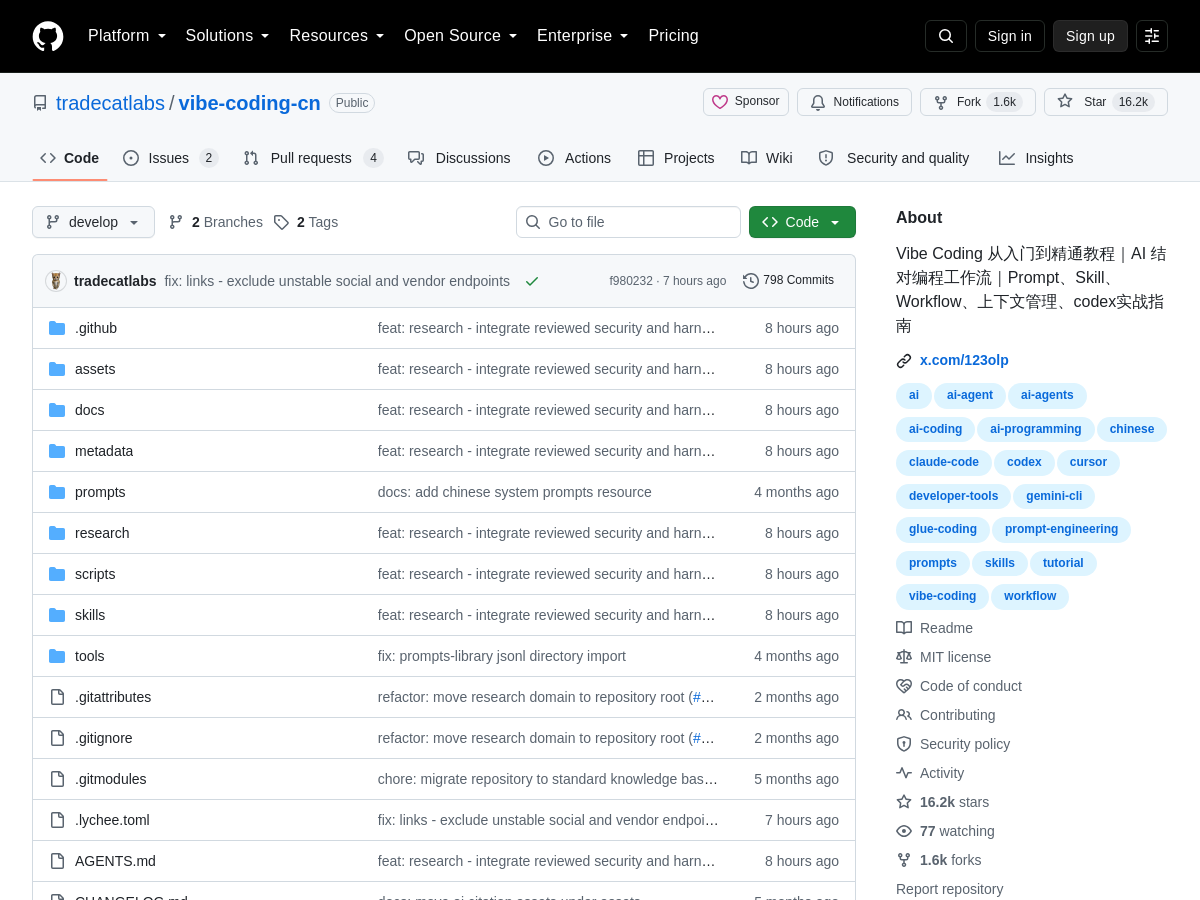
Vibe Coding Cn is an open-source tutorial repository that provides a comprehensive guide to Vibe Coding, an AI-assisted programming approach. It is designed to help developers progress from beginner to advanced levels in using AI pair programming workflows. The repository covers essential topics such as prompt engineering, skill development, workflow design, and context management, with a practical focus on OpenAI's Codex tool. The content is organized as a structured curriculum, offering actionable guidance for integrating AI coding assistants into daily development practices. It emphasizes real-world scenarios and hands-on techniques, making it suitable for developers who want to improve their productivity with AI. The repository is written in Chinese, targeting the Chinese-speaking developer community, and is freely available on GitHub. Beyond basic usage, the tutorial explores advanced concepts like managing conversation context, creating reusable skills, and designing efficient workflows. It also includes practical Codex usage examples, helping users leverage AI for code generation, debugging, and refactoring. As an open-source project, it encourages community contributions and continuous updates.

Solves

Vibe Coding Cn solves the lack of structured, practical guidance for developers adopting AI pair programming. It provides a step-by-step tutorial covering prompts, skills, workflows, and context management, enabling developers to effectively use AI coding assistants like Codex in real projects.

Screenshot of Reve Image
Reve Image
Image Gen Freemium

Reve Image is an AI-powered image generation platform that introduces Reve 2.0, a model designed to provide fine-grained creative control through a novel code-based intermediate representation. Unlike traditional text-to-image models that directly generate pixels from prompts, Reve separates the planning and rendering phases. The planning stage creates a detailed layout expressed as code, which specifies composition, relationships, style, text, and other elements. This code can be inspected, edited, and manipulated by humans or AI agents before rendering, enabling precise adjustments and iterative refinement. The rendering architecture then generates images at native 4K x 4K resolution (16 megapixels), making them suitable for high-quality print workflows without the need for a separate upscaling step. Reve 2.0 leverages a hybrid approach that combines the intelligence of autoregressive models for planning with the aesthetic capabilities of diffusion models for rendering. By using code as the intermediate representation, the platform allows for agent-native editing, where AI agents can reason about and modify the image layout directly. This design supports creative collaboration between humans and AI, moving beyond imprecise natural language instructions. Users can engage in a highly iterative process, viewing and adjusting the planned layout before finalizing the image, thus eliminating the unpredictability often associated with AI generation. Key features include: native 4K resolution output, fast rendering speeds, a clear separation of planning and rendering for enhanced controllability, agent-native editing capabilities, and support for complex, detailed compositions. The platform is designed for professionals who require high precision and quality, such as designers and content creators, and it aims to make AI image generation more predictable and collaborative.

Solves

Traditional AI image generators often operate like 'fireworks'—unpredictable and difficult to steer, with limited control over specific elements and a frustrating upscaling process that can alter details. Reve Image solves this by introducing a code-based intermediate representation that separates planning from rendering. This allows users to define, inspect, and edit the exact composition and attributes of an image before high-resolution generation, ensuring what they see during iteration is exactly what they get in the final output. It eliminates the need for upscaling by generating directly at 4K resolution and enables AI agents to collaborate meaningfully, addressing the imprecision and opacity of text-only interfaces.

Screenshot of Web Ui
Web Ui
AI Agents Open Source

Web UI is an open-source web application that provides a graphical interface for running AI agents capable of controlling a web browser. It is built on top of the browser-use library, which enables large language models to interact with web pages by performing actions such as clicking, typing, and navigating. The tool allows users to input natural language tasks, configure the AI model (such as OpenAI GPT-4 or Anthropic Claude), and observe the agent's actions in real-time within the browser. It supports multiple LLM providers and can be extended with custom tools. Web UI is designed to be self-hosted, giving users full control over their data and execution environment. It simplifies the deployment of browser automation agents for tasks like web scraping, testing, and research. As an open-source project, it encourages community contributions and is available under a permissive license, making it accessible for both personal and commercial use.

Solves

Web UI addresses the complexity of setting up and running browser-based AI agents by offering a user-friendly web interface. It removes the need to write code or interact with command-line tools, allowing users to focus on defining tasks in natural language and monitoring the agent's progress.

Screenshot of WeKnora
WeKnora
Evaluation Open Source

WeKnora is an open-source LLM knowledge platform developed by Tencent. It is designed to transform raw documents into a queryable Retrieval-Augmented Generation (RAG) system, enabling users to ask questions and get contextually relevant answers from their own data. The platform also functions as an autonomous reasoning agent, capable of multi-step reasoning over the knowledge base, and as a self-maintaining wiki that organizes and updates content automatically. WeKnora supports the full pipeline of document ingestion, text extraction, chunking, embedding, and vector storage, integrating with popular large language models. It provides a self-hosted solution that gives organizations full control over their data and infrastructure, while offering a modular architecture for customization. The tool is suitable for building internal knowledge bases, customer support bots, and research assistants. With WeKnora, users can turn scattered documents into a centralized, intelligent knowledge repository. Its open-source nature permits community contributions and enterprise extensions, making it a flexible foundation for AI-powered knowledge management.

Solves

WeKnora addresses the challenge of extracting actionable knowledge from unstructured documents. It automates the conversion of raw text into a structured, queryable knowledge base, eliminating manual organization and enabling natural language questions to be answered accurately using retrieval-augmented generation and autonomous reasoning.

Screenshot of Awesome Gpt Image 2 API And Prompts
Awesome Gpt Image 2 API And Prompts
Image Gen Open Source

Awesome GPT-Image-2 API and Prompts is a curated collection of resources, examples, and prompt engineering techniques for using the GPT-Image-2 API. It aims to help developers and creators understand how to generate images using the GPT-Image-2 model by providing a centralized list of API documentation links, code snippets, and prompt examples. The repository includes community-contributed prompts, integration guides, and best practices for interacting with the GPT-Image-2 API. It serves as a starting point for those looking to explore the capabilities of the image generation model, whether for prototyping, building applications, or conducting research.

Solves

It solves the problem of scattered information about GPT-Image-2 by aggregating API references, prompt examples, and tutorials into a single, easy-to-navigate list, saving users time and effort in discovering how to use the model effectively.

Screenshot of Opencodex
Opencodex
Dev Tools Open Source

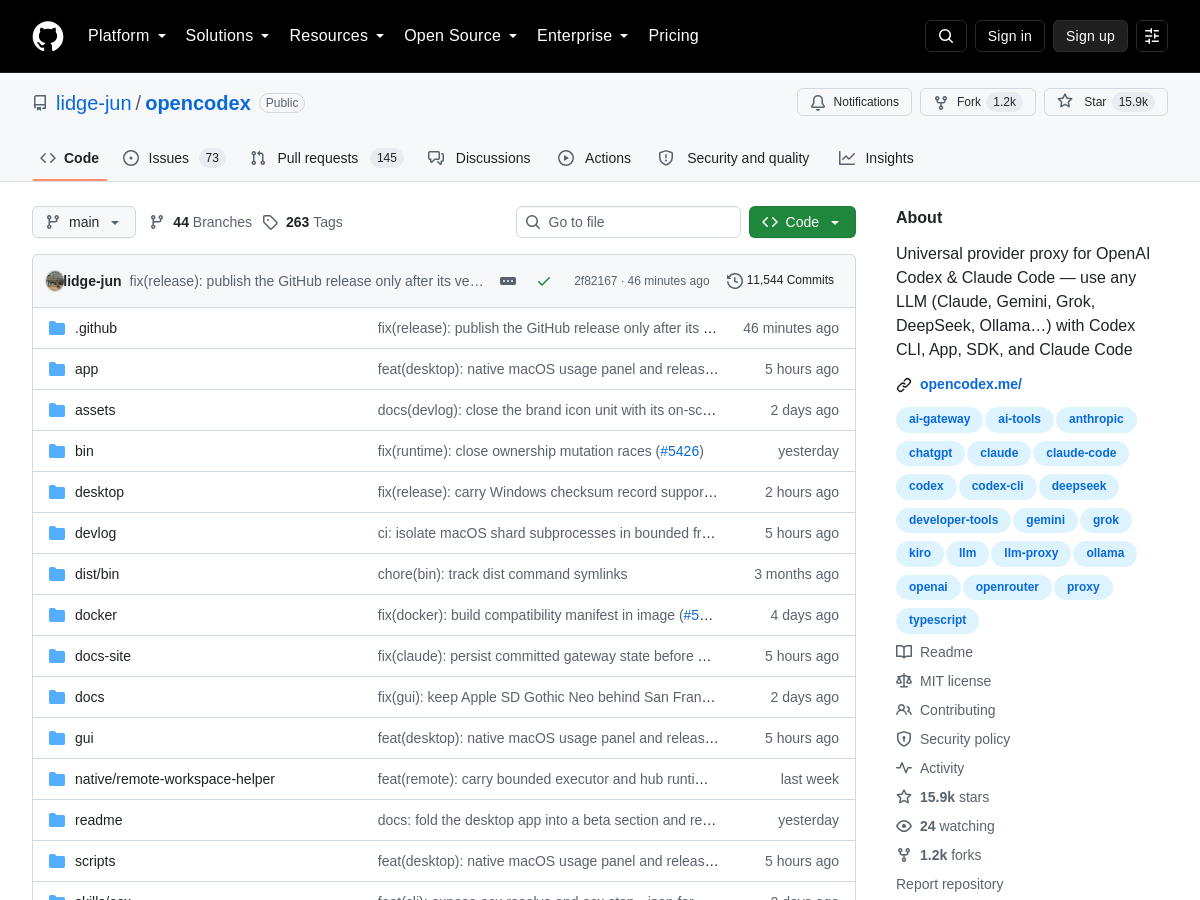
Opencodex is an open-source universal provider proxy designed for OpenAI Codex and Claude Code. It enables the Codex CLI, Codex App, Codex SDK, and Claude Code to work with any large language model provider rather than being limited to a single vendor. Supported providers mentioned in its description include Claude, Gemini, Grok, DeepSeek, and Ollama, among others. The project acts as an intermediary layer that translates requests from Codex- and Claude Code-compatible clients into calls to different LLM APIs. This allows developers to switch between cloud and local models, such as Ollama for local inference, without modifying their existing coding agent workflows. Opencodex is distributed as open-source software on GitHub. By decoupling the coding assistant interface from the underlying model provider, Opencodex helps reduce vendor lock-in and gives users more control over cost, privacy, and model choice. The repository is hosted at github.com/lidge-jun/opencodex.

Solves

Coding assistants like OpenAI Codex and Claude Code typically require using their own proprietary models, making it difficult to switch to alternative LLMs such as Gemini, Grok, DeepSeek, or local models via Ollama. Opencodex solves this by providing a universal proxy that lets these tools route requests to any supported LLM provider, reducing vendor lock-in and enabling flexible model selection.