Tool discovery

What type of AI tool
are you looking for?

Search the active catalog with LambdaBase AI Search, or keep browsing the popularity-ordered directory below.

Submitted search queries and interaction metrics may be analyzed to improve result quality. Do not include personal or confidential information

Browse popular tools.

Screenshot of Beamtrace
Beamtrace
Observability Freemium

Hyprcore is a native macOS workspace that combines an AI-powered wiki, meeting recorder, solo screen recordings, web captures, and dictation with voice commands. It captures the words you say, hear, and read into a single local-first vault that can be searched by AI. Users can dictate into any app by pressing a shortcut, or speak 'Hyper' to trigger voice commands that edit selected text. Recordings of calls or solo walkthroughs are automatically transcribed and summarized, with key decisions and action items extracted and linked into the wiki. The application emphasizes on-device processing and privacy, storing data locally while providing AI search and agent capabilities. It includes a Notion-style page tree, command palette (⌘K), and integration with multiple speech recognition engines. Hyprcore is distributed as a signed and notarized macOS app for Apple Silicon with automatic updates, available under a freemium model.

Solves

Hyprcore solves the fragmentation of meeting notes, dictation, screen recordings, and web captures by unifying them into a searchable local-first knowledge base, reducing the need to switch between separate tools.

Screenshot of MotionGen | Make Continues Video with Top Models

MotionGen is an AI-powered video generation platform that enables users to create continuous, full-length videos starting from a single good clip. Leveraging top AI models, it automatically extends and enhances video content, ensuring smooth and seamless motion across the entire video. The platform offers a rich template gallery organized by styles (such as Portraits, Romantic, Epic, Pets, Ads & E-com, ASMR, Chibi, Comedy, Stylize) and scenes (like Fashion, Cinematic, Futuristic, Anime & Cartoons, Gaming & TV, Crafts, Pop Art, Retro). This variety allows users to easily find and apply a desired aesthetic to their videos. With MotionGen, users can browse real examples to get inspiration and quickly understand the capabilities. The process is straightforward: upload or select a starting clip, choose a style and scene, and let the AI generate a coherent and visually appealing video. The tool is designed for both novice and experienced creators, eliminating the need for complex video editing software or advanced AI knowledge. MotionGen is particularly useful for creating short-form video content for social media, advertisements, e-commerce product showcases, and personal projects. Its freemium model allows users to explore basic features for free, with premium options likely offering higher resolution, longer durations, and additional customization. Overall, MotionGen democratizes video creation by harnessing cutting-edge AI to turn simple clips into professional-looking videos in minutes, empowering content creators, marketers, and hobbyists to produce engaging visual stories effortlessly.

Solves

Many individuals and businesses struggle to create long, engaging videos from short clips or static ideas due to lack of time, skills, or resources. MotionGen solves this by using advanced AI models to automatically generate continuous video from a single starting clip, with a variety of pre-built templates and styles, making high-quality video production accessible to everyone.

Screenshot of Toonflow App
Toonflow App
Image Gen Open Source

Toonflow is an open-source, cross-platform desktop application for creating animated short dramas from novels and scripts. It provides an integrated, one-stop pipeline that combines AI scriptwriting, intelligent storyboarding, character generation, and video generation. The application is designed to lower production costs and reduce the skill barrier for visual content creation by automating key steps from text to animation. The tool runs as a lightweight desktop app, allowing local deployment and batch processing of content. It is particularly suited for creators who want to turn written stories into ready-to-publish animated shorts without specialized animation expertise. By being open source, Toonflow also enables customization and community contributions to extend its capabilities.

Solves

Toonflow addresses the difficulty and expense of producing animated short dramas from written material. Traditionally, this process requires skilled animators, costly software, and significant time. Toonflow's AI-powered workflow automates scriptwriting, storyboarding, character design, and video synthesis in a single desktop tool, enabling creators to produce visual content quickly and at a fraction of the cost.

Screenshot of Managed Hermes Agent | Hostinger

Hostinger offers a managed Hermes Agent deployment, allowing users to launch the self-improving AI agent on a virtual private server (VPS) with a one-click Docker setup. The service eliminates the need for manual installation, ongoing maintenance, or infrastructure management. Hermes Agent features a browser-based admin panel for easy configuration and monitoring. It supports multi-platform messaging, enabling integrations with various chat and communication services. The agent is compatible with over 200 large language models, providing flexibility in AI model selection. Hostinger manages the underlying VPS, including automatic weekly backups and AI-driven server management. Pricing starts at $6.49 per month with a 30-day money-back guarantee, making it accessible for individuals and small teams.

Solves

Managed Hermes Agent removes the complexity of deploying and operating a persistent, self-improving AI agent. Users avoid manual server setup, Docker configuration, and ongoing maintenance, while gaining access to an admin panel, multi-platform messaging, and a wide range of LLM support.

Screenshot of Ralph Claude Code
Ralph Claude Code
AI Agents Open Source

Ralph Claude Code is an open-source command-line tool that creates an autonomous development loop for Claude Code. It repeatedly invokes Claude Code to work on a coding task, using intelligent exit detection to determine when the task is complete and stop the loop. This automates iterative workflows where the AI needs to make changes, run tests, and refine its output without manual intervention between steps. The tool is designed to improve developer productivity by allowing Claude Code to handle multi-step tasks autonomously, reducing the need for constant supervision. It is particularly useful for long-running coding sessions where the AI can explore a codebase, implement changes, and verify results until a satisfactory endpoint is reached.

Solves

Ralph Claude Code solves the problem of manually re-invoking Claude Code multiple times for complex tasks. It automates the iterative process, letting the AI continue working until it detects that the task is complete, saving developer time and reducing the need for constant supervision.

Screenshot of Hexstrike Ai
Hexstrike Ai
AI Agents Open Source

HexStrike AI MCP Agents is an advanced Model Context Protocol (MCP) server designed to bridge large language models (LLMs) with real-world offensive security capabilities. It enables AI agents such as Claude, GPT, and Copilot to autonomously execute over 150 cybersecurity tools, facilitating automated penetration testing, vulnerability discovery, bug bounty automation, and security research. By integrating directly with MCP-compatible AI platforms, it allows these models to perform security tasks without manual tool invocation. The server exposes a wide range of offensive security tools through a unified interface, enabling AI agents to run scans, exploit checks, and reconnaissance commands as part of automated workflows. This reduces the need for human intervention in repetitive security assessment tasks and accelerates the identification of potential vulnerabilities. As an open-source project, HexStrike AI encourages community contributions and customization. It is particularly valuable for security professionals and developers looking to enhance AI-driven security pipelines, automate bug bounty hunting, or conduct continuous security testing within DevOps environments.

Solves

Traditional penetration testing and vulnerability discovery require manual execution of numerous security tools, which is time-consuming and limits scalability. HexStrike AI enables AI agents to autonomously run these tools, reducing manual effort and allowing for continuous, automated security assessments. It bridges the gap between large language models and practical offensive security operations.

Screenshot of Morphic
Morphic
Search Open Source

Morphic is an open-source AI-powered search engine that features a generative user interface. It is designed to provide more interactive and dynamic search results by leveraging artificial intelligence to understand queries and generate relevant UI components. The project is available on GitHub, allowing developers to self-host and customize the search experience. Built with modern web technologies, Morphic aims to offer an alternative to traditional search engines by combining AI-driven answer generation with a flexible, component-based interface. Users can deploy their own instance to create personalized search solutions for various domains. The open-source nature encourages community contributions and adaptation.

Solves

Morphic addresses the limitations of conventional search engines that return static lists of links. By using AI and a generative UI, it provides more contextual and interactive answers, enabling users to find information quickly and explore results in a dynamic interface. This is particularly useful for private or domain-specific search scenarios.

Screenshot of Cai
Cai
Framework Open Source

Cybersecurity AI (CAI) is an open-source framework for AI security developed by Alias Robotics. It provides a structured approach to identifying and mitigating security risks in AI and machine learning systems. The framework aims to bridge the gap between cybersecurity practices and AI development, enabling teams to incorporate security assessments throughout the AI lifecycle. CAI offers a set of tools and methodologies for testing AI models against potential threats such as adversarial attacks, data poisoning, and model inversion. It is designed to be integrated into existing AI pipelines, allowing developers and security professionals to evaluate the robustness and security posture of AI applications before deployment. As an open-source project, CAI encourages collaboration and transparency in AI security research. It targets researchers and practitioners who need a practical framework for securing AI systems, regardless of the underlying ML frameworks or deployment environments.

Solves

CAI addresses the growing need for security in AI systems by providing a framework to systematically evaluate and defend AI models against cyber threats. It helps organizations reduce the risk of AI vulnerabilities being exploited, ensuring that AI applications are robust and trustworthy.

Screenshot of Junie by JetBrains
Junie by JetBrains
Coding Free

Junie by JetBrains is an AI coding agent that brings end-to-end software development assistance directly to the command line and CI/CD workflows. Built on the IntelliJ IDEA engine, it understands code and handles tasks such as refactoring, migrations, and test coverage. The tool supports more than ten AI models through bring-your-own-key (BYOK), including Claude, Gemini, GPT, and Grok, letting teams choose the model that best fits their needs and budget. Junie is designed to reduce tool-switching and keep developers in control. It includes an advanced Plan Mode that writes structured, editable plans before touching code, live prompting to steer the agent mid-task, and human-in-the-loop approval for key actions. Cost efficiency is achieved by allowing planning on a powerful model and implementation on a faster, cheaper model, with the same output quality at a fraction of the cost. The agent works from the terminal, as a GitHub Action, or in GitLab CI/CD, enabling AI tasks to run directly from issues, pull requests, or merge requests. It also supports persistent team guidelines, custom skills, and /commands shared between the CLI and JetBrains IDEs through the Agent Client Protocol. Junie offers a free tier with 5 AI credits and paid AI Pro/AI Ultimate subscriptions, along with BYOK provider-rate pricing without markup.

Solves

Junie reduces the overhead of switching between a terminal, IDE, chat tools, and CI systems by providing a single AI coding agent that works across all of them. It helps developers plan, implement, and review code changes with configurable AI models while maintaining human oversight, cost control, and minimal migration friction.

Screenshot of BentoML
BentoML
LLM Open Source

BentoML is an open-source framework that simplifies the deployment of AI applications. It provides a unified environment for packaging, serving, and managing machine learning models in production. BentoML supports a wide range of ML frameworks, including TensorFlow, PyTorch, Scikit-learn, XGBoost, and more. Models are packaged into a standardized format called 'Bentos', which includes all dependencies, ensuring consistency across development and deployment. The framework offers built-in support for creating high-performance API services with adaptive batching, micro-batching, and GPU support. BentoML also enables the composition of multiple models into inference pipelines and provides a job queue system for long-running or batch inference tasks. It integrates with cloud-native technologies and can be deployed on platforms like AWS, Google Cloud, Azure, and Kubernetes using Docker. The tool streamlines the transition from model training to production, reducing the engineering overhead required to serve models at scale.

Solves

Deploying machine learning models to production is often complex and time-consuming, requiring engineers to handle infrastructure, scaling, and API development. BentoML solves this by providing a standardized, easy-to-use platform that packages models and their dependencies into a portable format, automatically generates REST APIs, and manages serving infrastructure, allowing data scientists and ML engineers to focus on model development rather than operations.

Screenshot of Blink.new
Blink.new
AI/ML Freemium

Blink.new is an AI-powered full-stack app builder that allows users to describe applications in plain English, and its AI agent automatically generates, deploys, and hosts production-ready software. The platform handles everything from database setup and authentication to payment integration and API creation, requiring no coding knowledge. With over 1 million builders and 3 million apps created, Blink positions itself as a complete solution for turning ideas into live applications quickly. Unlike code assistants or low-code tools, Blink delivers true full-stack apps with real databases, edge functions, and global hosting configured automatically. It includes an AI Gateway providing instant access to over 200 frontier AI models (text, image, video, speech) via a single API key, and Blink Claw, which runs persistent AI agents on messaging platforms like Slack, Telegram, and Discord for 24/7 automated tasks. The platform also enables users to build custom alternatives to popular SaaS tools such as Salesforce, HubSpot, Notion, Shopify, and many more, with pre-built templates and community examples available. Its explore section showcases 50,000+ real apps across categories like CRM, dashboards, e-commerce, and productivity, while step-by-step tutorials help users get started quickly.

Solves

Many individuals and businesses want to build custom software but lack coding expertise, time, or resources. Blink solves this by allowing anyone to create production-grade, full-stack applications using only natural language descriptions. It eliminates the need for traditional development, infrastructure management, and third-party integrations, enabling rapid prototyping and deployment of scalable apps with features like databases, authentication, and payments out of the box.

Screenshot of ChatGPT Shortcut
ChatGPT Shortcut
LLM Open Source

ChatGPT Shortcut is a browser extension designed to supercharge productivity when using ChatGPT. It provides a sleek sidebar panel that users can open directly within the ChatGPT interface to access, manage, and share a vast library of community‑curated prompts. Each prompt is just a click away, instantly pasting the text into the chat input, eliminating the need to retype common or complex queries. Beyond simple insertion, the tool offers full prompt management: users can create custom categories, bookmark favorites, and even write their own prompts with variables for dynamic reuse. The extension supports multiple languages, including English, Chinese, Spanish, and Arabic, making it accessible to a global audience. A built‑in editor with syntax highlighting helps users craft and refine prompts, while sharing features allow them to contribute back to the public prompt hub or share privately via links. Developed as an open‑source project, ChatGPT Shortcut is transparent and continuously improved by a community of contributors. Its lightweight design ensures it doesn’t slow down the browsing experience, and it works seamlessly with the standard ChatGPT web app. The prompt library covers a wide range of domains, from coding and SEO to creative writing and education, making it a versatile companion for anyone who relies on ChatGPT regularly.

Solves

ChatGPT users often spend excessive time typing familiar or elaborate prompts, or they struggle to recall the exact phrasing that yields the best results. This repetitive effort reduces efficiency and can lead to inconsistent outputs. ChatGPT Shortcut solves this problem by offering a one‑click prompt injection system, coupled with an extensive, organized, and shareable prompt library. It transforms ChatGPT into a more streamlined and powerful tool, enabling users to focus on the conversation rather than prompt construction.

Screenshot of Semantica
Semantica
AI/ML Open Source

Semantica is an open-source, graph-native infrastructure designed to provide context and accountability for AI systems. It enables developers to build AI applications on top of a flexible graph data model, representing entities, relationships, and provenance as first-class citizens. This approach facilitates traceability, explainability, and integration with existing knowledge graphs and data sources. The project aims to address the 'black box' problem in AI by offering a substrate where decisions, data lineage, and model interactions are explicitly modeled and queryable. By leveraging graph technology, Semantica can power retrieval-augmented generation (RAG) with rich context, audit trails for compliance, and dynamic knowledge bases for intelligent agents. As an infrastructure layer, Semantica is designed to be modular and extensible, allowing developers to connect it with LLMs, vector stores, and other AI components. It is available on GitHub under the Semantica AGI organization, encouraging community contributions and adoption.

Solves

Semantica addresses the lack of context and accountability in modern AI systems by providing a graph-based foundation to capture relationships, provenance, and reasoning paths, enabling explainable and auditable AI applications.

Screenshot of Aident Loadout
Aident Loadout
AI integration Free

Aident Loadout is a platform that provides AI agents with access to over 1,000 pre-integrated third-party tools and services. It allows users to connect their accounts to services like Notion, Gmail, Google Calendar, and X (Twitter) once, and then reuse those authenticated connections across any supported AI agent, including Claude Code, Cursor, Codex, and ChatGPT. The platform is designed to eliminate the manual setup and maintenance typically required to give agents real-world capabilities. Key features include a unified dashboard for managing all tool connections, a secure credential vault that keeps raw API keys hidden while providing an audit trail of agent actions, and support for premium built-in tools like Firecrawl, Gladia, Fal, and Exa at discounted rates using Aident credits. Installation can be completed by pasting a prompt into a coding agent or using one-click installers for specific environments. Aident Loadout emphasizes cross-compatibility, allowing users to build a tool configuration once and run it across different AI harnesses, chat interfaces, and devices. This reduces friction for developers and teams who work with multiple AI systems. The platform also addresses security concerns by ensuring that every action is auditable and that credentials are never exposed to the AI agent itself.

Solves

Aident Loadout solves the problem of manually integrating and managing multiple third-party APIs and services for AI agents. Instead of writing custom code or configuring each tool individually, users can connect services once through a centralized dashboard and immediately grant their agents the ability to perform real-world actions, saving time and reducing complexity.

Screenshot of MailSweeper
MailSweeper
Email management Unknown

MailSweeper is a web-based SaaS tool that connects to Gmail to automatically clean and organize inboxes. It identifies mailing lists, old promotional and social emails, and large attachments, then allows users to bulk unsubscribe or delete them in a few clicks. A dashboard provides metrics such as emails cleaned, storage space reclaimed, and unsubscribe count. Users can also schedule automatic sweeps that move clutter to a designated 'Dustpan' label and delete messages older than 30 days, keeping the primary inbox focused on important mail. The service emphasizes privacy by stating that emails are never stored, sold, or read by humans. It offers a Quick Clean feature for instant cleanup, one-click unsubscribe from all detected lists, smart labeling to route clutter away from the inbox, and scheduled automatic cleanup. MailSweeper is targeted at individual Gmail users and families who want to reduce inbox clutter and avoid paying for extra Google storage.

Solves

MailSweeper solves the problem of Gmail inbox clutter and storage bloat by automating the discovery and removal of unwanted newsletters, old promotions, social updates, and large attachments. It reduces the manual effort of searching, selecting, and deleting messages, and prevents clutter from accumulating again through recurring automatic sweeps.

Screenshot of Jcode
Jcode
LLM Open Source

Jcode is an open-source coding agent harness that integrates large language models (LLMs) to automate various software engineering tasks. It serves as an orchestrator for AI-driven code generation, modification, and reasoning, allowing developers to build custom agents that can interact with codebases, execute commands, and learn from feedback. The platform is designed to be extensible, supporting multiple LLM backends and providing a unified interface for tool use, memory, and planning. By abstracting the complexity of LLM integration, Jcode enables rapid prototyping of autonomous coding assistants that can assist with routine programming chores, from writing boilerplate to debugging and testing. It aims to accelerate development cycles and reduce cognitive load on developers, freeing them to tackle more creative and architectural challenges.

Solves

Jcode automates repetitive and time-consuming coding tasks, such as writing boilerplate code, refactoring, and debugging, by leveraging LLMs. This reduces manual effort, minimizes errors, and allows developers to focus on higher-level design and problem-solving, ultimately accelerating software development cycles.

Screenshot of Bifrost
Bifrost
LLM Open Source

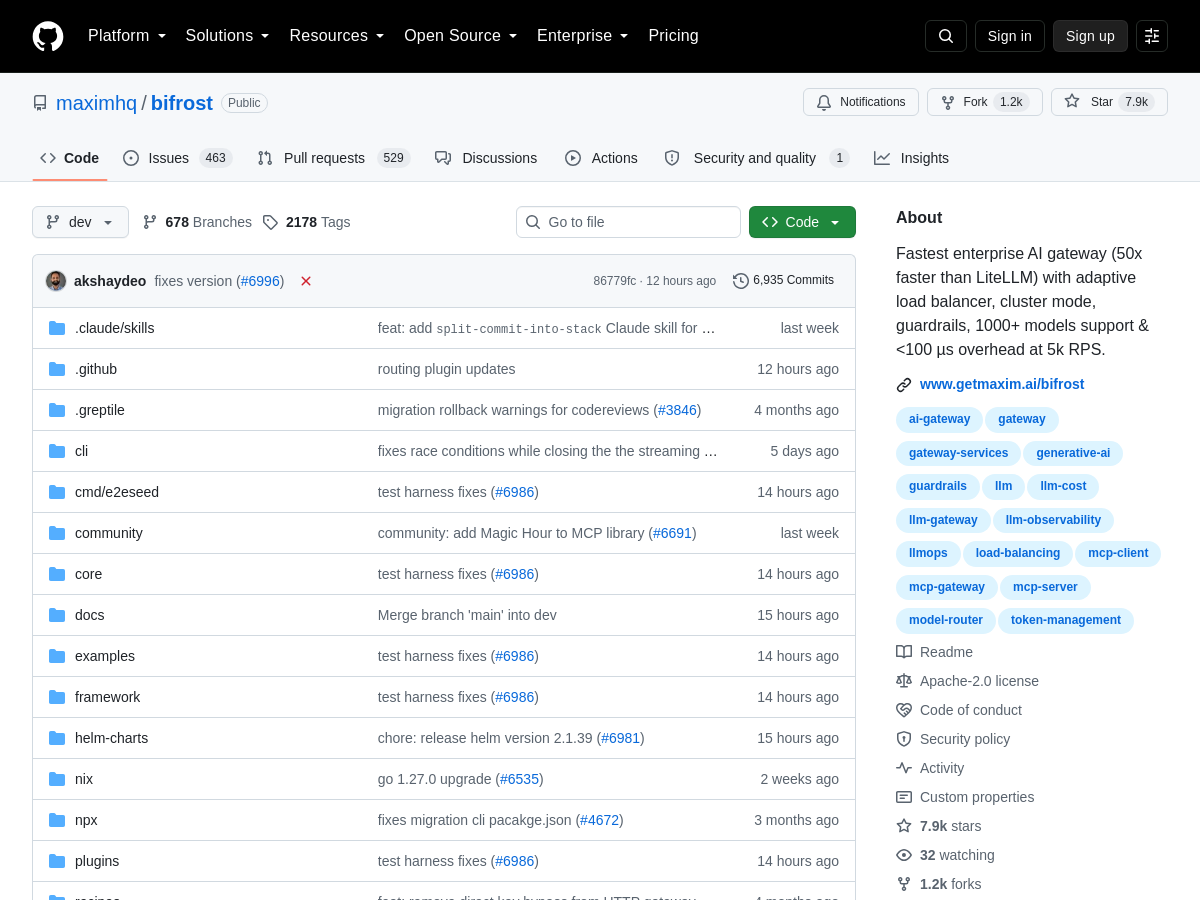
Bifrost is an open-source enterprise AI gateway designed to provide high-speed, reliable access to a broad ecosystem of large language models. According to its project description, Bifrost is up to 50x faster than LiteLLM, offering less than 100 microseconds of overhead at 5,000 requests per second. This level of performance makes it suitable for applications that demand real-time AI responses at scale. A key feature of Bifrost is its adaptive load balancer, which intelligently distributes traffic across multiple model providers to optimize throughput, availability, and cost. The gateway also supports cluster mode, enabling horizontal scaling and high availability across multiple nodes. This allows enterprises to build resilient AI infrastructure that can handle growing demand without compromising on latency or reliability. In addition to performance and scaling, Bifrost includes built-in guardrails for content safety and policy enforcement, along with compatibility for more than 1,000 different models. It centralizes access control, routing, and observability, simplifying the integration and management of LLMs within enterprise environments. As an open-source project, Bifrost offers organizations full control over their gateway layer without vendor lock-in.

Solves

Modern AI applications often need to communicate with many different LLM providers, but each provider has its own API, rate limits, and reliability characteristics. Managing these integrations directly is complicated and can introduce performance bottlenecks. Bifrost solves this by providing a unified, ultra-fast gateway that routes, load balances, and secures requests to thousands of models while maintaining sub-millisecond overhead, simplifying deployment and scaling.

Screenshot of AI Song Maker
AI Song Maker
Music Freemium

AI Song Maker is an AI-powered tool designed to generate royalty-free music tracks directly from a web browser. It aims to simplify the creative process, allowing users to produce songs without needing deep musical knowledge or composition skills. The freemium pricing model makes it accessible for casual creators while offering premium features for more demanding projects. The tool leverages artificial intelligence algorithms to compose melodies, harmonies, and rhythms based on user inputs such as genre, mood, or instrumentation. This enables rapid iteration and experimentation, with the platform generating full-length tracks in seconds. It is particularly useful for content creators who require original music for videos, podcasts, games, and other media. As a cloud-based solution, AI Song Maker eliminates the need for expensive software installations and provides a user-friendly interface suitable for both beginners and professionals. While the generated songs are royalty-free, users should verify the specific licensing terms on the platform to ensure compliance with their intended use cases. Overall, it lowers the barrier to music production and fosters creativity across various disciplines.

Solves

AI Song Maker addresses the challenge of quickly obtaining original, royalty-free music without requiring musical expertise or expensive production equipment. It allows individuals and businesses to generate custom tracks on demand, avoiding copyright issues associated with using commercial music and reducing time spent searching for suitable soundtracks.

Screenshot of Hermes Studio
Hermes Studio
LLM Open Source

Hermes Studio is a web-based dashboard designed to complement the Hermes Agent framework, providing a graphical interface for managing AI agents. It enables users to conduct multi-platform AI chats, manage agent sessions, schedule automated jobs, and monitor usage analytics. The dashboard connects to a Hermes Agent backend via API, allowing real-time interaction with agents and configuration of their behavior. It serves as a central hub for operating AI agents, reducing the complexity of command-line or programmatic interaction. The frontend is likely built with modern web technologies (e.g., React or Vue.js), offering a responsive and intuitive user experience. It supports multiple user accounts with role-based access, making it suitable for teams. Hermes Studio displays active and past chat sessions, stores chat history, and provides tools for session handoff or termination. Scheduled jobs can be configured with cron-like syntax, automating repetitive tasks such as data scraping, report generation, or periodic agent prompts. Key features include a unified chat panel that works across different messaging platforms (web, mobile, etc.), detailed usage analytics dashboards showing API call volumes, latency, cost estimation, and error rates, and a job scheduler with a visual interface. The tool also likely offers integration with various LLM providers and custom agent plugins, enabling extensibility. All data is persisted, and the dashboard supports export of analytics for reporting. As an open-source project, Hermes Studio encourages community contributions and can be self-hosted on-premises or in the cloud. It is intended to be a companion for Hermes Agent deployments, lowering the barrier for non-technical users to leverage AI agents while providing power users with deep operational insights. The dashboard accelerates development, debugging, and monitoring of agent-based applications.

Solves

Organizations and developers deploying the Hermes Agent framework often lack a convenient graphical interface to manage, monitor, and interact with their AI agents. Without a dashboard, operations such as viewing agent conversations, scheduling background jobs, or analyzing usage patterns require direct API calls or database queries, which is cumbersome and error-prone. Hermes Studio solves this by providing a centralized web interface that streamlines these tasks, enabling efficient agent oversight, reducing operational overhead, and making AI agent systems accessible to both technical and non-technical team members.

Screenshot of Presenton
Presenton
Dev Tools Open Source

Presenton is an open-source AI presentation generator and API designed as an alternative to commercial tools like Gamma, Beautiful AI, and Decktopus. It enables users to generate slide decks programmatically or through AI-driven content creation, with full access to the underlying source code for customization and self-hosting. The project provides an API that developers can integrate into their own applications to automate presentation creation from structured data or natural language prompts. Because it is open source, organizations can deploy it on their own infrastructure, retaining control over data and avoiding subscription fees. While specific feature details are limited in available metadata, the project positions itself as a flexible, self-hosted solution for teams seeking AI-assisted presentation workflows without proprietary constraints.

Solves

Presenton addresses the need for a cost-effective, self-hosted AI presentation generator with API access, reducing reliance on proprietary SaaS platforms and enabling integration into automated document generation pipelines.

Screenshot of Evolver
Evolver
Prompt Engineering Open Source

Evolver is an open-source engine designed to enable AI agents to self-evolve through the principles of Genetic Evolutionary Programming (GEP). It provides a structured framework for agents to adapt and improve their behavior over time, with a focus on auditable evolution. The engine introduces core abstractions such as Genes, Capsules, and Events, which together form a transparent lineage of changes and adaptations. The tool is particularly relevant in the field of prompt engineering, where it can be used to evolve and optimize prompts for large language model-based agents. By applying evolutionary algorithms, Evolver helps discover high-performing prompts and agent configurations while maintaining a record of the evolution process. Evolver is hosted on GitHub and is free to use, making it accessible for developers and researchers interested in building self-improving AI systems. Its modular design allows integration into existing agent pipelines, and the emphasis on auditability ensures that every evolutionary step can be traced and analyzed.

Solves

Evolver addresses the challenge of continuously improving AI agent behavior and prompts in a way that is transparent, reproducible, and auditable. Traditional manual tuning is time-consuming and lacks a systematic record of changes; Evolver automates the search for better configurations using genetic evolutionary programming while logging the evolution trail through Genes, Capsules, and Events.

Screenshot of Transformer Explainer
Transformer Explainer
LLM Open Source

Transformer Explainer is an open-source interactive web application developed by the Polo Club at Georgia Tech to demystify the inner workings of Transformer-based large language models. It runs entirely in the browser and allows users to input text and observe how each token flows through a multi-layer Transformer architecture. The tool visualizes key components such as tokenization, embedding, positional encoding, multi-head self-attention, feed-forward networks, and output probability distributions. Users can click on individual attention heads to inspect attention weights between tokens, and adjust temperature or top-k sampling to see generation dynamics. By making abstract concepts concrete, Transformer Explainer serves as an educational resource for students, researchers, and practitioners who want to build intuition about how models like GPT process and generate text. It is ideal for classroom demonstrations, self-study, and conference presentations. The project is hosted on GitHub under the Polo Club organization, is free to use, and can be easily launched locally or accessed via the provided live demo.

Solves

Transformer models are often treated as black boxes, making it difficult for learners and even practitioners to understand why they make certain predictions. Transformer Explainer addresses this by providing an interactive, visual breakdown of each step in the Transformer pipeline, reducing the barrier to understanding and enabling users to explore model behavior in real time.

Screenshot of A Stock Data
A Stock Data
Database Open Source

A Stock Data is an open-source, full-stack data toolkit designed for accessing and consolidating China A-share market data. It aggregates information from 15 different data sources and exposes 43 endpoints, covering a wide range of data types including real-time quotes, historical market data, research reports, capital flow, chip distribution, corporate announcements, limit-up board analysis, ETF options, and market sentiment. The toolkit features a 10-layer architecture to ensure robustness and scalability, and includes 3 official backup sources for automatic failover, enhancing data availability. It aims to provide a comprehensive one-stop solution for quantitative analysis, investment research, and financial data applications.

Solves

Gathering and standardizing diverse China A-share stock market data from multiple sources is complex and error-prone. This toolkit simplifies the process by offering a unified access layer, reducing development effort and enabling faster data-driven insights.

Screenshot of Learn Harness Engineering

Learn Harness Engineering is an open-source, beginner-friendly tutorial designed to teach the principles and practices of Harness engineering for Large Language Model (LLM) systems. It offers a comprehensive, step-by-step curriculum that takes learners from foundational concepts to advanced engineering techniques. The material is structured as a series of lectures, each accompanied by detailed documentation, Mermaid diagrams for visual learning, and hands-on projects that reinforce the concepts. The tutorial covers critical topics such as failure mode analysis, harness subsystem design, knowledge visibility, instruction architecture, session continuity, initialization lifecycles, WIP limits, feature state machines, termination checks, testing strategies (including the test pyramid), observability layers, and clean state management. This holistic approach ensures that learners not only understand the theory but also gain practical skills for building robust, testable, and observable LLM-powered applications. Hosted on GitHub, the repository includes both English and Chinese (ZH) versions of the content, with additional translations contributed by the community. The course materials are version-controlled, regularly updated, and benefit from community contributions and pull requests. A PDF build pipeline is integrated, allowing learners to download compiled lecture notes for offline study. The repository also includes automated workflows (GitHub Actions) for building PDFs and capturing screenshots, demonstrating real-world engineering practices in documentation maintenance. The tutorial is positioned as an official-style learning path, meaning it follows a structured, textbook-like format that is suitable for both self-paced learning and classroom instruction. It assumes no prior knowledge of Harness engineering, making it accessible to beginners, while gradually introducing advanced topics that are valuable even for experienced LLM engineers. By the end of the course, learners are expected to have a solid mental model of how to engineer, test, and maintain LLM systems safely and effectively.

Solves

Developers and ML engineers often struggle to build and scale reliable LLM-based applications due to a lack of systematic engineering practices tailored to the unique failure modes of LLMs. Without guidance, they face unpredictable outputs, difficult debugging, and insecure deployments. Learn Harness Engineering solves this by providing a clear, structured educational resource that teaches the fundamental concepts, patterns, and anti-patterns of LLM engineering. It equips learners with a framework to think about system design, testing, observability, and state management, enabling them to move from ad-hoc experimentation to robust, production-ready LLM systems.

Screenshot of Agent Squad
Agent Squad
AI Agents Open Source

Agent Squad is an open-source framework developed by 2FastLabs for managing multiple AI agents and handling complex conversations. It enables developers to orchestrate interactions among various agents, facilitating multi-agent collaboration and dialogue management. The framework is designed to be flexible and powerful, allowing customization for different conversational workflows. The project is hosted on GitHub and is distributed under an open-source license, making it accessible for integration into existing systems. It targets applications that require coordination of several AI agents, such as advanced chatbots, automated reasoning systems, and task-specific agent networks.

Solves

Agent Squad addresses the need for a flexible and powerful framework to manage multiple AI agents and handle complex conversations, simplifying the development of multi-agent systems where agents must interact and collaborate to accomplish tasks.

Screenshot of VidLux - Image to Video AI
VidLux - Image to Video AI
Image to video Free

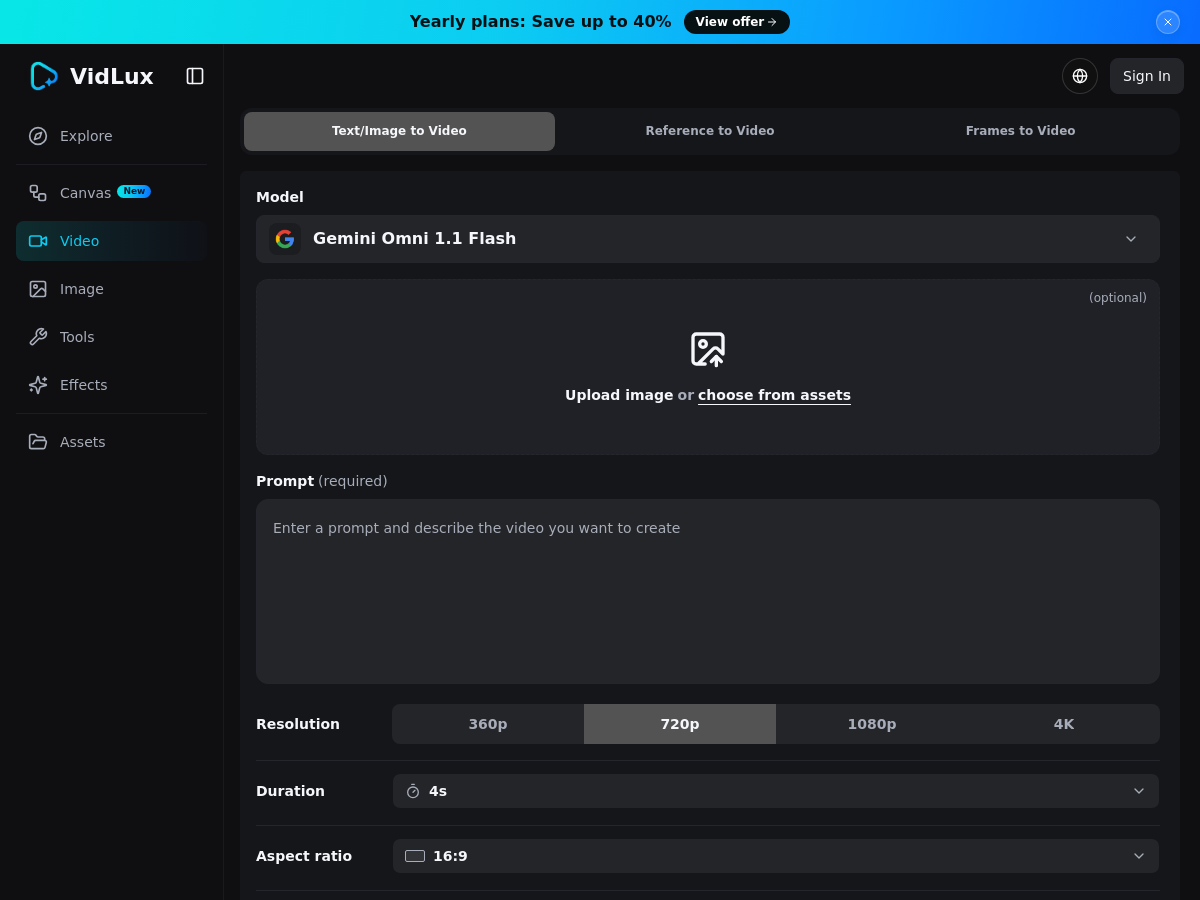
VidLux is a web-based AI image-to-video generator that animates still photos by adding motion and cinematic camera movement. The homepage positions VidLux as a free tool for bringing photos to life, with the image-to-video workflow as its primary video offering. It also links to related video modes such as Text/Image to Video, Reference to Video, and Frames to Video, as well as image tools like Text to Image and Image to Image. The platform presents itself as a creative suite with an Explore section, a Canvas tool, effects, and assets, suggesting that users can generate and manage AI media in one interface. According to the homepage, VidLux uses leading models to produce natural motion and cinematic camera movement. The page advertises that users can try it free, and it also promotes yearly plans with savings up to 40%. No public GitHub repository or self-hosted installation instructions are provided on the homepage. The homepage does not list specific underlying models, output resolution, maximum clip length, or API access. As a result, evaluation of VidLux's technical stack, licensing, and limits requires using the hosted service or contacting the vendor.

Solves

Creating video from a single still image traditionally requires animation, compositing, or editing skills. VidLux addresses this by using AI to add motion and camera movement to photos, allowing users to produce short video clips from images through a hosted web interface.

Screenshot of Evidently
Evidently
LLM Open Source

Evidently is an open-source Python framework for ML and LLM observability. It provides over 100 metrics to evaluate, test, and monitor AI-powered systems and data pipelines, covering both tabular data and generative AI applications. The framework generates interactive reports and test suites that can be used for debugging, validation, and ongoing monitoring. It detects data drift, model performance degradation, and quality issues in LLM outputs, helping teams maintain reliable AI systems. Evidently integrates easily into Python workflows, including Jupyter notebooks, CI/CD pipelines, and production monitoring stacks. It is designed for data scientists and ML engineers who need observability without heavy infrastructure.

Solves

Evidently helps teams detect and diagnose issues in ML and LLM systems by providing automated evaluation, testing, and monitoring capabilities, reducing the risk of model drift, data quality problems, and poor generative outputs in production.

Screenshot of Prompt_Engineering
Prompt_Engineering
LLM Open Source

This repository provides a comprehensive and hands-on guide to prompt engineering with 22 techniques, ranging from basic to advanced strategies for interacting with large language models (LLMs). Each technique is implemented in a self-contained Jupyter Notebook, complete with explanations, code examples, and practical demonstrations. The techniques cover a wide spectrum: fundamental methods like zero-shot, few-shot, and chain-of-thought prompting; advanced approaches such as self-consistency, generated knowledge, and directional stimulus; and applied strategies including prompt chaining, retrieval augmented generation (RAG), and structured output formatting. The notebooks are designed to be executable, allowing users to run and modify code against real LLM APIs (e.g., OpenAI) to see immediate effects of different prompt designs. The project is actively maintained, with regular updates to keep code compatible with the latest library versions and API changes. It serves as both a learning resource for beginners and a reference for experienced practitioners seeking to refine their prompting skills.

Solves

Many developers, data scientists, and engineers struggle to consistently elicit accurate, contextually relevant, and well-structured responses from large language models. The repository addresses this by providing structured, tried-and-tested prompt engineering patterns. Users can learn how to craft prompts that reduce hallucinations, improve reasoning, handle complex tasks, and adapt to specific use cases, thereby boosting the performance and reliability of LLM-powered applications without needing to fine-tune models.

Screenshot of Rig
Rig
LLM Open Source

Rig is an open-source Rust library designed for building modular and scalable applications powered by large language models (LLMs). It provides a unified interface to interact with popular LLM providers such as OpenAI, Anthropic, Cohere, and others, simplifying the integration of AI capabilities into Rust projects. The library emphasizes type safety, performance, and a composable architecture, enabling developers to create robust AI systems without sacrificing the benefits of the Rust ecosystem. The library includes abstractions for key LLM application patterns, including completion and chat generation, embeddings, vector stores for retrieval-augmented generation (RAG), and agent-based workflows that can use external tools. Its modular design allows users to mix and match components, extend functionality with custom providers and storage backends, and maintain clean separation of concerns. Rig also supports streaming responses, asynchronous execution with Tokio, and configuration through environment variables. Rig aims to bring the productivity of Python-based LLM frameworks to Rust while leveraging Rust's low-level control, memory safety, and concurrency. It is suitable for building production-grade services, CLI tools, and high-performance AI applications where latency and resource usage are critical. The project is actively maintained and welcomes community contributions.

Solves

Rig addresses the lack of a mature, type-safe framework for developing LLM applications in Rust. It provides a unified abstraction over multiple AI providers and common LLM workflows (generation, embeddings, agents, RAG), reducing boilerplate and enabling developers to build efficient and reliable AI-powered software in the Rust ecosystem.

Screenshot of MNKI
MNKI
Architectural design Free

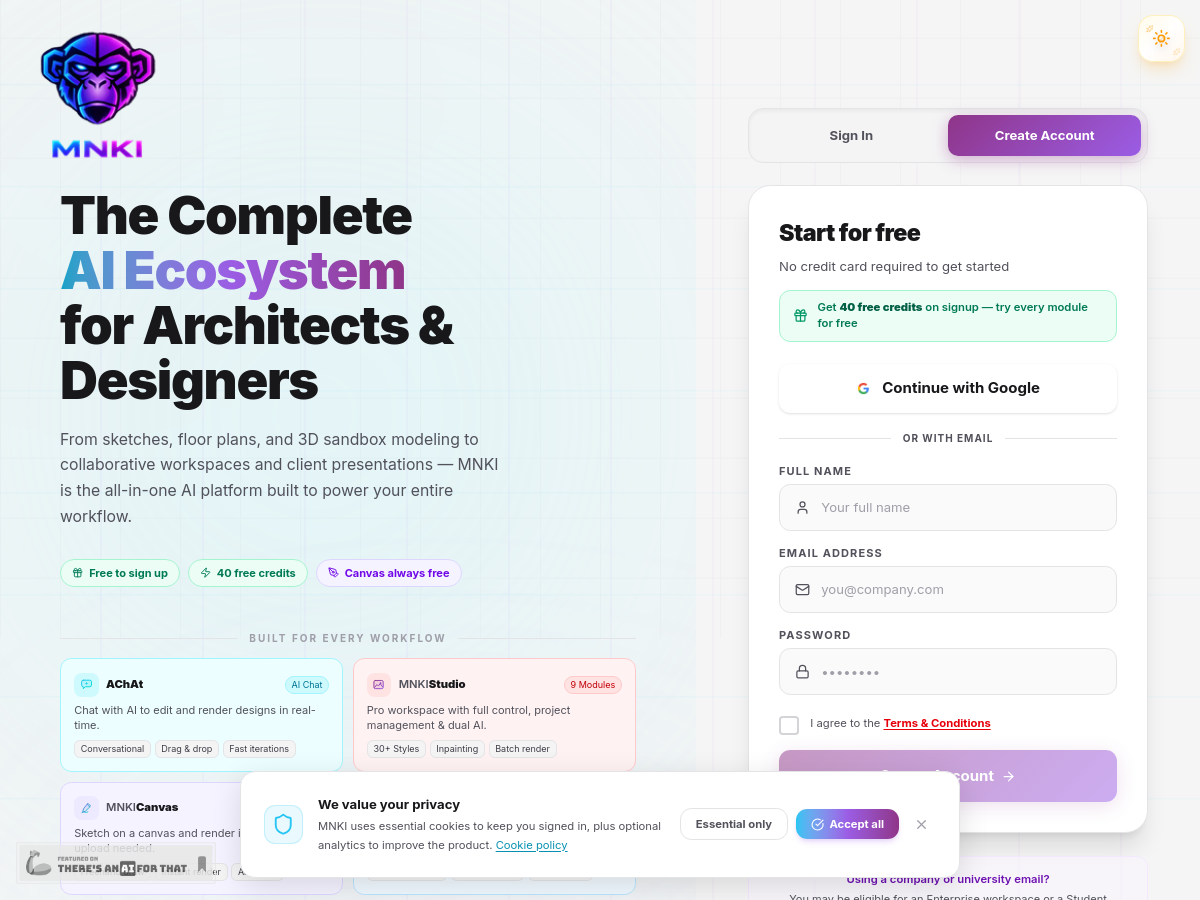
MNKI is an AI-powered architectural rendering and design platform that converts sketches, floor plans, and 3D sandbox models into photorealistic renders in seconds. It provides a full ecosystem with multiple integrated modules: a chat tool for conversational design edits, a Studio workspace with 30+ rendering styles and inpainting, a free Canvas for freehand drawing, a Space hub for team collaboration, a 3D Sandbox for building models and walkthroughs, and an AI presentation generator for client-facing decks. The platform is designed to support the entire architectural visualization workflow from initial idea to final presentation. Users can start for free with 40 credits, and Canvas access remains free, with no credit card required at signup. MNKI is marketed toward architects, interior designers, and real estate-related professionals. It also highlights support for Arabic users and includes features for live team permissions, shared projects, and batch rendering. Because it is browser-based, it can be used without local GPU hardware, making rapid prototyping and iterations accessible on almost any device.

Solves

Traditional architectural rendering requires specialized 3D software, significant time, and technical skill. MNKI addresses this by letting users quickly create realistic visuals from hand drawings, floor plans, or 3D sketches, reducing the time to produce high-quality concept images during early design and client approval stages.

Screenshot of Html Anything
Html Anything
AI Agents Open Source

Html Anything is an agentic HTML editor that leverages a local AI agent to write HTML code, allowing users to ship content rapidly. It comes with 75 skills that can generate content across 9 different surfaces: magazine layouts, presentation decks, posters, XHS/tweet images, prototypes, data reports, and Hyperframes. The tool runs entirely locally within a sandboxed environment, ensuring security and privacy while providing a flexible, prompt-driven approach to HTML creation. Users can describe the desired output, and the AI agent produces the corresponding HTML, which can then be used and shared directly.

Solves

It eliminates the need for manual HTML coding by enabling prompt-based generation of diverse visual content, making it easy for non-technical users to produce professional-looking, shareable HTML without deep web development expertise.

Screenshot of Hermes Web Ui
Hermes Web Ui
LLM Open Source

Hermes Web UI is an open-source web dashboard designed for Hermes Agent, providing a user-friendly interface for multi-platform AI chat. It enables users to manage chat sessions across different platforms, schedule automated jobs, and monitor usage analytics from a single location. The dashboard is built to simplify interaction with Hermes Agent, an LLM-based agent, by offering session persistence and management capabilities. Users can create, organize, and revisit conversations, schedule periodic LLM tasks, and track how the agent is being used over time. The project is intended to be self-hosted and customizable, making it suitable for individuals and teams who want a visual layer over their Hermes Agent deployment.

Solves

Hermes Web UI addresses the lack of a centralized, visual interface for managing Hermes Agent. It consolidates chat, session management, job scheduling, and usage analytics into one dashboard, reducing the need for command-line or API-only interaction and improving productivity for teams and individuals using the agent.

Screenshot of Glean
Glean
Personal assistant Unknown

Glean is an enterprise-focused work AI platform that connects to a company's tools, data, and context to provide intelligent search, assistance, and automation. It unifies information from over 250 connectors including SaaS applications, documents, and internal systems. The platform includes enterprise search with hybrid capabilities, a personal graph that understands individual work context, an enterprise graph mapping company knowledge, and an AI assistant that can answer questions, generate content, analyze data, and execute actions across systems. Glean also offers AI agents with a builder, orchestration, governance, and a library of reusable agents. Security and governance are emphasized, with features like an AI gateway and model hub to manage AI usage safely at scale. Glean is adopted by large enterprises such as Booking.com, Zillow, TIME, and Ericsson, positioning it as a comprehensive solution for knowledge management and AI-driven productivity.

Solves

Glean solves the problem of fragmented enterprise information and inefficient knowledge work by providing a unified AI layer that indexes all company data, understands context, and enables employees to find answers, generate content, and automate tasks without switching between tools.

Screenshot of Ego Lite
Ego Lite
LLM Open Source

Ego Lite is an open-source browser purpose-built for AI agents to perform web automation tasks. It enables sharing of the user's logged-in browser state with AI agents like Codex or Claude Code, allowing them to operate as authenticated users without requiring separate credentials or interrupting the human user. Designed for speed and simplicity, it requires zero configuration and incurs no cost, making it an accessible tool for integrating AI into browser-based workflows. The browser focuses on being the fastest option for agentic automation, providing a lightweight environment where AI can interact with web pages, fill forms, extract data, and test applications. By leveraging the existing browser session, Ego Lite removes the friction of setting up authentication, streamlining the development of AI assistants that need to act on behalf of the user.

Solves

Ego Lite solves the problem of allowing AI agents to use a web browser that is already authenticated, eliminating the need to configure separate login credentials or disturb the user's active session. This enables seamless automation of tasks that require access to logged-in services, reducing setup overhead and potential interruptions.

Screenshot of Openllmetry
Openllmetry
LLM Open Source

Openllmetry is an open-source project that provides observability for Generative AI and LLM applications using OpenTelemetry standards. It offers automatic instrumentation for popular LLM frameworks and services, capturing traces, metrics, and logs related to model calls, token usage, latency, and errors. The project includes SDKs for Python and TypeScript, enabling developers to add observability to their AI applications with minimal code changes. It supports integration with existing OpenTelemetry collectors and backends, allowing data to be exported to any observability platform that supports OTLP. Developed by Traceloop, Openllmetry aims to provide vendor-neutral telemetry for AI workloads, helping teams monitor performance, cost, and quality without being locked into a specific commercial observability tool. It is distributed under the Apache 2.0 license.

Solves

Openllmetry solves the challenge of monitoring and debugging LLM-based applications by providing standardized, vendor-neutral observability. It captures detailed telemetry data such as prompts, completions, token counts, latency, and model metadata, enabling teams to understand performance, cost, and reliability of their AI services.

Screenshot of Lyria
Lyria
Music Free

Lyria is Google DeepMind's advanced music generation model family, with Lyria 3.5 being the latest iteration. It enables users to create high-fidelity music and audio from textual descriptions, supporting a wide range of musical genres and styles. The model is designed to produce both instrumental and vocal tracks with impressive audio quality and coherence, making it suitable for creative professionals and enthusiasts. Lyria integrates with other Google DeepMind products and tools, offering a streamlined experience for generating musical content directly from prompts.

Solves

Lyria addresses the challenge of generating high-quality, original music using AI, eliminating the need for extensive musical training or expensive production equipment. It helps creators quickly transform ideas and text prompts into fully-formed musical pieces, accelerating the music creation process and enabling rapid prototyping of songs.

Screenshot of LTX 2
LTX 2
Video Open Source

LTX-2 is an open-source generative AI model developed by Lightricks that creates videos with synchronized audio from textual descriptions. The repository provides an official Python inference package, allowing users to generate audio-video content easily. It also includes a LoRA trainer, enabling fine-tuning on custom datasets to adapt the model to specific styles, characters, or domains without full retraining. LTX-2 leverages state-of-the-art deep learning techniques to produce high-quality, coherent video and audio outputs. The model weights are available on Hugging Face, and a live demo showcases its capabilities. With a modular codebase and pip-installable package, LTX-2 is designed for seamless integration into research and creative workflows. Active development and community contributions ensure continuous improvements and support.

Solves

Video content creators, researchers, and developers often struggle to produce engaging video content with matching audio from text descriptions alone, due to the complexity and resource requirements of existing tools. LTX-2 solves this by providing an open-source, accessible model that generates both video and audio in one pass, with the option to fine-tune on custom data using LoRA, dramatically lowering the barrier for personalized video generation.

Screenshot of Inkos
Inkos
AI Agents Open Source

Inkos is an open-source AI agent framework for autonomous story creation. It supports writing novels, scripts, translations, interactive game narratives, and other IP content. The system orchestrates multiple AI agents that collaborate on drafting, auditing, and revising narrative text. Human review gates are integrated to allow authors to approve or intervene at key stages, ensuring creative control and quality assurance. Inkos is designed to reduce the manual burden of long-form writing while maintaining human oversight. The project is hosted on GitHub and can be self-hosted by users.

Solves

Inkos addresses the challenge of producing long-form narrative content by coordinating multiple AI agents to write, audit, and revise text. It reduces manual effort while preserving human oversight through review gates, enabling faster draft generation without sacrificing creative control.

Screenshot of Learning
Learning
AI/ML Open Source

This repository is a personal learning log by Amit Chaudhary (amitness) that documents his ongoing studies, primarily in artificial intelligence and machine learning. It contains a collection of markdown notes, summaries, code snippets, and curated references on topics such as deep learning, natural language processing, computer vision, and MLOps. The content is organized by date and topic, allowing both the author and visitors to follow the learning journey and review key concepts. The repository serves as a public, versioned knowledge base that demonstrates a structured approach to self-directed learning in the AI/ML field.

Solves

It addresses the challenge of retaining and organizing knowledge from diverse learning sources by providing a public, versioned log of learnings. This helps the author reinforce concepts and enables others to find a curated path through AI/ML topics.

Screenshot of Bindu
Bindu
AI Agents Open Source

Bindu is an open-source project that serves as the identity, communication, and payments layer for AI agents. It provides foundational infrastructure to enable autonomous agents to establish verifiable identities, exchange messages securely, and conduct financial transactions. By offering these core capabilities, Bindu aims to facilitate trust and interoperability in multi-agent ecosystems. Developers can integrate Bindu into their agent frameworks to allow agents to authenticate, communicate, and transact without relying on centralized intermediaries. The project focuses on creating a standardized layer that abstracts away the complexities of agent-to-agent interaction, making it easier to build decentralized agent networks and marketplaces. As an open-source initiative hosted on GitHub, Bindu invites community contributions and aims to become a common substrate for the emerging agent economy. Its modular approach is designed to be extensible, supporting various identity schemes, communication protocols, and payment rails as the ecosystem evolves.

Solves

Bindu addresses the lack of standardized mechanisms for AI agents to identify themselves, communicate securely, and handle payments, enabling trustworthy and efficient interactions between autonomous agents in decentralized environments.

Screenshot of ChatLab
ChatLab
AI Agents Open Source

ChatLab is an open-source, local-first tool designed to analyze chat histories using artificial intelligence. It enables users to extract insights, patterns, and summaries from their chat logs without uploading data to external servers, preserving privacy and data sovereignty. The tool is hosted on GitHub and can be self-hosted or run locally, making it suitable for individuals and organizations concerned about data confidentiality. By leveraging modern AI techniques, ChatLab can process various chat formats and provide features such as sentiment analysis, topic detection, and conversation summarization. Its local-first architecture ensures that all analysis happens on the user's machine, reducing latency and eliminating cloud costs. The project is community-driven and open for contributions, aiming to provide a flexible and transparent solution for chat data analysis.

Solves

ChatLab addresses the challenge of extracting meaningful information from chat logs while maintaining privacy and control. Many existing chat analysis tools require uploading conversations to cloud services, which may not be acceptable for sensitive or personal data. ChatLab solves this by enabling AI-powered analysis entirely on the local device, allowing users to gain insights without compromising data security.

Screenshot of Ai Berkshire
Ai Berkshire
LLM Open Source

AI Berkshire is an open-source value investing research framework designed to work with AI assistants like Claude Code and Codex. It implements the methodologies of four renowned investors—Warren Buffett, Charlie Munger, Duan Yongping, and Li Lu—by orchestrating multiple AI agents to perform parallel research on potential investments. The framework provides structured prompts and workflows that guide the AI through fundamental analysis tasks such as evaluating moats, management quality, financial health, and intrinsic value. By leveraging multi-agent parallelism, AI Berkshire aims to accelerate the due diligence process for value investors, allowing simultaneous deep dives into multiple companies. Users can customize the agent roles and research criteria based on the philosophies of each master investor, enabling comparative analysis and generating investment theses. The tool is intended to augment, not replace, human decision-making by providing AI-generated insights grounded in time-tested value investing principles. The project is primarily developed in Chinese and targets users familiar with Chinese stock markets, though the underlying concepts are universal. It expects access to Claude Code or Codex, making it a niche tool for developers and researchers comfortable with AI-oriented coding environments. As an open-source initiative, it invites community contributions to expand its agent capabilities, integrate additional data sources, and refine the research templates.

Solves

AI Berkshire automates and scales the labor-intensive process of value investing research by enabling AI agents to analyze stocks in parallel using the proven frameworks of Buffett, Munger, Duan Yongping, and Li Lu. It reduces the time and expertise required to perform deep fundamental analysis, helping investors quickly screen and evaluate potential opportunities.

Screenshot of Intentkit
Intentkit
AI Agents Open Source

IntentKit is an open-source, self-hosted cloud agent cluster designed to manage a collaborative team of AI agents. It provides a unified infrastructure for deploying, orchestrating, and scaling multiple AI agents that can work together on complex tasks. The system is intended to be run on your own infrastructure, offering full control over data and operations. By abstracting the management of individual agents, IntentKit simplifies the creation of multi-agent workflows. It allows developers and teams to focus on defining agent behaviors and objectives rather than the underlying coordination mechanics. The project is available on GitHub under an open-source license.

Solves

Managing multiple AI agents individually can be complex and time-consuming. IntentKit solves this by providing a self-hosted cluster that coordinates a collaborative team of agents, streamlining deployment, communication, and task distribution in one unified system.

Screenshot of Undetectr
Undetectr
AI/ML Paid

Undetectr is a paid AI/ML audio processing tool designed to remove artificial artifacts from music tracks before distribution. It targets the audible signatures that can make AI-generated or AI-assisted music sound synthetic, such as metallic timbres, unnatural transients, or digital noise. The tool is intended for musicians, producers, and content creators who use generative music software and need their final masters to meet the quality expectations of streaming platforms and listeners. By cleaning these artifacts, Undetectr helps users prepare recordings for commercial distribution. Many digital service providers and distributors are increasingly screening for AI-generated content; Undetectr positions itself as a post-production step to reduce telltale markers and create a more natural, polished result. Its workflow is focused on audio processing rather than composition, making it suitable for finalizing tracks rather than creating them from scratch. The official homepage listed in the source data did not resolve to an Undetectr-specific site at the time of enrichment, and detailed technical documentation, pricing tiers, and supported input formats were not available from the provided homepage markdown. Therefore this description is based on the tool's stated purpose and category, not on verified implementation details.

Solves

Undetectr addresses the challenge of distributing AI-generated music that may contain obvious synthetic artifacts or be flagged by AI detection systems. It cleans audio to make AI-assisted productions sound more human and distribution-ready.

Screenshot of Postfox
Postfox
Voice & Audio Unknown

Postfox is a comprehensive LinkedIn content creation and scheduling platform that uses AI to write posts in your unique voice. It starts by analyzing your existing LinkedIn posts to detect patterns in your writing style, including tone, hook types, and topic preferences. This analysis generates a personalized 'content playbook' with insights such as your best posting times, most effective hooks, and winning content formulas. Once your style is learned, Postfox can generate fresh post ideas and full drafts that authentically mimic your voice, helping you overcome writer's block. The platform includes a content calendar for planning posts, a scheduler for automated publishing, and a browser extension that allows you to curate and schedule posts directly from LinkedIn. Additional features include a library of pre-written templates, real-time post previews, and performance analytics to track engagement. Postfox aims to save time while maintaining consistency and authenticity across your LinkedIn content strategy.

Solves

LinkedIn professionals, marketers, and founders often struggle to consistently produce engaging posts that sound authentic and match their personal brand. Writing takes time, and many feel unsure about what content will resonate with their audience. Postfox addresses this by offering AI-driven style analysis and content generation, helping users understand what works for them and effortlessly create posts that sound like they wrote them themselves. This reduces the time and effort required to maintain a strong LinkedIn presence, enabling users to grow their network and influence through regular, high-quality content.

Screenshot of Camofox Browser
Camofox Browser
AI Agents Open Source

Camofox Browser is an open-source stealth headless browser designed specifically for AI agents and automation tasks that require bypassing anti-bot measures. It provides a drop-in replacement for Puppeteer and Playwright, allowing developers to use familiar APIs while leveraging enhanced evasion techniques. The browser is engineered to avoid detection by services like Cloudflare, bot management systems, and anti-scraping tools, enabling more reliable automated browsing and data collection. The project focuses on maintaining compatibility with existing automation scripts while introducing stealth features that mimic human browsing behavior. By reducing the likelihood of being blocked, Camofox Browser enables AI agents and automated systems to access web content that would otherwise be inaccessible. It is particularly useful for tasks such as web scraping, automated testing, and AI-driven research where traditional headless browsers are often identified and blocked.

Solves

Camofox Browser solves the problem of automated browsing being detected and blocked by anti-bot services like Cloudflare. By providing a stealthy headless browser that can bypass these protections, it allows AI agents and automation scripts to access websites without interruptions, ensuring reliable data collection and task execution.

Screenshot of JustVibe
JustVibe
Search Free

JustVibe is a free search engine that positions itself as 'the search engine for doing, with instant apps built for you.' Unlike traditional search engines that primarily return links and informational results, JustVibe aims to generate interactive mini-applications directly from search queries. This allows users to perform tasks immediately within the browser, without needing to navigate to separate websites or install software. The platform is designed to bridge the gap between searching for information and taking action. The service appears to focus on practical, task-oriented searches, such as converting units, calculating values, generating codes, or setting timers. By dynamically creating an app tailored to the user's query, JustVibe seeks to reduce friction and save time. As a web-based tool, it requires no installation and is accessible from any modern browser. However, detailed technical documentation and public information about the underlying technology are currently limited, as the homepage presents only a security challenge and no GitHub repository is available. Overall, JustVibe represents an interesting evolution in search technology, shifting from passive information retrieval to active task completion. Its success will depend on the quality and breadth of its instant apps, as well as its ability to handle a wide range of user intents. For now, it offers a glimpse into a more action-oriented future for search engines.

Solves

Traditional search engines return lists of links, requiring users to visit multiple sites to complete a task. JustVibe solves this by generating instant apps that let users perform actions directly from the search results page, streamlining workflows and reducing the number of steps needed to accomplish common tasks.

Screenshot of Zcf
Zcf
LLM Open Source

Zcf is an open-source tool designed to provide a zero-configuration code flow for AI coding assistants Claude Code and Codex. Hosted on GitHub under the repository UfoMiao/zcf, it aims to streamline the use of these powerful language models in software development by eliminating the need for manual configuration. The project is positioned as a convenience layer that lets developers immediately start using AI-generated code and automated edits without wrestling with setup scripts or complex integration steps. By targeting both Claude Code and Codex, Zcf offers a unified approach to managing code-related workflows across two major AI coding ecosystems. While the repository's metadata does not detail the full feature set, the core value proposition is clear: reduce friction in leveraging AI for coding tasks such as code generation, refactoring, and multi-file modifications. The tool is distributed as open source, allowing users to inspect, modify, and contribute to its development.

Solves

Zcf addresses the configuration overhead often required when integrating AI coding tools like Claude Code and Codex into a developer's environment. By offering a zero-configuration setup, it lowers the barrier to entry, enabling developers to focus on writing code rather than managing tool setups and workflow configurations.