Tool discovery

What type of AI tool
are you looking for?

Search the active catalog with LambdaBase AI Search, or keep browsing the popularity-ordered directory below.

Submitted search queries and interaction metrics may be analyzed to improve result quality. Do not include personal or confidential information

Browse popular tools.

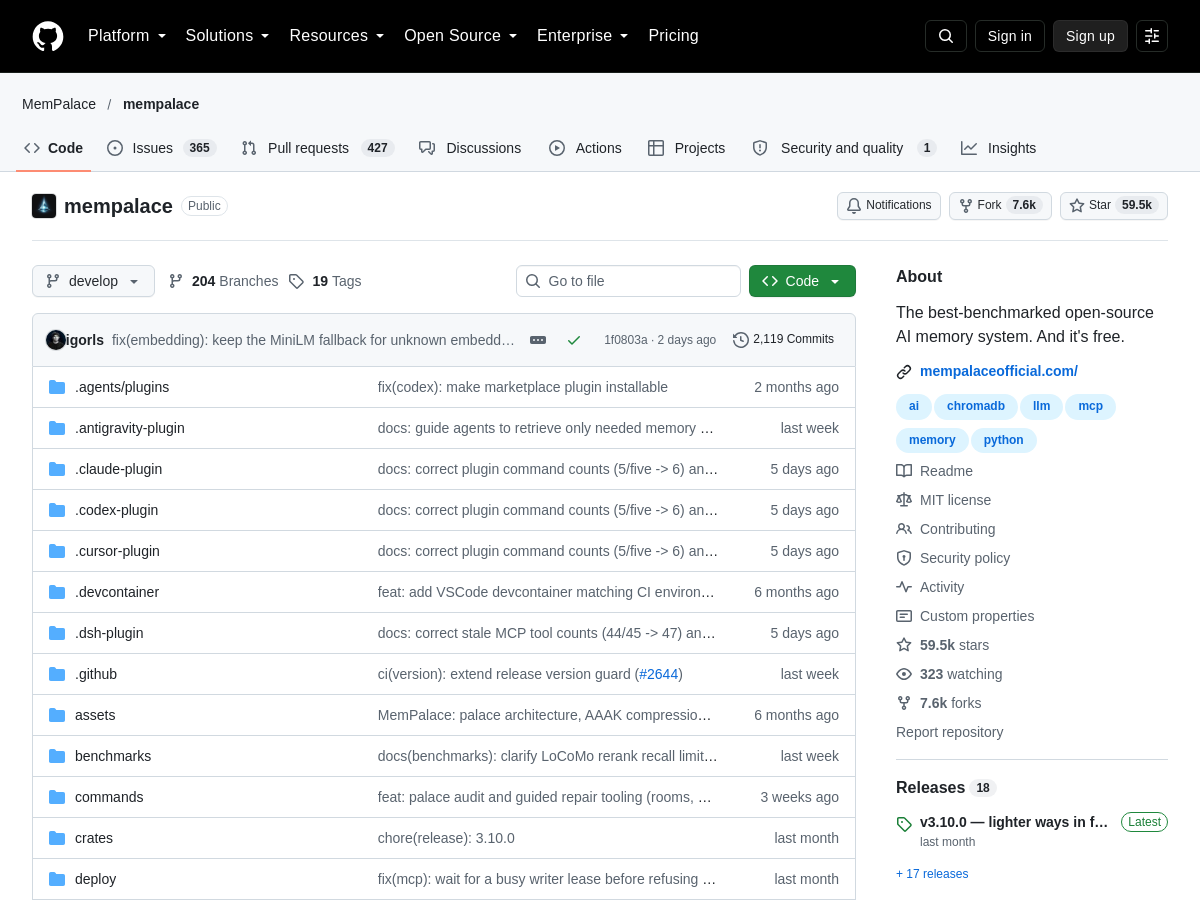
Screenshot of Mempalace
Mempalace
LLM Open Source

MemPalace is an open-source AI memory system that stores conversation history as verbatim text and retrieves it with semantic search. It does not summarize, extract, or paraphrase. The index is structured, allowing searches to be scoped rather than run against a flat corpus. The retrieval layer is pluggable, with ChromaDB as the default backend. MemPalace includes a temporal entity-relationship graph with validity windows, backed by local SQLite. It also features auto-save hooks for Claude Code, Codex CLI, and Cursor IDE, saving periodically and before context compression. MemPalace has a Python API, a CLI reference, and a full benchmark methodology. It requires Python 3.9+, a vector-store backend, and approximately 300 MB of disk space for the embedding model. MemPalace is licensed under the MIT license and has a strong focus on community involvement, with a contributing guide and a public notice system.

Solves

MemPalace solves the problem of efficiently storing and retrieving large amounts of conversation history, allowing users to quickly find relevant information and context. This is particularly useful for developers, researchers, and individuals working on complex projects, who need to keep track of multiple conversations, meetings, and discussions. By providing a structured and pluggable retrieval layer, MemPalace enables users to scope their searches and retrieve relevant information without having to manually sift through large amounts of data.
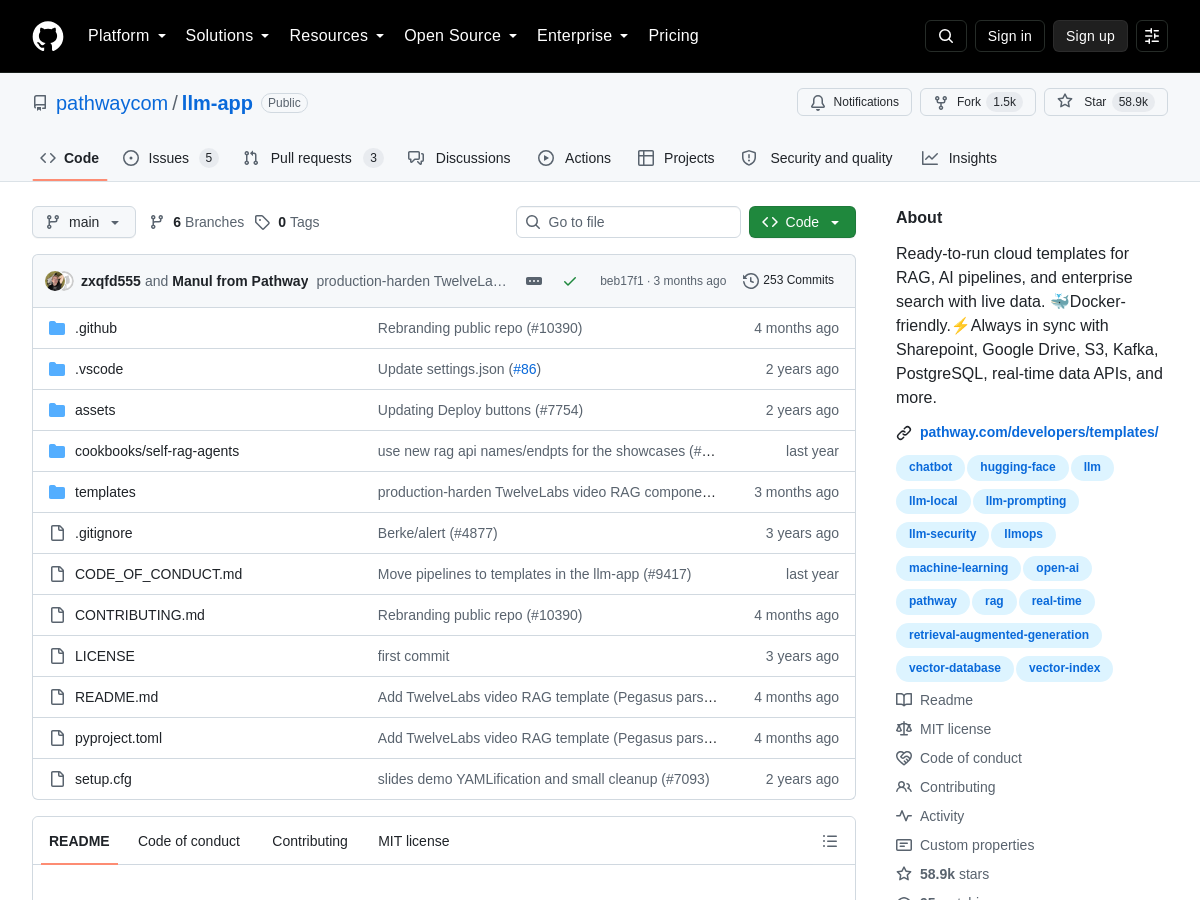
Screenshot of Llm App
Llm App
LLM Open Source

Llm App is an open-source project that provides ready-to-run cloud templates for RAG, AI pipelines, and enterprise search with live data. It is Docker-friendly and always in sync with various data sources such as Sharepoint, Google Drive, S3, Kafka, PostgreSQL, and real-time data APIs. The project has a wide range of applications and is suitable for developers, ML engineers, and data scientists. It has a large community of contributors and users, with over 58,000 stars on GitHub. The project is constantly evolving, with new features and updates being added regularly. It has a comprehensive documentation and a large collection of templates and examples, making it easy to get started and use. The project is also highly customizable, allowing users to tailor it to their specific needs and use cases. Overall, Llm App is a powerful and flexible tool for building and deploying AI-powered applications. It has a strong focus on enterprise search and RAG, and is well-suited for large-scale deployments. The project is also highly extensible, with a wide range of plugins and integrations available. With its large community and comprehensive documentation, Llm App is an ideal choice for developers and organizations looking to build and deploy AI-powered applications. The project is constantly improving, with new features and updates being added regularly. It is also highly secure, with a strong focus on security and compliance. The project has a wide range of use cases, including enterprise search, RAG, and AI-powered applications. It is suitable for a wide range of industries, including healthcare, finance, and manufacturing. Overall, Llm App is a powerful and flexible tool for building and deploying AI-powered applications.
Solves

Llm App solves the problem of building and deploying AI-powered applications, particularly in the areas of enterprise search and RAG. It provides a comprehensive set of tools and templates, making it easy to get started and use. The project is highly customizable, allowing users to tailor it to their specific needs and use cases. It also has a strong focus on security and compliance, making it suitable for large-scale deployments. With its large community and comprehensive documentation, Llm App is an ideal choice for developers and organizations looking to build and deploy AI-powered applications. The project is constantly improving, with new features and updates being added regularly, making it a reliable and trustworthy choice for building and deploying AI-powered applications.

Screenshot of Open Design
Open Design
AI Agents Open Source

Open Design is a local-first, open-source desktop application that serves as an alternative to Claude Design. It turns coding agents into a design engine, enabling the generation of prototypes, landing pages, dashboards, slides, images, and videos directly from agent prompts. The app runs natively on the desktop and keeps all data local, emphasizing privacy and control. Open Design integrates with popular coding agents such as Claude Code, Codex, Cursor, DeepSeek Harness, OpenCode, Hermes, and over 20 other CLIs through a bring-your-own-key (BYOK) model. It includes more than 259 skills and 142 design systems, supporting web, desktop, and mobile prototypes, as well as slide decks and media. Generated designs can be exported as real files in formats like HTML, PDF, PPTX, and MP4, making them ready for further use or sharing.

Solves

Open Design solves the problem of generating production-ready design artifacts from coding agents without relying on proprietary cloud design tools. It provides a local, open-source environment where developers can create prototypes, presentations, and media files and export them to standard formats, preserving full control and avoiding vendor lock-in.

Screenshot of Ruflo
Ruflo
AI Agents Open Source

Ruflo is an open-source agent meta-harness designed to deploy intelligent multi-agent swarms and coordinate autonomous workflows. It provides capabilities for building conversational AI systems, featuring adaptive memory and self-learning intelligence to enable agents to improve over time. Ruflo integrates with popular AI coding and assistant tools such as Claude Code, Codex, and Hermes, and supports RAG (Retrieval-Augmented Generation) integration for knowledge-grounded responses. It acts as a framework for orchestrating multiple agents to accomplish complex tasks collaboratively.

Solves

Ruflo addresses the challenge of coordinating multiple AI agents to work together on complex tasks. It provides adaptive memory and self-learning mechanisms, enabling agents to retain context and improve over time, while its integration with RAG and various AI tools allows for building sophisticated conversational and autonomous systems.

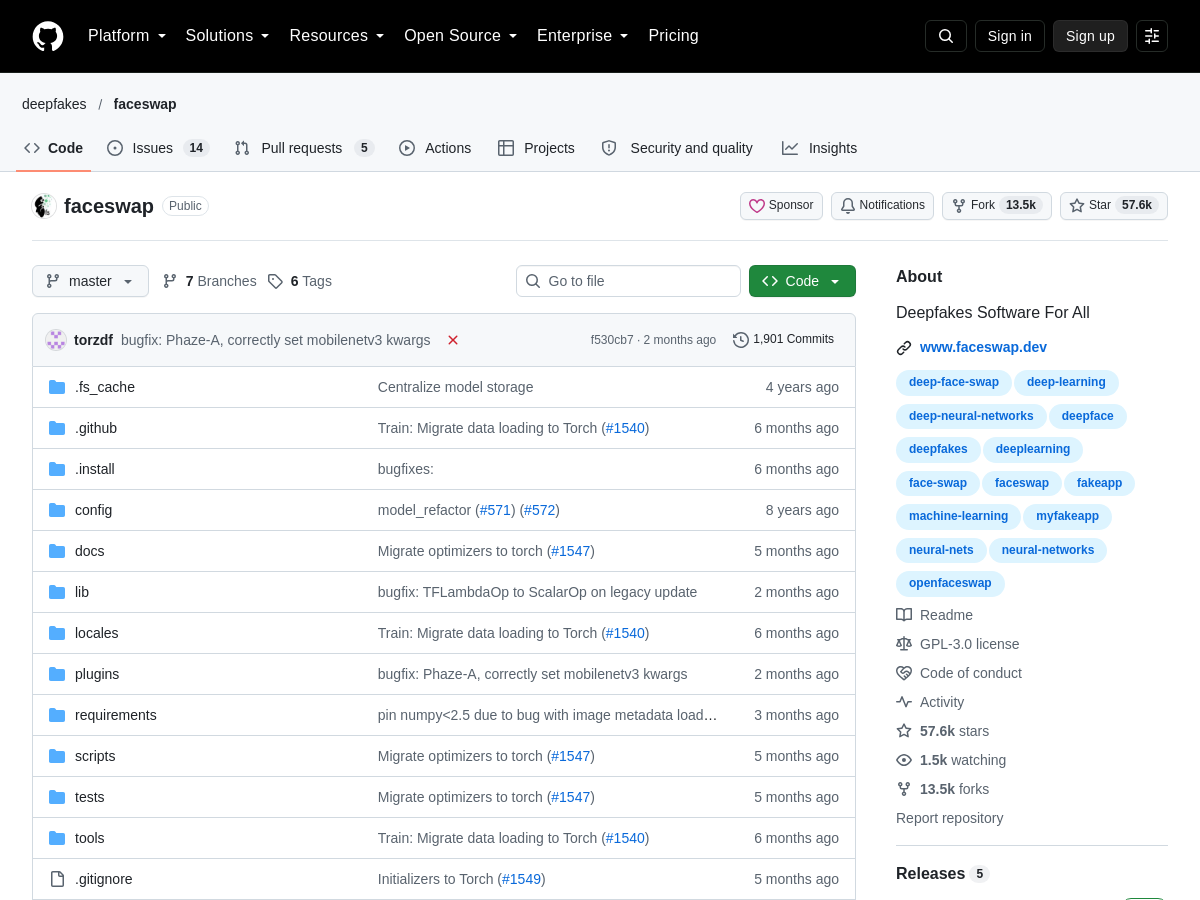
Screenshot of Faceswap
Faceswap
AI/ML Open Source

Faceswap is an open-source deepfakes software that allows users to swap faces in images and videos. It utilizes deep learning algorithms to achieve this task. The software is designed to be user-friendly and accessible to everyone, with a simple and intuitive interface. Faceswap supports various models, including Original, Villain, and DFL, each with its own strengths and weaknesses. The software also includes a range of features, such as face detection, face alignment, and face swapping, making it a powerful tool for creating realistic deepfakes. Faceswap is constantly being updated and improved, with new features and models being added regularly. The software is available on GitHub, where users can access the source code, report issues, and contribute to the development of the project.

Solves

Faceswap solves the problem of creating realistic deepfakes, which can be used for various purposes, such as entertainment, education, and research. The software provides a user-friendly interface for swapping faces in images and videos, making it accessible to everyone, regardless of their technical expertise. By utilizing deep learning algorithms, Faceswap is able to achieve high-quality results, making it a valuable tool for anyone looking to create realistic deepfakes.

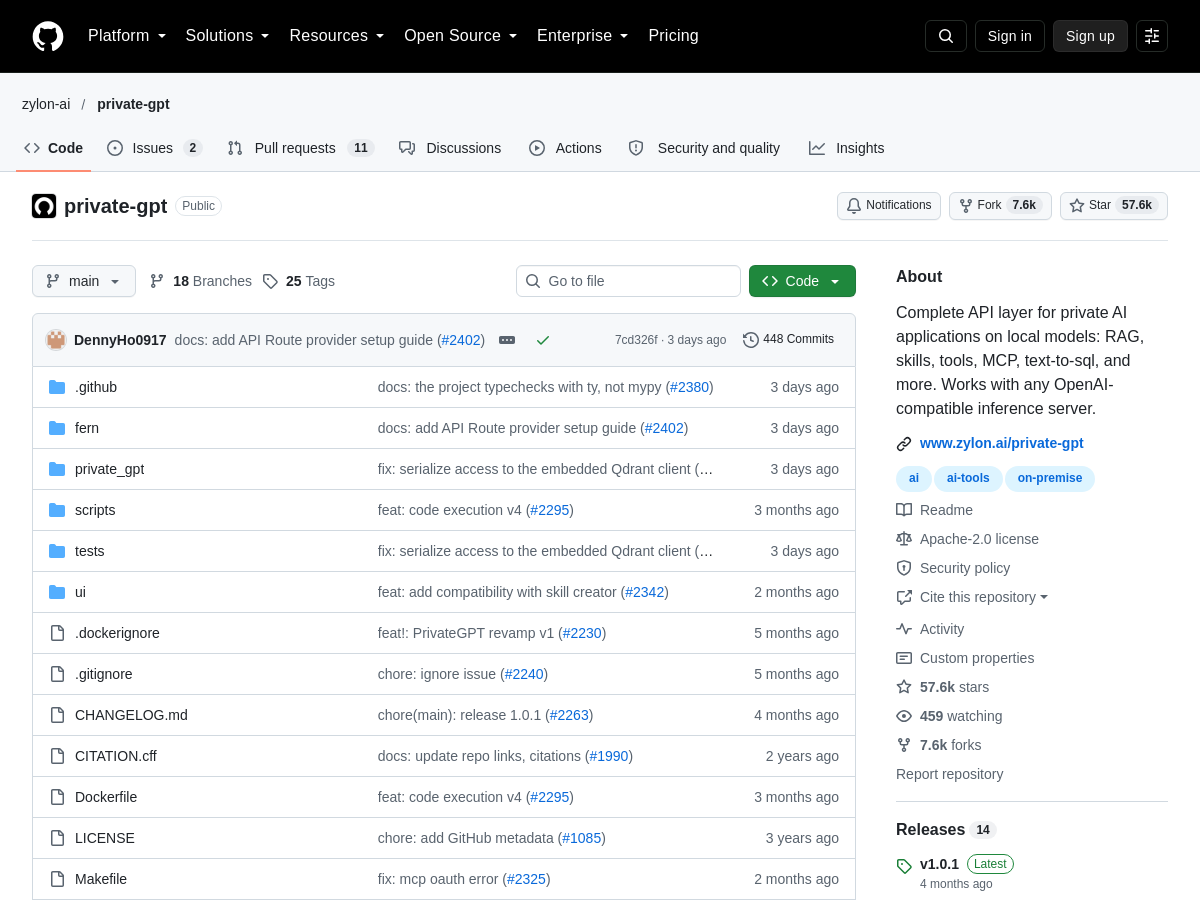
Screenshot of Private Gpt
Private Gpt
LLM Open Source

PrivateGPT is an open-source API layer that enables developers to build private AI applications on local models. It provides a standardized API for messages, ingestion, tools, retrieval, citations, database access, tabular analysis, MCP, skills, and custom tools. PrivateGPT is designed to work with any OpenAI-compatible inference server, allowing developers to build AI applications without depending on cloud APIs. The API is production-tested and powers Zylon, an on-premise AI platform for enterprises. PrivateGPT includes features such as standard messages API, file and artifact ingestion, retrieval with citations and agentic RAG, built-in tools mirroring the Claude API, custom tools and MCP connectors, structured access to databases and CSVs, embeddings and orchestration. The API is compatible with the Claude API and supports model selection, messages, streaming, batch/async processing, token counting, knowledge, tools, data, agents, output, and optimization. PrivateGPT is API-first, providing a standardized local backend for building self-hosted AI applications. It is maintained by the team at Zylon and is available under the Apache-2.0 license.

Solves

PrivateGPT solves the problem of building useful AI applications on top of local models. It provides a standardized API layer that enables developers to build private AI applications without depending on cloud APIs. This is particularly useful for enterprises and organizations that require private and secure AI solutions. PrivateGPT answers the question of how to build a useful AI application on top of a local model, whereas other projects such as Ollama, LM Studio, LocalAI, vLLM, and llama.cpp answer the question of how to run a model locally.

Screenshot of Yolov5
Yolov5
AI/ML Open Source

YOLOv5 is a family of compound-scaled object detection models trained on the COCO dataset. It is implemented in PyTorch and provides a complete training, validation, and inference pipeline. The model architecture uses a modified CSPDarknet53 backbone with a PANet neck and YOLO detection head, supporting anchor-based prediction across multiple scales. YOLOv5 ships with several pre-trained variants—nano, small, medium, large, and xlarge—that trade speed for accuracy. The repository includes utilities for automatic data augmentation (Mosaic, MixUp), hyperparameter evolution, auto-anchor selection, and export to deployment formats like ONNX, CoreML, TFLite, TensorRT, and OpenVINO. A classification module supports image classification tasks, and the codebase is designed for easy extension and customization. YOLOv5 has been widely adopted due to its balance of speed and accuracy, active community maintenance, and integration with the Ultralytics ecosystem. It can be used from the command line or as a Python library, and Docker containers are provided for reproducible execution. The project is under continuous updates with frequent commits addressing bugs, dependency bumps, and compatibility improvements.

Solves

YOLOv5 solves the problem of real-time object detection with high accuracy and low computational cost. Developers and researchers need a state-of-the-art detection system that can be deployed on edge devices like smartphones, embedded platforms, and browsers. YOLOv5 provides a single-stage detector that processes images and video streams quickly while maintaining competitive mAP scores, eliminating the need for complex two-stage detectors. Its extensive export capabilities further simplify deployment across diverse hardware.

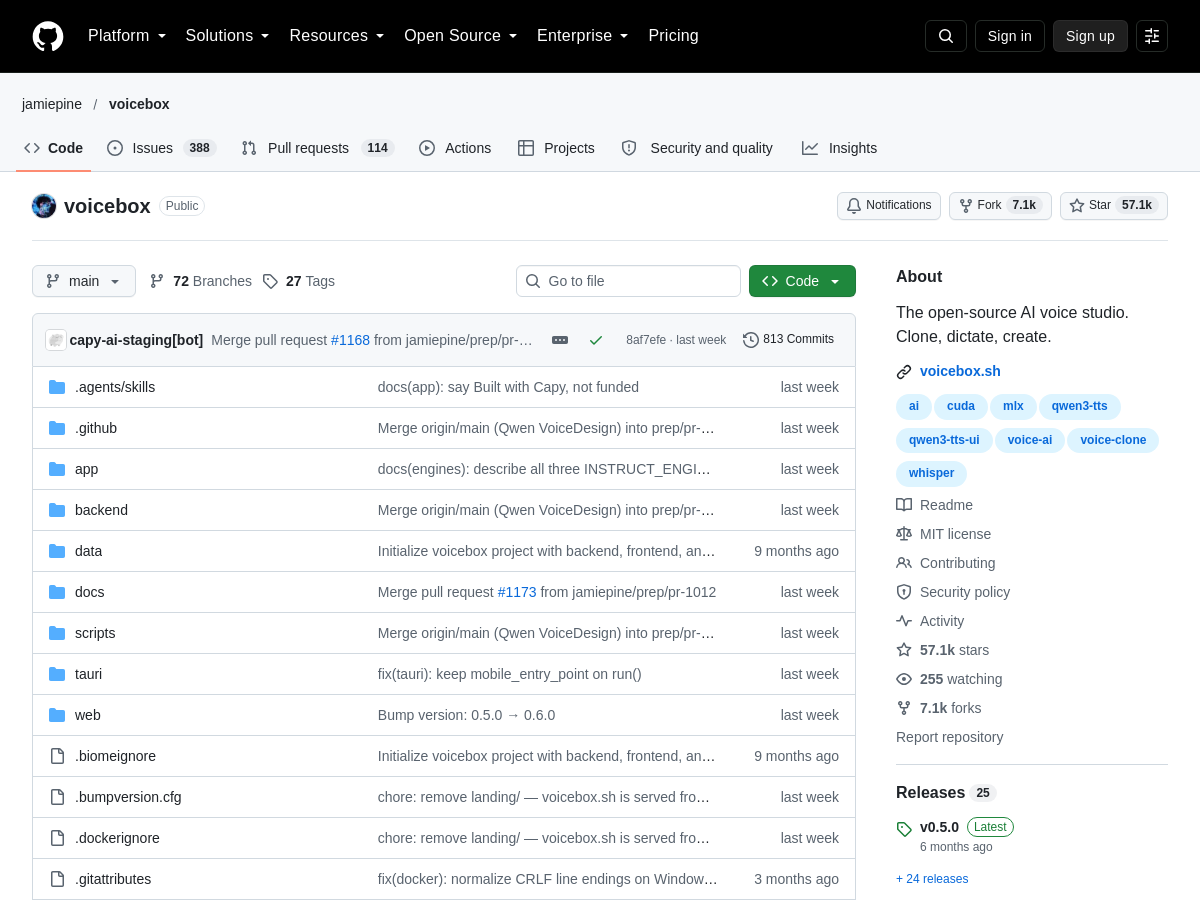
Screenshot of Voicebox
Voicebox
Voice & Audio Open Source

Voicebox is an open-source AI voice studio that allows users to clone voices, generate speech, dictate into any app, and talk to agents in voices they own. It is a local-first application, meaning that all models, voice data, and captures never leave the user's machine, ensuring complete privacy. The application supports multiple TTS engines, including Qwen3-TTS, Qwen CustomVoice, Qwen VoiceDesign, LuxTTS, Chatterbox Multilingual, Chatterbox Turbo, HumeAI TADA, and Kokoro, and allows users to switch between them per-generation. Voicebox also features post-processing effects, such as pitch shift, reverb, delay, chorus, compression, and filters, and supports unlimited generation length with auto-chunking and crossfade. Additionally, the application includes a stories editor for multi-voice timeline editing, global dictation and voice input, and agent voice output. Voicebox is built with Tauri (Rust) and uses a variety of technologies, including React, TypeScript, Tailwind CSS, FastAPI (Python), and Pedalboard (Spotify) for effects. The application is available for macOS, Windows, and Linux, and can be installed using a variety of methods, including downloading a pre-built binary or building from source. Voicebox is licensed under the MIT License and is free to use and distribute.

Solves

Voicebox solves the problem of providing a comprehensive and private AI voice studio that allows users to clone voices, generate speech, and interact with agents in a secure and flexible way. It addresses the need for a local-first application that does not rely on cloud services, ensuring that sensitive voice data and models are kept private. By providing a wide range of features and technologies, Voicebox enables users to create high-quality voice content and interact with agents in a natural and intuitive way.

Screenshot of Face_recognition
Face_recognition
Dev Tools Open Source

Face_recognition is an open-source Python library and command-line tool that provides simple, high-level interfaces for face recognition tasks. Built on top of dlib’s state-of-the-art deep learning model, it offers an incredibly easy API to detect faces in images, extract face encodings (128-dimensional vectors), and compare them for identity matching. The library abstracts away the complexity of machine learning, allowing users to perform face recognition with just a couple of lines of code. It supports both image files and real-time video streams, and can handle multiple faces in a single frame. Key features include face detection (finding all faces in an image), face landmarks (locating eyes, nose, mouth, etc.), face encoding (converting a face into a numerical vector), and face comparison (checking if two faces are of the same person). The command-line tool allows quick operations like finding faces, identifying known people, or extracting facial encodings without writing code. Designed for ease of use, it is ideal for rapid prototyping and integration into applications that require face identification, such as security systems, photo organizers, and access control. The library is well-documented with examples and has been widely adopted due to its simplicity and accuracy.

Solves

Integrating face recognition into software applications has traditionally required deep expertise in computer vision and machine learning. Developers without this specialized knowledge often struggle to implement reliable face detection and identification. Face_recognition solves this by offering a straightforward, high-level API that encapsulates the complexity of dlib’s underlying algorithms. It enables any Python developer to add face recognition capabilities—such as verifying a person’s identity, tagging photos, or building attendance systems—with just a few function calls, dramatically reducing development time and technical barriers.

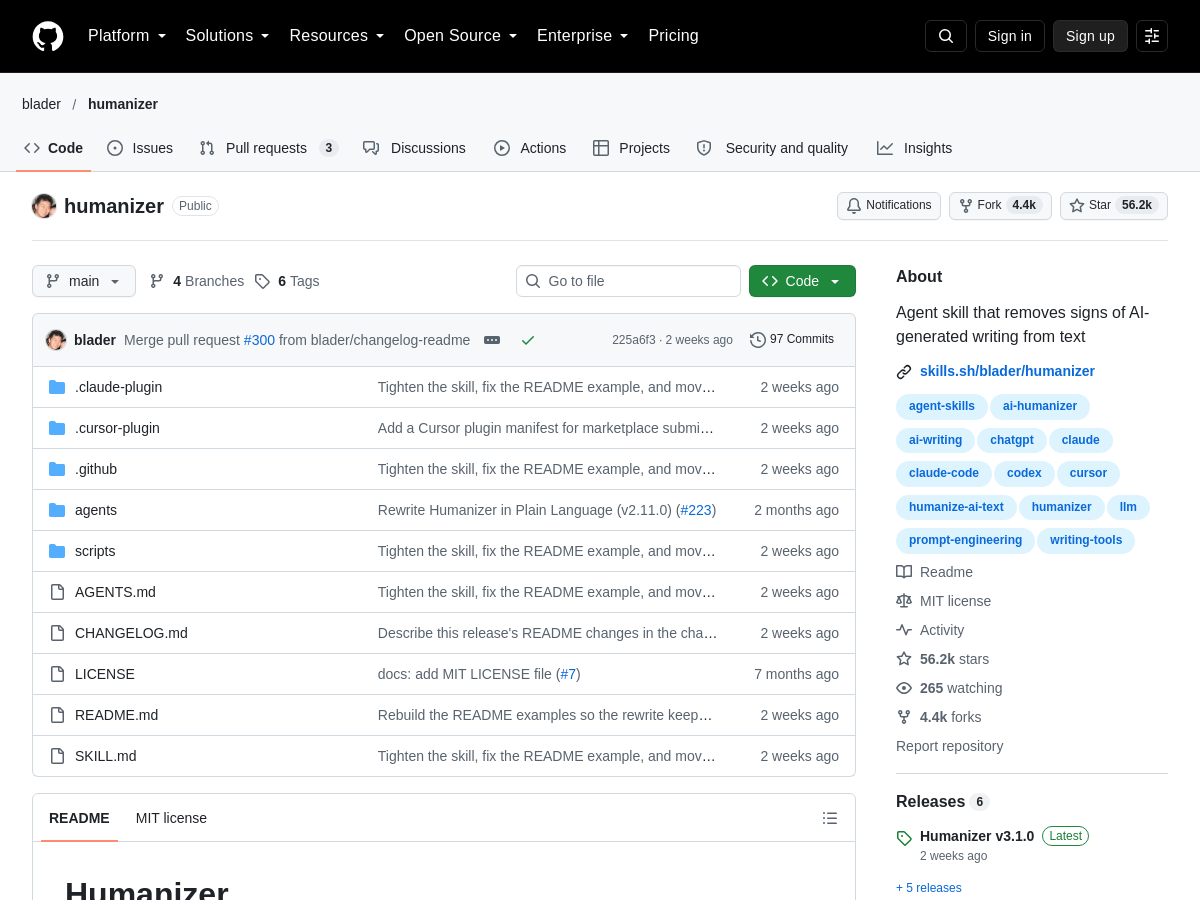
Screenshot of Humanizer
Humanizer
LLM Open Source

Humanizer is an open-source project that aims to remove signs of AI-generated writing from text, making it sound more like a person wrote it. It is built on Wikipedia's Signs of AI writing guide and works in various agents, including Claude Code, Codex, and others. Humanizer checks for 26 patterns in the text, including staged run-ups, sayings that sound deep, and inflated significance, and rewrites the text to make it sound more human-like. It does not make things up and only uses factual details from the source or the writer. Humanizer can be installed as a skill in various agents and can be used to rewrite text, match the writer's voice, and even rewrite files. The project is licensed under the MIT license and has a large community of users and contributors.

Solves

Humanizer solves the problem of AI-generated text sounding artificial and lacking a human touch. Many writers and content creators use AI tools to generate text, but the resulting text often sounds robotic and lacks the nuances of human writing. Humanizer helps to remove these signs of AI-generated writing, making the text sound more natural and engaging. This is particularly useful for writers, content creators, and businesses that want to create high-quality, engaging content that resonates with their audience.

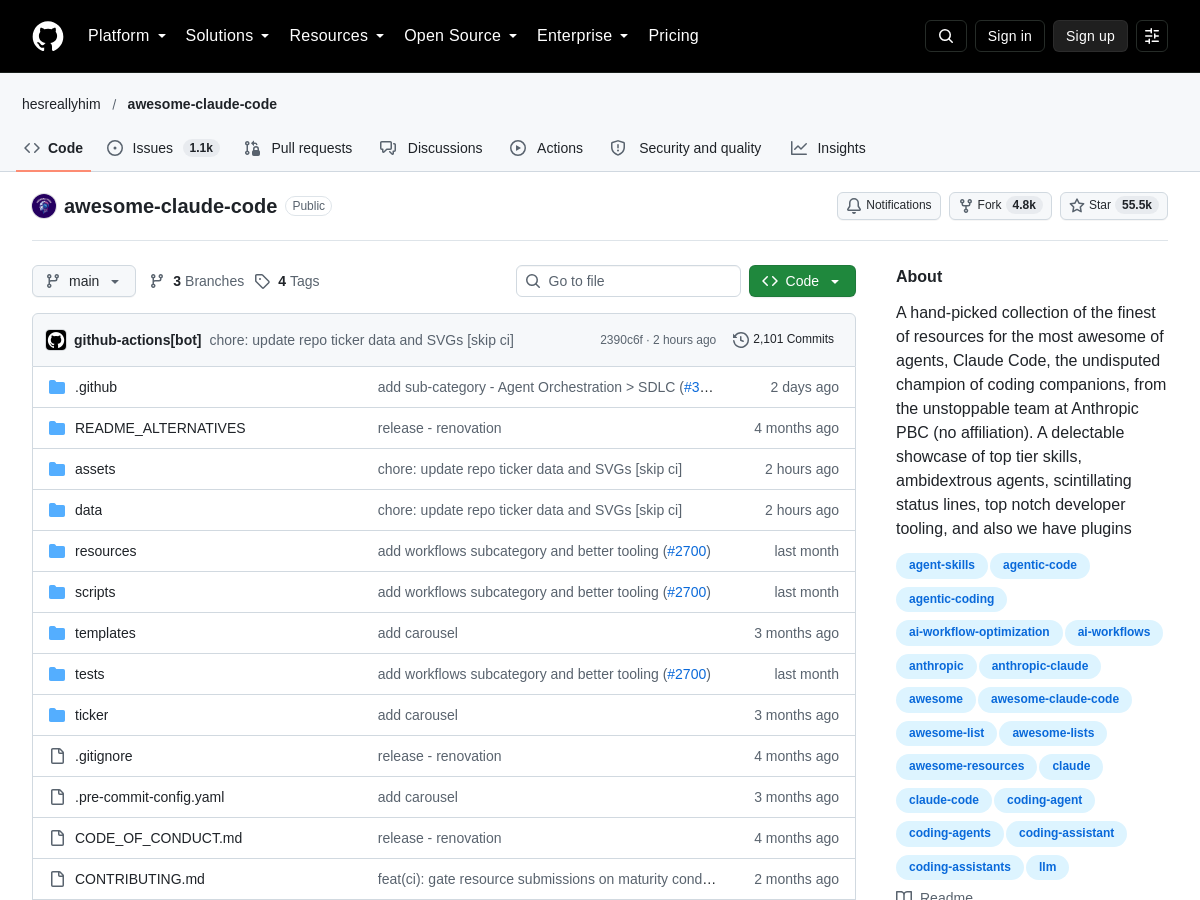
Screenshot of Awesome Claude Code
Awesome Claude Code
LLM Open Source

Awesome Claude Code is a hand-picked collection of the finest resources for Claude Code, a coding companion. The project is a showcase of top-tier skills, ambidextrous agents, scintillating status lines, top-notch developer tooling, and plugins. It is designed to provide a comprehensive set of resources for developers, ML engineers, and data scientists working with Claude Code. The project includes a range of topics, such as agent skills, agentic code, AI workflow optimization, and coding assistants. The resources are curated to help users get the most out of Claude Code and to provide a starting point for exploring the possibilities of coding companions. The project is open-source and has a large community of contributors, with over 55,000 stars on GitHub. The project is constantly evolving, with new resources and updates being added regularly. The goal of the project is to provide a comprehensive and up-to-date collection of resources for Claude Code, and to foster a community of developers and users who can share knowledge and expertise. The project includes a range of features, such as a README file, a license, and a code of conduct, which provide guidance and support for users and contributors. Overall, Awesome Claude Code is a valuable resource for anyone working with Claude Code, and is a testament to the power of open-source collaboration and community-driven development. The project's focus on providing high-quality resources and fostering a community of users and contributors makes it a unique and valuable asset for the development community. With its comprehensive collection of resources and active community, Awesome Claude Code is an essential tool for anyone looking to get the most out of Claude Code. The project's open-source nature and commitment to community-driven development ensure that it will continue to evolve and improve over time, providing a valuable resource for developers and users alike. The project's documentation and resources are well-organized and easy to use, making it a great starting point for new users and a valuable reference for experienced developers. The project's community is active and supportive, with many contributors and users sharing their knowledge and expertise through issues, pull requests, and discussions. The project's maintainers are responsive and helpful, ensuring that issues are addressed and updates are made regularly. Overall, Awesome Claude Code is a well-maintained and comprehensive resource that is essential for anyone working with Claude Code.

Solves

Developers, ML engineers, and data scientists working with Claude Code often struggle to find high-quality resources and tools to help them get the most out of the platform. Awesome Claude Code solves this problem by providing a comprehensive and curated collection of resources, including tutorials, examples, and plugins. The project provides a starting point for exploring the possibilities of coding companions and helps users to overcome common challenges and obstacles. By providing a centralized repository of resources, Awesome Claude Code saves users time and effort, and helps them to focus on developing their skills and expertise. The project also fosters a community of users and contributors, providing a supportive and collaborative environment for sharing knowledge and expertise.

Screenshot of Gpt Engineer
Gpt Engineer
Code Open Source

GPT Engineer is an open-source command-line interface (CLI) platform designed to experiment with AI-driven code generation. It allows users to describe software requirements in natural language, and the tool generates corresponding code files, enabling rapid prototyping and automation of coding tasks. The project was created by Anton Osika and serves as a precursor to the popular Lovable platform. The tool is intended for developers and technical enthusiasts who want to explore the capabilities of large language models in software development. By providing a flexible, local execution environment, GPT Engineer allows users to integrate different AI backends and customize generation workflows. It emphasizes iterative refinement and hands-on experimentation with code generation. As an open-source project, GPT Engineer has attracted a community of contributors and users interested in AI-assisted programming. While it may require familiarity with the command line and AI model APIs, it provides a foundation for understanding and building upon automated code generation techniques.

Solves

GPT Engineer addresses the need for rapid code generation from natural language specifications, reducing the time and effort required to translate ideas into functional code. It enables developers to bypass boilerplate and focus on higher-level design, accelerating prototyping and experimentation with AI-driven software development.

Screenshot of MojoMake - AI Image to Video Generator

MojoMake is an AI-powered image-to-video generation platform that enables users to transform static images into dynamic, engaging videos. By aggregating access to multiple leading AI models—such as those specialized in motion synthesis, style transfer, and animation—MojoMake gives users the ability to choose the best model for their specific creative needs directly from a single interface. With over 100 built-in effects, including zooms, pans, portraits, landscapes, and abstract animations, the platform caters to a wide range of visual styles. The tool is designed for simplicity: upload an image, select a desired effect and model, and generate a video clip in seconds. It operates entirely in the cloud, requiring no local hardware or technical expertise. MojoMake also offers a freemium pricing model, allowing users to experiment with limited free generations before upgrading to paid plans for higher resolutions, longer videos, and commercial usage rights. The platform is regularly updated with new models and effects to stay at the cutting edge of generative AI.

Solves

Content creators, marketers, social media managers, and small business owners often struggle to produce video content due to lack of time, skills, or resources. Creating even simple animated videos traditionally requires expensive software and technical know-how. MojoMake solves this by providing an intuitive, AI-driven solution that instantly converts any static image into a professional-looking video clip, lowering the barrier to video creation and enabling rapid content production without prior experience.

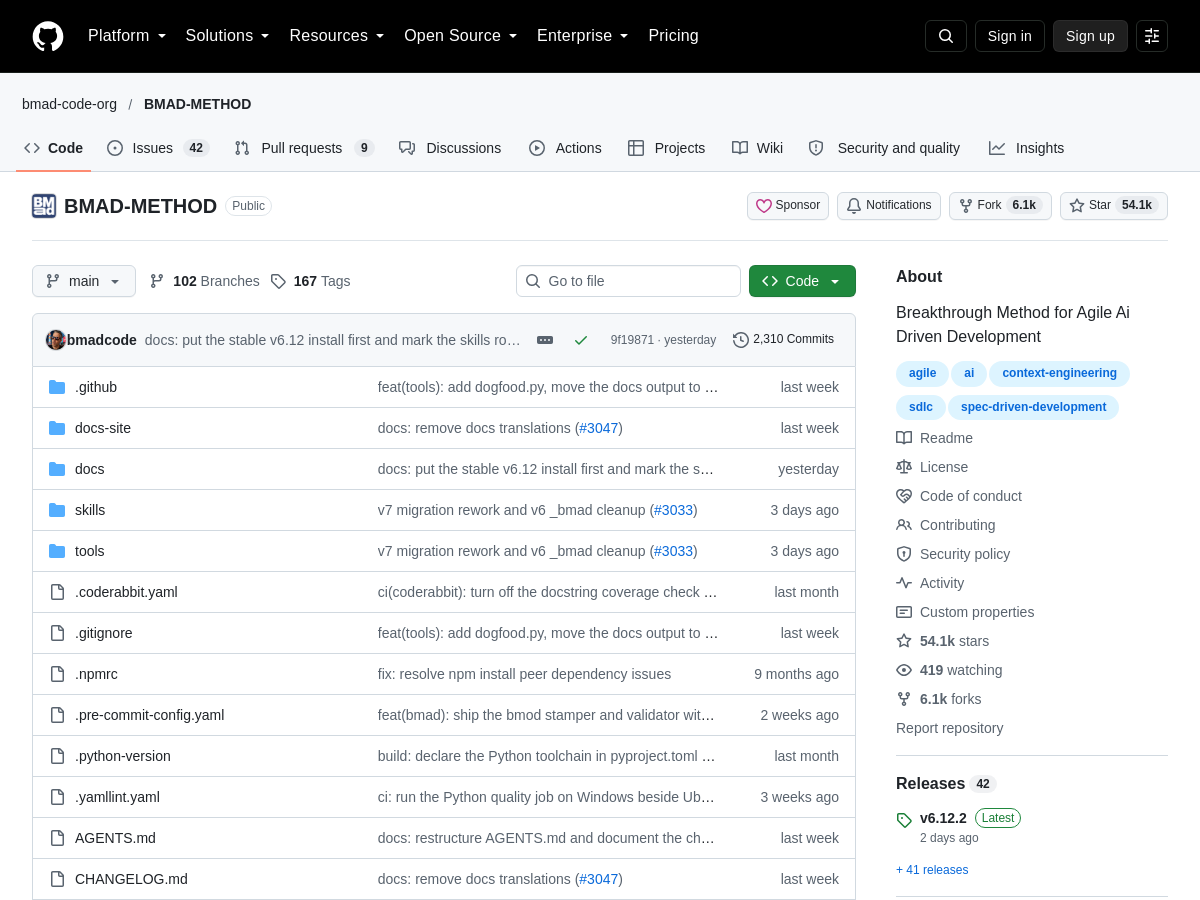
Screenshot of BMAD METHOD
BMAD METHOD
AI/ML Open Source

The BMAD METHOD is an open-source project that provides a breakthrough method for agile AI-driven development. It is designed to help developers turn an idea or change request into working software without giving up the thinking. The method covers the whole effort, not only the code, and includes decisions on what to build, how it holds together, and how it changes as you learn. BMAD METHOD is the agile way to do it, with decisions staying explicit, context carrying forward, and the process sizing itself to the work. Small changes can go straight to build, while complex work gets the depth it needs. The same method can cover a weekend prototype and a system with years of history behind it. The project has a stable release, v6.12, and a preview alpha release, v7, which is in development. The v7 release is expected to be finalized on October 16, 2026. BMAD METHOD is free and open source, with no paywalled workflows or gated community. It has a right-sized process, durable context, specialized perspectives, guided collaboration, and one delivery path. The project has a documentation section that includes guides on how to build your first project with BMAD, add BMAD to an existing codebase, and choose a planning path. The community section includes links to Discord, YouTube, GitHub Issues, and GitHub Discussions. The project is licensed under the MIT License and has a trademark policy. Contributions are welcome, and the project has a contributing guide.

Solves

The BMAD METHOD solves the problem of how to turn an idea or change request into working software without giving up the thinking. It provides a structured approach to agile AI-driven development, which helps developers to make explicit decisions, carry forward context, and size the process to the work. This approach helps to reduce the complexity of software development and makes it easier to collaborate with others. The BMAD METHOD is particularly useful for developers who want to work on complex projects, but need a more structured approach to manage the complexity. It is also useful for developers who want to work on small projects, but need a more agile approach to quickly turn an idea into working software.

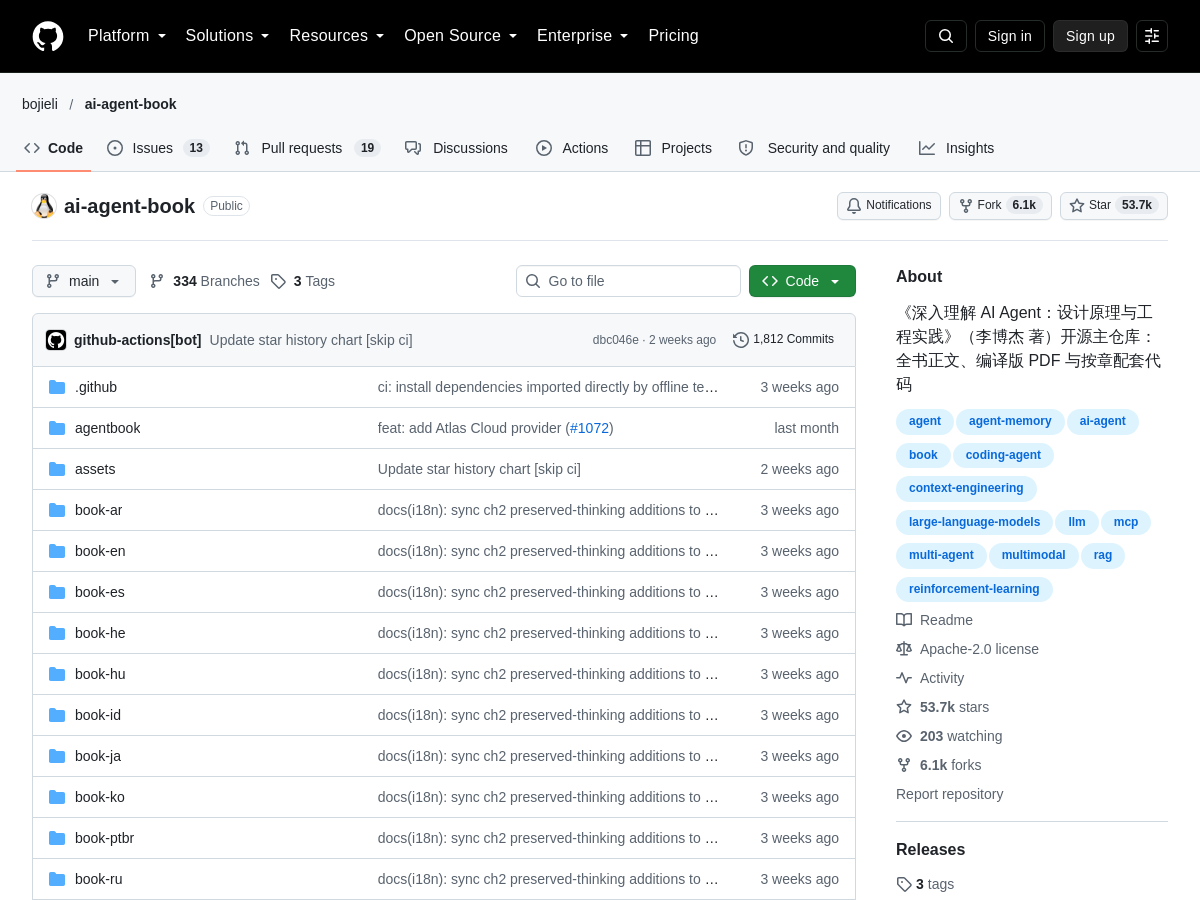
Screenshot of Ai Agent Book
Ai Agent Book
LLM Open Source

Ai Agent Book is an open-source project that provides a comprehensive resource for understanding AI agents. The project includes the full text of the book, compiled PDF versions, and accompanying code for each chapter. The book covers topics such as agent design principles, engineering practices, and large language models. The project is hosted on GitHub and has a large community of contributors and users. The book is available in multiple languages, including English, Arabic, Spanish, Hebrew, Hungarian, Indonesian, and Japanese. The project also includes a range of resources, such as a README file, license information, and activity logs. Overall, Ai Agent Book is a valuable resource for anyone interested in AI agents and large language models. The project is constantly updated with new features and improvements, making it a dynamic and evolving resource. The use of GitHub as a hosting platform allows for easy collaboration and contribution from the community, which has helped to make the project a success. The project's focus on AI agents and large language models makes it a unique and valuable resource in the field of artificial intelligence.

Solves

Ai Agent Book solves the problem of limited resources and information available for understanding AI agents and large language models. The project provides a comprehensive and accessible resource for anyone interested in these topics, regardless of their level of expertise. By making the book and accompanying code available open-source, the project allows users to learn from and contribute to the resource, which helps to advance the field of artificial intelligence. The project also helps to address the issue of limited accessibility to information on AI agents and large language models, particularly for non-English speaking users, by providing translations of the book in multiple languages.

Screenshot of Flowise
Flowise
AI Agents Open Source

Flowise is an open-source, low-code platform designed to help developers and technical users build LLM applications and AI agents visually. It provides a drag-and-drop interface where users can create chatflows and agent workflows by connecting nodes for LLMs, prompts, tools, and memory components. Flowise supports a wide range of integrations including OpenAI, Anthropic, Hugging Face, local models via Ollama, vector databases such as Pinecone and Chroma, and various external APIs. Key features include the ability to quickly prototype conversational AI, build multi-agent systems, and expose flows as APIs for integration into other applications. The platform is built on Node.js and React, and can be self-hosted using Docker or run locally. It also offers an embedded chat widget that can be added to websites. Flowise is maintained by the FlowiseAI team and has gained significant popularity in the AI developer community. It is suitable for both experimentation and production use, offering flexibility for customizing agent behavior and connecting to custom tools.

Solves

Flowise solves the complexity of building and orchestrating LLM applications by providing a visual, no-code/low-code environment. It eliminates the need to write extensive boilerplate code for connecting language models, managing prompts, and integrating tools, enabling faster iteration and broader accessibility for non-programmers.

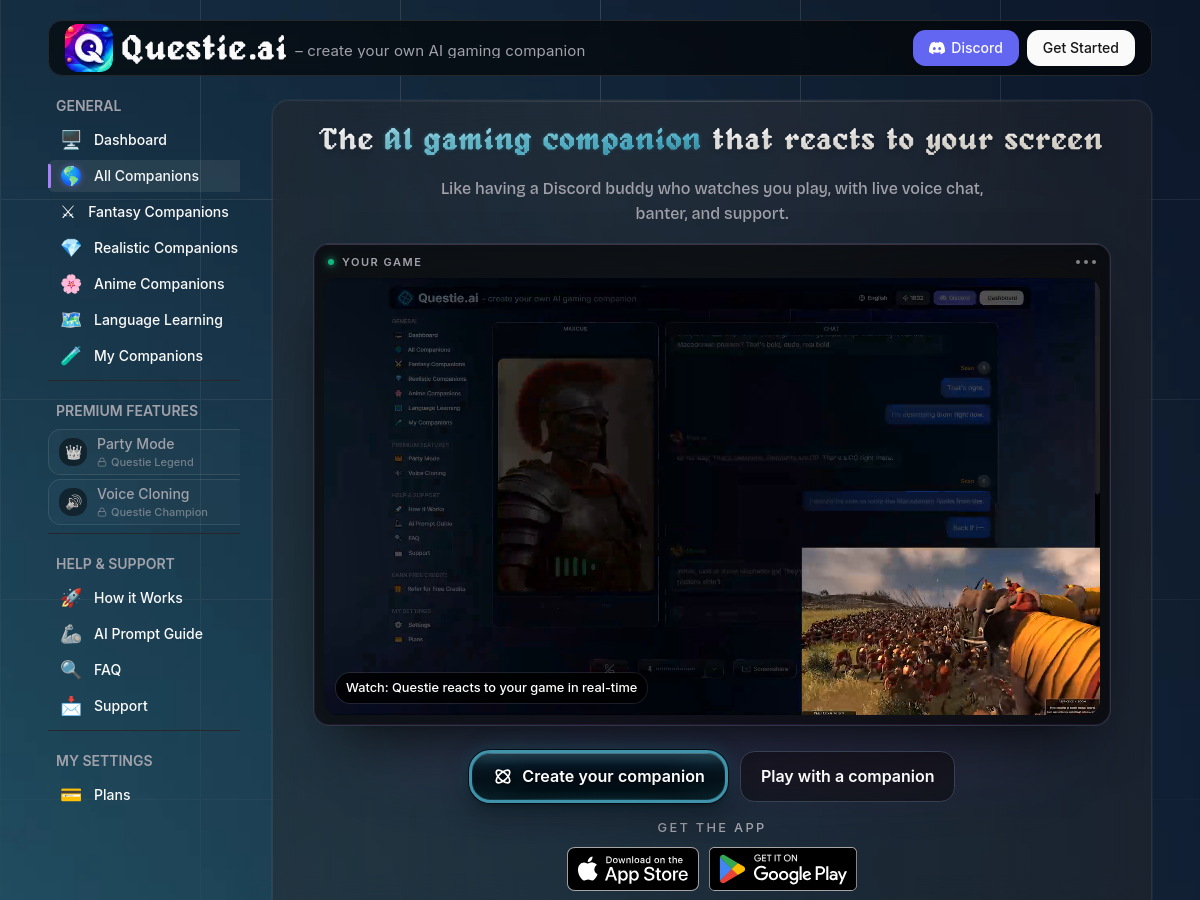
Screenshot of Questie AI - Game Companion & Roleplay Character Chat

Questie AI is a freemium AI companion platform designed specifically for gamers and roleplay enthusiasts. It allows users to create custom AI characters that act as gaming companions, reacting to gameplay in real time through live screenshare and engaging in voice chat. The service positions itself as a virtual Discord buddy that watches you play, offering banter, encouragement, and interactive roleplay while you game. It is available as a web application and through native iOS and Android apps, with a reported community of over 50,000 players. The platform includes a library of pre-made companions across categories such as fantasy, anime, realistic, and language learning. Users can also build and personalize their own AI companions. Premium features include Party Mode and voice cloning, available through paid tiers. Questie AI has been featured in outlets such as 404 Media, Kotaku, and iXBT Games, and markets itself as an alternative to Character.AI, Moemate, PolyBuzz, Hakko AI, and similar AI roleplay platforms. Questie AI combines vision-language AI with conversational roleplay, enabling the AI to observe on-screen gameplay and respond contextually. This creates a hands-free companion experience for single-player campaigns, multiplayer sessions, and casual play. The service also supports language learning scenarios, allowing users to practice conversations with AI characters in a game-adjacent context. Its design targets gamers seeking companionship, entertainment, or a more immersive roleplay experience while playing video games.

Solves

Questie AI solves the problem of playing games alone by providing an AI companion that can watch your screen, react to gameplay events, and chat with you by voice in real time. It gives gamers a social, interactive presence during solo sessions, and offers customizable roleplay characters for those who want narrative or conversational companionship beyond traditional game NPCs.

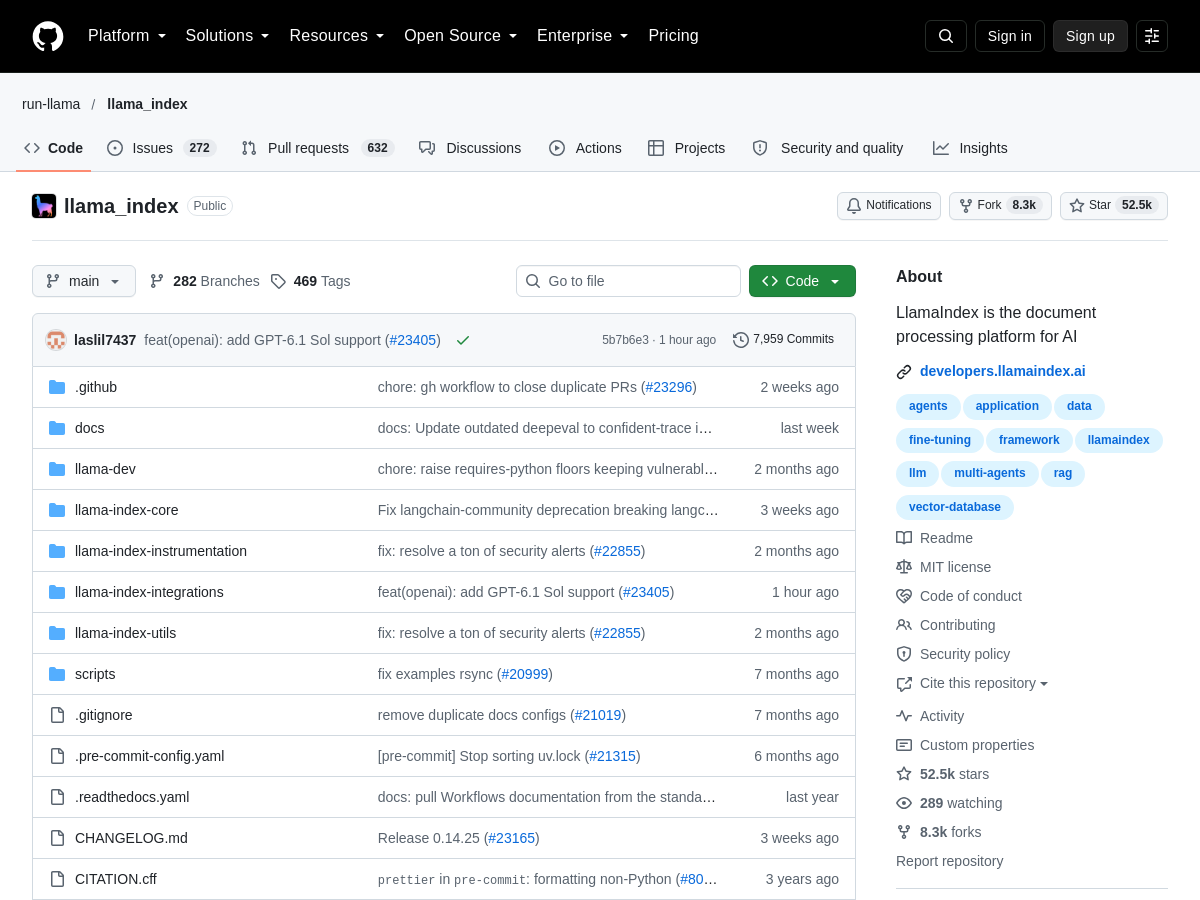
Screenshot of Llama_index
Llama_index
Fine-tuning Open Source

LlamaIndex is an open-source framework designed to build agentic applications, particularly for document parsing and extraction. It provides a comprehensive toolkit to help perform data augmentation for Large Language Models (LLMs). The framework offers data connectors to ingest existing data sources and formats, tools to structure data for easy use with LLMs, and an advanced retrieval/query interface over the data. LlamaIndex allows for easy integrations with outer application frameworks and provides tools for both beginner and advanced users. The high-level API enables beginner users to ingest and query data in a few lines of code, while the lower-level APIs allow advanced users to customize and extend modules to fit their needs. LlamaIndex is part of a broader ecosystem that includes LlamaParse, a document agent platform focused on agentic OCR, parsing, extraction, and indexing. LlamaParse can be used with the LlamaIndex framework or standalone and includes tools like Parse for agentic OCR and document parsing, Extract for structured data extraction, and Index for ingest, index, and RAG pipelines.

Solves

Developers and organizations face the challenge of effectively augmenting Large Language Models (LLMs) with their own private data. LlamaIndex solves this problem by providing a data framework that helps build LLM apps, offering tools for data ingestion, structuring, and querying, and enabling seamless integration with various application frameworks. This allows users to unlock the full potential of LLMs with their private data, enhancing knowledge generation and reasoning capabilities.

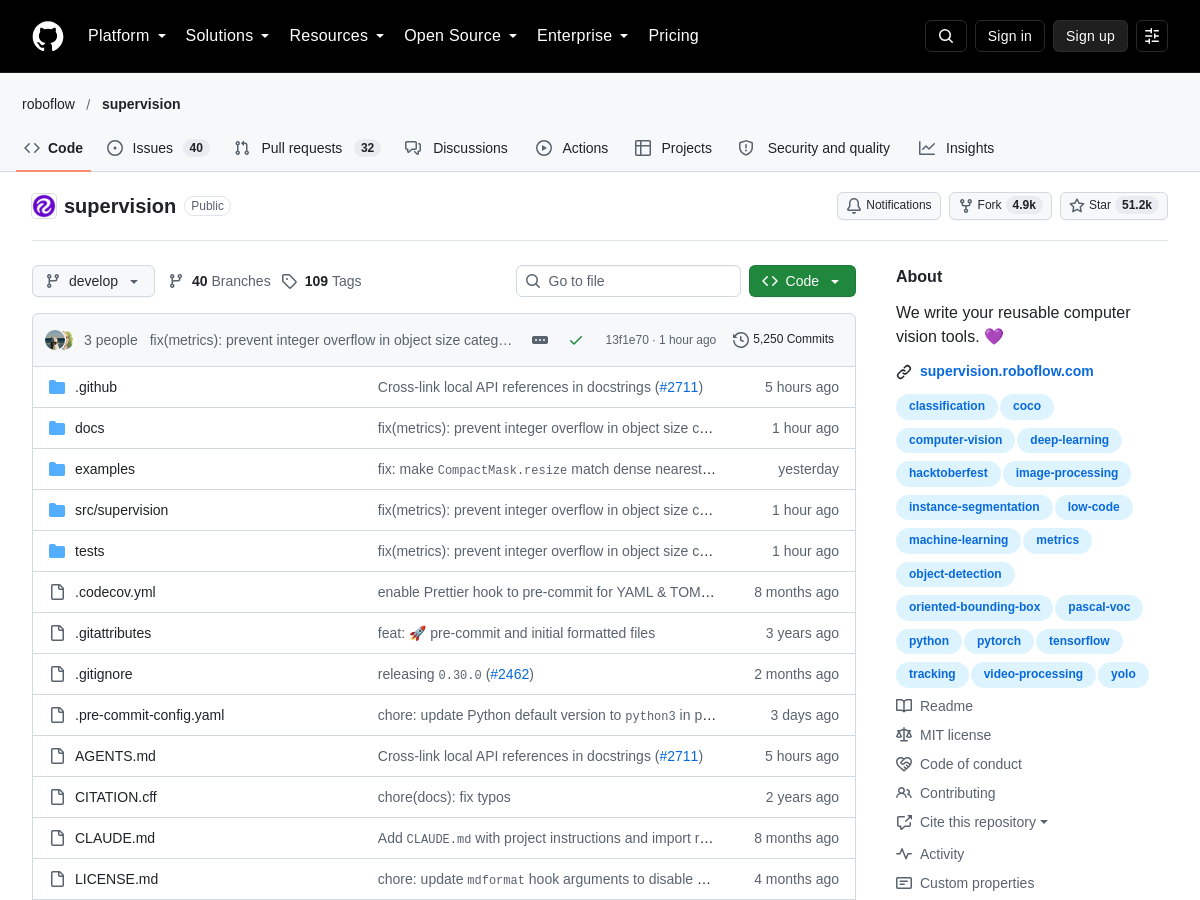
Screenshot of Supervision
Supervision
AI/ML Open Source

Supervision is an open-source library designed to be a comprehensive toolkit for computer vision applications. It provides a wide range of functionalities, including data loading, model integration, annotation, and dataset management. The library is model-agnostic, allowing users to plug in any classification, detection, or segmentation model. Supervision offers a variety of highly customizable annotators, enabling users to compose the perfect visualization for their specific use case. Additionally, it provides a set of utilities for loading, splitting, merging, and saving datasets in various formats. The library is well-documented, with a detailed documentation page and a contributing guide for those who want to get involved in the development process. Supervision is built with Python and supports multiple libraries, including Ultralytics, Transformers, MMDetection, and Inference. It is designed to help users build computer vision applications faster and more reliably.

Solves

Supervision solves the problem of building and deploying computer vision applications by providing a comprehensive and flexible toolkit. It helps users to focus on building applications around their models, rather than spending time on data loading, annotation, and dataset management. The library is particularly useful for developers, data scientists, and researchers who work with computer vision applications, as it provides a wide range of functionalities and utilities to streamline their workflow.

Screenshot of ChatGPT Images
ChatGPT Images
Images Unknown

ChatGPT Images is a feature integrated into OpenAI's ChatGPT platform that allows users to generate and edit images directly through natural-language text prompts. Rather than operating as a standalone image generator, it functions within a conversational interface, enabling users to iteratively refine visuals by describing changes, adding objects, or adjusting styles in an ongoing dialogue. The tool leverages OpenAI's advanced multimodal models to interpret both text and existing images, supporting tasks like creating original illustrations, transforming photos, and generating custom graphics for various creative and professional purposes. Because it is part of ChatGPT, users can combine image creation with text-based assistance, making it easy to brainstorm concepts, develop visual assets, and maintain context across a project. The interface is designed for simplicity, allowing anyone with access to ChatGPT to produce visuals without prior design expertise or special software. While the underlying model is proprietary and not open source, the service is delivered through a web-based platform, requiring no installation. ChatGPT Images is continuously improved by OpenAI, reflecting the company's broader roadmap for multimodal AI capabilities.

Solves

ChatGPT Images addresses the need for accessible, conversational image generation, enabling users without design skills to create and refine visuals simply by describing what they want, eliminating the need for complex image-editing tools or separate AI art platforms.

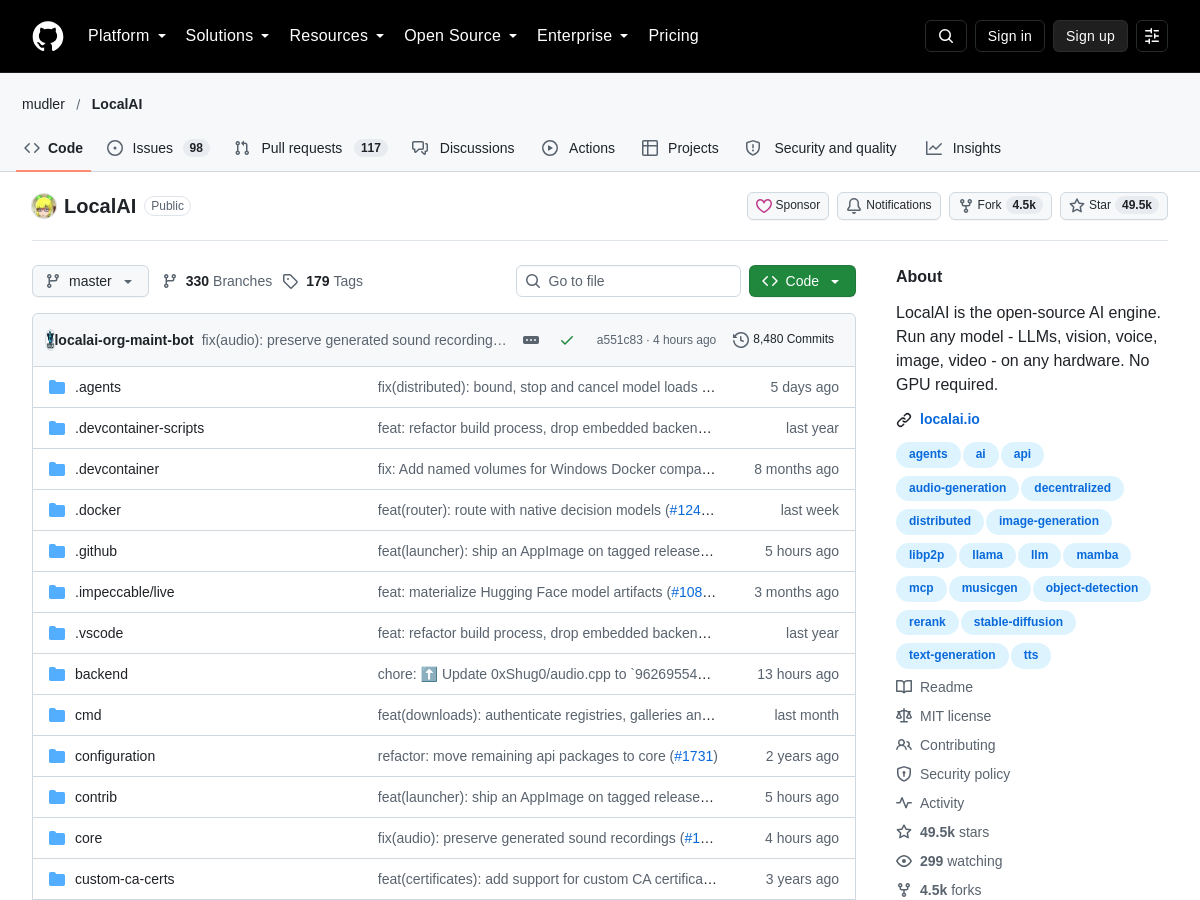
Screenshot of LocalAI
LocalAI
Image Gen Open Source

LocalAI is an open-source AI engine that allows users to run any model, including LLMs, vision, voice, image, and video, on any hardware without requiring a GPU. It has a small core and is designed to be composable, open, and extensible, with a drop-in API compatibility for OpenAI, Anthropic, and ElevenLabs APIs across every backend. LocalAI supports various hardware, including NVIDIA, AMD, Intel, Apple Silicon, Vulkan, and CPU-only, and is multi-user ready with API key auth, user quotas, and role-based access. It also features built-in AI agents with autonomous capabilities, tool use, RAG, MCP, and skills, and prioritizes privacy by keeping user data within their infrastructure. The project is maintained by a small team of humans and a wider community of contributors, and is licensed under the MIT license.

Solves

LocalAI solves the problem of limited access to AI models and hardware for individuals and organizations by providing a flexible, open-source, and extensible platform that can run on various hardware configurations, allowing users to leverage AI capabilities without being restricted by specific hardware requirements or vendor lock-in.

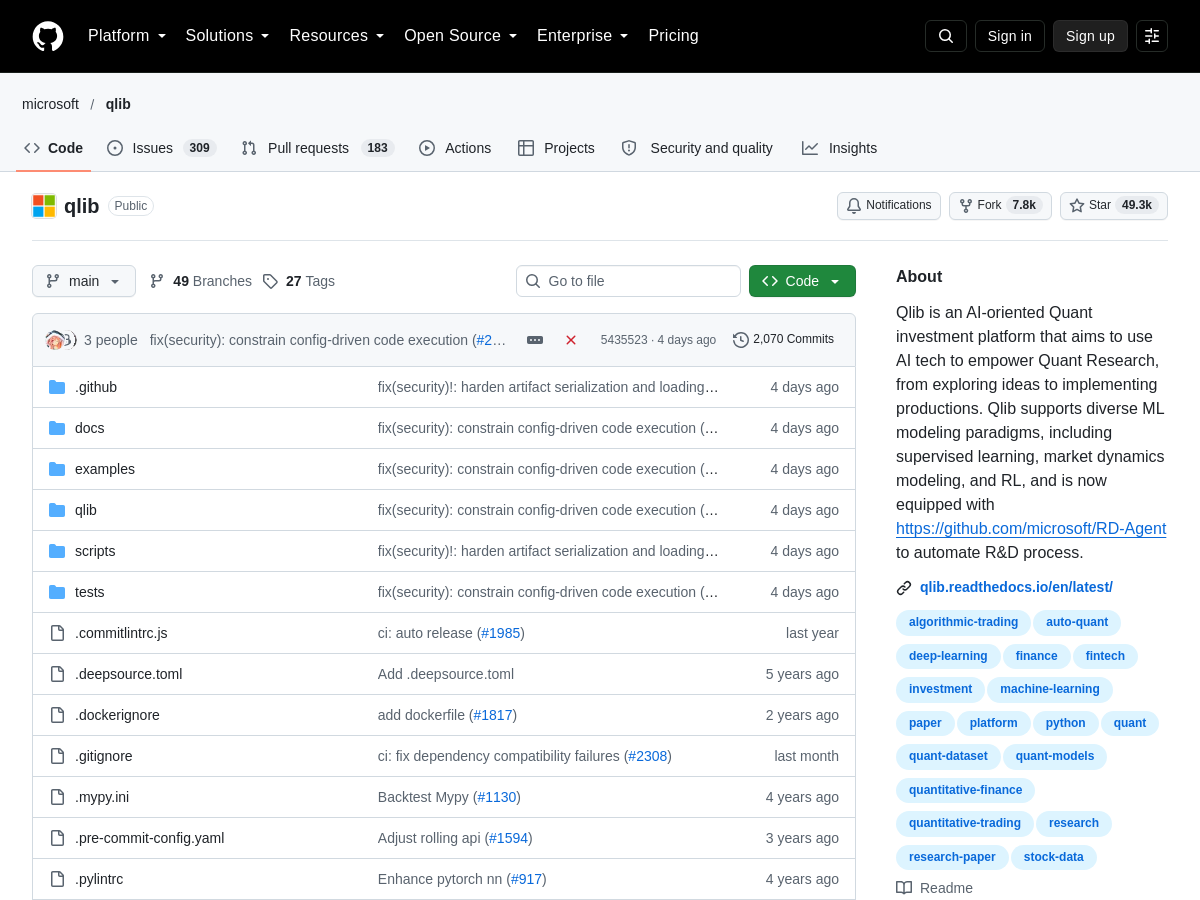
Screenshot of Qlib
Qlib
AI Agents Open Source

Qlib is an AI-oriented Quant investment platform that aims to use AI technology to empower Quant Research, from exploring ideas to implementing productions. Qlib supports diverse ML modeling paradigms, including supervised learning, market dynamics modeling, and reinforcement learning (RL). The platform is now equipped with RD-Agent to automate the R&D process. Qlib provides a comprehensive framework for quantitative research and investment, allowing users to explore ideas, implement productions, and automate workflows. The platform is designed to support various machine learning models and provides a range of tools and features to facilitate quantitative research and investment. Qlib is an open-source project, and its development is actively maintained by Microsoft. The platform has gained significant attention and adoption in the quantitative finance community, with over 49,000 stars on GitHub. Qlib's documentation and community resources are available on the project's GitHub page and Read the Docs website. The platform's codebase is written in Python, and it is licensed under the MIT license. Qlib has a large and active community of contributors and users, with over 7,800 forks and 2,070 commits on GitHub. The platform's development is driven by a team of experienced researchers and engineers, and it has received significant contributions from the open-source community. Qlib's features and capabilities make it an attractive choice for quantitative researchers and investors looking to leverage AI and machine learning in their workflows. The platform's ability to support diverse ML modeling paradigms, automate workflows, and provide a comprehensive framework for quantitative research and investment makes it a valuable tool for anyone involved in quantitative finance. Qlib's open-source nature and large community of contributors and users ensure that the platform is continuously improved and updated, providing users with access to the latest advancements in AI and machine learning. Overall, Qlib is a powerful and flexible platform that has the potential to revolutionize the field of quantitative finance by providing a comprehensive framework for quantitative research and investment.

Solves

Quantitative researchers and investors face significant challenges in exploring ideas, implementing productions, and automating workflows. Qlib solves this problem by providing a comprehensive framework for quantitative research and investment, supporting diverse ML modeling paradigms, and automating workflows. The platform's ability to support various machine learning models and provide a range of tools and features to facilitate quantitative research and investment makes it an attractive choice for quantitative researchers and investors. By using Qlib, users can streamline their workflows, improve their research and investment outcomes, and gain a competitive edge in the market.

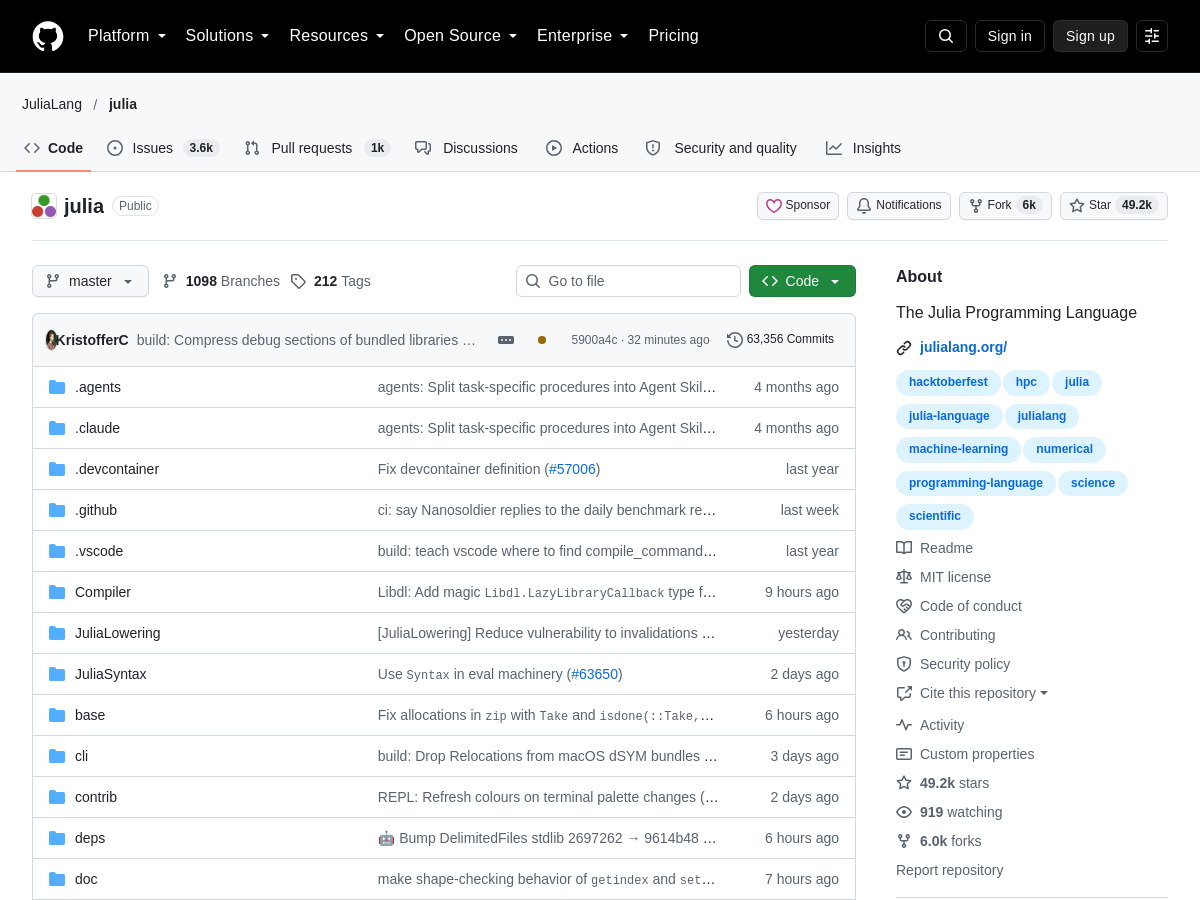
Screenshot of Julia
Julia
AI/ML Open Source

Julia is a high-performance, high-level, multi-paradigm programming language. It is designed to be fast, efficient, and easy to use, making it a great choice for a wide range of applications, including scientific computing, machine learning, and data analysis. Julia has a strong focus on performance, dynamism, and ease of use, and is often compared to other popular programming languages such as Python, R, and MATLAB. One of the key features of Julia is its ability to run at speeds comparable to C++, while also providing a high-level, dynamic programming environment. This makes it an attractive choice for developers who need to write high-performance code, but also want the flexibility and ease of use of a dynamic language. Julia also has a growing ecosystem of packages and libraries, including popular data science and machine learning libraries such as MLJ and Flux. Overall, Julia is a powerful and flexible programming language that is well-suited to a wide range of applications, from scientific computing and data analysis to machine learning and web development. Julia's performance capabilities make it an ideal choice for applications that require fast execution speeds, such as real-time data processing and scientific simulations. Additionally, Julia's dynamic nature and high-level syntax make it easy to write and debug code, reducing the time and effort required to develop and maintain complex applications. With its growing ecosystem of packages and libraries, Julia is becoming an increasingly popular choice among developers and researchers who need a fast, flexible, and easy-to-use programming language.

Solves

Developers and researchers who need a fast, flexible, and easy-to-use programming language for scientific computing, machine learning, and data analysis often face the problem of choosing between languages that are either high-performance but difficult to use, or easy to use but slow. Julia solves this problem by providing a high-performance, high-level, multi-paradigm programming language that is designed to be fast, efficient, and easy to use. With Julia, developers and researchers can write high-performance code without sacrificing ease of use, making it an ideal choice for a wide range of applications.

Screenshot of Career Ops
Career Ops
Open Source Open Source

The Career Ops project is an open-source AI-powered job search system that integrates with AI coding command-line interfaces such as Claude Code, Codex, OpenCode, and Antigravity. It automates the process of scanning job portals, evaluating listings using a structured A-F rubric that produces a 1.0-5.0 score, tailoring CVs to specific job descriptions, and tracking applications over time. The system runs entirely locally, which helps keep personal data private and avoids reliance on third-party cloud services. Career Ops includes 14 distinct skill modes that let users customize the AI's behavior for different stages of the job search workflow. A Go-based dashboard provides a visual overview of tracked applications and evaluations, while PDF generation enables the creation of polished reports. Batch processing capabilities allow users to handle multiple job listings or applications simultaneously, making the tool suitable for both casual job seekers and those managing a high volume of opportunities. The project is structured as a set of skills that can be loaded into compatible AI coding environments, meaning it leverages the underlying language model's reasoning capabilities to interpret job descriptions and generate tailored application materials. Because it operates within local CLIs, users retain control over their data and can inspect or modify the underlying scripts to fit their specific needs. This approach contrasts with subscription-based SaaS job search platforms by offering full transparency and customization at no cost. Overall, Career Ops is positioned as a flexible, developer-friendly alternative for job seekers who are comfortable with command-line tools and want to automate repetitive parts of the job application process while maintaining control over their personal information.

Solves

Career Ops solves the tedious and repetitive aspects of job searching by automating job portal scanning, evaluating listings with a structured A-F rubric, tailoring CVs, and tracking applications. It reduces manual effort, provides consistent scoring, and keeps data local for privacy.

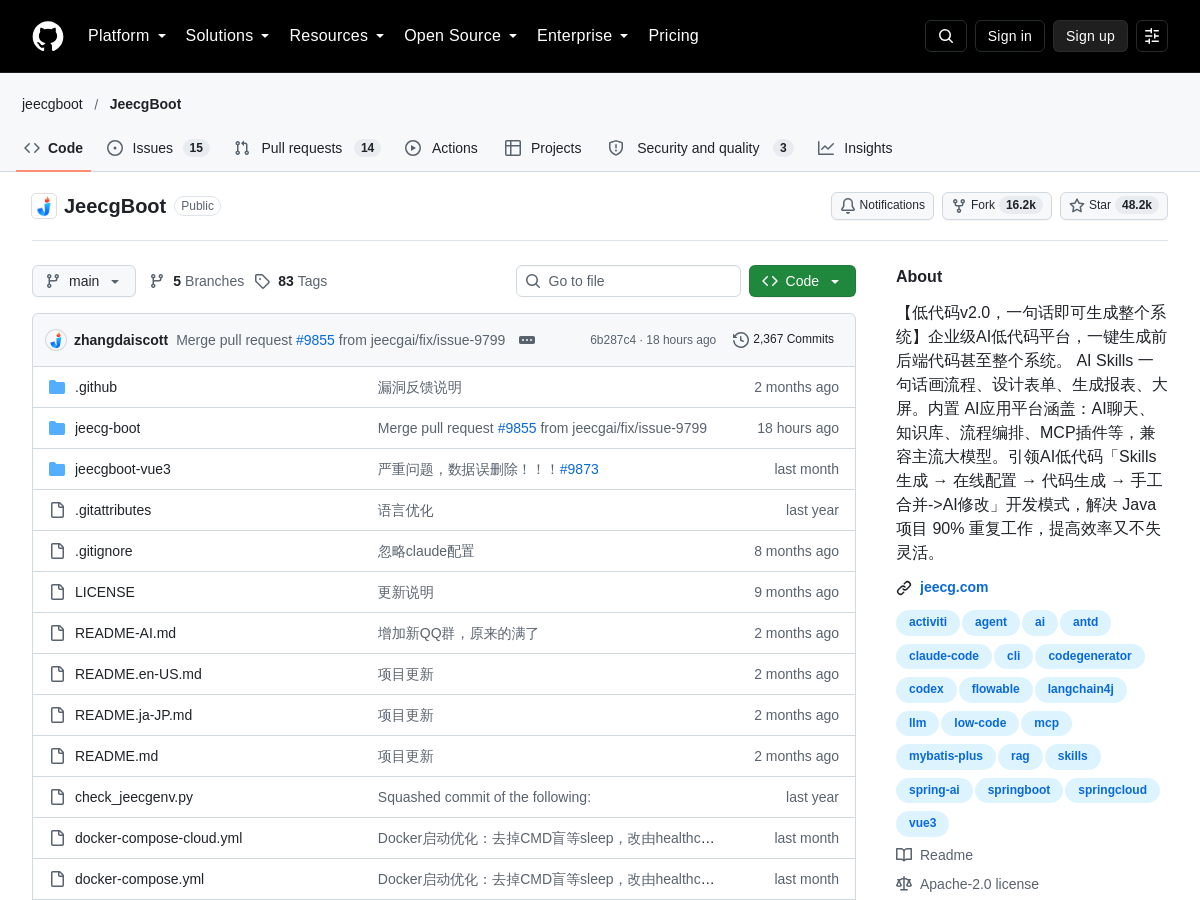
Screenshot of JeecgBoot
JeecgBoot
LLM Open Source

JeecgBoot is an open-source, low-code development platform that utilizes AI technology to generate complete systems or business modules with just one sentence. It provides a range of features, including AI application management, knowledge base, flow orchestration, and MCP plugins, and is compatible with mainstream large models. The platform supports microservices and single-body deployment modes and is suitable for various project scenarios, including OA, ERP, CRM, and SaaS. JeecgBoot has a strong and granular permission control system, supporting button permissions, data permissions, and table field permissions. It also provides a range of tools and components, including a code generator, report designer, and data visualization tools. The platform is highly customizable, with a range of templates and themes available, and supports multiple databases, including MySQL, Oracle, and PostgreSQL.

Solves

JeecgBoot solves the problem of low-code development for Java projects, providing a platform that can generate complete systems or business modules with just one sentence, reducing the need for manual coding and increasing development efficiency. It also provides a range of features and tools that support the development of AI applications, including AI model management, knowledge base, and flow orchestration.

Screenshot of Made With ML
Made With ML
Model Serving Open Source

Made With ML is an open-source educational project that guides developers through the complete lifecycle of production-grade machine learning applications. It provides a hands-on curriculum covering data engineering, model training, deployment, monitoring, and continuous improvement. The repository includes modular code, Jupyter notebooks, and DevOps scripts that demonstrate best practices such as experiment tracking, automated testing, containerization, and orchestration with tools like Ray. By working through the project, users learn to build scalable ML systems that can be iteratively refined and adapted to real-world requirements.

Solves

Many ML practitioners know how to build models in notebooks but struggle to transition them into reliable, maintainable production services. Made With ML bridges this gap by offering a structured, end-to-end example that teaches the engineering principles and tools needed to serve models at scale, handle data drift, and implement CI/CD pipelines.

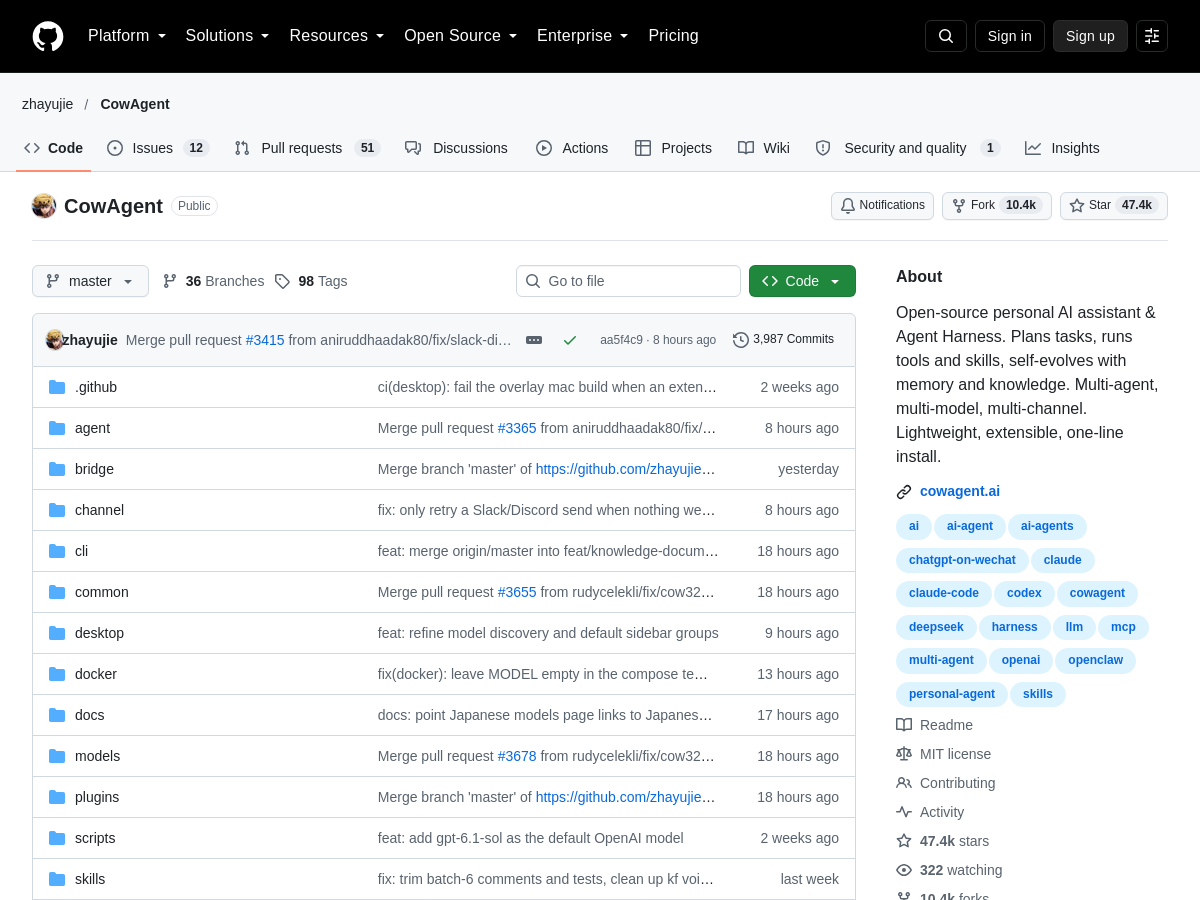
Screenshot of CowAgent
CowAgent
AI Agents Open Source

CowAgent is an open-source personal AI assistant and Agent Harness that plans tasks, runs tools and skills, self-evolves with memory and knowledge, and forms multi-agent teams. It is a lightweight, extensible, and one-line install solution that supports multiple channels, including Web, WeChat, Feishu, DingTalk, WeCom, QQ, Official Accounts, Telegram, and Slack. CowAgent has a three-tier architecture for long-term memory, automatic Deep Dream distillation, and a personal knowledge base that organizes structured knowledge by topic. It also supports multiple LLM providers, including Claude, GPT, Gemini, DeepSeek, Qwen, GLM, Kimi, MiniMax, Doubao, and more. The project has a large community and is actively maintained, with a Discord server and a WeChat group for discussion and support.

Solves

CowAgent solves the problem of managing complex tasks and workflows by providing a personal AI assistant that can plan and execute tasks, and self-evolve with memory and knowledge. It also solves the problem of integrating multiple channels and LLM providers, making it a versatile and powerful tool for individuals and teams.

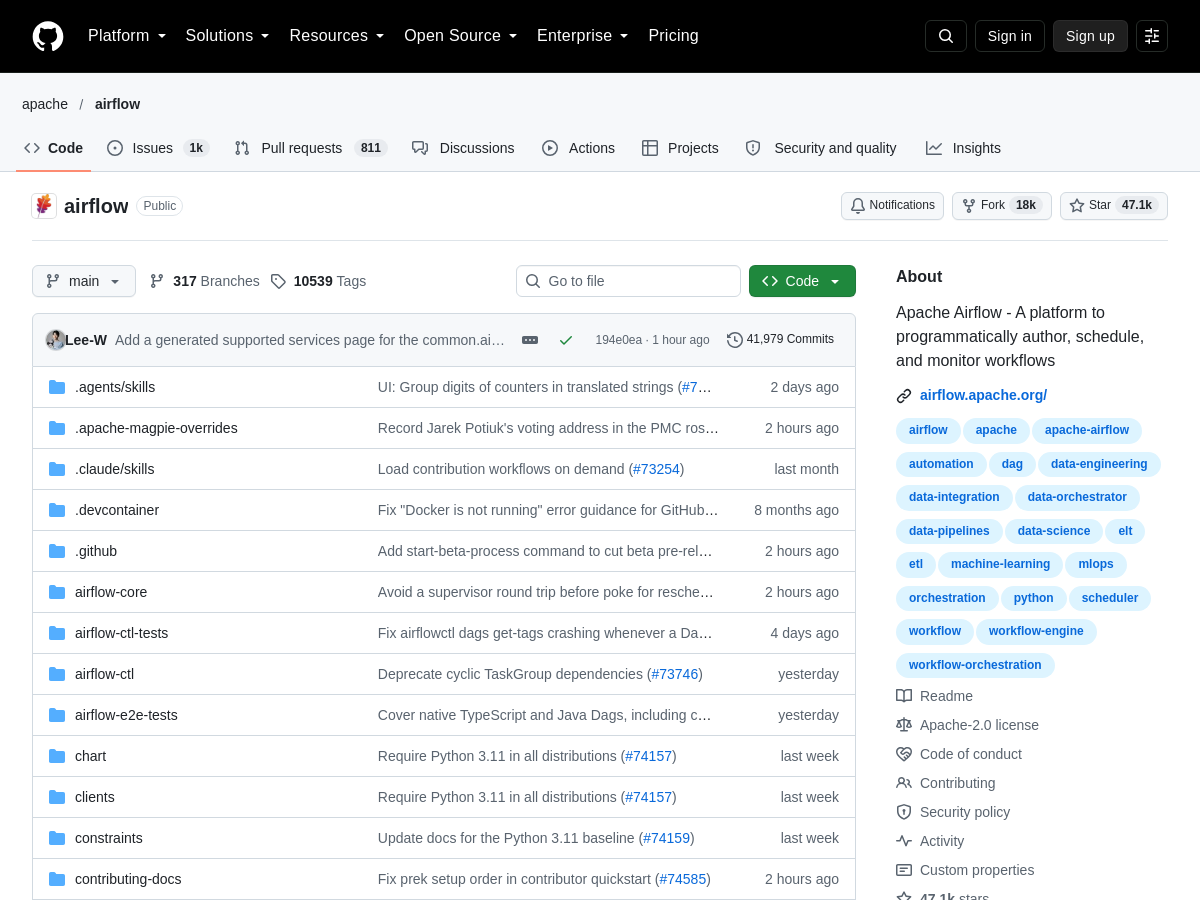
Screenshot of Airflow
Airflow
Observability Open Source

Apache Airflow is a platform to programmatically author, schedule, and monitor workflows. It is a powerful tool for managing and automating complex workflows, allowing users to define tasks, dependencies, and schedules in a flexible and scalable way. Airflow provides a web-based interface for managing workflows, as well as a robust API for integrating with other tools and systems. With Airflow, users can create, manage, and monitor workflows across a wide range of domains, from data processing and machine learning to DevOps and cloud management. Airflow is highly customizable and extensible, with a large community of users and developers contributing to its growth and development. It is written in Python and is widely used in industry and academia for workflow management and automation. Airflow provides a number of key features, including workflow definition, task management, scheduling, monitoring, and alerting. It also provides a number of integrations with other tools and systems, including databases, messaging systems, and cloud platforms. Overall, Airflow is a powerful and flexible tool for managing and automating complex workflows, and is widely used in a variety of domains. Airflow is designed to be highly scalable and reliable, with features such as distributed task execution, fault tolerance, and high availability. It also provides a number of security features, including authentication, authorization, and encryption. With its large community of users and developers, Airflow is constantly evolving and improving, with new features and functionality being added regularly.

Solves

Apache Airflow solves the problem of managing and automating complex workflows, which is a common challenge in many domains, including data processing, machine learning, DevOps, and cloud management. Without Airflow, users would have to manually manage and automate their workflows, which can be time-consuming, error-prone, and difficult to scale. Airflow provides a flexible and scalable way to define, manage, and monitor workflows, allowing users to focus on higher-level tasks and improve overall productivity and efficiency. By providing a centralized platform for workflow management, Airflow helps users to reduce errors, improve reliability, and increase visibility into their workflows, making it easier to identify and troubleshoot issues.

Screenshot of Cherry Studio
Cherry Studio
LLM Open Source

Cherry Studio is an open-source AI productivity studio that provides smart chat, autonomous agents, and a library of over 300 pre-built assistants. It offers unified access to frontier large language models (LLMs), allowing users to interact with multiple AI providers from a single desktop interface. The application is distributed via GitHub and is free to use under an open-source license. Designed for knowledge workers and developers, Cherry Studio consolidates various AI capabilities into one workspace. Users can engage in conversational chat, configure and run autonomous agents for task automation, and select from a wide range of specialized assistants without needing to switch between different tools or services.

Solves

Cherry Studio addresses the fragmentation of AI tools by providing a unified desktop interface for accessing multiple frontier LLMs. It eliminates the need to manage separate applications or accounts for different AI providers and offers built-in smart chat, autonomous agents, and hundreds of ready-made assistants to boost productivity.

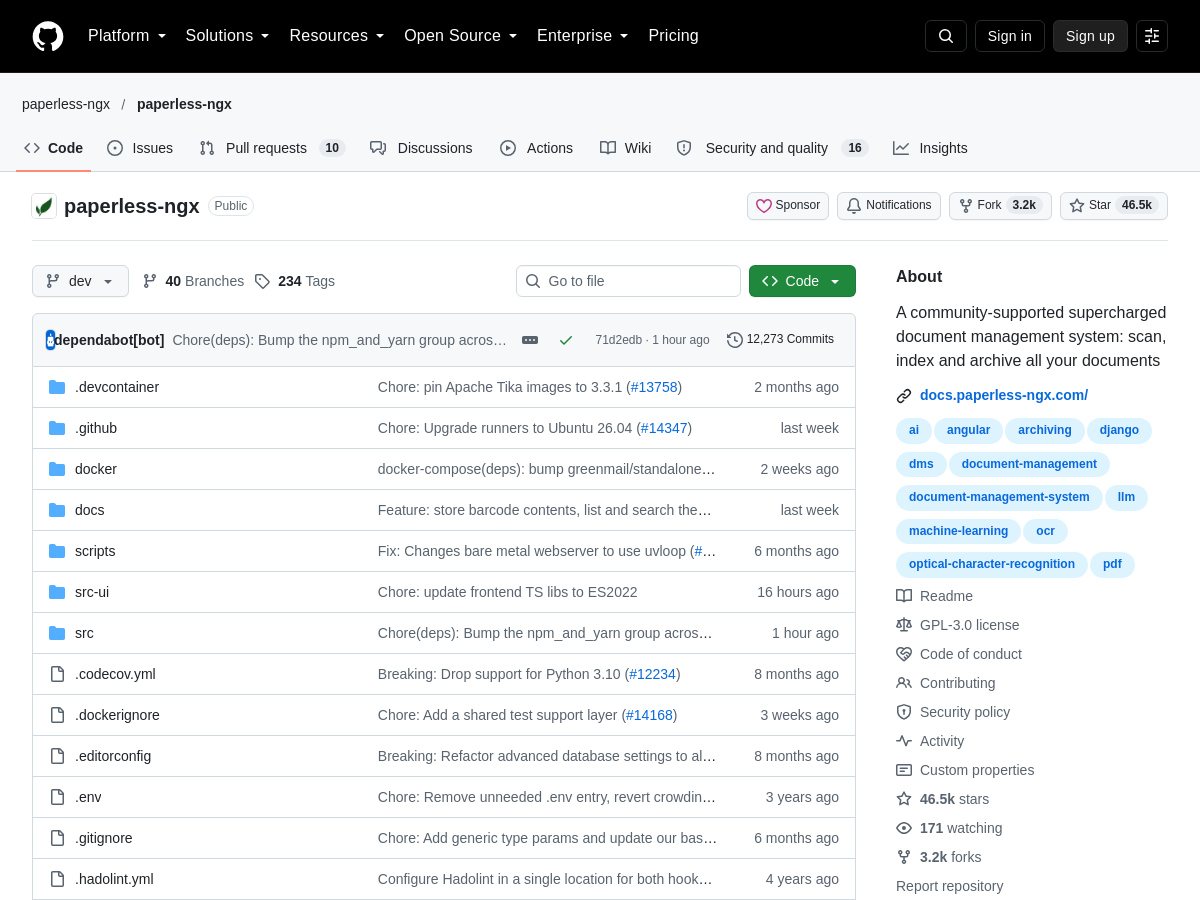
Screenshot of Paperless Ngx
Paperless Ngx
LLM Open Source

Paperless Ngx is a community-supported document management system that allows users to scan, index, and archive their documents. The system utilizes machine learning and optical character recognition (OCR) to automatically extract relevant information from documents, making it easier to organize and search for specific documents. Paperless Ngx is built using a variety of technologies, including Django, Angular, and OCR, and is designed to be highly customizable and extensible. The system includes features such as document scanning, indexing, and archiving, as well as advanced search and filtering capabilities. Paperless Ngx is open-source and has a large community of contributors and users, making it a popular choice for individuals and organizations looking for a robust and flexible document management system. The project has a strong focus on security and quality, with regular updates and patches to ensure the system remains stable and secure. Overall, Paperless Ngx is a powerful and feature-rich document management system that is well-suited for a wide range of use cases, from personal document management to large-scale enterprise deployments. The system's use of machine learning and OCR technology makes it particularly useful for organizations that need to process and manage large volumes of documents. Additionally, the system's open-source nature and large community of contributors make it an attractive choice for developers and organizations looking for a customizable and extensible document management solution. Paperless Ngx has a wide range of applications, including document scanning and indexing, automated data extraction, and advanced search and filtering. The system is also highly scalable, making it suitable for use in large-scale enterprise deployments. In terms of technical details, Paperless Ngx is built using a microservices architecture, with separate services for document scanning, indexing, and archiving. The system uses a variety of programming languages, including Python, JavaScript, and HTML/CSS, and is designed to be highly modular and extensible. Overall, Paperless Ngx is a powerful and flexible document management system that is well-suited for a wide range of use cases, from personal document management to large-scale enterprise deployments.

Solves

Paperless Ngx solves the problem of document management for individuals and organizations by providing a robust and flexible system for scanning, indexing, and archiving documents. The system's use of machine learning and OCR technology makes it particularly useful for organizations that need to process and manage large volumes of documents. By automating the process of document scanning and indexing, Paperless Ngx saves users time and reduces the risk of human error, making it an attractive choice for organizations looking to improve their document management processes. Additionally, the system's open-source nature and large community of contributors make it an attractive choice for developers and organizations looking for a customizable and extensible document management solution.

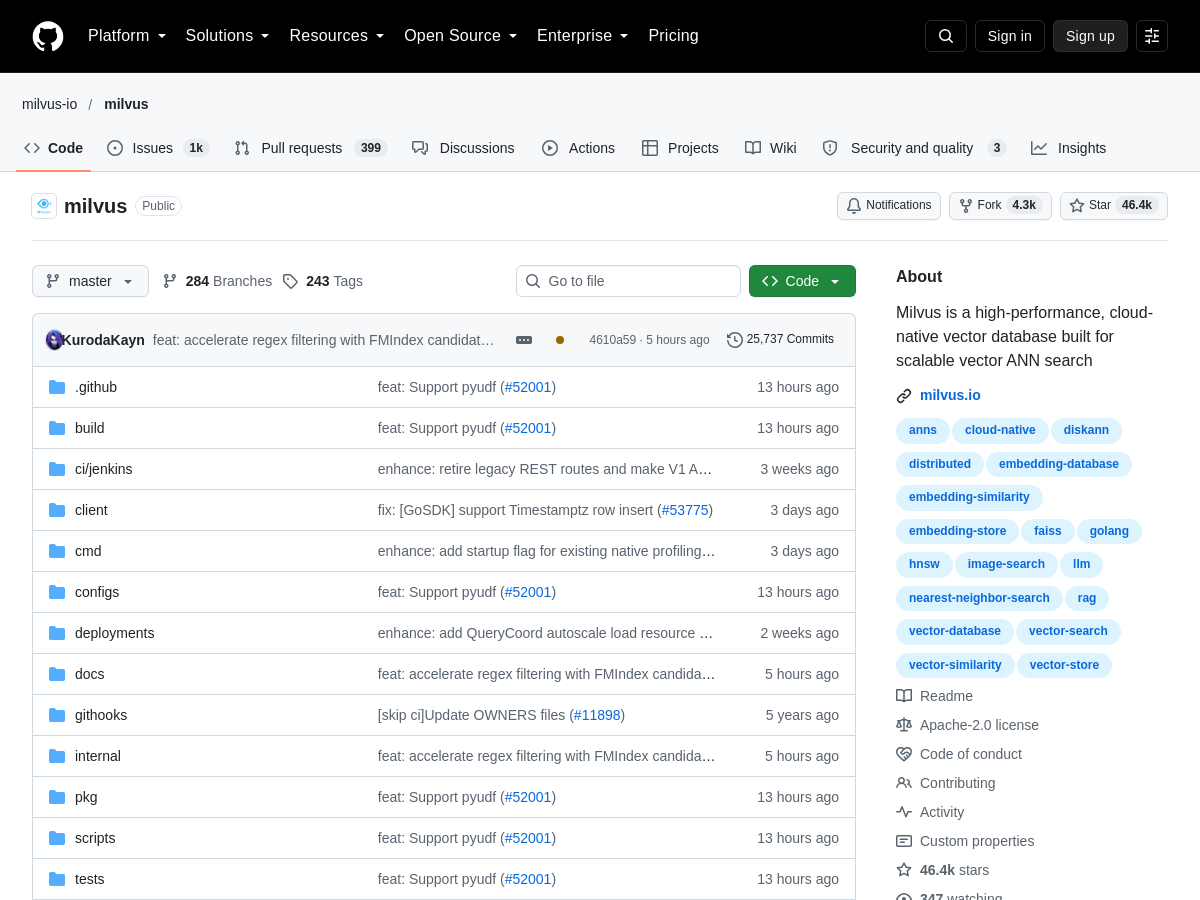
Screenshot of Milvus
Milvus
LLM Open Source

Milvus is a high-performance, cloud-native vector database built for scalable vector ANN search. It is designed to handle large-scale vector data and provide efficient search and retrieval capabilities. Milvus is built using a cloud-native architecture and is designed to be highly scalable and flexible. It supports a variety of data formats and provides a range of features, including data ingestion, indexing, and querying. Milvus is also highly customizable, allowing users to tailor the database to their specific use cases. The database is built using a variety of technologies, including Go, and is designed to be highly performant and reliable. Milvus has a large and active community of users and contributors, and is widely used in a variety of applications, including image and video search, natural language processing, and recommender systems. The database is highly scalable and can handle large volumes of data, making it an ideal choice for applications that require high-performance vector search capabilities. Milvus is licensed under the Apache-2.0 license and is available on GitHub. The database has a wide range of features, including support for multiple data formats, flexible indexing and querying capabilities, and a highly customizable architecture. Overall, Milvus is a powerful and flexible vector database that is well-suited to a wide range of applications. It is highly scalable, performant, and reliable, making it an ideal choice for applications that require high-performance vector search capabilities. Milvus is also highly customizable, allowing users to tailor the database to their specific use cases. The database has a large and active community of users and contributors, and is widely used in a variety of applications. Milvus is designed to be highly scalable and flexible, and is built using a cloud-native architecture. It supports a variety of data formats and provides a range of features, including data ingestion, indexing, and querying. The database is built using a variety of technologies, including Go, and is designed to be highly performant and reliable.

Solves

Milvus solves the problem of efficient and scalable vector search, which is a critical component of many machine learning and artificial intelligence applications. By providing a high-performance, cloud-native vector database, Milvus enables users to efficiently search and retrieve large volumes of vector data, making it an ideal choice for applications such as image and video search, natural language processing, and recommender systems. The database's scalable and flexible architecture also makes it well-suited to a wide range of use cases, from small-scale applications to large-scale enterprise deployments. By using Milvus, users can improve the performance and efficiency of their applications, and reduce the complexity and cost of managing large volumes of vector data.
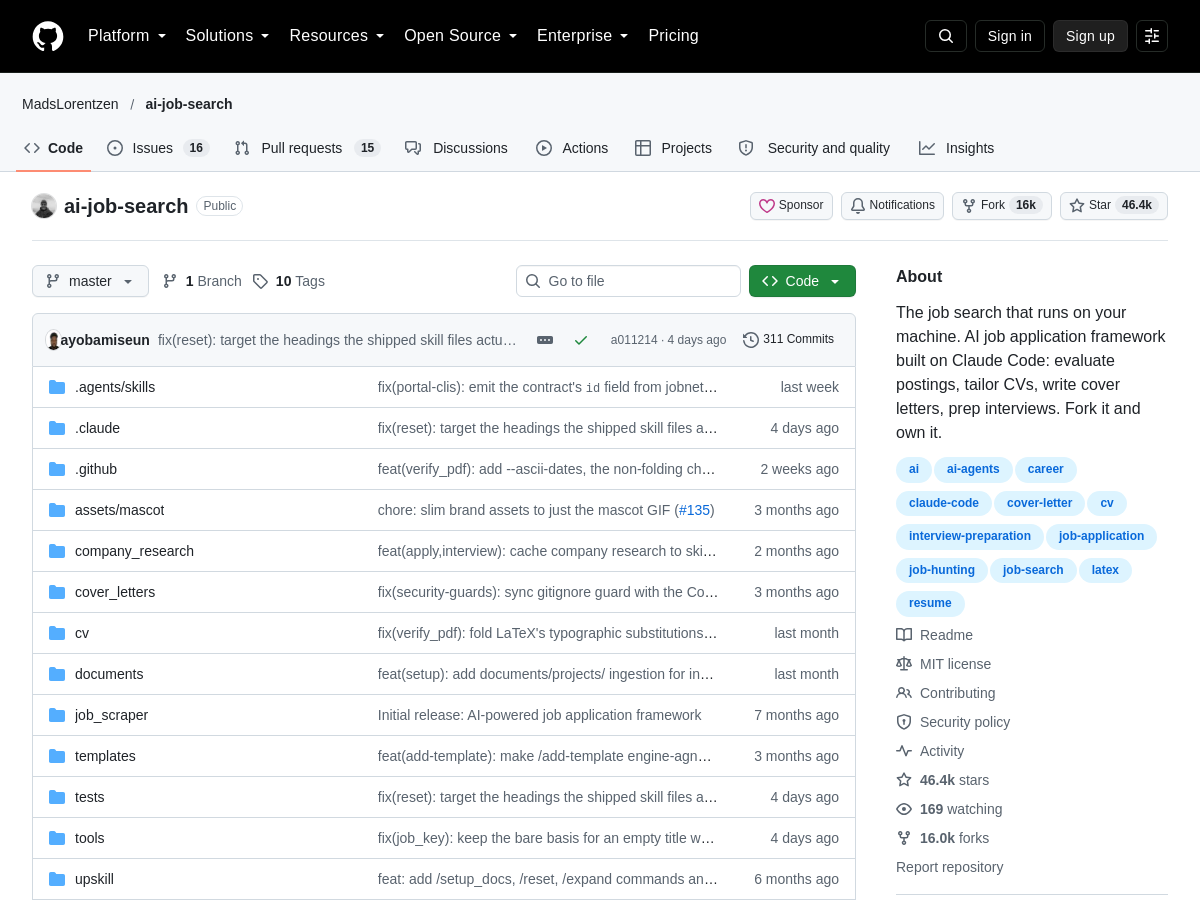
Screenshot of Ai Job Search
Ai Job Search
AI Agents Open Source

Ai Job Search is an AI-powered job application framework built on Claude Code. It is designed to run on a user's machine and provides a range of features to assist with job searching and application. The framework can evaluate job postings, tailor CVs, write cover letters, and prepare users for interviews. The project is open-source and can be forked and modified by users. Ai Job Search uses LaTeX for formatting and has a range of features, including interview preparation and resume building. The project has a large community of contributors and users, with over 46,000 stars on GitHub. The framework is highly customizable and can be integrated with other tools and services. Ai Job Search is a powerful tool for anyone looking to streamline their job search and application process. It provides a comprehensive set of features and tools to help users stand out in a competitive job market. With its open-source nature and large community of contributors, Ai Job Search is a constantly evolving and improving project. The project's documentation and guides provide a clear and comprehensive overview of its features and functionality, making it easy for users to get started and make the most of the framework. Ai Job Search is a valuable resource for anyone looking to take their job search to the next level.

Solves

Ai Job Search solves the problem of tedious and time-consuming job searching and application. It provides a range of features and tools to assist with every stage of the process, from evaluating job postings to preparing for interviews. By automating and streamlining the job search and application process, Ai Job Search saves users time and effort, allowing them to focus on other aspects of their job search. The framework also helps users to tailor their CVs and cover letters to specific job postings, increasing their chances of success. Additionally, Ai Job Search provides a range of resources and guides to help users improve their interview skills and prepare for common interview questions.

Screenshot of Shannon
Shannon
Vector DB Open Source

Shannon is an open-source AI-driven penetration testing tool designed for web applications and APIs. It automates the identification and exploitation of security vulnerabilities by analyzing application source code, detecting potential attack vectors, and executing real-world exploits to confirm their existence. By integrating into the development lifecycle, Shannon helps teams uncover critical flaws before they reach production. Unlike traditional static analysis or simple scanners, Shannon uses artificial intelligence to understand the logic and flow of an application, enabling it to craft targeted attacks that mimic those of a human pentester. It goes beyond just flagging potential issues, actually performing safe but realistic attacks to validate the presence and severity of vulnerabilities such as SQL injection, cross-site scripting, and authentication bypasses. Built for developers and security engineers, Shannon can be run from the command line or integrated into CI/CD pipelines, making it suitable for both manual security assessments and automated regression testing. Its AI model learns from each engagement, potentially improving its accuracy and coverage over time.

Solves

Manually penetration testing web applications and APIs is time-consuming and requires specialized expertise. Shannon automates this process by using AI to analyze source code, identify attack vectors, and execute exploits, enabling teams to find and verify vulnerabilities earlier and more efficiently.

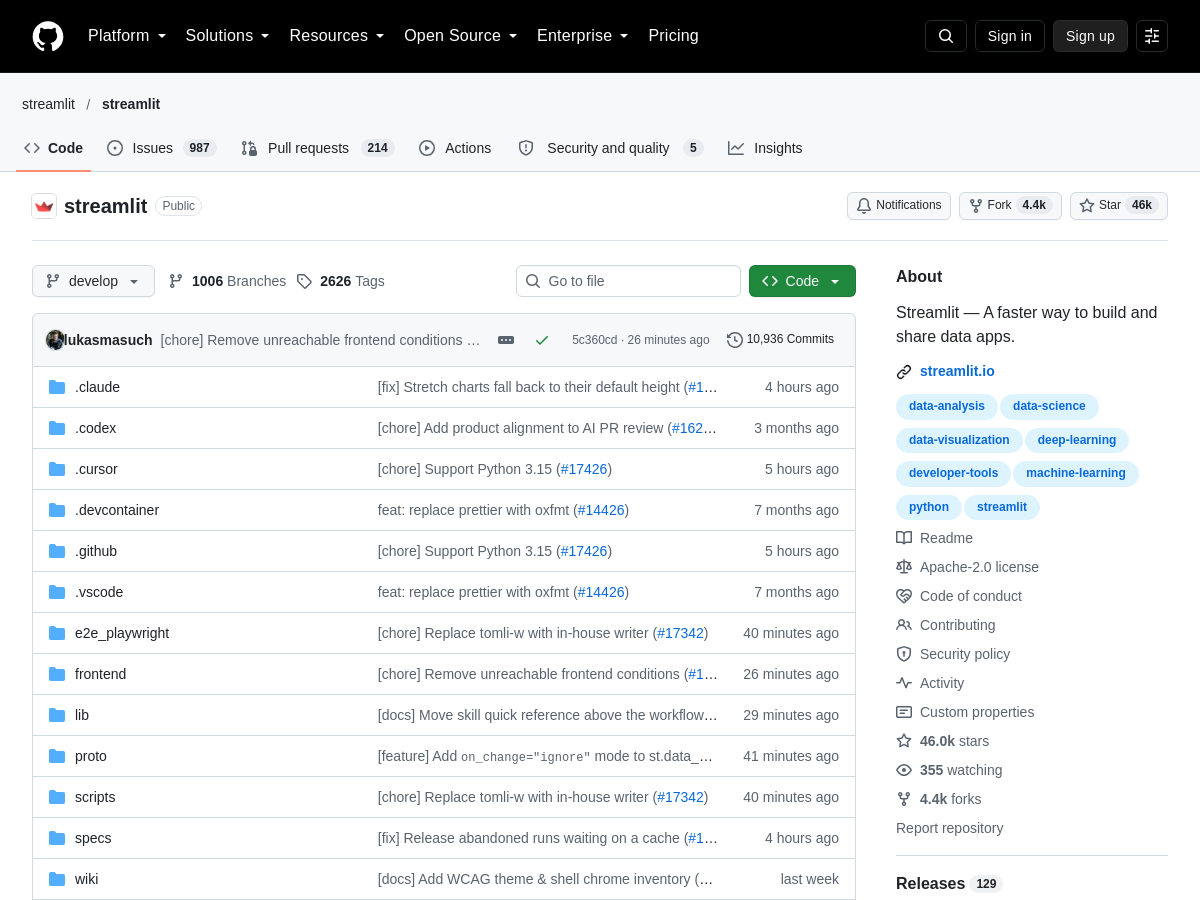
Screenshot of Streamlit
Streamlit
Dev Tools Open Source

Streamlit is an open-source Python library that allows users to create and share interactive web apps for data science and machine learning in minutes. It provides a simple and Pythonic way to build dashboards, generate reports, and create chat apps. Streamlit apps can be deployed, managed, and shared using the Community Cloud platform. The library offers a range of features, including input widgets, dataframes, charts, layout options, and multi-page apps. Additionally, Streamlit has a vibrant community of creators who extend its capabilities using custom components. Streamlit is completely free and open-source, licensed under the Apache 2.0 license. It is designed to be fast, interactive, and easy to use, making it an ideal choice for data scientists and machine learning engineers who want to quickly build and share interactive web apps. Streamlit also provides a range of resources, including documentation, community forums, and blogs, to help users get started and learn how to use the library. With Streamlit, users can create a wide range of apps, from simple dashboards to complex machine learning models, and share them with others in a matter of minutes. Overall, Streamlit is a powerful and flexible library that makes it easy to build and share interactive web apps for data science and machine learning. Streamlit's key features include its simplicity, speed, and ease of use, making it an ideal choice for users who want to quickly build and share interactive web apps. The library's custom components and Community Cloud platform also make it easy to extend and share apps with others. Streamlit's documentation and community resources provide users with the support they need to get started and learn how to use the library. Whether you're a data scientist, machine learning engineer, or simply someone who wants to build and share interactive web apps, Streamlit is a great choice.

Solves

Streamlit solves the problem of having to spend weeks or even months building and deploying interactive web apps for data science and machine learning. With Streamlit, users can create and share apps in minutes, making it an ideal choice for users who want to quickly build and share interactive web apps. Streamlit also solves the problem of having to learn complex web development frameworks and technologies, as it provides a simple and Pythonic way to build apps. Additionally, Streamlit solves the problem of having to deploy and manage apps, as it provides a Community Cloud platform that makes it easy to deploy, manage, and share apps.

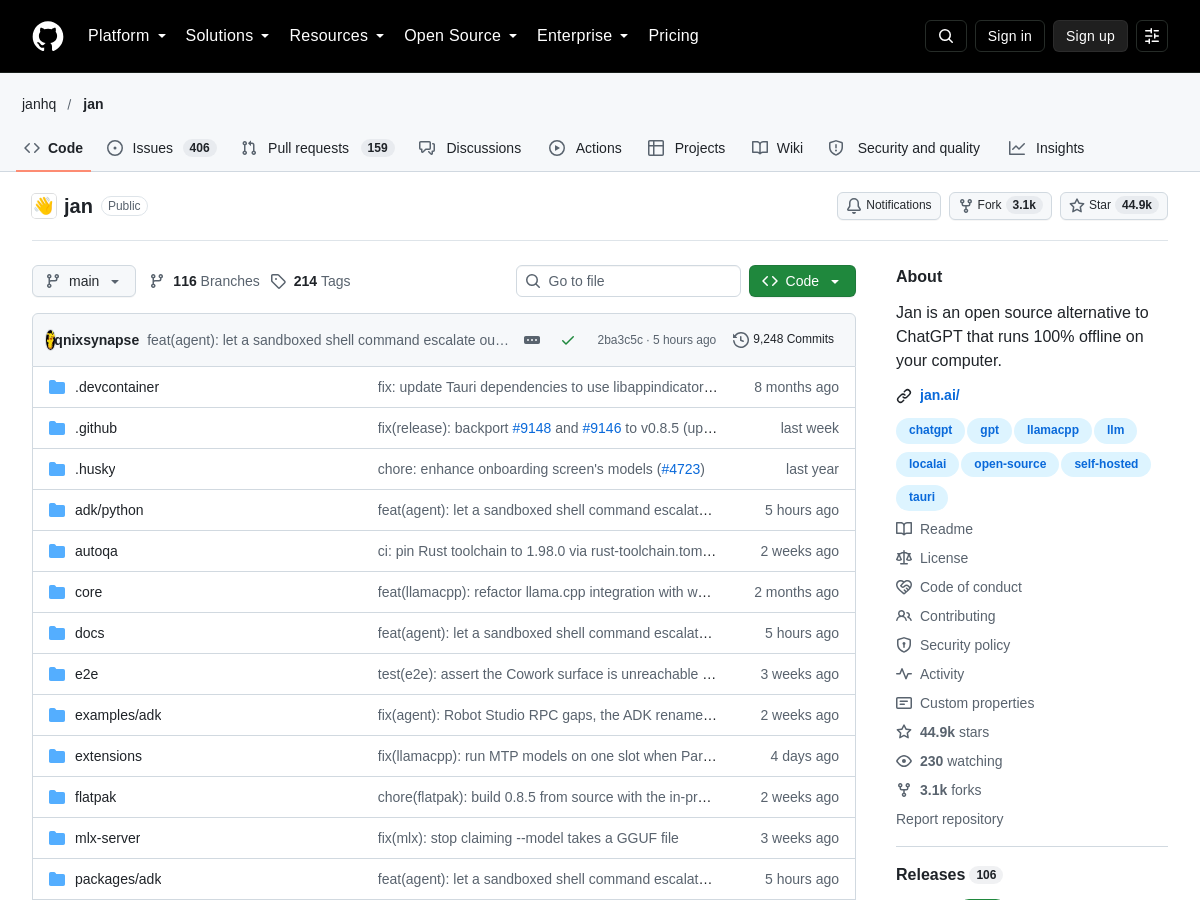
Screenshot of Jan
Jan
LLM Open Source

In terms of use cases, Jan can be used for a variety of tasks, such as text generation, language translation, and conversation. The tool's custom assistants feature allows users to create specialized AI assistants for their specific needs. Jan's cloud integration feature also allows users to connect to GPT models via OpenAI, Claude models via Anthropic, and other cloud-based AI services. This makes it easy for users to access a wide range of AI models and services from within the tool. Jan's OpenAI-compatible API also makes it easy for developers to integrate the tool into their existing workflows. Overall, Jan is a versatile tool that can be used for a wide range of AI-related tasks.

Solves

Jan solves the problem of users wanting a private and customizable AI experience. Many AI tools and services are cloud-based, which can raise concerns about data privacy and security. Jan's self-hosted nature and open-source license address these concerns by providing users with a tool that they can run on their own computers, with full control over their data and models. Additionally, Jan's custom assistants feature and cloud integration feature provide users with a high degree of flexibility and customization, allowing them to create specialized AI assistants and access a wide range of AI models and services.

Screenshot of Bruno
Bruno
Dev Tools Open Source

Bruno is an open-source API client and integrated development environment (IDE) for exploring, testing, and debugging REST, GraphQL, and other HTTP APIs. It is designed as a lightweight, privacy-focused alternative to commercial tools like Postman and Insomnia, with a strong emphasis on storing API collections locally as plain text files. Built on Electron, Bruno runs on Windows, macOS, and Linux. It supports variables, environments, pre-request scripts, and assertions, enabling developers to create complex API workflows without relying on a cloud account. Collections are saved in a human-readable format that can be easily versioned with Git. Bruno also includes a command-line interface (CLI) runner that allows API tests to be executed in CI/CD pipelines, making it suitable for both interactive development and automated testing. Because all data remains on the user's machine, it appeals to teams concerned about data privacy and vendor lock-in.

Solves

Bruno solves the problem of needing a lightweight, offline-capable API testing client that stores collections as version-controllable plain text files. Unlike cloud-based tools, it eliminates account requirements and data sharing, giving developers full control over their API collections and enabling seamless Git-based collaboration.

Screenshot of Siyuan
Siyuan
AI/ML Open Source

Siyuan is a privacy-first, self-hosted personal knowledge management software that combines note-taking, outlining, and mind mapping in a block-based editor. It offers a WYSIWYG Markdown experience, allowing users to seamlessly blend formatted text with live editing. The core architecture is block-oriented, enabling granular content organization, transclusion via block references, and automatic backlinks for a networked thought approach. A built-in graph view visualizes relationships between notes, while a spaced repetition and flashcard system supports learning. Siyuan is fully open source, written in TypeScript (frontend and Electron) and Go (kernel), ensuring transparency and the ability to self-host the entire infrastructure for complete data sovereignty. The ecosystem includes a community marketplace for plugins, themes, and templates, extending functionality. It provides native desktop applications for Windows, macOS, and Linux, mobile apps for iOS and Android, and a web interface, with optional end-to-end encrypted sync across devices. Advanced features include a web clipper, local AI integration, an extensive API for automation, and support for multiple sync backends (WebDAV, S3, etc.). Siyuan is under active development with frequent releases and a vibrant open source community.

Solves

Users who are concerned about data privacy and vendor lock-in with proprietary cloud-based note-taking apps (like Notion or Evernote) need a self-hosted, open source alternative that doesn't compromise on rich editing features. Siyuan addresses this by providing a fully self-hosted, block-based knowledge management platform where all data stays under the user's control. It enables users to manage complex notes, research, and personal wikis with advanced linking, while remaining accessible across devices through self-managed sync.

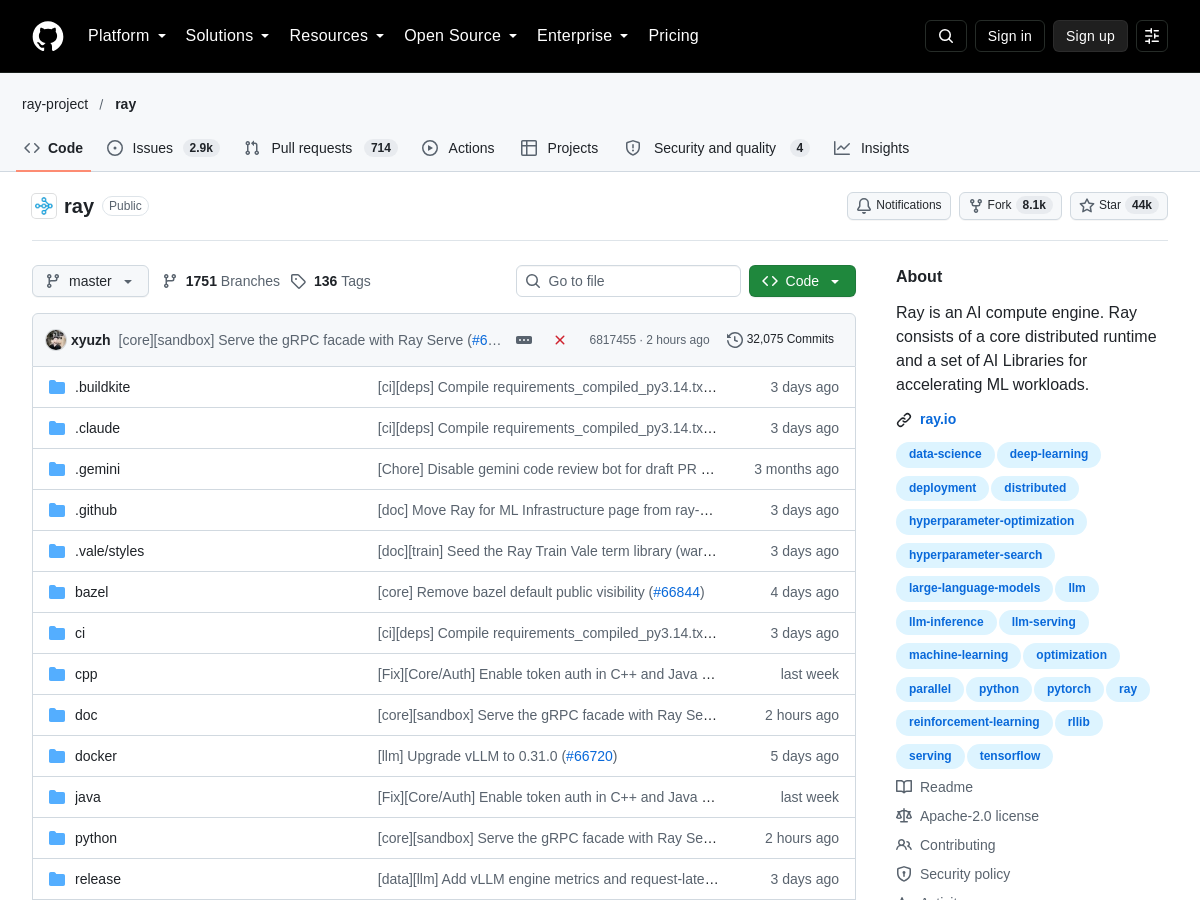
Screenshot of Ray
Ray
LLM Open Source

Ray is an AI compute engine that consists of a core distributed runtime and a set of AI libraries for accelerating ML workloads. It is designed to be general-purpose, meaning that it can performantly run any kind of workload. Ray allows users to seamlessly scale the same code from a laptop to a cluster, making it a unified way to scale Python and AI applications. The core distributed runtime provides a set of key abstractions, including tasks, actors, and objects, which enable efficient and scalable execution of AI workloads. The AI libraries, including Data, Train, Tune, RLlib, and Serve, provide a range of functionalities for simplifying ML compute, such as scalable datasets, distributed training, hyperparameter tuning, reinforcement learning, and serving. Ray runs on any machine, cluster, cloud provider, and Kubernetes, and features a growing ecosystem of community integrations.

Solves

Ray solves the problem of scaling AI and Python applications from a laptop to a cluster, which is increasingly important as ML workloads become more compute-intensive. By providing a unified framework for scaling, Ray enables developers to focus on writing code rather than worrying about infrastructure, making it easier to develop and deploy AI applications.

Screenshot of Files
Files
Dev Tools Open Source

Files is a modern, open-source file manager for Windows designed to replace the default Windows File Explorer with a more intuitive and feature-rich experience. It is built using C# and the Windows App SDK / WinUI framework, offering a clean, fluent design that aligns with Windows 11 aesthetics while remaining compatible with Windows 10. The application provides advanced file management capabilities such as tabbed browsing, dual-pane view, tags, customizable themes, and a quick look feature for previewing files. It also supports cloud storage integration for services like OneDrive and Google Drive, and includes a variety of layout options to suit different workflows. Files is actively developed by a community of contributors and is licensed under the MIT License. It is distributed via the Microsoft Store, GitHub releases, and winget, making it easy for users to install and keep up to date. The project has gained significant popularity as a powerful alternative to the native Windows file manager.

Solves

Files addresses the limitations of the default Windows File Explorer by providing a modern, customizable, and efficient file management experience. It solves common frustrations such as lack of tabs, limited theming, and poor dual-pane support, enabling users to organize and navigate their files and folders more effectively.

Screenshot of Gradio
Gradio
AI/ML Open Source

Gradio is an open-source Python package that allows users to quickly build and share machine learning web apps. It provides a simple and intuitive way to create demos for machine learning models, APIs, or any arbitrary Python function. Gradio offers a range of features, including a high-level Interface class for building demos, a low-level Blocks class for designing custom web apps, and a ChatInterface class for creating chatbot UIs. Additionally, Gradio has a Python and JavaScript ecosystem that includes a Python client, a JavaScript client, and integration with Hugging Face Spaces. Gradio is built on top of many open-source libraries, including Hugging Face, Python, FastAPI, Encode, Svelte, Vite, pnpm, Tailwind, Storybook, and Chromatic. Gradio is licensed under the Apache License 2.0 and has been cited in a research paper titled 'Gradio: Hassle-Free Sharing and Testing of ML Models in the Wild'. Gradio has a large community of users and contributors, with over 43,000 stars on GitHub and a active Discord server. Gradio is widely used in the machine learning and AI community, and has been used to build a range of applications, including image generation, natural language processing, and recommender systems. Gradio provides a range of benefits, including ease of use, flexibility, and customizability, making it a popular choice for machine learning practitioners and researchers. Gradio also provides a range of tutorials, guides, and documentation, making it easy for users to get started and learn how to use the library. Overall, Gradio is a powerful and flexible library that makes it easy to build and share machine learning web apps, and is a valuable tool for anyone working in the field of machine learning and AI.

Solves

Gradio solves the problem of making it difficult for machine learning practitioners and researchers to share and test their models with others. Traditional methods of sharing models, such as hosting them on a web server or using a cloud platform, can be time-consuming and require a lot of technical expertise. Gradio provides a simple and intuitive way to create demos for machine learning models, making it easy to share and test them with others. This makes it easier for practitioners and researchers to collaborate, get feedback, and improve their models, ultimately leading to better outcomes and more accurate results.

Screenshot of Nanobot
Nanobot
AI Agents Open Source

Nanobot is an ultra-lightweight, open-source, self-hosted personal AI agent framework written in Python. Developed by HKUDS, it enables users to run their own AI agents locally with a focus on simplicity and minimal resource usage. It includes a web-based user interface (WebUI) for interaction, supports custom tools, and provides memory mechanisms for maintaining context across conversations. The framework also implements the Model Context Protocol (MCP), allowing agents to connect to external tools and data sources. Additionally, Nanobot supports multi-agent workflows, enabling orchestration of multiple agents for complex tasks, and includes automation features for building chat applications and other AI-powered utilities. Being self-hosted, it gives users full control over their data and infrastructure.

Solves

Nanobot addresses the need for a lightweight, self-hosted AI agent that can be customized with tools and memory. It allows developers and hobbyists to run personal AI assistants and automated workflows on their own infrastructure without relying on external cloud services, providing a Python framework with WebUI, multi-agent capabilities, and MCP integration.

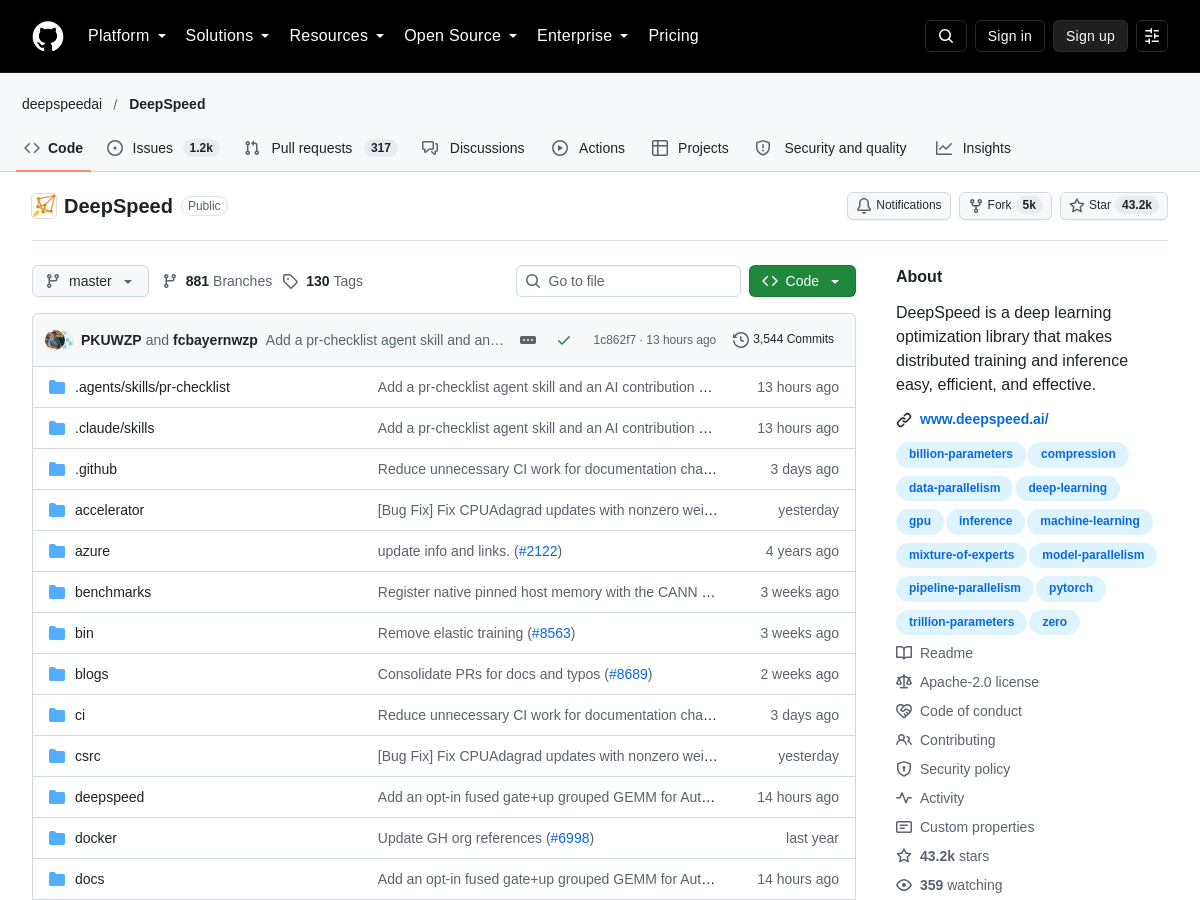
Screenshot of DeepSpeed
DeepSpeed
Fine-tuning Open Source

DeepSpeed is a deep learning optimization library that makes distributed training and inference easy, efficient, and effective. It provides a range of features and tools to help developers and researchers optimize their deep learning models, including support for billion-parameter and trillion-parameter models, compression, data parallelism, model parallelism, and pipeline parallelism. DeepSpeed is designed to work with popular deep learning frameworks such as PyTorch and provides a simple and intuitive API for developers to integrate into their existing workflows. The library is highly customizable and allows developers to fine-tune their models for specific use cases and hardware configurations. With its focus on ease of use, efficiency, and effectiveness, DeepSpeed has become a popular choice among developers and researchers in the field of deep learning. DeepSpeed is an open-source library, which means that it is free to use, modify, and distribute. This has led to a large and active community of developers and researchers who contribute to the library and provide support to users. The library is well-documented, with a comprehensive README file and a range of tutorials and examples to help users get started. Overall, DeepSpeed is a powerful and flexible library that can help developers and researchers to optimize their deep learning models and achieve state-of-the-art results. DeepSpeed has a wide range of applications, including natural language processing, computer vision, and recommender systems. It can be used to train large-scale models on distributed hardware, such as clusters of GPUs or TPUs. The library provides a range of features to support distributed training, including data parallelism, model parallelism, and pipeline parallelism. DeepSpeed also provides a range of tools and features to support model optimization, including compression, quantization, and knowledge distillation. With its focus on ease of use, efficiency, and effectiveness, DeepSpeed has become a popular choice among developers and researchers in the field of deep learning.

Solves

DeepSpeed solves the problem of optimizing deep learning models for distributed training and inference. Many developers and researchers struggle with optimizing their models for large-scale datasets and hardware configurations, which can lead to slow training times, high computational costs, and poor model performance. DeepSpeed provides a range of features and tools to help developers and researchers optimize their models, including support for billion-parameter and trillion-parameter models, compression, data parallelism, model parallelism, and pipeline parallelism. By using DeepSpeed, developers and researchers can easily optimize their models for distributed training and inference, which can lead to faster training times, lower computational costs, and better model performance.

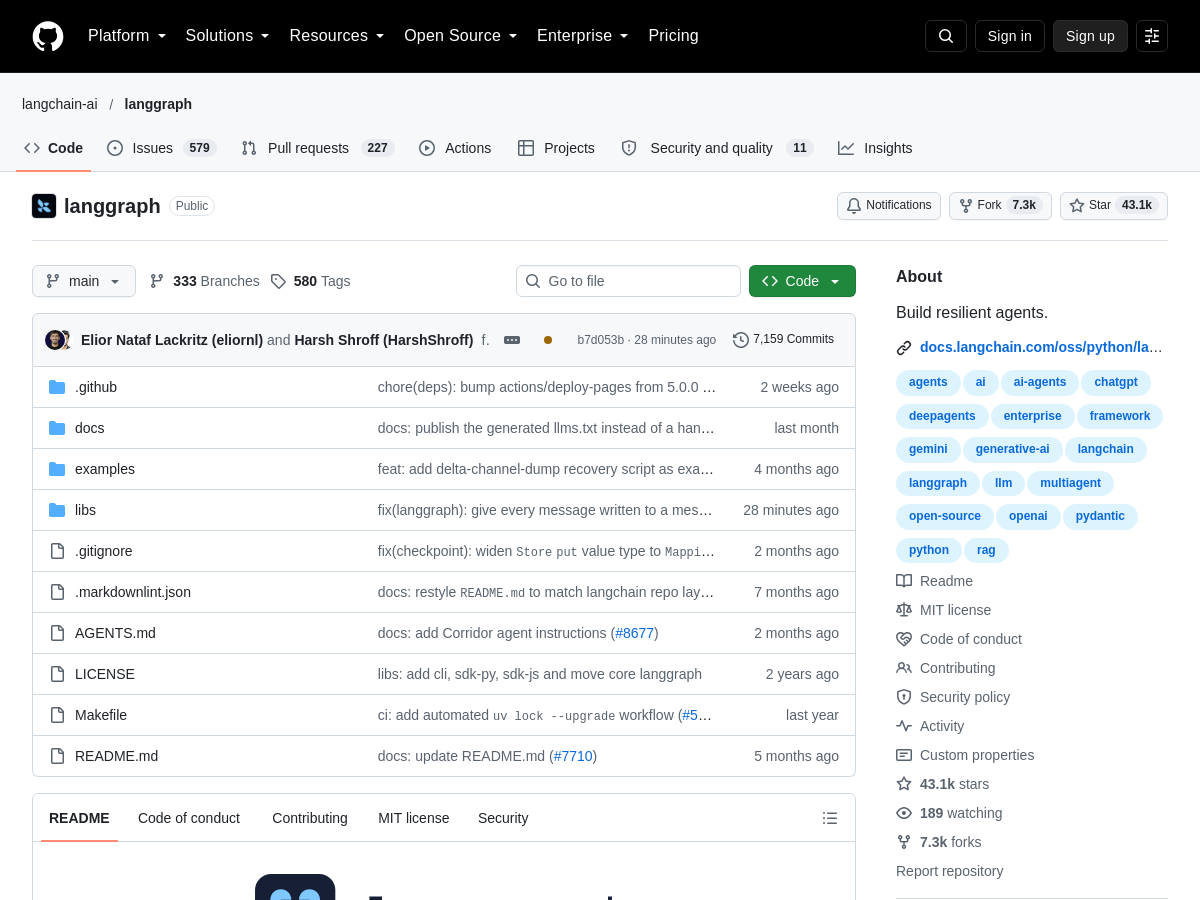
Screenshot of Langgraph
Langgraph
AI Agents Open Source

LangGraph is a low-level orchestration framework for building, managing, and deploying long-running, stateful agents. It provides durable execution, human-in-the-loop capabilities, comprehensive memory, and production-ready deployment. LangGraph is designed to be used standalone or integrated with other LangChain products, such as Deep Agents, LangChain, and LangSmith. The framework is inspired by Pregel and Apache Beam, and its public interface draws inspiration from NetworkX. LangGraph is built by LangChain Inc and is available under the MIT license. The project has a comprehensive documentation, including conceptual overviews, guides, and API reference docs. Additionally, there are resources such as guides, LangChain Academy, case studies, and a contributing guide to help developers get started and contribute to the project. LangGraph has a wide range of applications, including building AI agents, LLM applications, and complex tasks. It is trusted by companies such as Klarna, Replit, Elastic, and more. The project has a strong community, with a forum for discussions, a chat for questions, and a code of conduct for participation. Overall, LangGraph is a powerful tool for building and deploying stateful agents, and its open-source nature makes it accessible to developers and organizations alike. LangGraph can be used in a variety of scenarios, such as building agents that can plan, use subagents, and leverage file systems for complex tasks. It can also be used for developing, debugging, and deploying AI agents and LLM applications. Furthermore, LangGraph provides a range of features, including durable execution, human-in-the-loop capabilities, and comprehensive memory, making it a versatile and reliable choice for building and deploying stateful agents.

Solves

LangGraph solves the problem of building and deploying long-running, stateful agents, which is a challenging task in the field of AI and machine learning. By providing a low-level orchestration framework, LangGraph enables developers to build agents that can persist through failures, incorporate human oversight, and create truly stateful agents with both short-term working memory and long-term persistent memory. This makes it an ideal solution for companies and organizations that need to deploy AI applications at scale, such as Klarna, Replit, Elastic, and more. The problem of building and deploying stateful agents is complex and requires a robust and reliable framework, which LangGraph provides.

Screenshot of GoAI: Personal AI Investment Assistant

GoAI is an AI-native investment research workspace that coordinates multiple large language models—including ChatGPT, Claude, Gemini, and Perplexity—through a central orchestrator. It pairs these models with institutional-grade financial data to deliver deep financial domain expertise, covering valuations, catalysts, risk signals, and market intelligence. The platform operates as a team of specialized autonomous agents that run on schedules or in real time. Examples include GoAI Picks for high-conviction stock ideas, a Social Sentiment Monitor, a Macro Strategist, a Technical Alerts Engine, and a Daily Market Narrative. These agents scan thousands of equities, track indicators, and deliver personalized briefs, alerts, and deep-dive research. GoAI remembers user portfolios and watchlists, providing a 24/7 assistant that proactively surfaces opportunities and risks. It offers a free pricing tier and a sign-in via app.goai.digital, positioning itself as a personal AI investment analyst for individual and professional investors.

Solves

GoAI replaces manual investment research with automated, AI-driven analysis. It helps investors identify high-conviction opportunities, monitor market shifts, and receive timely alerts and deep research without spending hours on data gathering and interpretation.

Screenshot of Agno
Agno
AI Agents Open Source

Agno is a framework and runtime for agent platforms. It allows users to build, run, and manage their own agent platforms, giving them control over their data, memory, and security posture. Agno provides a web UI for managing the platform and supports features such as production API, storage, integrations, context providers, human approval, observability, security, interfaces, and scheduling. The platform can be deployed anywhere, including on cloud platforms that run containers, and can be used with coding agents. Agno is distributed under the Apache-2.0 license and sends telemetry events to prioritize model providers, but does not send prompts, messages, or outputs. The project has a large community and provides extensive documentation, including a contributing guide and a newsletter for updates.

Solves

Agno solves the problem of building, running, and managing agent platforms for users who want control over their data, memory, and security posture. It provides a flexible and customizable solution for users who need to integrate their agent platforms with various tools and services, and who require features such as human approval, observability, and security. By using Agno, users can avoid relying on third-party platforms and instead build and manage their own agent platforms, giving them more control and flexibility.

Screenshot of Agentic Awesome Skills
Agentic Awesome Skills
AI Agents Open Source

Agentic Awesome Skills is a GitHub repository that curates and distributes over 1,935 installable agentic skills designed to augment AI coding assistants such as Claude Code, Cursor, Codex CLI, Gemini CLI, Autohand Code, and Antigravity. The project bundles these skills into specialized plugins and provides a command-line installer to streamline their integration into developers' workflows. Each skill encapsulates a reusable directive, prompt, or multi-step automation that extends the capabilities of the underlying agent, enabling it to handle domain-specific tasks, generate complex code patterns, or interact with external tools and APIs. Unlike traditional code snippets or libraries, these skills are tailored for conversational AI agents that operate within IDEs and terminals, allowing developers to teach their assistants new behaviors without modifying the agents' core models. The repository maintains a structured manifest of skills, each with metadata about its purpose, dependencies, and target environments, making discovery and selection straightforward. The installer CLI automates fetching, updating, and activating skills across different platforms, reducing the friction of manual configuration. The collection covers a wide range of use cases: from scaffolding projects and writing tests to performing data analysis and managing cloud resources. Skills are contributed by the community and reviewed for compatibility, ensuring they work across supported agents. The project also supports bundle creation, where related skills are packaged together for cohesive task execution, and workflow integration, allowing skills to be chained into sequences that automate entire development cycles. By centralizing agentic skills in one open-source hub, Agentic Awesome Skills addresses the fragmentation in the AI-assisted coding ecosystem. It fosters a community-driven approach to sharing best practices and evolving agent capabilities, making it easier for teams and individuals to adopt and customize AI-driven development tools. The project's open license and transparent contribution model encourage rapid iteration and broad participation.

Solves

Developers face a fragmented landscape of AI coding agents, each with its own skill format and discovery method. This project provides a single, installable library of over 1,935 reusable agentic skills that work across popular agents, solving the problem of finding, sharing, and managing extensions that enhance agent capabilities.

Screenshot of Pagesmith.ai
Pagesmith.ai
Websites Free

Pagesmith.ai is an AI website builder that lets users create a new site from a text description or rebuild an existing public website by pasting its URL. The generated site is an editable Astro project, and users can review the draft before publishing. Editing can be done through natural-language prompts, visual controls, or code workflows, and the platform includes hosting, SEO controls, forms, and analytics. Pagesmith emphasizes search-friendly, static-first delivery: main content is sent as HTML in the first response, and the platform includes crawlable pages, metadata, sitemaps, and structured data controls. It also generates social sharing previews for platforms like WhatsApp, LinkedIn, and social media. Managed publishing and delivery are handled on Cloudflare, and the service offers templates for industries such as business, tech, SaaS, fashion, restaurants, portfolios, blogs, healthcare, education, real estate, fitness, and more. Pagesmith is positioned as a practical alternative to traditional website builders for users who want to own and keep improving their site. It supports importing sites from WordPress, Wix, Squarespace, Webflow, or any public site, and provides an agency workspace for building and managing client sites. The product is free to use, with pricing plans available for additional site limits and credits.
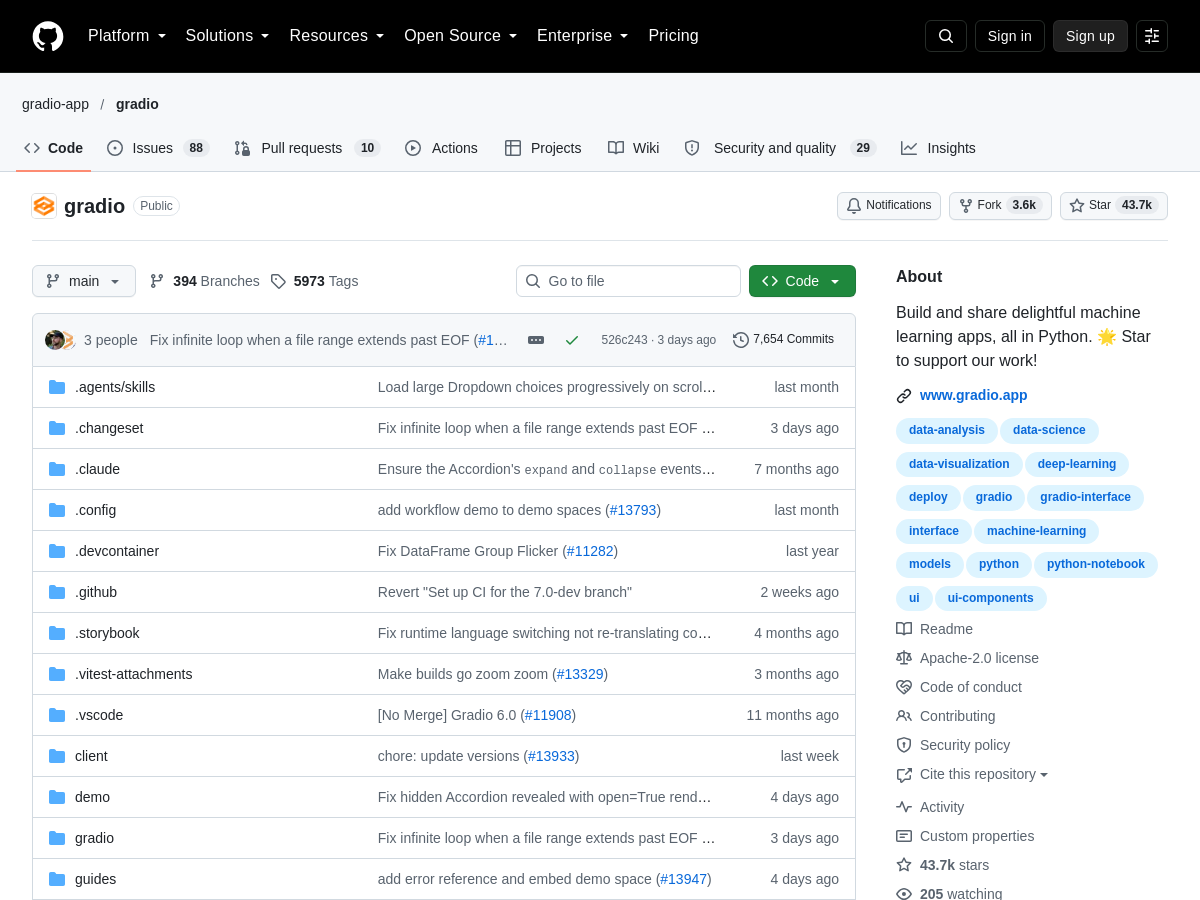
Solves

Pagesmith solves the problem of building and maintaining a website by letting users import an existing site or describe a new one, then edit, publish, and manage an Astro site with hosting, SEO controls, forms, and analytics—without locking content into a proprietary builder.

Screenshot of AstrBot
AstrBot
LLM Open Source

AstrBot is an open-source all-in-one Agent chatbot platform that integrates with mainstream instant messaging apps. It provides reliable and scalable conversational AI infrastructure for individuals, developers, and teams. Whether you're building a personal AI companion, intelligent customer service, automation assistant, or enterprise knowledge base, AstrBot enables you to quickly build production-ready AI applications within your IM platform workflows. AstrBot supports integration with various agent platforms, including Dify, Alibaba Cloud Bailian, and Coze, and offers a range of features such as AI LLM conversations, multimodal, agent, MCP, skills, knowledge base, persona settings, and auto context compression. The platform also supports multi-platform deployment, including QQ, WeChat Work, Feishu, DingTalk, WeChat Official Accounts, Telegram, Slack, and more. Additionally, AstrBot offers plugin extensions with over 1000 plugins available for one-click installation, as well as a range of deployment methods, including one-click cloud deployment, Docker deployment, and desktop application deployment.

Solves

AstrBot solves the problem of building and deploying conversational AI applications for individuals, developers, and teams. It provides a reliable and scalable infrastructure for integrating AI capabilities with mainstream instant messaging apps, allowing users to quickly build production-ready AI applications without requiring extensive development expertise. By providing a range of features and deployment methods, AstrBot makes it easier for users to create and deploy conversational AI applications that meet their specific needs.