Tool discovery

What type of AI tool
are you looking for?

Search the active catalog with LambdaBase AI Search, or keep browsing the popularity-ordered directory below.

Submitted search queries and interaction metrics may be analyzed to improve result quality. Do not include personal or confidential information

Browse popular tools.

Screenshot of Notes that talk with you
Notes that talk with you
AI Mental Health Unknown

Notes that talk with you is a personal AI coaching journal developed by Rin Inc. It presents one question each day and uses the user's answers to help map their values and inner patterns. The product is designed for people who find it hard to open up to others: it offers a private place where they can leave thoughts they have not been able to say, and gradually see their own value system take shape. Rin describes the service as a "notebook to talk with yourself." Instead of requiring long emotional writing, the daily question format lowers the barrier to reflection and builds a habit of noticing one's feelings and choices. The AI coach is intended to make values visible through the accumulation of small daily responses, supporting users in everyday decisions rather than only at times of crisis. The tool is part of Rin Inc.'s broader focus on mental health and human development for working people. The company also offers StrengthsFinder-based training and corporate AI coaching, but this particular offering is positioned for individual use. Pricing and platform details are not listed on the homepage, and the service materials are currently in Japanese.

Solves

Many people feel they have nobody to talk to or cannot put their emotions into words. Notes that talk with you gives them an always-available AI companion that asks a simple question each day. By answering regularly, users can clarify their personal values, recognize what matters to them, and improve their daily choices without needing to disclose vulnerable thoughts to another person.

Screenshot of Minaco
Minaco
AI Research Tool Unknown

Minaco is an AI cofounder workspace designed to support business decisions with competitor intelligence. It helps founders and teams estimate competitor revenue and user counts, analyze growth trajectories, and uncover customer acquisition and marketing tactics. The platform pulls data from multiple sources, including traffic analytics, search data, and app store intelligence, to build operating models for private companies. Beyond analysis, Minaco functions as a strategic partner that reads context from email, docs, meetings, and platforms, then orchestrates other AI agents to complete research, coding, outreach, and growth tasks. It is positioned as a cost-effective alternative to enterprise market intelligence stacks, integrating capabilities similar to Similarweb, Semrush, Ahrefs, and Sensor Tower in one interface. Minaco also supports finding early seed users by identifying where potential customers gather and what they care about. The platform aims to provide evidence-based answers with data, models, and next questions, allowing users to act on insights quickly. It emphasizes an unbiased, non-political decision-making perspective, contrasting with human cofounders' agendas.

Solves

Minaco solves the problem of inaccessible and costly competitive intelligence for founders and small teams. It provides revenue estimates, growth analysis, customer acquisition insights, and strategic recommendations in one platform, replacing multiple expensive subscriptions and the need for a dedicated market intelligence analyst. It also helps startups identify early adopters and validate strategy.

Screenshot of Read Aloud Reader
Read Aloud Reader
AI Text-to-Speech Unknown

Read Aloud Reader is a free online text-to-speech tool that converts written text into natural-sounding speech. It provides a web-based studio where users can paste text, upload PDFs, or input up to 40,000 characters per session, and listen to the content read aloud by one of six neural voices. The tool is designed to be simple and accessible, requiring no signup or payment, and works across all major browsers on devices including Mac, Windows, Chromebook, iPhone, and Android. The studio offers a distraction-free reading pane with word-by-word or sentence highlighting, adjustable playback speed, and one-click MP3 export for offline listening. This makes it useful for a variety of scenarios, such as catching up on articles during a commute, proofreading documents by hearing them read back, studying hands-free, or assisting users with dyslexia, ADHD, or visual fatigue. The tool emphasizes natural voice quality, aiming to sound like a person rather than a robotic narrator. In addition to the web studio, Read Aloud Reader provides a free Chrome extension that works with Chrome, Edge, Brave, Arc, and Opera. The extension allows users to read any web page aloud without leaving the tab, either by pressing Alt+R or selecting highlighted text. Audio continues playing while browsing, with controls for pause, skip, and speed in the extension popup. Both the studio and extension are part of the same free offering, with no hidden paywalls or subscription requirements.

Solves

Read Aloud Reader solves the need to access written content in audio form quickly and freely, using natural AI voices. It eliminates the need for expensive TTS software or manual narration, making it easy for anyone to listen to articles, documents, or study materials, and to create MP3 files for offline use.

Screenshot of Katto
Katto
Long Video To Short Video AI Unknown

Katto is an AI-powered video clipping platform designed to transform long-form videos and podcasts into viral-ready short clips. By simply pasting a link, users receive a curated set of vertical 9:16 clips that are automatically reframed, captioned, and scored based on their viral potential. The platform supports over 99 caption languages, offers AI dubbing across multiple languages, and includes a comprehensive editor for fine-tuning every aspect of the clip, from captions and B-roll to emojis and hooks.

Solves

Katto solves the time-consuming process of manually finding and editing the best moments from long videos to create engaging short-form content, eliminating guesswork and reducing production time from hours to minutes.

Screenshot of PostMcpAi
PostMcpAi
AI Social Media Unknown

PostMcpAi is an AI-powered social media publishing platform that leverages the Model Context Protocol (MCP) to let AI agents write, schedule, and publish content across seven social networks. It offers 16 MCP tools that can be used by ChatGPT, Cursor, or any MCP-compatible client. The platform includes a built-in agent that takes plain-English instructions and generates network-specific posts, a visual scheduling calendar, brand memory, and team collaboration features. The service is built on an open-source social media MCP server, and a REST API is also provided for developers who want to integrate social publishing into their own products. Users can connect their social accounts via OAuth, maintain control through approval workflows, and manage all posts from a unified dashboard. PostMcpAi aims to simplify multi-network social media management by combining AI content generation with scheduling and automation.

Solves

PostMcpAi solves the problem of managing social media across multiple networks by using AI agents to automatically create, schedule, and publish platform-specific content. It reduces manual effort, ensures consistent brand voice, and lets users maintain oversight through approval and scheduling tools.

Screenshot of zclaw
zclaw
AI Agents Open Source

zclaw is an open-source firmware designed to turn inexpensive ESP32 microcontrollers into functional AI personal assistants. Written entirely in C, it is engineered to be the smallest possible implementation, with a default firmware size of less than 888 KiB. This makes it ideal for constrained embedded devices while still providing core assistant capabilities. The firmware supports real-time wake word detection, audio capture, and integration with cloud-based large language models (LLMs) for natural language understanding and response generation. It can output synthesized speech or control connected hardware. By leveraging the Wi-Fi and Bluetooth features of the ESP32, zclaw can connect to various AI services and smart home devices. The project is actively maintained on GitHub and provides configuration files for multiple ESP32 board variants, including the ESP32-S3-BOX-3 and ESP32-T-Relay, ensuring broad hardware compatibility. Users can customize wake words, prompts, and behaviors to create a tailored assistant experience. The build system uses ESP-IDF, and an installation script simplifies flashing the firmware onto a device. Despite its tiny size, zclaw demonstrates that powerful AI features can be embedded in low-cost, everyday electronics.

Solves

Many users seek a personal AI assistant that is affordable, privacy-respecting, and fully customizable, but commercial assistants often come with high costs, vendor lock-in, and limited control over data. zclaw solves this by providing a lightweight, open-source firmware that runs on extremely cheap ESP32 boards, allowing anyone to build their own assistant without relying on proprietary ecosystems. It enables local wake word processing for privacy and can be tailored to specific needs while remaining accessible to hobbyists and developers.

Screenshot of Wondershare Repairit
Wondershare Repairit
AI Productivity Tools Unknown

Wondershare Repairit is a powerful AI-driven data repair tool designed to fix corrupted or unopenable files across video, photo, audio, and document formats. It supports a wide range of file types including MP4, MOV, AVI, MKV, JPG, PNG, CR3, MP3, WAV, DOCX, PDF, and more. The tool employs advanced AI algorithms that analyze the structure of damaged files and reconstruct them to restore lost data. Available for both Windows and macOS, it also offers an online version for quick repairs without installation. The repair process is user-friendly: simply add corrupted files, initiate the scan, and let the AI repair them; users can preview repaired files before saving them. For severely damaged videos, an advanced repair mode uses a sample file from the same device to significantly improve repair success rates. Batch processing allows multiple files to be fixed simultaneously, saving time. Regular updates ensure compatibility with new formats and devices, making it a versatile solution for individuals and professionals alike.

Solves

Data corruption is a common issue caused by improper storage device ejection, virus attacks, system crashes, or hardware failures, leading to inaccessible videos, photos, audio recordings, and documents. Wondershare Repairit solves this by providing a non-technical, AI-powered platform that repairs such files quickly and effectively, eliminating the need for expensive professional data recovery services or the risk of permanent data loss.

Screenshot of Zocks
Zocks
AI For Finance Unknown

Zocks is an AI-powered platform designed specifically for financial advisors and wealth management professionals. It acts as an intelligent assistant that automates operational and administrative tasks, enabling advisors to spend more time with clients and on business development. By leveraging advanced natural language processing and machine learning, Zocks can join virtual meetings, listen to conversations, and automatically generate structured, accurate meeting notes. It also extracts key action items, updates client records in the CRM, and helps ensure compliance by documenting client interactions thoroughly. The platform integrates seamlessly with widely used tools in the financial advisory industry, such as popular CRM systems, email platforms, and video conferencing software. This integration allows for a smooth workflow: from the moment a meeting is scheduled to the completion of follow-up tasks. Zocks not only captures what was said but also understands context, identifying financial goals, risk tolerances, and other critical data points that advisors need to personalize their services. Beyond note-taking, Zocks provides features for business growth. It can generate personalized email drafts for follow-ups, create summaries for client reviews, and even help prepare for upcoming meetings by pulling relevant client history and suggesting talking points. The AI assistant continuously learns from the advisor's style and preferences, further enhancing its utility over time. Additionally, Zocks offers analytics on client engagement and meeting trends, helping advisors identify opportunities and improve their practice. In terms of security and compliance, Zocks is built with financial industry regulations in mind. It offers data encryption, access controls, and audit trails to maintain the confidentiality and integrity of sensitive financial information. By reducing the manual effort required for routine documentation and data entry, Zocks allows advisors to scale their business without sacrificing personalization or compliance, making it a valuable tool for solo practitioners and large firms alike.

Solves

Financial advisors often grapple with the burden of administrative tasks that eat into time that could be spent advising clients. Manual note-taking, data entry, and compliance documentation are not only time-consuming but also prone to error. Zocks solves this by automating the capture, organization, and actioning of client interaction data. It transcribes meetings, extracts actionable insights, updates CRM systems, and generates necessary documentation, all while maintaining regulatory compliance. This automation frees advisors to focus on client relationships and business growth.

Screenshot of ZSky AI
ZSky AI
AI Video Generator Unknown

ZSky AI is a free, web-based AI tool that enables users to generate high-quality images and 1080p resolution videos from textual descriptions. Using advanced generative AI models, it transforms simple prompts into visually compelling content without requiring any design or technical expertise. The platform offers unlimited creation at no cost, making it an attractive choice for individuals and businesses looking to produce visual media quickly. Users can input descriptive text, select desired styles or parameters, and instantly receive ready-to-use images or short video clips. The 1080p video output ensures decent quality for social media, presentations, or marketing materials. As a cloud-based solution, it requires no installation or powerful hardware, operating entirely within a web browser. This accessibility, combined with the promise of unlimited free generation, positions ZSky AI as a potential go-to tool for casual creators, marketers, and hobbyists seeking rapid visual content.

Solves

Content creators, small businesses, and individuals often struggle to afford expensive graphic design tools or hire professionals for simple visual assets. ZSky AI alleviates this by providing a free, unlimited platform that instantly converts text descriptions into images and 1080p videos, enabling anyone to produce high-quality visual content without technical skills or financial investment.

Screenshot of YeeroAI
YeeroAI
AI Knowledge Base Free

YeeroAI is an AI chat and knowledge platform that integrates multiple large language models into a single, unified interface. Users can enter a prompt and receive responses from several AI models simultaneously, displayed in a parallel view for easy comparison. A distinctive feature of YeeroAI is its branching thoughts capability, which allows users to explore alternative conversation paths by creating divergent threads from any point in a dialogue. The platform is designed to facilitate knowledge discovery, creative brainstorming, and informed decision-making by aggregating diverse AI perspectives. It aims to streamline the user experience by eliminating the need to switch between different AI chat services, providing a seamless environment for interacting with various state-of-the-art models. YeeroAI is free to use and accessible via a web browser, making advanced AI comparison and exploration readily available to a broad audience.

Solves

Users of AI chat tools often need perspectives from multiple models to compare accuracy, style, and completeness, but switching between different platforms is cumbersome and time-consuming. Additionally, linear chat interfaces restrict exploration of alternative ideas. YeeroAI solves these problems by offering a multi-model parallel view that displays responses side-by-side, and by enabling branching conversations that allow users to pursue different lines of inquiry without losing previous context, thereby enhancing productivity, creativity, and critical analysis.

Screenshot of ZeroSphere
ZeroSphere
Ai Engineer Unknown

ZeroSphere is an AI-powered development platform designed to streamline the entire software creation lifecycle. It leverages advanced artificial intelligence to assist developers in writing, testing, and deploying code more efficiently. By integrating AI-driven code generation, intelligent debugging, and automated DevOps workflows, ZeroSphere aims to reduce the friction between idea and production. The platform provides a collaborative environment where teams can work on projects with real-time AI suggestions, reducing the need for manual boilerplate coding and repetitive tasks. It supports multiple programming languages and frameworks, with a strong focus on Python and modern web technologies. Additionally, ZeroSphere offers built-in MLOps capabilities, enabling seamless integration of machine learning models into applications. ZeroSphere's key features include context-aware code completions, natural language to code translation, automated test generation, and one-click deployment to cloud services. It also incorporates monitoring and analytics tools to track application performance and AI model drift. The platform is accessible via a web interface and provides APIs for custom integrations. By abstracting away the complexities of infrastructure management and AI integration, ZeroSphere empowers teams to focus on innovation rather than operational overhead. It is suitable for startups and enterprises looking to accelerate their digital transformation with AI.

Solves

Software development teams often face bottlenecks when integrating AI capabilities into their applications, leading to prolonged development cycles and increased costs. These bottlenecks include manual coding of repetitive patterns, difficulty in managing AI model lifecycles, and complex infrastructure setup. ZeroSphere solves this by providing an all-in-one platform that automates these tasks, allowing developers to rapidly build, deploy, and scale AI-powered applications without deep expertise in every underlying technology.

Screenshot of yenchieh/diagramzu-mcp
yenchieh/diagramzu-mcp
Developer Tools Open Source

yenchieh/diagramzu-mcp is an open-source Model Context Protocol (MCP) server that bridges AI assistants and the Diagramzu diagramming platform. It enables AI models to programmatically create, read, update, and delete Mermaid diagrams directly within a shared workspace, eliminating the need to paste raw Mermaid syntax. The server exposes a set of tools that allow AI to generate flowcharts, sequence diagrams, entity-relationship diagrams, mind maps, and more, and then store them in a collaborative space where users can comment, embed, and present via clean, shareable URLs. Under the hood, the MCP server translates natural language instructions into Diagramzu API calls, managing authentication, workspace organization, and diagram lifecycle. Once generated, diagrams live on Diagramzu’s servers, providing a persistent, collaborative canvas for teams. AI can also read existing diagrams, appending comments or suggesting changes, enabling a conversational workflow around visual documentation. Key features include generating various Mermaid diagram types, reading back diagram contents for iterative editing, adding comments to diagrams for team discussion, embedding diagrams in external documents or websites via iframes or links, and presenting diagrams in a full-screen slide mode. The integration leverages MCP’s standard tool interface, making it compatible with any MCP-supporting AI client such as Claude Desktop, Continue.dev, or custom applications. Beyond basic diagramming, Diagramzu MCP supports versioning and workspace management, allowing multiple diagrams to coexist and reference each other. The open-source nature of the server means developers can self-host, extend with custom diagram types or integrations, and inspect the code. The project is actively maintained on GitHub, welcoming contributions and community feedback.

Solves

AI assistants typically generate Mermaid code that needs to be manually copied into an editor, rendered, and shared—a cumbersome process that breaks flow and makes collaboration difficult. Diagramzu MCP solves this by letting AI interact directly with a live diagramming workspace: it creates diagrams, organizes them in shared projects, and provides clean URLs for sharing, commenting, embedding, and presenting. This turns AI into a collaborative partner that can instantly produce visual documentation without interrupting the user's workflow.

Screenshot of wso2/fhir-mcp-server
wso2/fhir-mcp-server
Developer Tools Open Source

The wso2/fhir-mcp-server is a Python-based Model Context Protocol (MCP) server that bridges AI assistants (such as Claude or other MCP-compatible clients) with FHIR (Fast Healthcare Interoperability Resources) APIs. It enables seamless, standardized access to FHIR servers, allowing AI models to perform healthcare data operations like searching, retrieving, and creating resources directly through the MCP interface. The server abstracts the complexity of FHIR endpoints by exposing a set of MCP tools that handle authentication, resource querying, and data manipulation. It supports common FHIR interactions such as searching for patients, observations, or conditions; reading specific resources; and creating new entries. Configuration is managed through environment variables, including FHIR server base URLs and authentication credentials, with support for OAuth2 and other security mechanisms. The server can be run locally via pip, as a Docker container, or deployed in cloud environments like Choreo. Built by WSO2, a leader in open-source integration software, the tool ensures compatibility with major FHIR servers (e.g., HAPI FHIR) and is designed to be extensible. Its modular codebase includes helpers for extracting bundle resources, filtering with FHIRPath, and handling pagination, making it robust for production use cases. The project includes comprehensive tests and documentation, along with demo recordings for popular FHIR backends. Overall, this MCP server empowers healthcare developers and data scientists to integrate AI-driven insights into clinical workflows without building custom API integrations, accelerating the development of AI-assisted healthcare applications.

Solves

Healthcare developers and data scientists often struggle to connect AI assistants with FHIR-compliant electronic health record systems due to the complexity of FHIR APIs and the lack of standardized AI integration layers. This tool solves that problem by providing a ready-to-use MCP server that exposes FHIR operations as simple, AI-friendly tools, eliminating the need for custom glue code and ensuring secure, interoperable access to healthcare data.

Screenshot of VocaIQ
VocaIQ
AI Agent Unknown

VocaIQ is a fully-managed AI voice agent platform designed for small to medium businesses that need 24/7 call handling, appointment booking, and lead qualification. Unlike DIY voice bot builders, VocaIQ handles every aspect: their team builds the knowledge base from your website, configures the voice model, sets compliance guardrails, and manages ongoing updates. The service answers inbound calls with sub-300ms latency in over 100 languages, using advanced AI models (including GPT-5.4 and a suite of 18 models) to deliver natural-sounding conversations. The platform integrates with popular CRMs, scheduling tools, and payment systems to sync bookings and send follow-up SMS messages. Key features include managed setup, multi-location scaling, call transcripts with summaries, and built-in compliance for regulations like PIPEDA, GDPR, and TCPA. Plans are tiered by usage and features, with no long-term contracts, and the company emphasizes a zero-risk start with transparent performance metrics. The system targets industries such as dental, HVAC, real estate, legal, and beauty, with specific workflows like insurance verification and emergency call routing.

Solves

Small and medium businesses often miss up to 62% of inbound calls, leading to lost revenue estimated at $126K annually per practice. Callers who reach voicemail rarely call back, and owners cannot afford or staff 24/7 reception. VocaIQ solves this by providing an always-on AI receptionist that answers every call instantly, books appointments, qualifies leads, and integrates with existing business tools—all without requiring technical setup from the business owner.

Screenshot of Webotee
Webotee
AI Research Tool Unknown

Webotee is an Amazon market intelligence platform that brings brand, seller, ASIN, and niche research directly into the AI assistants you already use. You can add it to Claude or ChatGPT through an MCP connector and then ask natural language questions to get instant insights about the Amazon marketplace. It aggregates and analyzes data from Amazon product listings, search results, and historical trends, providing a conversational interface to complex e-commerce data. The platform is designed to simplify the process of product research, competitor analysis, and market trend identification. Instead of manually browsing spreadsheets or dashboards, users can ask questions like 'Show me the top-selling brands in lawn and garden' or 'Compare the estimated monthly sales of these three ASINs.' Webotee handles the data retrieval and analysis behind the scenes, leveraging its own proprietary data pipeline. Webotee likely offers a range of data points such as sales estimates, revenue projections, keyword tracking, and competitive intelligence. Its MCP integration means it works seamlessly with your existing AI assistant workflow, allowing you to combine Amazon market data with other AI-powered tasks like content generation or strategic planning.

Solves

Amazon sellers, brand managers, and e-commerce analysts face a significant challenge in gathering and interpreting market data to make informed business decisions. Traditional methods involve manually searching through Amazon listings, using multiple tools, and relying on static reports. Webotee solves this by providing a conversational AI interface that allows users to query dynamic market intelligence directly, reducing the time and technical barriers required to access actionable insights.

Screenshot of WeKraft
WeKraft
AI Project Management Unknown

WeKraft is an AI-powered project management platform that seamlessly integrates with GitHub, designed specifically for engineering teams to streamline their workflows and enhance productivity. By leveraging machine learning algorithms, WeKraft automates routine tasks such as sprint planning, issue prioritization, and resource allocation, allowing developers and managers to focus on high-value activities. The platform intelligently analyzes repository activity, including commits, pull requests, and issue discussions, to generate actionable insights and predictive analytics that help teams anticipate bottlenecks and deliver projects on time. Key features include AI-driven task assignment that matches issues with the most suitable developers based on past performance and expertise, automated daily standup summaries extracted from GitHub activity, and personalized dashboards that highlight critical metrics like velocity, cycle time, and burndown charts. WeKraft also supports cross-repository views, enabling organizations to manage multiple projects from a single interface while maintaining tight synchronization with GitHub’s issue tracking and project boards. In addition to project management, WeKraft facilitates team communication by generating intelligent alerts and notifications through popular collaboration tools, reducing the need for manual status updates. Its integration with GitHub is bidirectional, ensuring that changes in either platform are instantly reflected. The platform also provides automated changelog generation from merged pull requests and tagged releases, which is particularly useful for maintaining documentation and release notes.

Solves

Engineering teams often struggle with project management overhead when using GitHub alone, as it lacks advanced planning features, automated prioritization, and real-time visibility into project health. WeKraft solves this by providing an AI layer that automates repetitive project management tasks, synthesizes data from GitHub into actionable insights, and improves cross-team coordination. It eliminates the need for manual status tracking, reduces miscommunication, and helps teams deliver software faster by predicting risks and optimizing resource allocation.

Screenshot of WhiteWhale
WhiteWhale
AI Sales Assistant Unknown

WhiteWhale is a custom B2B buying signals platform that leverages artificial intelligence to deliver verified source quotes and intent data to sales teams. By aggregating and analyzing vast amounts of web data, WhiteWhale identifies companies actively researching specific products or services, providing real-time alerts on high-intent prospects. The platform uses machine learning to sift through behavioral signals, such as content consumption, job postings, and technology installations, and then matches these signals to relevant businesses, enriching each signal with a direct quote from a verified source to confirm the intent. This approach goes beyond traditional intent data by offering concrete evidence of purchase readiness, enabling sales representatives to prioritize outreach with confidence. Key features include customizable signal filtering, integration with CRM and sales engagement tools, and dashboards that track intent trends and conversion metrics. WhiteWhale is designed to help revenue teams cut through noise, focus on accounts that matter, and accelerate pipeline generation.

Solves

B2B sales and marketing teams often waste time cold-prospecting companies that show no real buying intent, leading to low conversion rates and inefficient resource use. Generic intent data provides vague signals that lack verification and actionable insights. WhiteWhale solves this problem by delivering buying signals that are backed by verified source quotes, making it clear which companies are in active evaluation mode and why. This allows teams to prioritize high-intent accounts, personalize outreach with concrete proof, and close deals faster, ultimately increasing sales productivity and revenue.

Screenshot of VSCode Extension
VSCode Extension
AI Agents Unknown

Blinky is an open-source AI debugging agent that functions as a Visual Studio Code extension, harnessing the power of large language models (LLMs) to automate the identification and resolution of software bugs, particularly in backend systems. Inspired by the SWE-agent framework, Blinky provides a user-friendly chat interface within VSCode where developers can describe errors, optionally provide reproduction steps, and then watch as the agent autonomously explores the codebase, leveraging the VSCode API, Language Server Protocol, and dynamic print statement insertion to triangulate the root cause of issues. The agent iterates through potential fixes, incorporates real-time user feedback, and ultimately proposes changes that can be reviewed and accepted or rejected via a built-in diff viewer. Designed to accelerate the debugging workflow, Blinky aims to reduce the manual effort required to trace and fix bugs, making it a valuable tool for both solo developers and teams. Its open-source nature encourages community contributions and customization, while its integration with the widely-used VSCode editor ensures a low barrier to entry for most developers.

Solves

Software developers often spend a disproportionate amount of time manually debugging backend code, which involves sifting through logs, inserting print statements, and hypothesizing about failure causes. This process is tedious, error-prone, and can delay delivery timelines. Blinky addresses this by acting as an automated AI pair-debugger that uses LLMs to interpret bug reports, analyze source code, and execute runtime debugging steps. By offloading the repetitive parts of debugging to an agent, developers can focus on higher-level problem-solving, leading to faster resolution of defects and more reliable software.

Screenshot of VOVV AI
VOVV AI
AI Product Photography Unknown

VOVV AI is an AI-powered platform that enables e-commerce brands to create high-quality product photographs and videos without the need for traditional photoshoots. By leveraging generative AI models, users can generate realistic images of their products in various settings, backgrounds, and styles, simply by providing a description or an existing product photo. The tool automates the process of staging, lighting, and editing, delivering professional-grade visuals in minutes. At its core, VOVV AI likely uses advanced computer vision and image synthesis techniques to understand product shapes, textures, and colors, and then places them into AI-generated scenes that match the desired aesthetic. Users can customize the output by specifying attributes like background type, lighting conditions, camera angles, and even add lifestyle elements. The platform probably offers a user-friendly interface where you upload your product photo, select a template or prompt, and the AI generates multiple variations to choose from. Beyond static images, VOVV AI also generates short product videos, which are increasingly important for social media marketing and online ads. These videos might include simple animations, rotating views, or contextual scenes, all created from the product photo. The tool aims to democratize high-end product photography, making it accessible to small and medium businesses, startups, and even large enterprises looking to scale their content production efficiently. Key features may include: instant background removal and replacement, AI scene generation, batch processing for multiple products, style transfer, 360-degree product views, integration with e-commerce platforms, and customizable branding options. The AI is likely trained on a vast dataset of product images to ensure photorealism and consistency.

Solves

E-commerce brands often face high costs, long lead times, and logistical challenges in producing professional product photography. VOVV AI solves this by providing an AI-driven virtual photo studio that generates photorealistic product images and videos on demand, eliminating the need for physical samples, studio equipment, and manual editing.

Screenshot of ViralScribe
ViralScribe
AI Transcription Unknown

ViralScribe is an AI-powered tool designed specifically for short-form video creators to transcribe and analyze their content for virality potential. The platform uses advanced speech recognition to automatically generate accurate transcriptions of videos, and then applies natural language processing and virality models to evaluate the transcript for factors that contribute to viral spread, such as emotional hooks, pacing, keyword optimization, and engagement triggers. By providing a transcript along with a virality score and actionable suggestions, ViralScribe helps creators refine their scripts and video structure to maximize audience retention and sharing. The tool integrates seamlessly with popular short-form video platforms, allowing users to upload videos directly or import from URLs. Once processed, users can view a detailed breakdown of their video's virality metrics, including emotional tone analysis, keyword density, and predicted engagement rates. The transcription is fully editable, and users can export it in multiple formats for subtitling or repurposing. Additionally, the virality analysis provides side-by-side comparisons with trending videos to highlight areas for improvement. Key features include automated transcription in multiple languages, real-time virality scoring, trend identification, and A/B testing capabilities for video scripts. ViralScribe also offers collaboration tools for teams, enabling content creators, marketing agencies, and social media managers to work together on optimizing video content. The platform is cloud-based, ensuring fast processing and accessibility from anywhere.

Solves

Content creators and marketers often struggle to understand why some short-form videos go viral while others do not. Manually transcribing videos and analyzing textual content for viral patterns is time-consuming and subjective. ViralScribe automates both transcription and virality analysis, providing objective data-driven insights that save hours of work and help creators optimize their content for maximum reach and engagement.

Screenshot of ViperJuice/mcp-gateway
ViperJuice/mcp-gateway
Developer Tools Open Source

MCP Gateway (pmcp) is an open-source meta-server designed to minimize tool bloat in Claude Code and other MCP-compatible AI assistants. It acts as a central gateway that exposes a small set of stable meta-tools (9 by default), which dynamically discover and provision other MCP servers on demand using a progressive disclosure model. Instead of loading dozens of tools into the AI's context, the gateway presents a clean, minimal interface and auto-starts specialized servers like Playwright for browser automation and Context7 for documentation retrieval only when needed. This reduces memory and token usage, resulting in faster, more focused interactions. Under the hood, MCP Gateway manages lifecycle and discovery for multiple downstream MCP servers. It can be configured to start essential services automatically, while less frequently used tools remain dormant until a meta-tool invocation triggers their activation. The meta-server also supports dynamic tool discovery, allowing new MCP servers to be added without restarting the entire assistant session. This architecture keeps tool lists lean and avoids the context window dilution common when many tools are active concurrently. MCP Gateway is built in Python and is distributed as both a pip-installable package and a Docker container. It uses a configuration-driven approach where users define which MCP servers to expose and under what conditions they should be activated. The server can run locally alongside Claude Code, or as a standalone daemon, providing compatibility across Linux, macOS, and Windows. Key features include automatic Playwright and Context7 server provisioning, a stable set of 9 meta-tools for common operations, progressive disclosure of additional tool capabilities, and extensible architecture that lets developers add custom tool mappings. The project aims to simplify MCP tool management while preserving the flexibility of the broader MCP ecosystem.

Solves

AI assistants like Claude Code can become overwhelmed by tool bloat when many MCP servers are connected, each registering multiple tools that consume context window space and increase latency. MCP Gateway solves this by consolidating access behind a unified meta-server that exposes a minimal, stable tool surface. It dynamically starts specialized servers only when their tools are requested, preventing unnecessary context pollution and improving performance for developers and power users who rely on a large suite of MCP integrations.

Screenshot of VividManga
VividManga
AI Manga Generator Unknown

VividManga is an advanced AI-powered manga colorizer that transforms black-and-white manga pages into vibrant, full-color illustrations. Using cutting-edge deep learning algorithms, it analyzes the line art, shading, and composition to automatically apply contextually appropriate colors, dramatically reducing the time and skill required for manual coloring. The tool supports both single pages and full chapters, making it suitable for quick edits as well as large-scale projects. Accessible via a web interface, users simply upload their manga files in common image formats, and the AI generates colorized versions within minutes. The underlying neural network has been trained on a vast dataset of colored manga and art, enabling it to understand stylistic nuances, such as character skin tones, hair colors, clothing, backgrounds, and special effects. It intelligently preserves the original line integrity while adding a natural, artist-like color palette. Key features include batch processing for entire chapters, the ability to refine results with user adjustments, and export options for high-resolution output. VividManga aims to democratize manga colorization, empowering independent creators, publishers, and fans to produce professional-grade colored manga without specialized artistic training or expensive software.

Solves

Manga artists, publishers, and fans often face the laborious task of manually coloring black-and-white manga pages, which requires significant artistic skill and many hours per page. VividManga solves this by providing an AI-driven tool that automates the colorization process, delivering high-quality, consistent results in a fraction of the time, without manual effort.

Screenshot of VaaniStudio
VaaniStudio
AI Video Translator Unknown

VaaniStudio is an advanced AI-powered video dubbing platform designed to break language barriers while preserving the original speaker's voice and delivering frame-accurate lip synchronization. By leveraging generative artificial intelligence and deep learning, VaaniStudio enables content creators, media companies, and enterprises to seamlessly translate audio tracks into multiple languages without losing the emotional nuance, tone, and unique vocal characteristics of the original speaker. The platform's core innovation lies in its ability to analyze the source video's speech patterns and generate a new audio track that not only matches the translated script but also syncs the lip movements of the on-screen individuals precisely, eliminating the uncanny valley effect often associated with automated dubbing. The tool works by first extracting the audio track and transcribing the speech using automatic speech recognition. Users then upload or edit the translated script in the target language, and VaaniStudio's proprietary voice cloning model generates a new voice track that mimics the original speaker's timbre, intonation, and cadence. Simultaneously, a separate module adjusts the video frames to align the speaker's lip movements with the new audio, ensuring that the visual output looks natural. The dubbing process supports a wide range of languages and can handle various video formats, from short social media clips to full-length feature films. The platform offers both a user-friendly web interface suitable for non-technical users and API access for integration into existing media pipelines, making it versatile for different scales of production. Key features of VaaniStudio include voice-preserving dubbing that retains speaker identity, frame-accurate lip sync that modifies video pixels in real time, support for over 50 languages, bulk video processing for enterprise needs, and collaborative workflows for teams. The AI models are trained on extensive multilingual datasets, enabling high-quality output even in noisy or expressive speech scenarios. Additionally, VaaniStudio provides fine-tuning options that allow users to adjust the intensity of voice preservation or lip sync accuracy based on the specific requirements of their project. With its combination of cutting-edge AI and ease of use, VaaniStudio positions itself as a one-stop solution for global video localization. VaaniStudio caters to a broad market, from independent YouTube creators wanting to reach international audiences to multinational corporations localizing training materials and marketing content. Its ability to maintain brand voice and on-screen authenticity reduces the need for expensive and time-consuming traditional dubbing studios. As remote work and global content consumption grow, VaaniStudio addresses the critical need for scalable, high-quality video translation that feels human.

Solves

Content creators and businesses often struggle to expand their video content globally due to the high cost and complexity of traditional dubbing, which typically employs different voice actors, leading to a loss of the original speaker's identity and poor lip synchronization. VaaniStudio solves this by providing an AI-driven dubbing solution that automatically translates audio, preserves the original speaker's voice, and ensures the on-screen lip movements match the new language, all through an intuitive platform.

Screenshot of Tweet
Tweet
AI Agents Unknown

Tweet is an AI agent designed for automating and enhancing Twitter activities. It leverages large language models to generate engaging, contextually relevant tweets, schedule posts, and analyze social media trends. The tool can be configured to maintain a consistent brand voice, reply to mentions, and even conduct sentiment analysis on incoming interactions. It integrates with the Twitter API to post tweets, fetch timelines, and monitor engagement. Built with flexibility in mind, Tweet can be deployed as a standalone service or integrated into larger marketing stacks. It aims to save time for social media managers by handling repetitive tasks and providing data-driven content suggestions.

Solves

Social media managers and content creators struggle to maintain a consistent and engaging presence on Twitter due to the time required for crafting tweets, monitoring trends, and responding to followers. Tweet automates the tweet creation process using AI, ensuring a steady stream of content tailored to the audience, while freeing up human resources for more strategic tasks.

Screenshot of Unfox AI
Unfox AI
AI Content Detector Unknown

Unfox AI is a free online AI content detection tool that uses advanced machine learning algorithms to analyze text and determine the likelihood that it was generated by an artificial intelligence model. The platform examines linguistic patterns, statistical markers, and semantic structures that are characteristic of AI-generated content, such as low perplexity and high burstiness, and provides a detailed report with a confidence score. Users can upload documents or paste text directly into the interface, and the tool processes the submission in real time, highlighting segments that appear machine-generated. Unfox AI supports multiple languages and file formats, and offers both a simple user interface and an API for integration into existing workflows. The detector is trained on outputs from popular large language models like GPT-3, GPT-4, and others, and is continuously updated to keep pace with evolving AI writing capabilities. It is designed for anyone who needs to verify the authenticity of written content, from educators and publishers to content marketers and entrepreneurs. Beyond plain text analysis, Unfox AI provides interpretive insights explaining why certain text snippets are flagged, helping users make informed decisions about content originality.

Solves

With the proliferation of generative AI models, distinguishing between human-written and AI-generated text has become a critical challenge. Educators face academic integrity issues, content creators risk SEO penalties for AI-generated spam, and businesses struggle to maintain authentic communication. Unfox AI addresses this by providing a reliable, easy-to-use detection tool that identifies AI-generated content with high accuracy, enabling users to verify originality, uphold quality standards, and make data-driven decisions about the content they consume or produce.

Screenshot of UGO Autonomous Marketing AI
UGO Autonomous Marketing AI
Marketing Automation Platforms Unknown

UGO Autonomous Marketing AI is a cutting-edge marketing automation platform that leverages artificial intelligence to manage and optimize digital marketing activities. The platform is designed for businesses that struggle to maintain a consistent and effective online presence due to limited resources or the complexity of modern marketing channels. By automating routine tasks such as content scheduling, campaign management, and performance monitoring, UGO frees up marketers to focus on strategy and creative development. The AI engine within UGO continuously analyzes user behavior, market trends, and campaign data to make intelligent decisions. It can automatically adjust ad spend, personalize content for different audience segments, and recommend the best times to post on social media. The platform supports multi-channel integration, including email, social media, and search engine advertising, providing a centralized dashboard for all marketing efforts. With its machine learning capabilities, UGO improves over time, adapting to changes in consumer behavior and market dynamics. Key features include an intuitive interface, real-time analytics, and autonomous campaign optimization. UGO also offers content generation tools that can create social media posts, email copy, and ad headlines based on brand guidelines and performance data. Additionally, it provides detailed reports and insights, helping businesses understand the impact of their marketing investments and make data-driven decisions. Ideal for startups, small to medium-sized businesses, and enterprise marketing teams, UGO aims to democratize sophisticated marketing automation. By reducing the need for manual intervention, it allows companies with limited staff to compete with larger organizations in the digital space. Overall, UGO Autonomous Marketing AI represents a shift towards more efficient, AI-driven marketing operations.

Solves

Many businesses, especially small to medium-sized ones, lack the time, personnel, or expertise to execute consistent and effective digital marketing campaigns. The manual effort required for content creation, scheduling, optimization, and analytics can be overwhelming. UGO Autonomous Marketing AI solves this by automating the repetitive and time-consuming aspects of marketing, enabling businesses to maintain a strong online presence, improve campaign performance, and focus on strategic growth rather than operational details.

Screenshot of Twitter thread describing the system

Awesome AI Agents is a curated list of AI agent frameworks, platforms, and tools hosted on GitHub under the e2b-dev organization. It provides a comprehensive directory of autonomous agents, multi-agent systems, and agent-building libraries, helping developers and researchers discover and compare various AI agent solutions. The list includes open-source projects, commercial offerings, and research experiments, each with a brief description and link to its repository or website. Maintained by the community, it is regularly updated to reflect the rapidly evolving field of AI agents. Its purpose is to serve as a central hub for anyone looking to explore, evaluate, or integrate AI agents into their projects.

Solves

Developers, researchers, and organizations often struggle to keep up with the multitude of AI agent projects emerging in the fast-moving AI landscape. Awesome AI Agents solves this by aggregating, categorizing, and maintaining a curated list of agent-related resources, saving users time and effort in discovering relevant tools and frameworks.

Screenshot of TransVoice Studio - AI Video Dubbing & Visual Translator

TransVoice Studio is an AI-powered video dubbing and visual translation platform designed to help content creators effortlessly localize their video content for global audiences. The platform combines advanced speech recognition, machine translation, and neural text-to-speech to generate natural-sounding dubbed audio tracks in multiple languages. It goes beyond simple voiceover by incorporating voice cloning technology, which replicates the original speaker’s vocal characteristics, and lip-sync algorithms that adjust mouth movements to match the new audio, preserving visual coherence. Additionally, TransVoice Studio offers visual translation capabilities, such as translating on-screen text, captions, and subtitles, ensuring a fully localized viewing experience. The workflow is straightforward: users upload a video, select target languages, and the AI automatically processes the content. The platform transcribes the audio, translates the script, generates synthetic speech with cloned voices, and performs lip-syncing. Users can then review and fine-tune the output through an integrated studio editor, adjusting timing, translations, or voice inflections before exporting the final video. This end-to-end automation significantly reduces the time and cost associated with traditional dubbing, which often requires hiring multiple voice actors, recording sessions, and post-production editing. TransVoice Studio is built for scalability, enabling creators, businesses, and enterprises to localize everything from short social media clips to full-length films and e-learning courses. The AI models are continuously refined to support a growing number of languages and dialects, ensuring high accuracy and cultural relevance. The platform also provides collaboration tools for teams, version control, and integration with popular video hosting and content management systems, making it a versatile solution for modern multimedia localization. By removing language barriers, TransVoice Studio empowers creators to expand their reach, engage international audiences, and increase content revenue without the traditional overheads. Whether for marketing campaigns, educational content, or entertainment, the tool democratizes video localization, making it accessible to users with no prior dubbing expertise.

Solves

Video content creators and businesses face a major obstacle when trying to reach global audiences: dubbing videos into multiple languages is traditionally expensive, slow, and technically complex. Hiring voice actors, managing recording sessions, and syncing audio to video require significant resources and expertise, often limiting localization to high-budget projects. TransVoice Studio solves this by using AI to automate the entire dubbing pipeline—transcribing, translating, generating natural-sounding speech with voice cloning, and lip-syncing—allowing users to produce professional-quality localized videos in a fraction of the time and cost.

Screenshot of Twitter
Twitter
AI Agents Unknown

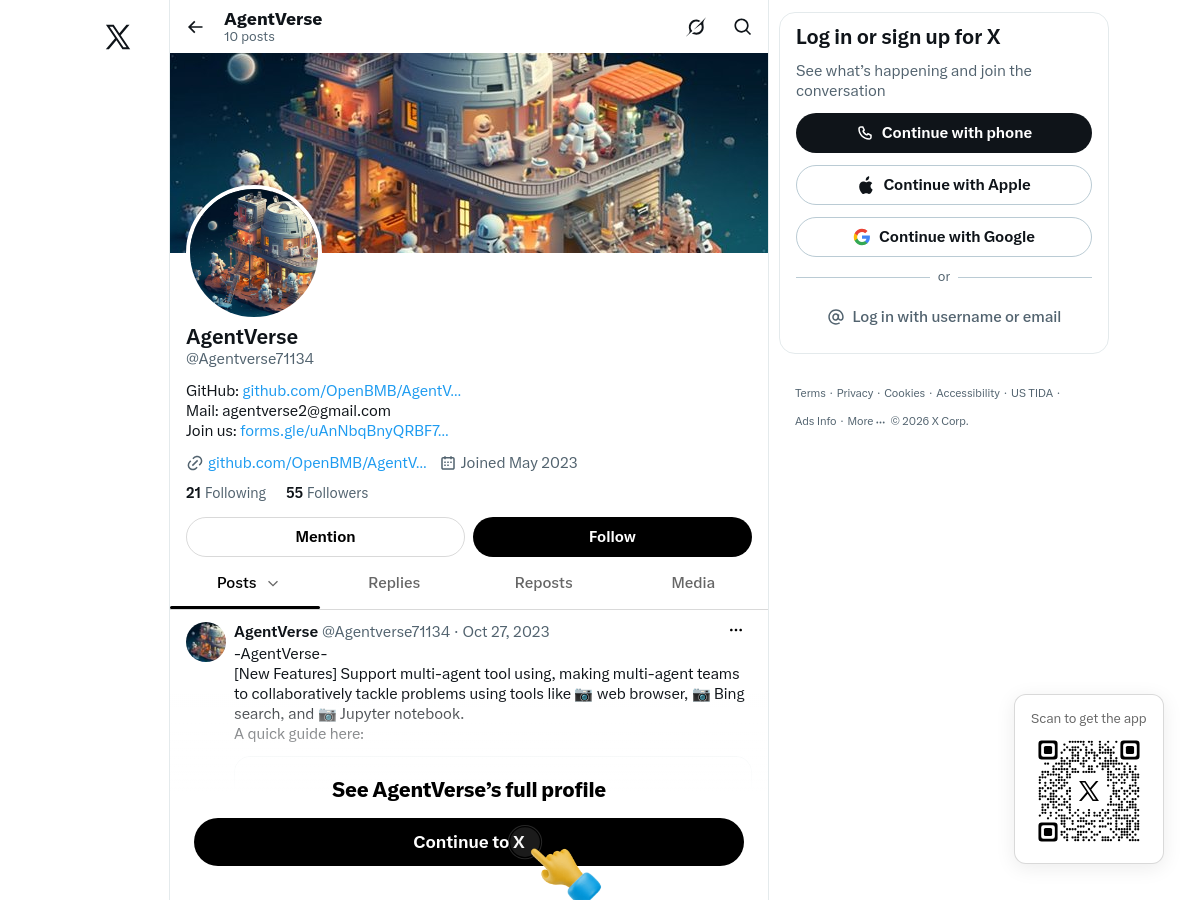
AgentVerse is an open-source framework designed for building and orchestrating multi-agent systems. It leverages large language models to enable agents to communicate, collaborate, and perform complex tasks within simulated environments. The framework provides a modular structure for defining agent roles, memories, decision-making processes, and interaction protocols, allowing developers and researchers to create dynamic agent-based simulations. AgentVerse facilitates the study of emergent behaviors, strategic planning, and cooperative problem-solving among autonomous agents. It is particularly useful for experimenting with scenarios where multiple AI entities need to coordinate, negotiate, or compete to achieve goals.

Solves

Developing multi-agent systems from scratch requires significant effort to handle agent communication, memory management, and environment simulation. AgentVerse solves this by offering a ready-to-use, extensible framework that abstracts these complexities, enabling researchers and developers to quickly prototype and experiment with agent-based models without reinventing core infrastructure.

Screenshot of TransVoice AI- Live Voice Translator

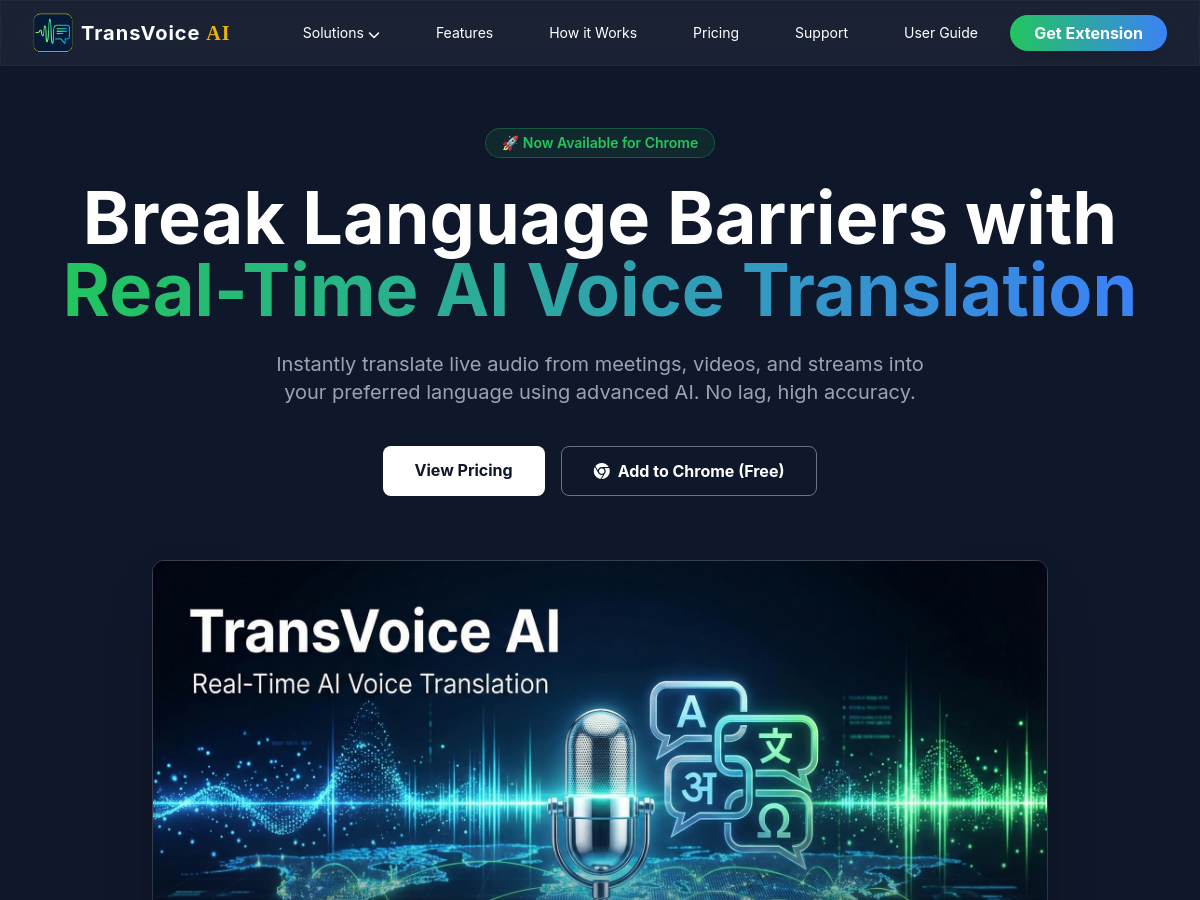
TransVoice AI is an advanced real-time voice translation application that leverages cutting-edge artificial intelligence to break down language barriers by providing instant, natural-sounding translations during live conversations. Unlike traditional translation tools that suffer from lag and require manual text input or complex interfaces, TransVoice AI processes spoken language in real time, enabling seamless, fluid communication across multiple languages. It is designed to make cross-language interactions as natural as speaking in one's native tongue. The app operates by combining three core AI technologies: automatic speech recognition (ASR) that accurately transcribes spoken words, neural machine translation (NMT) that converts the transcribed text into the target language with contextual understanding, and a text-to-speech (TTS) engine that produces human-like voice output. This pipeline runs with minimal latency, often within milliseconds, to simulate a natural conversation flow. It supports bidirectional translation in a conversational mode, allowing two or more participants to speak and hear translations without switching modes. Key features include support for dozens of languages and dialects, voice recognition that adapts to various accents and speaking styles, conversation memory for context-aware translations, and customizable voice speed and pitch. The app also offers text transcripts of conversations for later reference, multi-party conversation support for group discussions, and integration with phone calls and popular messaging apps. Users can enjoy offline translation for essential phrases when internet connectivity is unavailable. For enterprise users, TransVoice AI provides enhanced security, administrative controls, and API access for embedding translation into custom business workflows, customer support systems, or teleconferencing platforms. Its user-friendly interface is accessible to both casual travelers and professional users, requiring minimal setup. With continuous updates and machine learning improvements, the translation quality evolves over time to handle idiomatic expressions and specialized terminology.

Solves

Language barriers in real-time communication cause misunderstandings, delays, and friction in both personal and professional contexts. Traditional translation methods, such as typing phrases into a translator or waiting for post-processed audio, are too slow and cumbersome for spontaneous dialogue. TransVoice AI solves this by delivering instantaneous, accurate voice translations, enabling natural, unbroken conversation between speakers of different languages. It removes the need for human interpreters in many everyday scenarios and dramatically accelerates cross-language communication.

Screenshot of TrackSensei
TrackSensei
AI Assistant Unknown

TrackSensei is an AI-powered music production mentor that provides genre-aware mix and arrangement feedback. The platform leverages advanced machine learning models trained on professional mixes across various genres to analyze uploaded audio tracks. It evaluates critical aspects such as frequency balance, stereo imaging, dynamics, tonal clarity, and arrangement structure, then generates a detailed report with actionable recommendations. The tool understands genre-specific conventions, allowing it to tailor its advice to the intended style, whether it's pop, rock, electronic, hip-hop, or others. Producers can use TrackSensei to gain an objective second opinion on their work, identify weaknesses, and learn how to improve their mixing and arranging skills. The service is designed to be accessible via a web interface, requiring only an audio file upload to receive near-instant analysis. TrackSensei aims to democratize high-quality music production feedback, making it affordable and available to creators at all levels, from bedroom producers to semi-professionals.

Solves

Many music producers, especially those working in home studios, lack access to experienced mixing engineers who can provide critical, unbiased feedback on their tracks. Professional mix critiques are often expensive and time-consuming, leaving producers to rely on their own ears and limited monitoring environments. TrackSensei solves this by offering instant, AI-driven analysis that pinpoints mix and arrangement issues with genre-specific context, empowering producers to make informed adjustments and accelerate their learning without external assistance.

Screenshot of Teno
Teno
AI Ad Creative Unknown

Teno is an AI-powered ad creative platform that streamlines the entire ad creation process through a conversational interface. Users can describe their campaign goals, target audience, and messaging in natural language, and Teno's Ad Agent automatically constructs a detailed creative brief. From this brief, the platform generates high-quality image and video ads tailored to various platforms and formats, including social media, display, and video channels. Leveraging generative AI models, Teno produces visual content that aligns with brand guidelines and marketing objectives. The chat-based interaction makes it accessible to marketers with no design or copywriting experience, while offering advanced users the ability to refine briefs and iterate on generated assets. The tool supports rapid A/B testing by creating multiple ad variants in minutes, significantly reducing the time from concept to campaign launch. Teno also offers built-in editing tools for tweaking generated images and videos, ensuring final outputs meet specific needs. Its asset library and template system allow for further customization, while integration capabilities with ad networks and marketing platforms enable seamless deployment of creatives. The platform continuously learns from user feedback to improve output relevance and quality. By automating the repetitive and skill-intensive parts of ad creation, Teno empowers businesses to maintain a consistent and visually appealing ad presence without expanding their creative teams. It is particularly valuable for performance marketers who need to produce high volumes of ads quickly and respond to market trends in real time.

Solves

Creating effective ad creatives requires significant time, design skills, and marketing expertise, which many businesses, especially small teams and startups, lack. Manually briefing designers, writing copy, and producing image and video assets for multiple platforms leads to slow campaign launches and missed opportunities. Teno solves this by providing an AI assistant that can understand goals expressed in plain language, generate a strategic brief, and automatically produce polished image and video ads, dramatically cutting production time and eliminating the need for specialized talent.

Screenshot of tigranbs/mcgravity
tigranbs/mcgravity
Developer Tools Open Source

mcgravity is a reverse proxy designed specifically for the Model Context Protocol (MCP), which enables AI models to interact with external tools via standardized servers. By sitting between MCP clients (such as AI agents or applications) and multiple backend MCP server instances, mcgravity provides a single unified endpoint that distributes incoming tool requests across the available servers. This load balancing mechanism, analogous to how Nginx handles HTTP traffic, allows horizontal scaling of AI tools—simply add more MCP server instances behind the proxy to handle increased demand or provide fault tolerance. Built in Rust for performance and reliability, mcgravity supports configurable load balancing strategies, health checks to detect unhealthy backends, and dynamic reconfiguration to adapt to changing infrastructure. The tool is open source and can be deployed as a standalone binary, making it suitable for both development and production environments where scaling AI tool access is critical.

Solves

Developers building AI applications that leverage MCP servers often face scalability challenges: a single MCP server can become a performance bottleneck or a single point of failure as usage grows. mcgravity solves this by allowing multiple MCP server instances to be pooled behind a single proxy endpoint. Requests are automatically load balanced, increasing overall throughput and ensuring high availability even if some instances fail.

Screenshot of Timi AI-AI image prompt gallery
Timi AI-AI image prompt gallery
AI Prompt Generator Free

Timi AI is a comprehensive online prompt gallery designed for AI image and video generation. It hosts a vast collection of over 10,000 free prompts that users can browse, copy, remix, and generate with a single click. The platform aims to streamline the creative process by providing ready-to-use prompts that produce high-quality results across various AI models such as Midjourney, DALL-E, Stable Diffusion, and Runway. By offering a searchable and categorized gallery, Timi AI makes it easy for creators to find inspiration, learn effective prompt structures, and quickly produce visuals without the trial-and-error of crafting prompts from scratch. The interface is user-friendly, allowing users to preview prompts and the resulting images or videos. The remix feature enables customization, letting users tweak prompts to better suit their specific needs while building upon proven templates. Integration with popular AI generators means that once a prompt is selected, generating the content is just a click away, reducing friction and saving time. Timi AI serves as both an educational resource and a productivity tool. Beginners can learn how to write better prompts by studying examples, while experienced users can speed up their workflows by leveraging community-contributed prompts. The platform covers a wide range of styles, themes, and use cases, from photorealistic portraits to abstract art and video effects. It is particularly valuable for content creators, designers, marketers, and AI enthusiasts who want to maintain a consistent output of high-quality AI-generated media. Despite being free, Timi AI maintains a curated and organized collection, ensuring that prompts are effective and up-to-date with the latest AI model capabilities. The gallery steadily grows as new prompts are added, reflecting evolving trends and techniques in AI art generation. Overall, Timi AI democratizes access to professional-grade AI prompts, empowering anyone to create compelling visual content effortlessly.

Solves

Creating effective prompts for AI image and video generators is often challenging and time-consuming, requiring knowledge of specific keywords, styles, and parameters. Many users lack the expertise or inspiration to produce the results they envision. Timi AI solves this problem by offering a large, free library of pre-tested prompts that users can instantly use or customize, eliminating the guesswork and making high-quality AI generation accessible to everyone.

Screenshot of Task-Driven Autonomous Agent
Task-Driven Autonomous Agent
AI Agents Unknown

Task-Driven Autonomous Agent is an AI agent designed to autonomously execute given tasks. Details about its architecture, implementation, and capabilities are not provided in the scraped content. Based on its name and category, it likely uses large language models to interpret high-level objectives, decompose them into actionable sub-tasks, plan a sequence of steps, and execute them while adapting to feedback. It may interface with external tools or APIs to perform real-world actions. As an open-source project featured in a curated list, it is intended to be flexible and extensible for various automation scenarios, though specific documentation or code was not accessible in this analysis.

Solves

Users face repetitive, multi-step tasks that require human intervention, such as data collection, code execution, or workflow orchestration. Task-Driven Autonomous Agent automates these by accepting a goal and autonomously planning and performing the necessary actions, reducing manual effort and minimizing the cognitive load on users.

Screenshot of SwarmClaw
SwarmClaw
AI Agents Open Source

SwarmClaw is a self-hosted AI runtime specifically engineered for orchestrating multi-agent systems. It provides core infrastructure for managing agent lifecycles through heartbeat monitoring, scheduled task execution, dynamic delegation, shared memory persistence, and extensible runtime skills. The platform bridges multiple AI coding assistants (OpenClaw, Claude Code, Codex, Gemini CLI) and major LLM providers, enabling a unified interface for building, deploying, and observing swarms of autonomous agents. At its heart, SwarmClaw addresses the coordination challenges inherent in multi-agent architectures. Heartbeats ensure agents remain alive and responsive, schedules allow periodic or time-based agent invocation, and delegation enables agents to hand off subtasks to peers. Memory services provide persistent context across calls, so agents can recall previous interactions. Runtime skills extend agent capabilities dynamically, for example, by injecting custom code or tools at runtime without redeploying the entire system. The project ships as a self-contained runtime with a desktop interface (built on Electron) and a command-line tool. It is designed for ease of self-hosting, giving users full control over their data and infrastructure. With over 500 stars and frequent releases, the development is active and community-driven. It integrates with various LLM backends via a provider abstraction, supporting popular models and custom endpoints. In summary, SwarmClaw is a versatile platform for anyone looking to move beyond single-agent scripts to robust, long-running, multi-agent workflows. Its feature set covers the operational aspects (heartbeats, scheduling), the collaborative aspects (delegation, memory), and the customization aspects (skills, multiple LLM support), all while remaining open source and self-hostable.

Solves

Teams and developers building complex agentic systems face significant infrastructure hurdles: coordinating multiple agents, ensuring reliability through health checks, scheduling recurring tasks, sharing memory, and integrating various LLM providers. Existing frameworks often require extensive custom plumbing. SwarmClaw solves these problems by providing a ready-made orchestration runtime with built-in heartbeats, schedulers, delegation protocols, persistent memory, and a skill system. It reduces the time to deploy multi-agent solutions from weeks to hours, all while keeping data self-hosted and under the user's control.

Screenshot of StackScope Launch Readiness
StackScope Launch Readiness
Testing And Qa Software Unknown

StackScope Launch Readiness is a pre-launch website audit tool designed for startups and product teams preparing to launch on public platforms like Product Hunt, Hacker News, and PeerPush. The tool allows users to submit their site's URL and receive a comprehensive readiness report, including a composite 0-10 score that identifies specific issues likely to cause problems during high-traffic public launches. The report covers critical areas such as security headers (HSTS, CSP, X-Frame-Options, etc.), privacy and legal compliance (presence of privacy policy, terms of service), web standards (robots.txt, sitemap.xml, security.txt, llms.txt), AI-built content signals (placeholder text, missing social links, unconfigured emails, AI-builder fingerprints), infrastructure details (ASN, DNS provider, SSL certificate expiry, domain age), and a detailed tech stack fingerprint (frameworks, libraries, hosting, analytics, payment processors, etc.). The service only fetches the main page, respects robots.txt, and completes within about 30 seconds, ensuring a quick, non-intrusive check. Reports are private and never automatically published; public listings only arise from actual launches on supported platforms. Users receive a bookmarkable URL to re-run the check after implementing fixes, limited to one rescan per 24 hours. The tool provides a focused, actionable checklist specifically tailored to avoid last-minute technical embarrassments during public launches.

Solves

Startups and indie developers often rush to launch their websites on platforms like Product Hunt or Hacker News, only to discover critical oversights—missed security headers, broken privacy policy links, placeholder text, or expired SSL certificates—that undermine credibility and user trust. StackScope Launch Readiness solves this by providing a one-click audit that surfaces these issues before the public launch, giving teams a clear, prioritized list of fixes. By checking against a standardized launch readiness score, it reduces the risk of technical failures and improves the overall launch quality, ensuring a smoother start.

Screenshot of Story Notes
Story Notes
AI Code Review Unknown

Story Notes is an AI-powered screenplay coverage service that provides automated, in-depth feedback on scripts. Using advanced natural language processing and machine learning models trained on vast libraries of screenplays and coverage notes, it analyzes narrative elements such as plot structure, character development, dialogue, pacing, and format. The tool delivers a comprehensive coverage report that includes letter grades for key categories, enabling writers to quickly gauge the overall strength of their screenplay. The analysis is not just high-level; Story Notes highlights specific pages and passages within the script that need attention, offering precise citations and actionable rewrite suggestions. This allows screenwriters to make targeted revisions without reading lengthy, subjective human notes. The system can process common script formats like Final Draft, PDF, and Fountain, making it accessible to a broad range of users. Key features include instant turnaround—a typical script is analyzed in minutes—consistent objective grading free from personal bias, and the ability to compare multiple drafts. Story Notes aims to democratize script feedback, making professional-level coverage affordable and accessible to aspiring writers, film students, and independent filmmakers who may not have the budget for traditional coverage services. Designed for both novice and professional screenwriters, the tool can serve as a first-pass review before submitting to competitions, producers, or agents. It also assists producers and script readers by providing a reliable preliminary assessment, allowing them to focus their time on scripts with higher potential. The AI model is continuously updated with new data to improve accuracy and adapt to evolving storytelling trends.

Solves

Many screenwriters struggle to obtain timely, affordable, and unbiased feedback on their scripts. Traditional screenplay coverage from human readers is expensive and slow, often costing hundreds of dollars and taking weeks. Story Notes solves this by offering instant AI-driven coverage at a fraction of the cost, providing detailed letter grades, page-specific citations, and concrete rewrite suggestions, enabling writers to iterate quickly and improve their scripts without breaking the bank.

Screenshot of symphony
symphony
AI Agents Open Source

Symphony is an open-source orchestration framework from OpenAI designed to turn project work into isolated, autonomous implementation runs. It integrates with project management tools like Linear to monitor tasks and spawn AI coding agents that autonomously handle them. Each run is self-contained, producing verifiable proof of work including CI build status, automated PR reviews, complexity analysis, and video walkthroughs. The system is built to allow teams to manage high-level work rather than supervising individual coding agents, enabling a shift from micromanagement to strategic oversight. The reference implementation is written in Elixir and is intended for experimental use in trusted environments. Symphony builds on the concept of harness engineering, where coding agents are guided by existing tooling and processes, and extends it to fully autonomous task completion. It aims to streamline software development workflows by offloading routine implementation tasks to AI, while maintaining quality through rigorous verification.

Solves

Software development teams often spend significant time reviewing, guiding, and correcting AI-generated code. Symphony solves this by automating the entire implementation lifecycle for defined project tasks. Instead of manually supervising each code change, engineers can define work items and let Symphony's agents autonomously implement, verify, and merge them with comprehensive proof of correctness. This reduces the cognitive load on developers and allows them to focus on higher-level design and project management.

Screenshot of sxhxliang/mcp-access-point
sxhxliang/mcp-access-point
Developer Tools Open Source

MCP Access Point is an open-source, self-hosted proxy server that converts any existing REST API or web service into an MCP (Model Context Protocol) server on the fly. It acts as a middle layer, accepting MCP client connections and translating them into HTTP requests to the upstream API, then formatting the responses back into MCP-compliant outputs. This allows AI agents and large language models to interact with legacy or third-party services without requiring any code modifications to those services. The tool leverages the OpenAPI specification to automatically discover API endpoints, parameters, and data models, generating corresponding MCP tools and resources dynamically. It supports complex configurations, including routing rules, SSL termination, load balancing across multiple upstreams, and global request/response transformation rules. An admin dashboard provides real-time monitoring of connected services, request logs, and configuration status. Built in Rust on top of the high-performance Pingora proxy framework, MCP Access Point is designed for reliability and low latency. It can be deployed as a standalone binary or via Docker, and is suitable for both local development and production environments. Its design emphasizes ease of use: point it at an API and it immediately makes that API accessible to any MCP-compatible client. By decoupling the MCP interface from the underlying service implementation, it enables rapid integration of diverse APIs into agent workflows, supporting use cases from automating internal tools to enabling natural language access to web services.

Solves

Developers and organizations often have existing web services that they want to make accessible to AI agents via the Model Context Protocol, but retrofitting MCP support into each service is time-consuming and error-prone. MCP Access Point eliminates this hurdle by providing a proxy that automatically wraps APIs with an MCP interface, requiring no code changes and minimal configuration. It solves the interoperability gap between traditional REST APIs and the emerging MCP ecosystem.

Screenshot of Streamlit App
Streamlit App
AI Agents Unknown

Streamlit App is a demo application built with Streamlit, serving as a showcase for AI agent capabilities. The app provides an interactive web interface where users can experiment with AI-driven conversational agents, likely powered by large language models. It demonstrates how to create a simple yet functional AI agent interface with Streamlit's components, including chat input/output, session state, and visualization. While primarily a reference implementation, it serves as a starting point for developers looking to build their own Streamlit-based AI agent demos. As part of the awesome-ai-agents curated list, it represents a minimal example of integrating AI agents into web applications.

Solves

Developers and AI enthusiasts often need a quick, functional template to prototype and demonstrate AI agent interactions. This demo solves the problem by providing a ready-to-use web app that showcases a working AI agent, eliminating the need for complex setup. It illustrates how to connect an LLM with a Streamlit front-end, making it easier to understand and replicate.

Screenshot of SuperAGI
SuperAGI
AI Agents Open Source

SuperAGI is an open-source autonomous AI agent framework designed for developers to build, manage, and run autonomous AI agents. It provides a comprehensive platform with a graphical user interface (GUI) to create and configure agents, define tools and actions, and monitor their execution. The framework supports a variety of tools out-of-the-box, including integration with external services like GitHub, and allows adding custom tools. SuperAGI emphasizes a dev-first approach, enabling deep customization while offering convenience features such as one-click Docker deployment for self-hosting, support for local LLMs, and webhook-driven event triggers. With features like a tool console, knowledge console, and a marketplace for sharing agent templates, SuperAGI facilitates rapid development and orchestration of complex autonomous workflows. The platform is built to be extensible, allowing developers to create sophisticated agents that can reason, plan, and execute tasks across multiple domains with minimal boilerplate.

Solves

Developers and AI practitioners often face significant complexity when building autonomous AI agents from scratch, including handling tool integration, state management, and deployment. SuperAGI solves this by providing a complete, open-source framework that abstracts these challenges, offering a ready-to-use infrastructure with a GUI, built-in tools, and orchestration capabilities, thereby accelerating the development and deployment of autonomous agents.

Screenshot of Strands Agents SDK
Strands Agents SDK
AI Agents Open Source

Strands Agents SDK is an open-source Python library that enables developers to build AI agents using a model-driven approach. By defining agent behaviors, tools, and interactions through declarative models, users can create complex multi-agent systems with minimal boilerplate code. The SDK abstracts away the underlying infrastructure for language model integration, tool calling, and conversation management, allowing developers to focus on the logic and flow of their agents. It supports rapid prototyping and production deployment, making it suitable for a wide range of applications from simple chatbots to autonomous research assistants.

Solves

Developers face significant complexity when building AI agents, needing to handle prompt engineering, tool integration, state management, and orchestration. Strands Agents SDK addresses this by providing a high-level, model-driven framework that simplifies the creation, configuration, and deployment of AI agents, reducing development time and cognitive load.

Screenshot of Suno
Suno
Music Unknown

Suno is an AI-powered music and song generation platform that enables anyone to create original songs simply by describing what they want to hear. Users start with a text prompt—a mood, a story, lyrics they've written, or even a melody in their head—and the system generates high-quality audio tracks complete with vocals and instrumentation. The platform includes advanced editing tools like voice selection, style sliders, exclusion settings, and vocal gender controls, allowing granular creative direction. Songs can be shared publicly on the platform, and paid subscribers receive commercial rights to their creations. A free tier offers daily generation credits, making it accessible to casual users, while the Pro plan unlocks longer tracks and more features.

Solves

Creating music traditionally requires expensive equipment, technical production skills, and musical talent, which excludes most people from expressing themselves through original songs. Suno removes these barriers by turning natural language into finished tracks, enabling anyone—from hobbyists and content creators to professional musicians looking for rapid inspiration—to generate custom music instantly without instruments, studios, or audio engineering knowledge.

Screenshot of Stephen Bonifacio
Stephen Bonifacio
AI Agents Unknown

Stephen Bonifacio is an AI agent tool referenced in the 'awesome-ai-agents' curated list. Specific details about its functionality are unavailable from scraped content. The project appears to be associated with a developer building AI applications for a Philippine conglomerate, but no codebase, documentation, or feature descriptions were accessible. Due to limited information, the tool's exact purpose and capabilities remain unclear. It may serve as a framework, library, or standalone agent application within the AI agents ecosystem.

Solves

The precise problem solved by Stephen Bonifacio is not documented in the available sources. As a curated entry in an AI agents list, it likely addresses challenges in building, deploying, or managing AI-driven autonomous agents, but specific use cases or pain points it targets are unknown.

Screenshot of Significant Gravitas
Significant Gravitas
AI Agents Unknown

Significant Gravitas is the online handle of Toran Bruce Richards, the inventor of AutoGPT, a groundbreaking open‑source AI agent that leverages large language models to autonomously accomplish user‑defined goals. AutoGPT chains together LLM calls (primarily GPT‑4) to reason, plan, and execute multi‑step tasks without continuous human intervention. It can generate and execute code, browse the web, manipulate files, and interact with APIs, making it a general‑purpose autonomous agent. The project gained viral popularity for demonstrating the potential of autonomous AI agents, becoming the most starred AI repository on GitHub and sparking an entire ecosystem of agent‑based tools. AutoGPT operates via a command‑line interface and can be extended with plugins, giving users fine‑grained control over its capabilities and memory management.

Solves

Users who need to perform complex, open‑ended tasks that require multiple steps, research, or decision‑making can delegate them to an autonomous agent instead of manually breaking down and executing each step. AutoGPT attempts to fill the gap between simple prompt‑and‑response interactions and fully automated problem‑solving, saving time and enabling non‑trivial workflows like market research, code generation, or content creation to run unattended.

Screenshot of @sourcegraph
@sourcegraph
AI Agents Unknown

Sourcegraph is a code intelligence platform that combines universal code search, AI-powered assistance, and automation to help developers and engineering teams navigate, understand, and manage large codebases. At its core, Sourcegraph provides a powerful search engine that indexes code across multiple repositories and code hosts, enabling fast and precise searches across an organization's entire codebase. It goes beyond simple text search by understanding code structure, symbol references, and dependencies, making it easier to find definitions, trace function calls, and identify usage patterns. The platform integrates seamlessly with popular development tools, including IDEs like VS Code and JetBrains, and code hosts like GitHub, GitLab, and Bitbucket, providing a unified interface for code exploration. A key component of Sourcegraph's AI capabilities is Cody, an AI coding assistant that uses large language models to understand the context of a codebase and provide intelligent suggestions, explanations, and automated fixes. Cody can answer natural language questions about the codebase, generate code snippets, explain complex logic, and even identify and fix bugs. This agent-like behavior makes it an autonomous assistant that can perform tasks like refactoring, writing tests, and documenting code, all while maintaining awareness of the specific codebase's patterns and conventions. Sourcegraph also offers batch changes, a feature that automates large-scale code modifications across multiple repositories. This is particularly useful for tasks like upgrading dependencies, applying security patches, or enforcing coding standards, where manual changes would be impractical. Code insights provide visualizations and alerts on code health, ownership, and trends, helping teams make data-driven decisions about their codebase. Overall, Sourcegraph serves as a comprehensive AI agent for codebases, blending search, intelligence, and automation to give developers and teams the tools they need to take control of their code, improve productivity, and maintain high-quality software.

Solves

Developers and engineering teams working with large, complex codebases often struggle to find relevant code, understand dependencies, and perform consistent large-scale changes. This leads to wasted time, increased cognitive load, and higher risk of errors. Sourcegraph solves this by providing an AI-powered platform that indexes and understands the entire codebase, enabling instant search, intelligent navigation, and automated transformations. The integrated AI assistant Cody further augments developers by offering contextual explanations, code generation, and bug fixes, effectively acting as an always-available teammate who deeply understands the project.

Screenshot of Semantic Kernel
Semantic Kernel
AI Agents Open Source

Semantic Kernel is an open-source SDK from Microsoft that enables developers to integrate cutting-edge large language model (LLM) technology into their applications. It provides a lightweight, extensible framework for orchestrating AI capabilities, including chat, text generation, semantic search, and task automation. The SDK abstracts away the complexities of working with different AI services (such as OpenAI, Azure OpenAI, Hugging Face) by offering a unified programming interface. It supports multiple programming languages, with primary implementations in C#, Python, and Java, allowing developers to build AI-powered features natively in their preferred stack. At its core, Semantic Kernel introduces a plugin architecture that allows AI models to call native functions and APIs, turning them into skilled 'agents' that can interact with real-world data and services. Developers can define semantic and native functions, compose them into pipelines, and leverage built-in planners to automatically generate multi-step execution plans based on user goals. The framework also includes memory capabilities — using embeddings and vector databases to store and retrieve relevant information, enabling long-term context and personalized experiences. Semantic Kernel is designed for production use: it handles error resilience, telemetry, and security best practices, and integrates seamlessly with Microsoft’s broader ecosystem including Azure, .NET, and Visual Studio. Its modular design means you can swap components (e.g., AI backends, memory stores) without rewriting your application logic. The project is actively developed by Microsoft and has a growing community, with frequent updates and thorough documentation. Whether you’re building a simple chatbot, an intelligent document analyzer, or a complex autonomous agent, Semantic Kernel provides the building blocks to prototype quickly and scale confidently. It emphasizes developer productivity and code-first configuration, aiming to make AI integration as natural as possible while maintaining full control over the underlying models and services.

Solves

Many developers and organizations want to incorporate advanced AI capabilities into their applications — such as natural language understanding, content generation, and semantic search — but face significant hurdles: managing diverse AI service APIs, handling context and memory, orchestrating multi-step reasoning, and ensuring reliability in production. Semantic Kernel solves these problems by offering a consistent, easy-to-use SDK that abstracts away the differences between LLM providers, provides out-of-the-box orchestration and memory management, and allows developers to infuse AI into new and existing codebases with minimal friction. It specifically targets .NET and enterprise environments, lowering the barrier to AI adoption for teams already invested in Microsoft technologies.