Tool discovery

What type of AI tool
are you looking for?

Search the active catalog with LambdaBase AI Search, or keep browsing the popularity-ordered directory below.

Submitted search queries and interaction metrics may be analyzed to improve result quality. Do not include personal or confidential information

Browse popular tools.

Screenshot of Fastshot
Fastshot
AI App Builder Unknown

Fastshot is a cloud-based AI platform that builds native mobile apps for iOS and Android from a text prompt. According to its homepage, users describe their app idea in plain language, then Fastshot generates designs, branding, and cross-platform source code using React Native and Expo. The resulting code can be launched through one-click deployment to the App Store and Google Play, with Fastshot also producing store metadata, screenshots, and documentation. The platform is designed to eliminate the need for separate backend and authentication work. It can connect a managed Supabase backend (PostgreSQL, auth, storage, and API keys) in a single click, and it provides one-click integration with Adapty for subscriptions and Google AdMob for ads. The homepage emphasizes native app quality and built-in monetization features, allowing makers to earn revenue without a dedicated engineering team. Fastshot was backed by Y Combinator and presents itself as a complete "idea-to-launch" workflow. It supports example categories such as calorie trackers, dating apps, habit trackers, task managers, and social media apps. The website offers docs, a gallery of community-built apps, tutorials, and a Discord community as supporting resources.

Solves

Fastshot bridges the gap between an app concept and a store-ready mobile product. It removes the need for manual UI coding, backend setup, authentication, and store deployment tasks, enabling users with little or no programming experience to launch native iOS and Android apps quickly and monetize them.
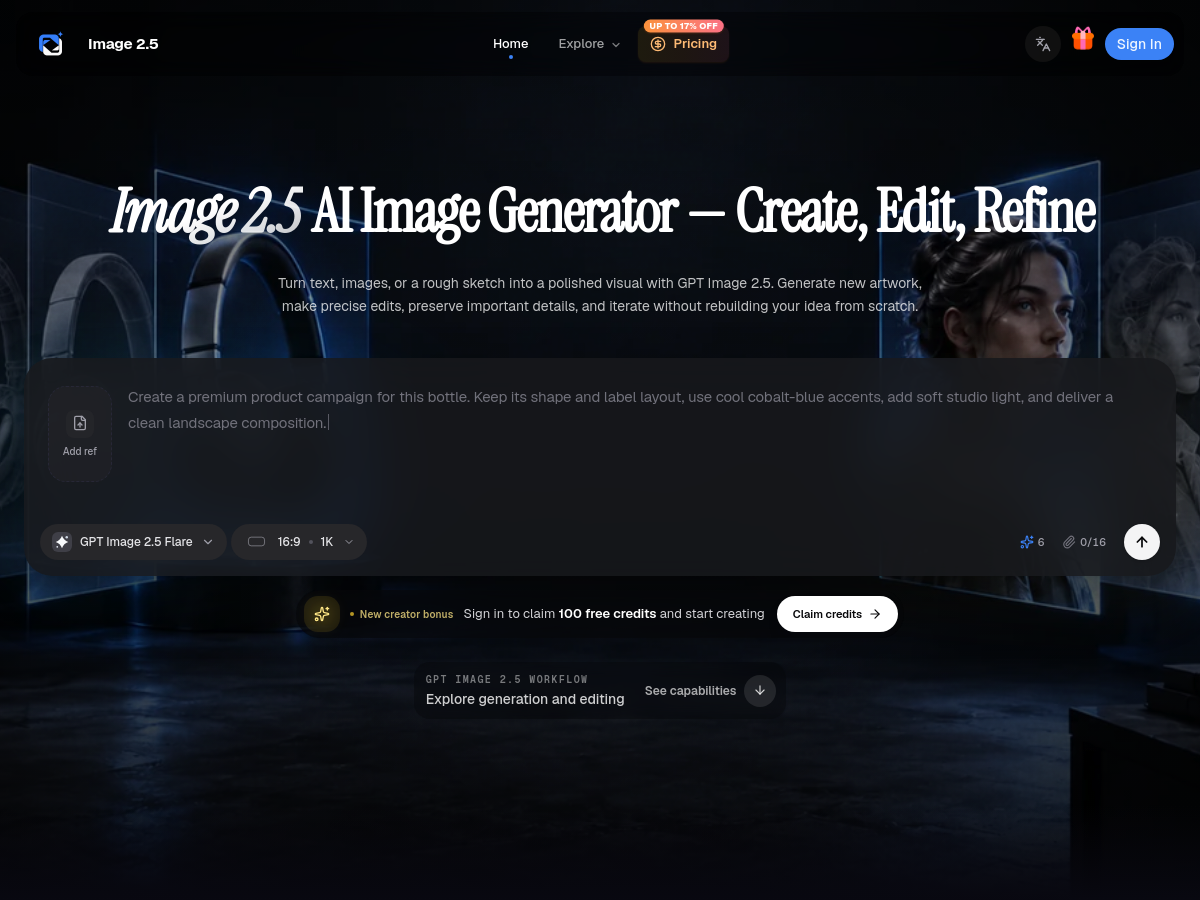
Screenshot of Image 2.5
Image 2.5
AI Image Generator Unknown

Image 2.5 is a web-based AI image generator and editor built around the GPT Image 2.5 model. It offers two distinct models: Sunburst, which prioritizes editing precision and maximum image quality, and Flare, which is optimized for fast, high-quality everyday generation. The platform supports creation from text prompts, uploaded images, or rough sketches, and allows users to refine outputs through an interactive workflow. With support for custom dimensions up to 4K, multiple quality modes, and flexible output formats including PNG, JPEG, and WebP, it aims to cover a broad range of visual production needs from concept to final asset. The tool emphasizes editing consistency, layout control, and iteration speed. Users can make targeted changes to style, color, material, or composition while preserving recognizable details in products, characters, or scenes. It also claims improved text rendering for layouts and infographics, though automated output still requires manual review. The interface is designed as a continuous conversation, enabling users to compare deliberate changes and maintain coherence across campaign assets, storyboards, or product visuals. Image 2.5 is positioned as a production-oriented service for visual creators, marketers, and designers who need to quickly generate and iterate on images without switching between multiple tools. The platform includes example workflows and supports reference images to guide the generation process, making it a practical choice for both polished final assets and exploratory creative work.

Solves

Image 2.5 solves the difficulty of producing polished, consistent visuals from text or sketches without manual design skills. It helps users create new images, make precise edits, preserve important details, and iterate efficiently, reducing the need for multiple graphic tools or expensive creative resources.

Screenshot of EvoForge
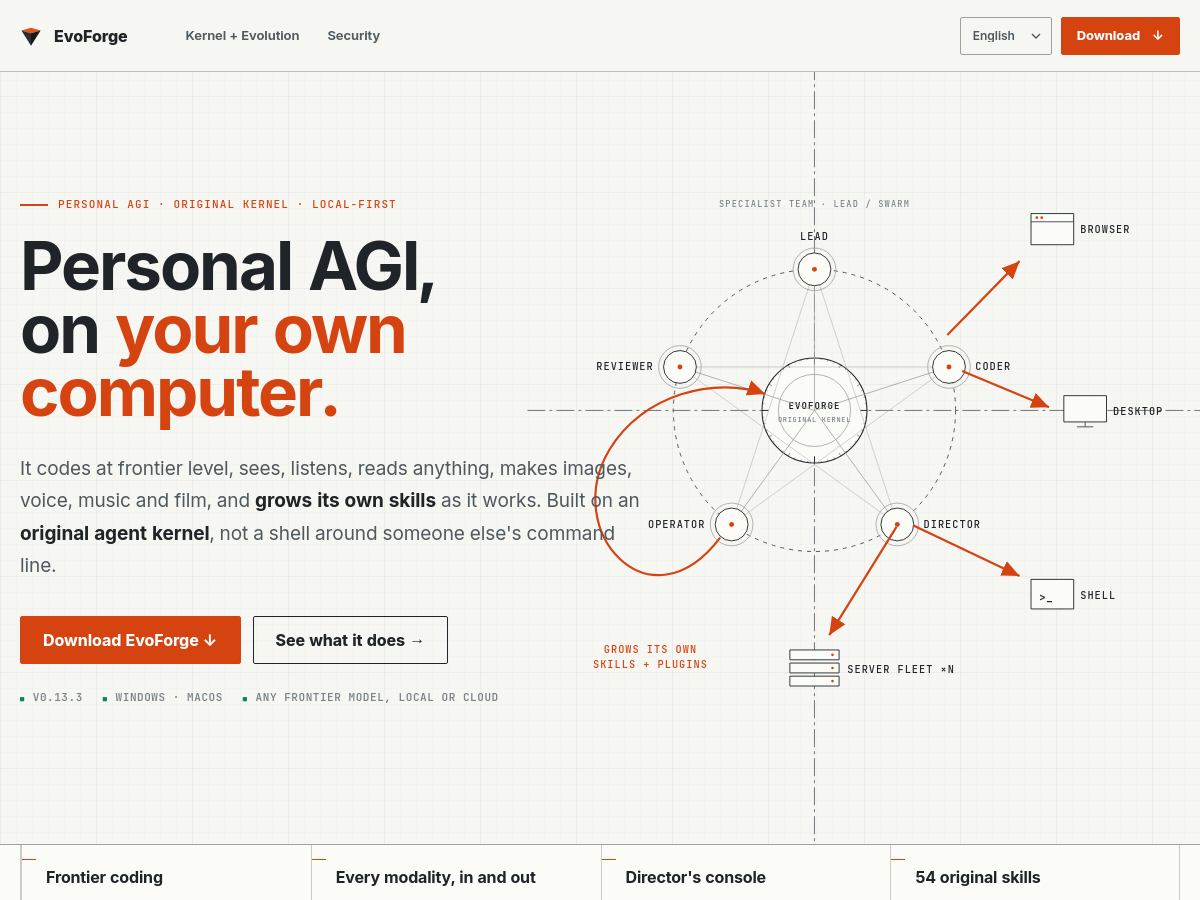
EvoForge
AI Agent Free

EvoForge is a local-first, desktop 'personal AGI' product for building software, automating workflows, and generating media with AI agents. The product is based on an original agent kernel written in Rust rather than a command-line wrapper. It includes 98 native host tools and 54 original skills, allowing agents to interact with the shell, file system, browser, desktop applications, documents, terminal output, email, and multimodal media backends. Users can connect either local models or cloud frontier models, and data and model keys can stay on the user's machine. For software developers, EvoForge supports frontier-level coding workflows. The mutation gate runs a change in an isolated worktree and requires the regression tests to first fail (red) and then pass (green) before code is merged, adding guard tests that accumulate over time. The system can coordinate work through a 'lead' mode—delegating subtasks—or a 'swarm' mode, where multiple specialist agents claim tasks from a shared board with leases and peer notes. EvoForge handles every modality in and out. It can read text, images, audio, video, and documents in all common formats; it can produce code, essays, slides, documents (docx/pptx/xlsx), images, voice, music, podcast episodes, video clips, and finished films. The director's console offers a multi-track timeline for film creation: narration becomes the master clock, placeholders are filled by generated or recorded assets, and a human reviews and exports final media. Free to download, EvoForge targets Windows and macOS and provides six interface languages. While it is positioned as a personal AGI, practical use may require sufficient local hardware or API keys for advanced multimodal generation. The code base is not published; the primary source of information is the official homepage.

Solves

EvoForge addresses the fragmentation of AI tasks by providing a local desktop environment that unifies coding assistance, workflow automation, multimodal generation, and multi-agent collaboration. It lets individuals build and run a personal AGI while keeping data, tools, and keys on their own machine, and enables users to direct agents through known control flows rather than relying on wrappers.

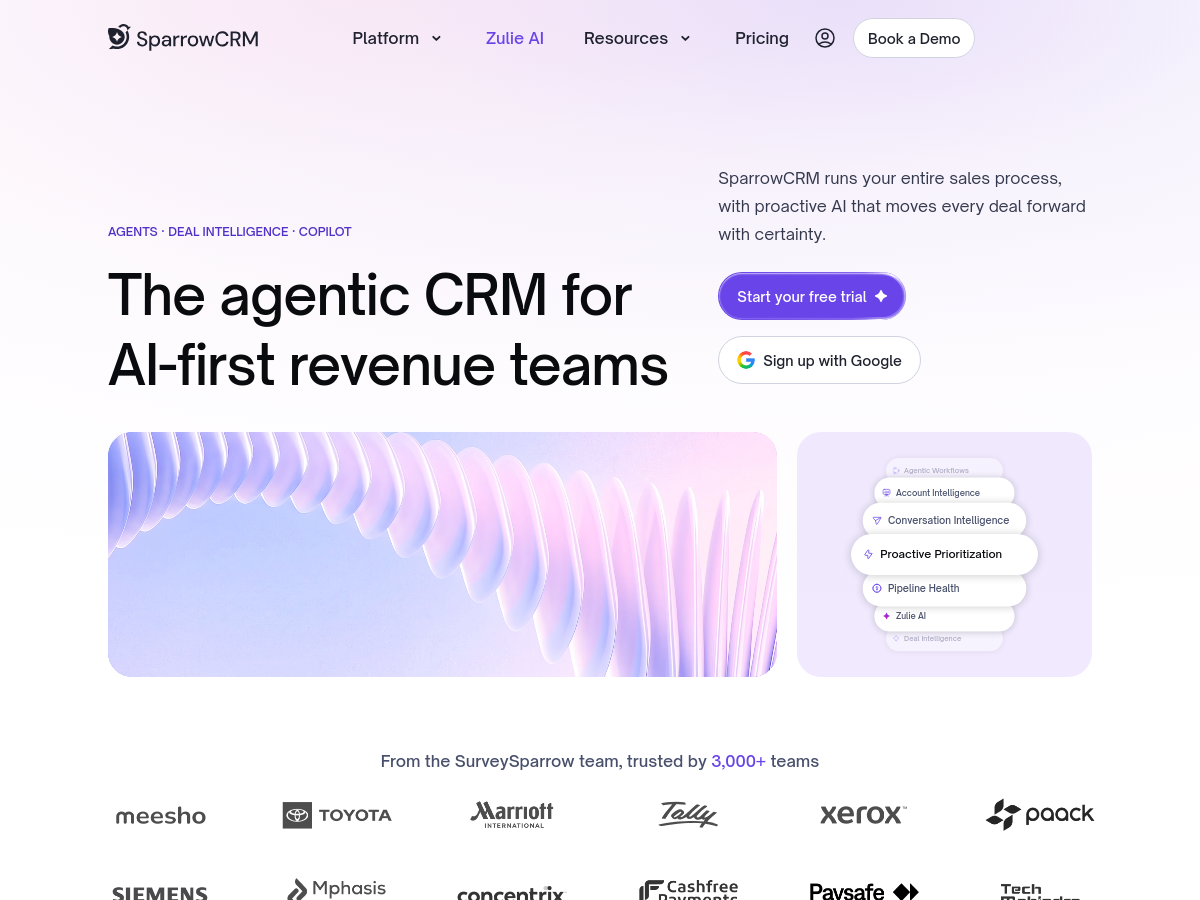
Screenshot of SparrowCRM
SparrowCRM
AI CRM Unknown

SparrowCRM is an AI-native customer relationship management platform designed for AI-first revenue teams. It consolidates leads, deals, and conversations into a single workspace where artificial intelligence surfaces critical information and automates follow-through. The platform positions itself as an agentic CRM, meaning AI agents not only provide intelligence but also actively execute sales tasks to advance deals with greater certainty. Core capabilities include deployable AI agents that handle routine actions such as chasing follow-ups, scoring deals, updating stages, conducting research, and cleaning duplicate records. Additional features like deal intelligence, account intelligence, conversation intelligence, proactive prioritization, and pipeline health analysis help sales teams manage workflows more efficiently. Users can also build custom agents by describing a task in natural language, with the system executing the task automatically. SparrowCRM is developed by the team behind SurveySparrow and states that it is trusted by over 3,000 teams, including organizations like Meesho, Toyota, Marriott, Siemens, and Tech Mahindra. It offers a free trial and a demo, with pricing not publicly listed on the homepage. The platform targets businesses aiming to reduce manual CRM admin and rely on AI agents to support the entire sales process.

Solves

Traditional CRMs require sales teams to manually enter data, track follow-ups, prioritize next steps, and maintain pipeline hygiene. SparrowCRM solves this by embedding AI agents that automate these administrative tasks, surface what needs attention, and directly act to move deals forward, ensuring no deal slips through the cracks.

Screenshot of Burp
Burp
AI Video Editor Unknown

Burp is an AI-powered video and motion editor for creating on-brand videos and motion graphics at scale. Users begin by typing a prompt, and Burp generates a video in seconds. The platform combines AI generation with robust manual editing, allowing users to compose assets on one infinite canvas and edit layers, keyframes, and timing. Outputs can be exported as MP4, GIF, or 4K. Burp is designed for team coordination around shared brand video systems. Marketing teams can ship campaigns, product teams can create feature bands, and different moments such as social media posts, ads, website animations, presentations, and data visualization can all be produced from the same underlying motion system. It supports storyboarding for social posts, paid creative with callouts, UI animations, and animated data figures. The interface features conversational editing: a user can chat with Burp to change colors, trim clips, or retime motion; the system describes the edits it made. For more precise work, manual keyframing and layer editing are also available. This lets both non-designers and motion designers work efficiently without regenerating entire scenes for every adjustment.

Solves

Producing consistently branded videos and motion graphics across multiple departments and channels often requires specialized tools, manual animation, and slow iteration. Burp solves this by enabling AI-generated drafts, natural-language editing, and a shared canvas where teams can quickly create and refine videos for social, ads, web, and presentations while keeping brand assets aligned.

Screenshot of Artlist Plugins
Artlist Plugins
Video editing Free

Artlist Plugins is a software extension for Adobe Premiere Pro that brings direct access to Artlist's extensive stock media library within the video editor. The plugin integrates seamlessly into the timeline interface, allowing users to search for music, sound effects, and video assets without switching to a web browser. It leverages Artlist's AI tagging system to suggest trending tracks that match the mood, length, and pacing of the current project. This assists editors in discovering music that fits their edit in seconds, based on the audio/visual cues from the footage. Once the user finds an asset, the plugin provides one-click adding to the timeline, along with time-syncing and preview capabilities. It also syncs with the user's Artlist account, so any downloaded or added media remains licensed as long as their subscription is active. The plugin is free to download from Artlist, and updates are distributed to support new versions of Premiere Pro. The tool is particularly useful for content creators, video editors, and small creative teams looking to speed up their workflow. By removing the friction of context switching, it supports a more fluid and efficient editing process. However, it is important to note that the plugin does not include free media; all media assets require a paid Artlist membership or a separate access plan. The plugin is built exclusively for Adobe Premiere Pro and is not available for other video editing software like Final Cut Pro or DaVinci Resolve.

Solves

Solves the inefficiency of searching for licensed music and sound effects in a separate browser window during video editing. Editors must constantly switch between their video editor and stock media websites to preview and download assets. Artlist Plugins eliminates this interruption by providing a search and preview experience right alongside the timeline, so users can find, audition, and drop media directly on the fly, maintaining creative flow and reducing time spent on asset discovery.

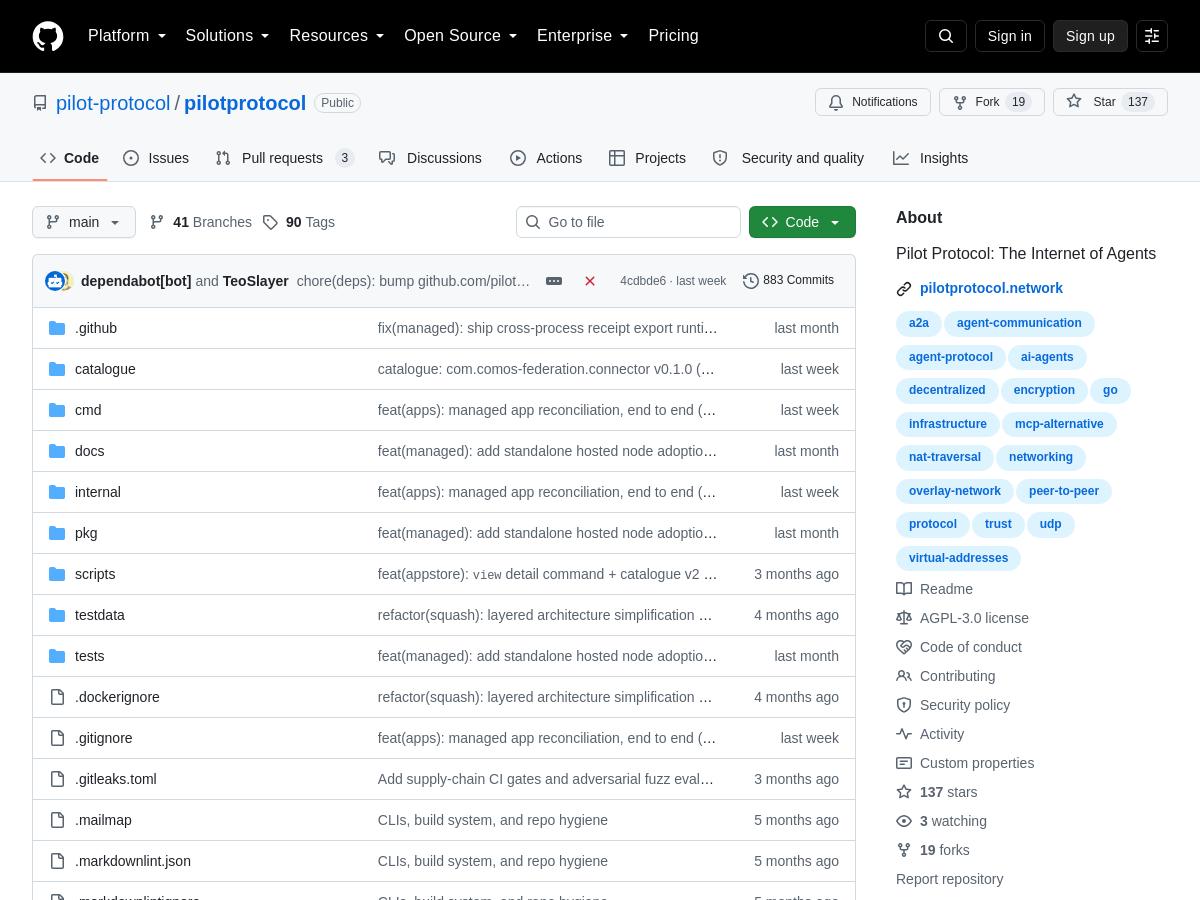
Screenshot of Pilot Protocol
Pilot Protocol
AI Agents Open Source

Pilot Protocol is an open-source overlay network stack designed for AI agents. It provides agents with virtual addresses, encrypted UDP tunnels, NAT traversal, and mutual trust, enabling direct communication across the public internet. The protocol is intended to support an "Internet of Agents" in which autonomous agents can reliably reach one another with stable identities regardless of the physical networks they reside on. The implementation is written in Go and has zero runtime dependencies.

Solves

Pilot Protocol solves the problem of connecting AI agents that run on different machines, clouds, or private networks. Agents often need stable identities and secure communication paths, but NATs and firewalls block direct traffic. Pilot Protocol gives agents overlay addresses, encrypted UDP tunnels, and mutual trust so they can communicate peer-to-peer without manually opening ports or relying on centralized agent servers.

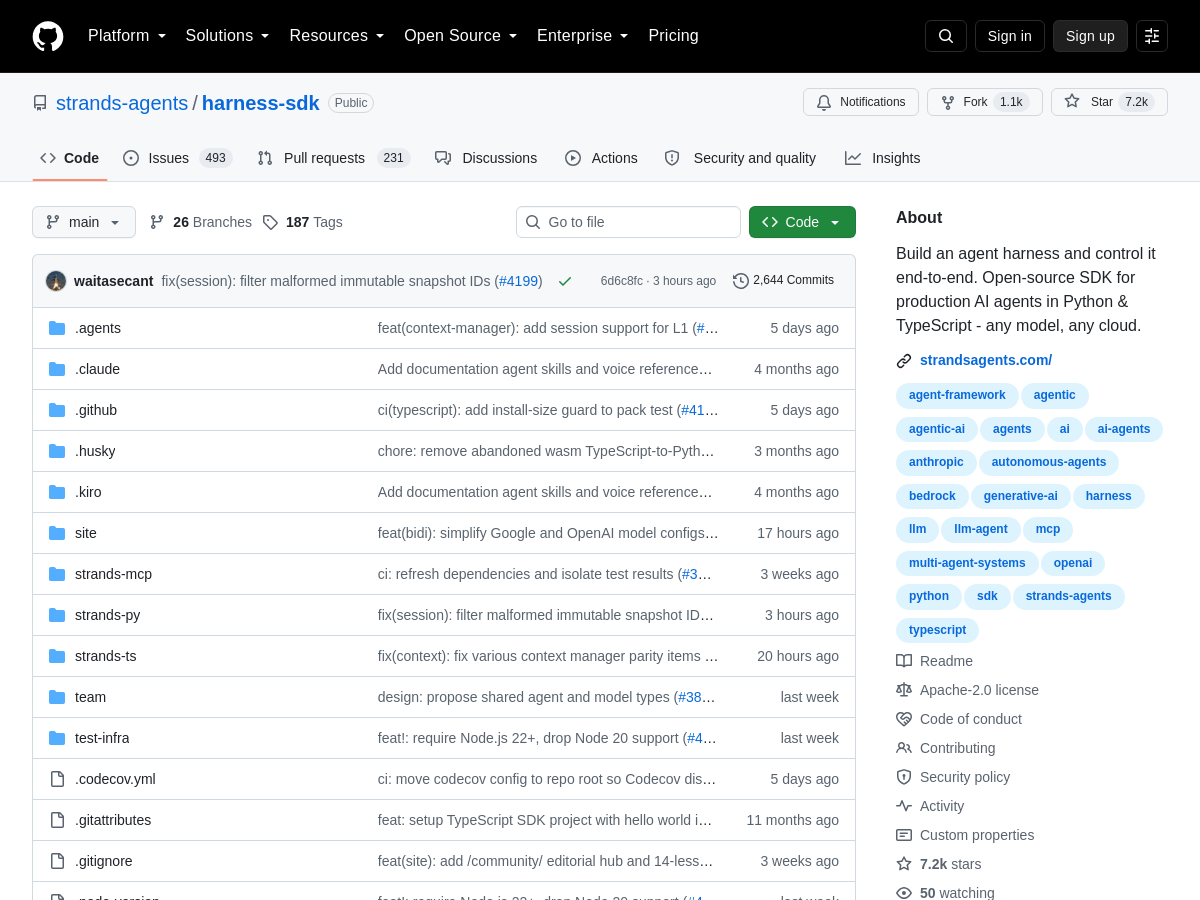
Screenshot of Strands Agents SDK
Strands Agents SDK
AI Agents Open Source

Strands Agents SDK is an open-source software development kit for building and controlling production-grade AI agents. It adopts a model-driven approach, enabling developers to define agent harnesses and manage their execution with just a few lines of code. The SDK supports both Python and TypeScript, making it approachable for a wide range of development teams. It is designed to be model-agnostic and cloud-agnostic, allowing integration with any underlying large language model and deployment on any cloud provider without vendor lock-in. This flexibility is particularly valuable for enterprises that need to adapt quickly to evolving AI technologies while maintaining control over their infrastructure. The SDK provides end-to-end control over the agent lifecycle, including state management, tool invocation, and interaction loops. This reduces the complexity typically associated with wiring together model calls, external APIs, and custom logic. By abstracting away many of the repetitive and error-prone aspects of agent implementation, Strands Agents SDK helps developers focus on defining the behavior and goals of their agents. The result is a foundational tool for teams looking to ship reliable AI agents quickly and maintain them in production environments.

Solves

Strands Agents SDK solves the problem of building complex, brittle AI agents by offering a structured, model-driven framework to define agent behavior and execution. It abstracts away the orchestration of model calls, tool usage, and state transitions, enabling developers to create dependable, maintainable agents with minimal boilerplate code.

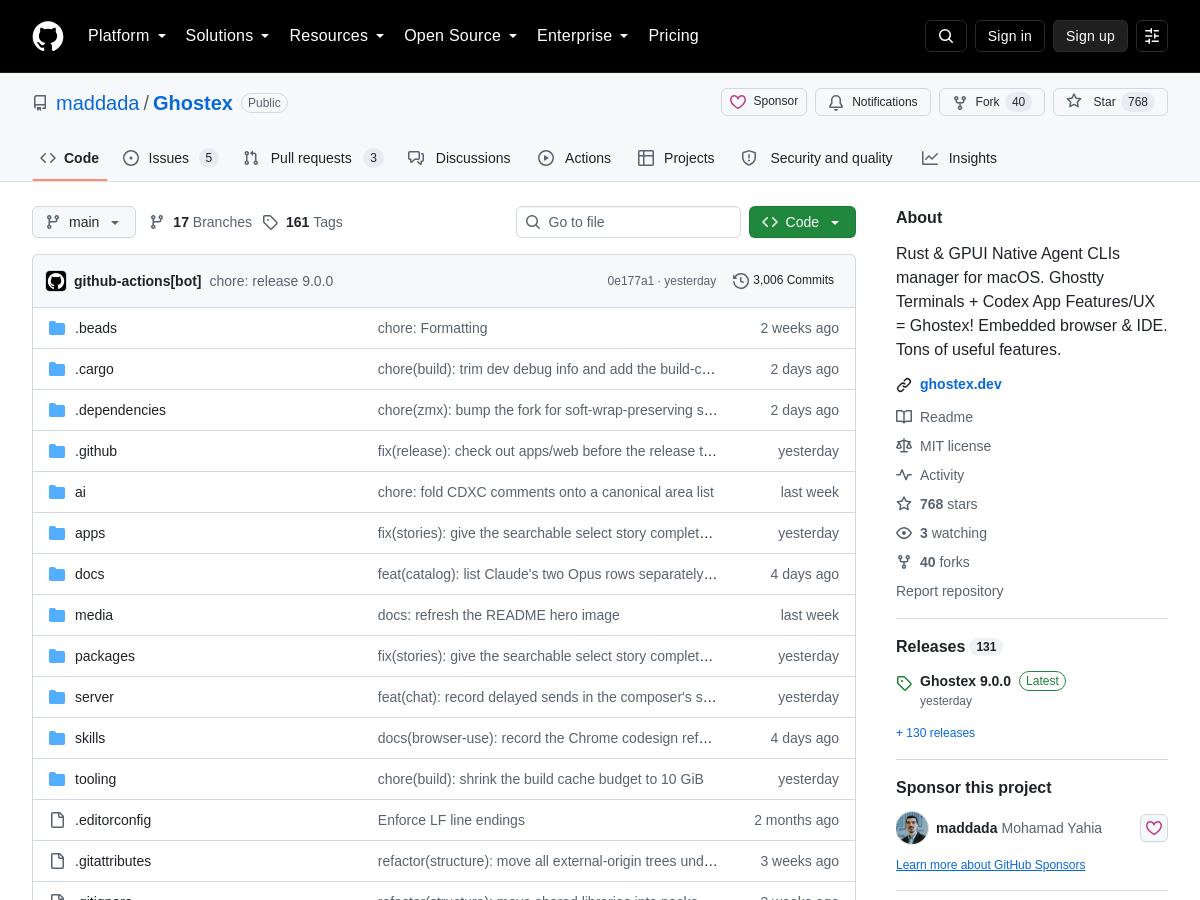
Screenshot of Ghostex
Ghostex
AI Agents Open Source

Ghostex is an open source native macOS workspace designed for developers who run AI coding agents as command-line interfaces (CLIs). Built with Rust and GPUI, it provides a performant and low-latency environment in which multiple agent terminals can operate side by side. The application is conceptually a fusion of Ghostty's terminal features and the Codex app's user experience, offering an integrated environment that feels familiar to users of both. The workspace embeds browser and IDE editor panes directly into the same window, enabling developers to inspect outputs, read documentation, edit source code, and interact with agents without switching between apps. A built-in Kanban board allows users to organize sessions, track tasks, and manage the work produced by different AI agents. Additionally, Ghostex provides iOS and Android clients, giving users the ability to access and monitor their agent sessions remotely from a mobile device. By combining low-RAM terminal rendering with multiple interactive surfaces, Ghostex aims to reduce the overhead of running several coding agents and companion tools at once. It is available as an open source project on GitHub, inviting developers to inspect, modify, and contribute to its codebase.

Solves

Developers working with AI coding agents often need to juggle multiple terminal windows, an editor, and a browser, leading to context switching and high resource usage. Ghostex solves this by providing a single native macOS application where multiple CLI agents can be launched and observed in low-memory terminals, while embedded browser and editor panes and a Kanban board keep all relevant information in one place. Users can also access their sessions remotely from iOS or Android.

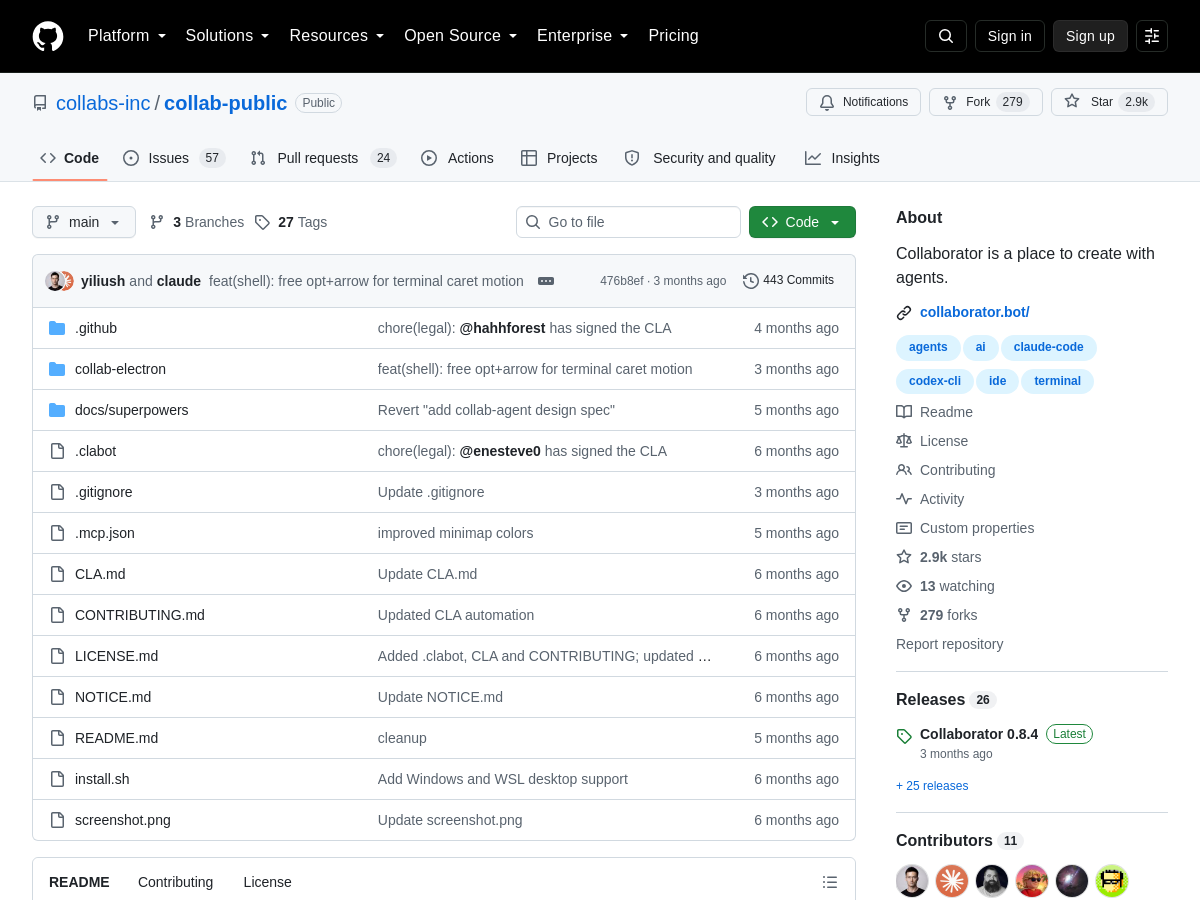
Screenshot of collaborator
collaborator
AI Agents Open Source

Collaborator is an open-source project from collabs-inc that offers a place for creating software together with AI agents. Instead of organizing a developer environment around traditional tabs, Collaborator presents terminals, editors, and files as tiles that can be placed on an infinite pan-and-zoom canvas. The intended workflow supports keeping many pieces of context visible at once while agents and human developers move through a task. The project describes itself as “a place to create with agents.” Its interface is designed around the idea that AI-assisted development benefits from a spatial workspace: users can zoom out to see the overall landscape of their work, pan between related code, terminals, and files, and zoom in to focus on individual tasks. This contrasts with conventional tab-based editors, where switching views can obscure context during rapid agent interactions. Because the repository is public, the open-source code can be inspected and extended by the community. The material provided here does not include detailed installation, license, or release information, so developers interested in using or contributing to Collaborator should consult the GitHub repository for the latest project status.

Solves

Traditional code editors and terminals confine developer workflows to tabs or split panes, which can become cluttered when multiple AI agents are active at once. Collaborator addresses this by replacing tabs with an infinite canvas of tiles, allowing terminals, editors, and files to coexist spatially and making it easier for humans and agents to share context and manage complex, parallel work.

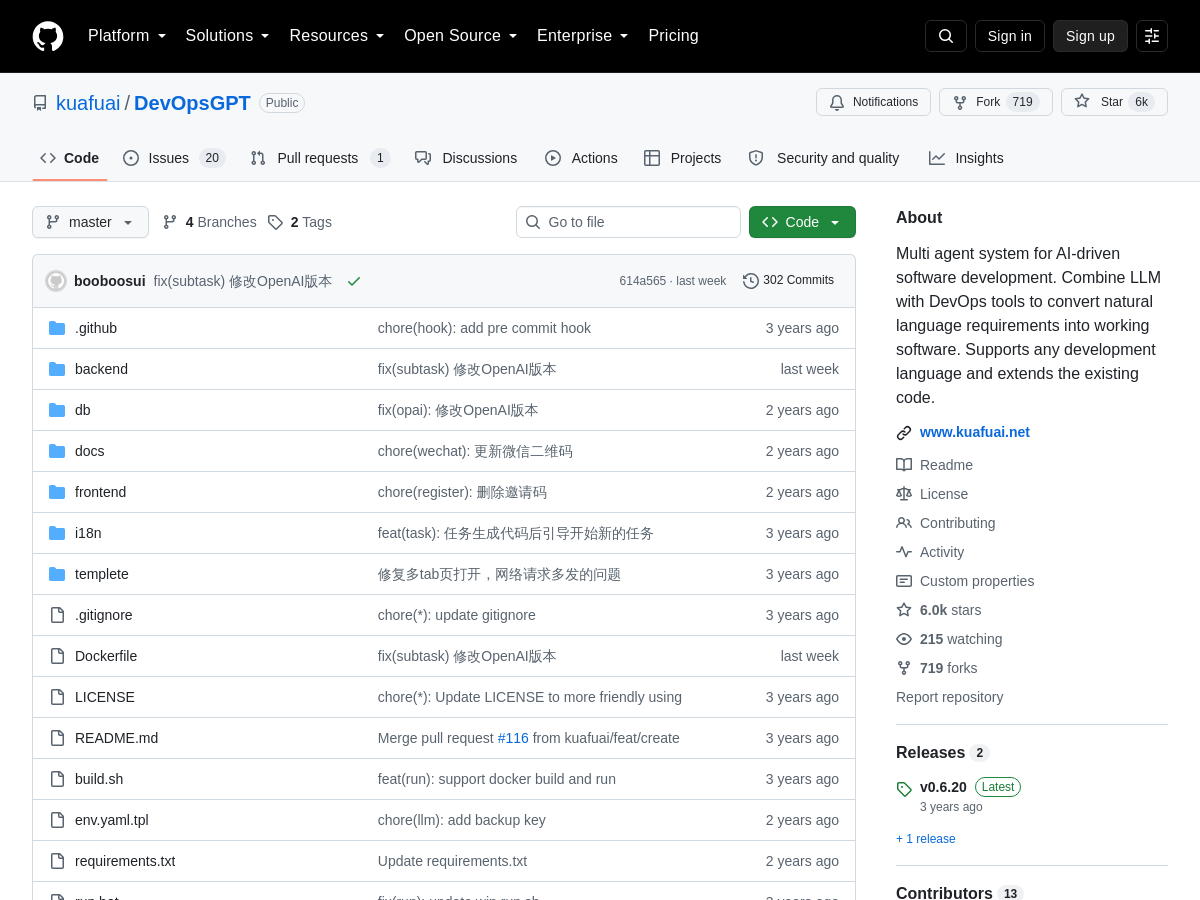
Screenshot of DevOpsGPT
DevOpsGPT
AI Agents Open Source

DevOpsGPT is an open-source, multi-agent system designed to automate AI-driven software development. It combines large language models (LLMs) with DevOps tools, such as version control, CI/CD, and project management platforms, to translate natural language requirements into working software. The platform supports any development language and is capable of extending existing codebases, making it adaptable to both greenfield projects and ongoing maintenance work. As a multi-agent framework, it orchestrates multiple AI agents that collaborate on requirement interpretation, code generation, testing, and integration tasks, reducing human intervention in routine development steps. The system operates by receiving high-level natural language descriptions from users, decomposing them into actionable development tasks, and using LLM-powered agents to implement those tasks. It integrates with popular DevOps workflows, enabling automated commits, pull requests, and deployment pipelines. This design allows development teams to accelerate the delivery of features, automate repetitive coding work, and maintain consistency with existing architecture patterns. DevOpsGPT is intended to serve as a bridge between business requirements and executable software, minimizing the gap between product intent and implementation. The project is hosted on GitHub under the kuafuai/DevOpsGPT repository and is distributed as an open-source tool. This makes it freely available for use, modification, and contribution. As an emerging technology, DevOpsGPT reflects the growing trend of using AI agents in software engineering, but its output quality is inherently dependent on the underlying LLM and the clarity of the input requirements. The project is best suited for teams interested in experimenting with or adopting AI-driven development workflows, especially those already using DevOps practices.

Solves

DevOpsGPT addresses the delay and complexity involved in converting natural language requirements into executable software. Traditionally, feature requests must be manually translated into technical specifications, code, and tests by multiple engineers, which is time-consuming and error-prone. DevOpsGPT automates much of this process by having AI agents interpret the requirements, generate implementations, and integrate with DevOps tooling to deliver working software more efficiently.

Screenshot of Xelta AI
Xelta AI
AI Video Generator Unknown

Xelta AI is an all-in-one AI creative studio designed to help users generate images, videos, audio, and complete microdramas from simple text prompts. The platform is powered by over 100 AI models, encompassing a wide range of generative tasks such as text-to-video, image generation, voice cloning, video dubbing, face swapping, and more. It aims to be a comprehensive workspace for creative professionals, enabling them to produce everything from short social media reels to cinematic-style storylines and advertising content. The platform is organized into multiple modules, each tailored to a specific creative outcome. The AI Video Generator supports both quick clips and complex microdrama production, including script and scene generation. The Design Studio features tools like virtual try-on, home design, sketch-to-image, and AI wallpapers. An AI Ads module specializes in creating promotional materials, including UGC-style ads, instant ad generation from URLs, and long-form video advertisements. Xelta AI also provides voice-related tools for dubbing, lip sync, and AI music generation, alongside a SocialVerse suite for automating content publishing across Instagram, LinkedIn, and YouTube. Xelta AI is positioned as a versatile solution for creators, marketers, and brands who want to streamline their content workflows without needing deep technical skills. The interface emphasizes speed and ease of use, with the tagline "Create Your imagination in seconds." It also offers developer-oriented features and dedicated usecases, suggesting scalability from individual projects to enterprise-level content production. While specific pricing and model details are not fully public, the breadth of tools suggests a subscription-based SaaS model, typical of advanced AI creative platforms.

Solves

Xelta AI addresses the fragmentation of AI creative tools by combining text-to-image, text-to-video, audio generation, and specialized advertising/social media features into a single platform. It enables users to rapidly create polished, multi-format content without needing expertise in multiple separate AI tools, video editing, or voiceover production.

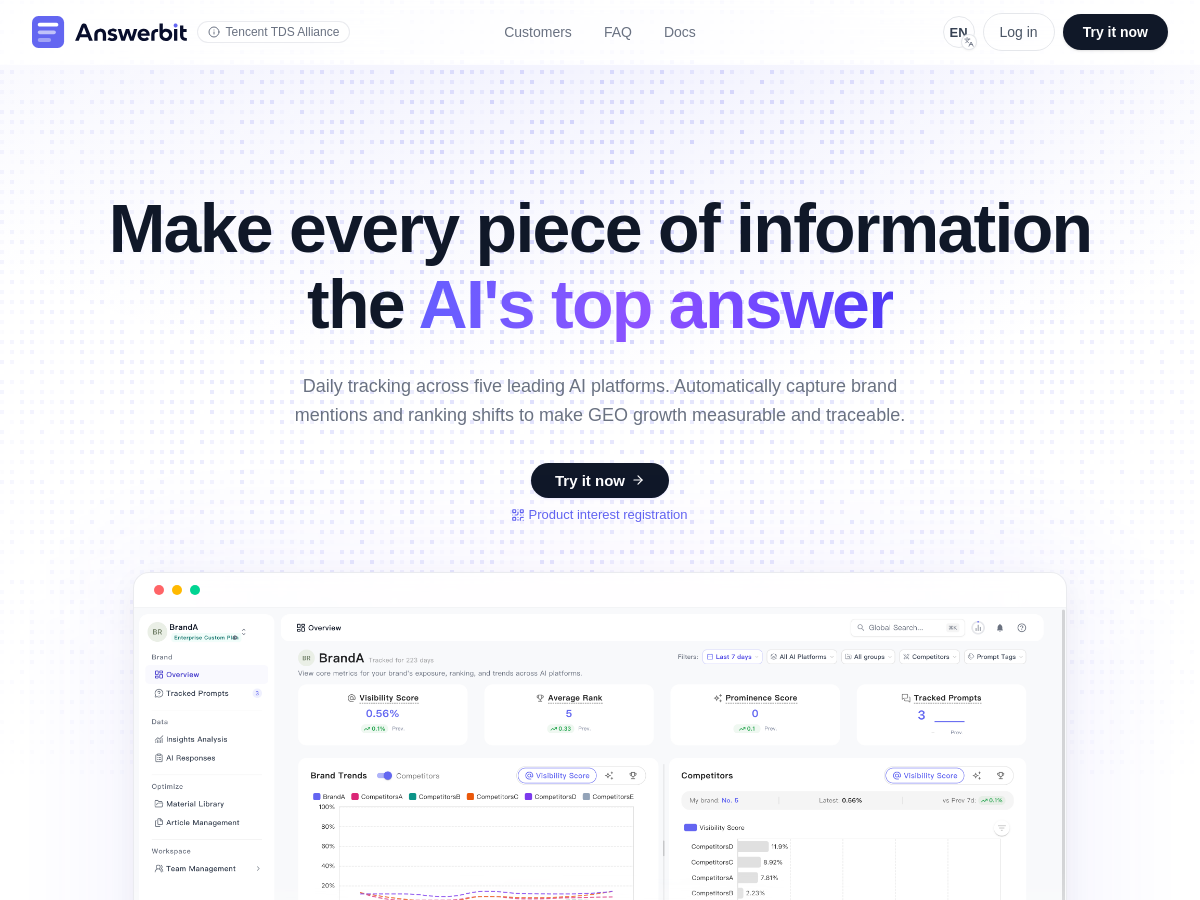
Screenshot of Answerbit
Answerbit
AI SEO Tools Unknown

Answerbit is a SaaS platform for monitoring and optimizing brand visibility in AI-generated search responses, offered by Tencent's TDS Alliance. It helps brands understand how they appear in answers produced by AI assistants such as DeepSeek, Doubao, Yuanbao, Kimi, and Qwen. The platform automatically collects data on a daily basis and presents brand mentions, ranking shifts, and visibility trends in a dashboard, making generative engine optimization (GEO) measurable and traceable. Answerbit addresses the emerging challenge of being cited or mentioned by AI engines rather than just appearing in traditional search results. By tracking which brand or content gets referenced in AI answers, marketing and brand teams can set baselines, observe changes over time, and connect their content or GEO efforts to actual outcomes. The product is positioned as a practical tool for the AI search era, where visibility increasingly depends on whether AI models select your content as a source. According to the product homepage, Answerbit is already used by Tencent-family products and teams across a variety of industries, including Tencent Cloud, VooV Meeting, Tencent App Store, WeTV, and others. This early adoption by large product teams suggests a focus on helping established brands maintain presence in AI-driven discovery channels. Answerbit appears to be designed for business teams that need actionable GEO data rather than for individual hobbyists or developers.

Solves

Answerbit solves the difficulty of measuring a brand's presence in AI-generated search results. It provides daily automated monitoring of brand mentions and ranking positions across major AI platforms, enabling teams to establish a GEO baseline, identify visibility changes, and quantify the impact of content and optimization work.

Screenshot of Top10.ai
Top10.ai
AI Tools Directory Free

Top10.ai is an editorial AI tools directory that helps users discover, compare, and select the right AI websites and software through focused research and structured rankings. The platform publishes in-depth articles across numerous AI categories, including ChatGPT alternatives, generative AI for art and media, AI photoeditors, music generators, network security tools, AI search optimization platforms, and more. Each review typically examines around ten options, delivering clear scorecards, feature research, verified pricing details, and product screenshots to support straightforward recommendations. The platform positions itself as a trustworthy middle ground between generic software listings and hands-on tool testing. Its editorial approach aims to reduce the guesswork in AI purchasing by consistently applying the same evaluation criteria across comparable tools. Articles are updated regularly, reflecting new releases and changing market conditions, and the collection has expanded to cover emerging niches such as generative engine optimization (GEO), AI visibility analytics, and SQL server integration. Top10.ai is free to access, allowing readers to navigate all published rankings and comparisons without a paywall. The site serves as both a starting point for researching unfamiliar AI categories and a reference for verifying features and pricing before committing to a specific tool. By concentrating on practical, real-world use cases, it appeals to casual users, business decision-makers, developers, and researchers alike.

Solves

Top10.ai solves the problem of choosing among hundreds of AI tools by publishing focused editorial comparisons that include clear scorecards, checked pricing, feature research, screenshots, and direct recommendations for specific use cases.

Screenshot of Top100.ai
Top100.ai
AI Tools Directory Free

Top100.ai is an AI tools directory and editorial review platform that helps users discover, compare, and evaluate AI websites and applications. The site presents ranked lists of tools across categories such as logo design, design workflows, teacher content creation, brand visibility monitoring, AI art platforms, generative engine optimization, enterprise chatbots, avatar platforms, AI apps, coding agents, podcast video snippets, and voice cloning. Each article typically covers dozens or hundreds of tools and includes product screenshots, pricing signals, feature comparisons, and independent editorial reviews. The platform combines category research with editorial judgment: it publishes periodically updated rankings and practical selection guidance, rather than simply listing links. Users can browse articles for a topic or use an article ranking to see scores, usage signals, free access status, and limitations. For vendors and creators, the site also functions as a channel for visibility within the AI ecosystem, since reviewed tools are showcased alongside comparable products. The website is offered free of charge to visitors and is maintained as a web-based resource. It is positioned for anyone who wants to navigate the rapidly growing landscape of AI software, whether for professional workflows, creative projects, or business decisions.

Solves

It solves the problem of discovering and comparing an overwhelming number of AI tools by providing independent, ranked editorial reviews that consolidate pricing, features, screenshots, usage signals, and limitations in one place.

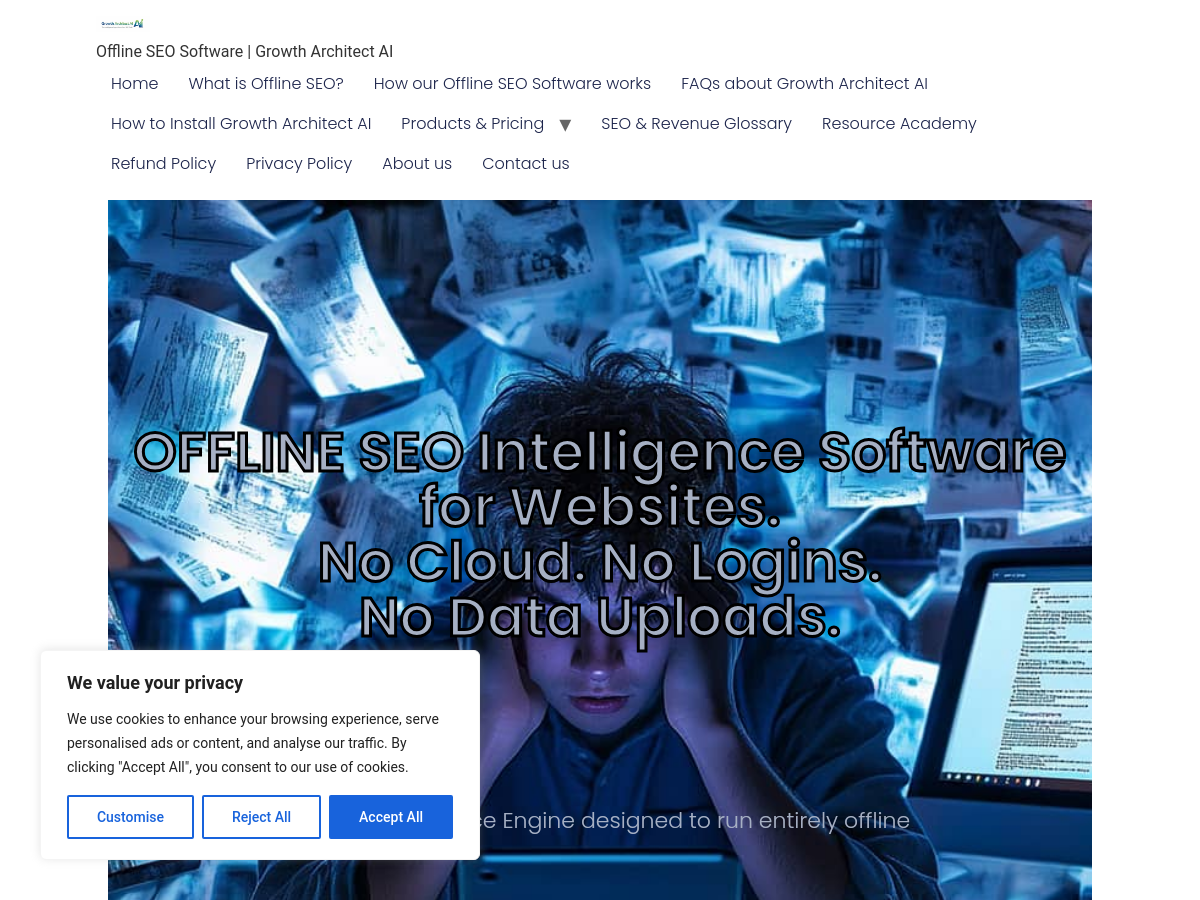
Screenshot of Growth Architect AI
Growth Architect AI
Seo Tools Unknown

Growth Architect AI is an offline SEO intelligence software that brings together data from Google Analytics 4, Google Search Console, and Screaming Frog SEO Spider into a single, unified analysis layer. Unlike cloud-first SEO tools, it is designed to run entirely on the user's local environment, ensuring that sensitive website data is never uploaded to external servers. By connecting traffic, search visibility, technical SEO, and business performance metrics, it aims to give SEO professionals a holistic view of their website without compromising data privacy. The platform emphasizes simplicity and control, supporting analysis directly in Excel, a familiar tool for many marketers and analysts. Its offline-first architecture removes the need for logins, cloud storing, or third-party data processing, making it particularly valuable for teams handling confidential client data or operating in industries with strict data governance requirements. Growth Architect AI is offered in several editions—from a free Starter experience to Pro, Agency, and Enterprise tiers—allowing individuals, agencies, and large organizations to adopt the tool according to their scale and needs.

Solves

SEO professionals often face fragmented workflows across multiple cloud tools and risk exposing sensitive client data through third-party platforms. Growth Architect AI solves this by offering an offline analysis platform that combines GA4, Google Search Console, and Screaming Frog data locally, enabling unified, privacy-safe SEO analysis without cloud dependency.

Screenshot of LLMBoard.ai
LLMBoard.ai
Large Language Models (LLMs) Free

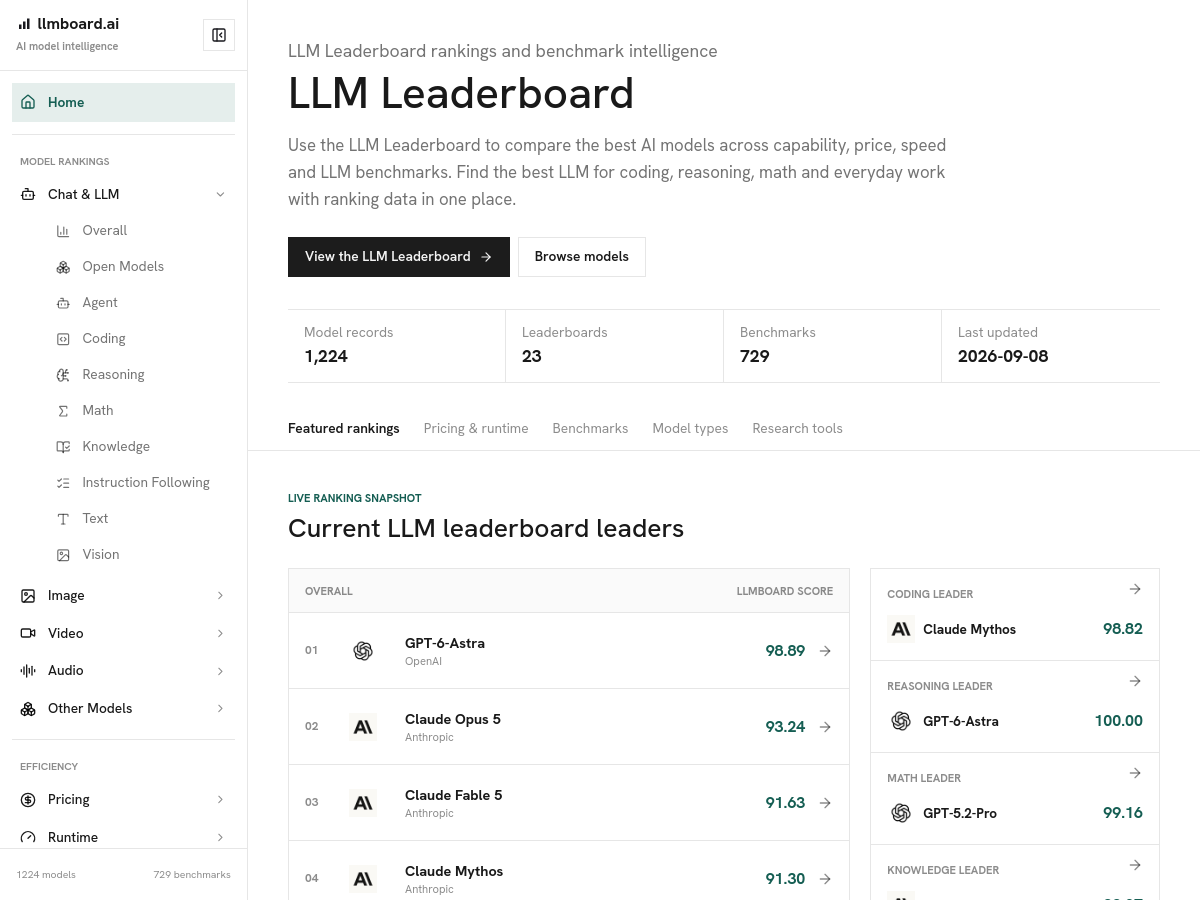
LLMBoard.ai is a free AI model intelligence and leaderboard platform that tracks and ranks large language models and other AI systems. According to its homepage, it provides a comprehensive live snapshot of 1,224 model records, 729 benchmarks, and 23 leaderboards, covering chat, coding, reasoning, math, knowledge, instruction following, vision, image generation/editing, video generation/editing, text-to-speech, speech-to-text, and embeddings. The platform separates capability scores from deployment signals, allowing users to compare model quality alongside official input/output pricing and runtime performance such as chat speed and latency. The leaderboard is organized into multiple views: overall rankings, open model rankings, agent-specific rankings, and task-specific rankings. It also includes specialized pricing pages for chat, image, video, and audio models, and runtime pages for provider reliability and speed. LLMBoard.ai includes a model directory for browsing individual models and a methodology page explaining scoring and data sources. The homepage highlights current overall leaders from OpenAI, Anthropic, Meta, and Moonshot, offering a snapshot of the competitive landscape. As a comparative intelligence tool, it is designed to help individuals and organizations find the best AI model for coding, reasoning, math, everyday work, and creative tasks. Because it is free and browser-based, it can be used for quick research, procurement decisions, model selection, and ongoing monitoring of the AI model ecosystem.

Solves

LLMBoard.ai solves the problem of fragmented and hard-to-compare AI model information by providing centralized rankings for AI capabilities, pricing, speed, and benchmarks. It enables users to quickly identify the best model for tasks like coding, reasoning, math, vision, and media generation without visiting many vendor pages.

Screenshot of AutoSprite
AutoSprite
AI Animation Generator Unknown

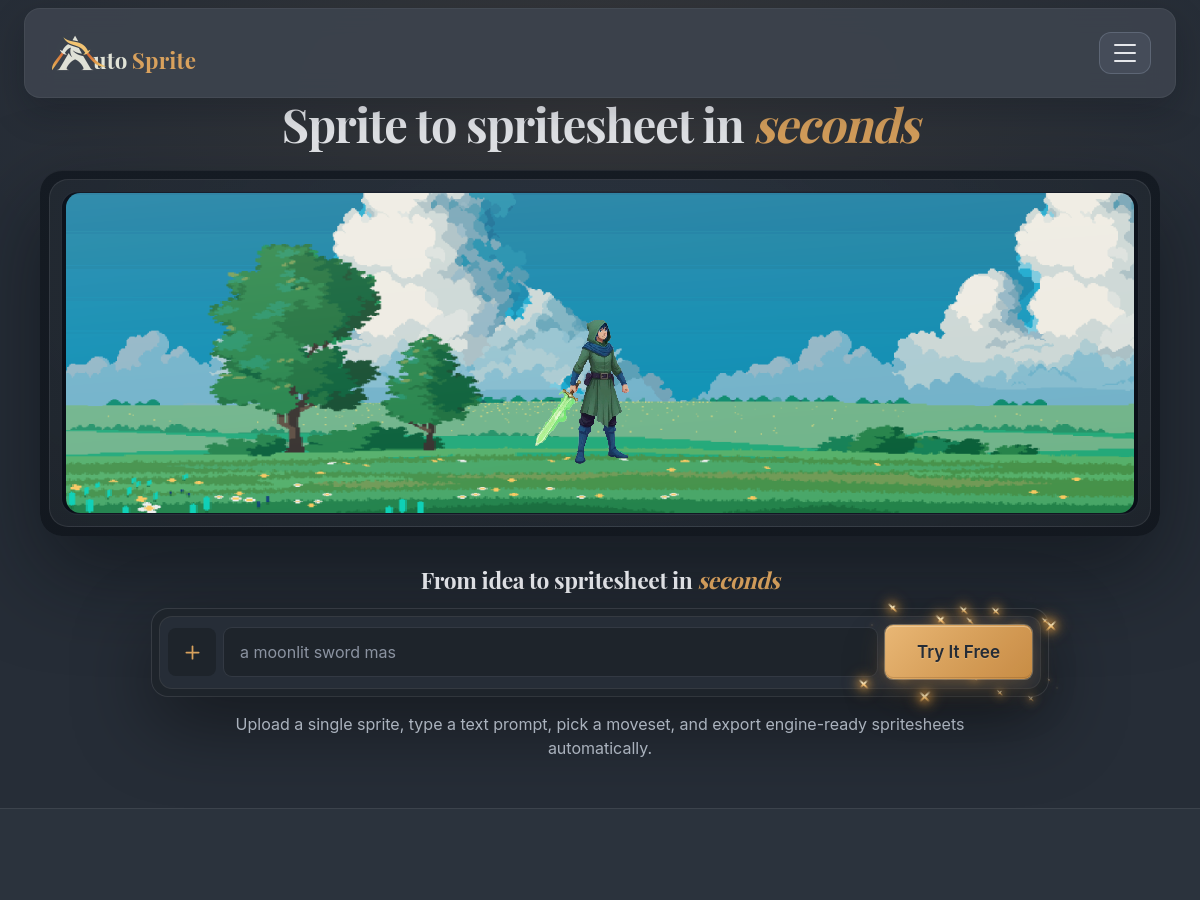
AutoSprite is an AI-powered sprite sheet generator designed to speed up 2D game animation workflows. Users upload a single character image or create one from a text prompt, then select a moveset such as idle, walk, run, jump, or attack. The platform automatically generates a sequence of frames that remain visually consistent with the original character, and exports them as production-ready sprite sheets with atlas metadata and individual frame files. The service is aimed at game developers who need to create animations quickly without frame-by-frame manual work, while ensuring characters look aligned across multiple animations. AutoSprite also supports 8-directional isometric movement, allowing a single character to be turned into a complete movement set where each direction preserves the same identity and loops cleanly. Its built-in assets feature lets users generate icons, weapons, items, and pickups in a shared visual style, useful for filling inventory grids and in-game shops. Additionally, character editing tools permit changing outfits, skins, or other visual directions while keeping the character centered and consistently scaled, ready for animation. The platform provides an AI agent and storyboard-based controls for directing motion, including the ability to define custom animation beat-by-beat or apply motion transfer from an existing animation or a video. For more advanced use cases, AutoSprite can generate fully rigged 3D models from a character image and animate them from any angle, as well as produce cinematic AI videos for cutscenes from text prompts. Generated spritesheets are engine-ready for popular game engines such as Unity, Godot, GameMaker, and Phaser, eliminating secondary conversion workflows. Users can preview animations in the browser, test loops, adjust timing, and review changes before exporting. A free trial is available through the app, while pricing details are otherwise undisclosed.

Solves

AutoSprite automates the manual, repetitive work of generating consistent character animations and sprite sheets for 2D games, allowing developers to turn a single image or text prompt into polished, engine-ready assets in seconds rather than drawing each frame by hand.

Screenshot of Blume
Blume
AI Agent Unknown

blume is a narrow, always-on desktop companion designed to monitor and improve coding agents. It sits alongside popular agent harnesses such as Codex, Claude, and Cursor, watching how each agent operates and surfacing real-time activity through a clear interface. Instead of requiring developers to manually supervise every run, blume provides a unified view of agent tasks, branches, and statuses, allowing teams to spot issues and understand behavior at a glance. blume goes beyond basic oversight by actively helping to keep agent configuration healthy. It observes when chat instructions or unstructured feedback contradict the existing rulebook, then prompts users to tidy up rules, skills, hooks, and corrections. This keeps the knowledge base in sync with actual behavior and reduces the need for repetitive steering. The tool is built as a lightweight local desktop application, keeping data on the user's machine and providing low-latency updates. The product is positioned for teams that rely on coding agents across different harnesses and need a systematic way to maintain their evolving playbooks. It appears to be developed by blume.codes and is likely aimed at developer teams who have adopted AI-assisted coding workflows.

Solves

Developers lose time manually supervising coding agents and maintaining scattered rules and instructions. blume solves this by offering a single desktop interface that monitors agent activity, surfaces contradictions between chat feedback and established rules, and helps users iteratively refine the agent's rulebook to improve performance and consistency.

Screenshot of Motion
Motion
AI Video Generator Unknown

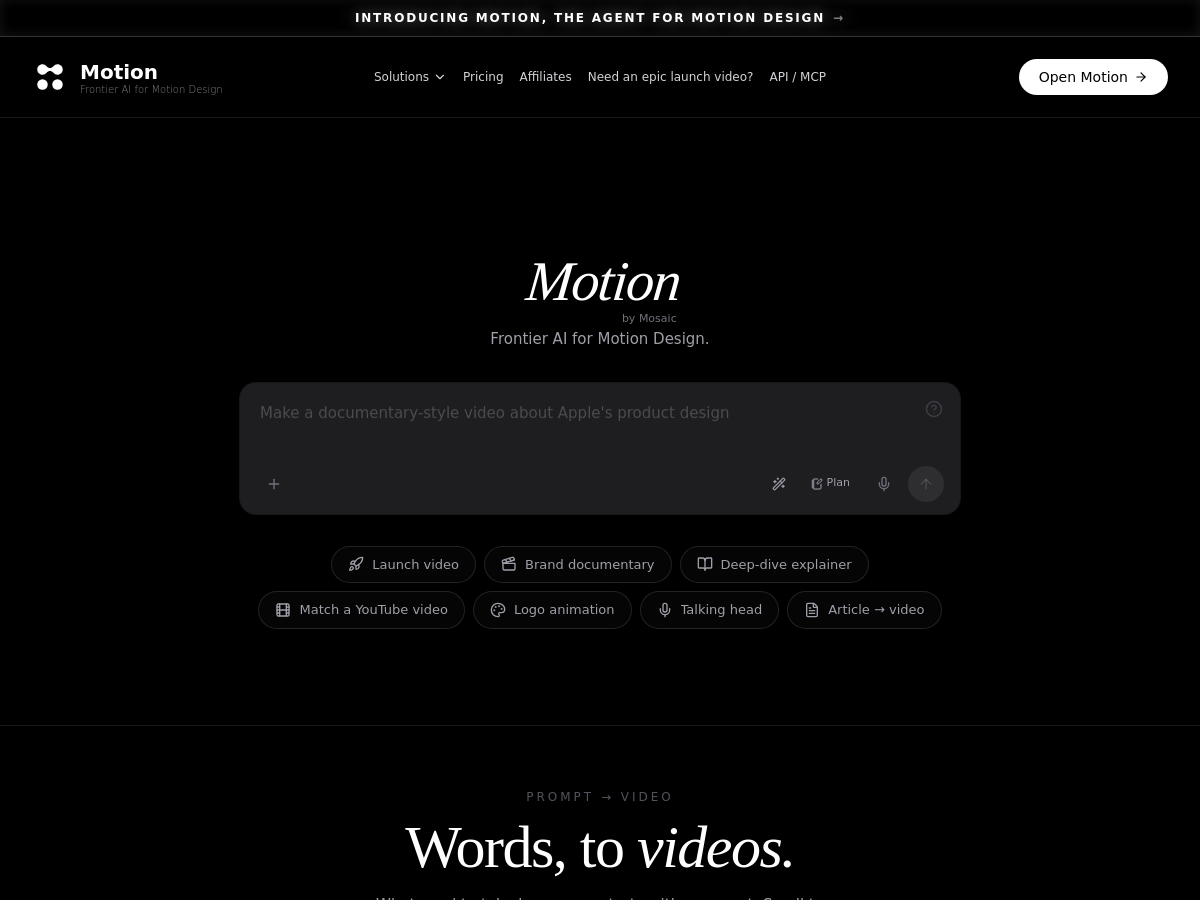
Motion is a browser-based AI motion design agent developed by Mosaic. It turns text prompts into finished videos for launch campaigns, product demos, explainers, logo animations, and social ads. The tool is positioned as a frontier agent for motion design, aiming to replace manual motion graphics workflows with an automated pipeline that plans, designs, animates, and renders video content. The workflow starts with a one-sentence brief. Motion can read a company's website and brand assets to extract colors, typography, and visual style, then creates a storyboard with scene-by-scene pacing. It then builds each scene with visuals, motion graphics, voiceover, music, and captions, producing a rendered video in minutes. Motion is accessible through the browser and can be used with ChatGPT or any MCP-compatible agent, making it embeddable in AI-driven workflows. It supports multiple video formats including article-to-video, brand documentaries, deep-dive explainers, and matching reference videos. Pricing is not publicly listed on the homepage.

Solves

Motion solves the problem of producing polished motion design videos—such as launch videos, product demos, explainers, and social ads—without requiring manual editing or motion graphics expertise. Users describe a video in a sentence, and the agent researches the brand, plans scenes, animates motion graphics, adds voiceover, music, and captions, and renders a finished video in minutes.

Screenshot of Tabbit Browser
Tabbit Browser
AI Browsers Unknown

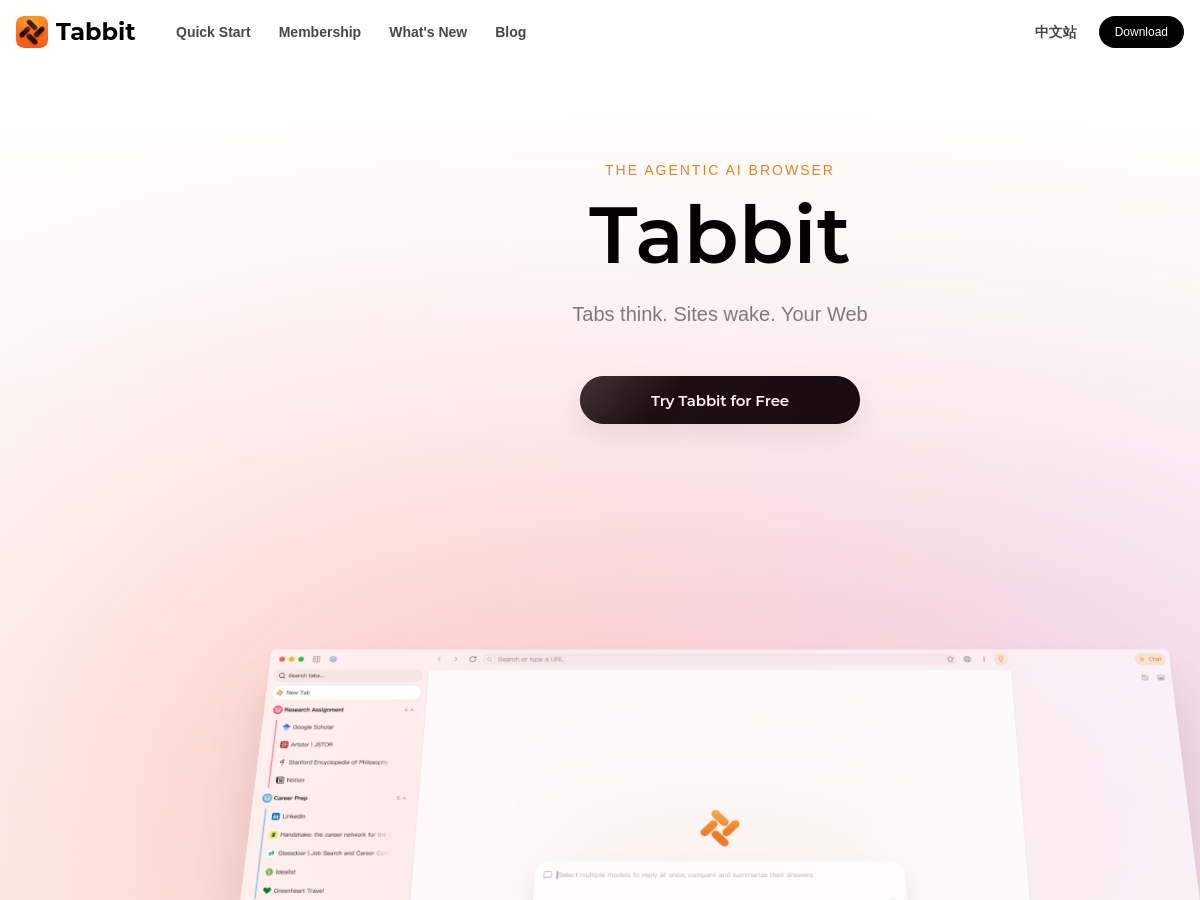
Tabbit Browser is an AI-native desktop browser for macOS and Windows that aims to make web browsing context-aware and agentic. It allows users to chat directly with webpages, PDFs, screenshots, highlighted text, local files, and other on-screen content. The browser is built to understand user context, enabling natural language queries about the current page or document. The browser includes an Agent mode that automates complex online tasks such as research, data extraction, and content creation. Tabbit supports 'Skills', which are tailored actions for specific websites including YouTube, Bilibili, ChatGPT, Substack, Papers, Reddit, GitHub, and Gmail. A multi-agent system lets users combine specialized agents — for research, writing, data analysis, and file operations — to work on broader workflows. Under the hood, Tabbit integrates Site MCPs (Model Context Protocols), agent memory, and a growing registry of thousands of community-contributed Skills. It also offers a set of built-in productivity tools like a triage feed for prioritizing unread uploads, a video highlight reel generator, PDF table extractors, cross-database literature search, and automatic folder sorting. The browser claims to support a range of state-of-the-art large language models, updated quickly as new models are released. Tabbit targets power users and researchers who work across many documents and web sources. With its AI-native interface and tab management features like tab graveyard and context retrieval, it attempts to address the growing problem of information overload in desktop browsing.

Solves

Tabbit solves the problem of fragmented and overwhelming web browsing by embedding AI directly into the browser. It helps users quickly understand, organize, and act on content from a mix of web pages, local files, PDFs, and media, while automating repetitive online tasks and maintaining contextual awareness across tabs and an integrated agent environment.

Screenshot of Bitrig
Bitrig
AI App Builder Unknown

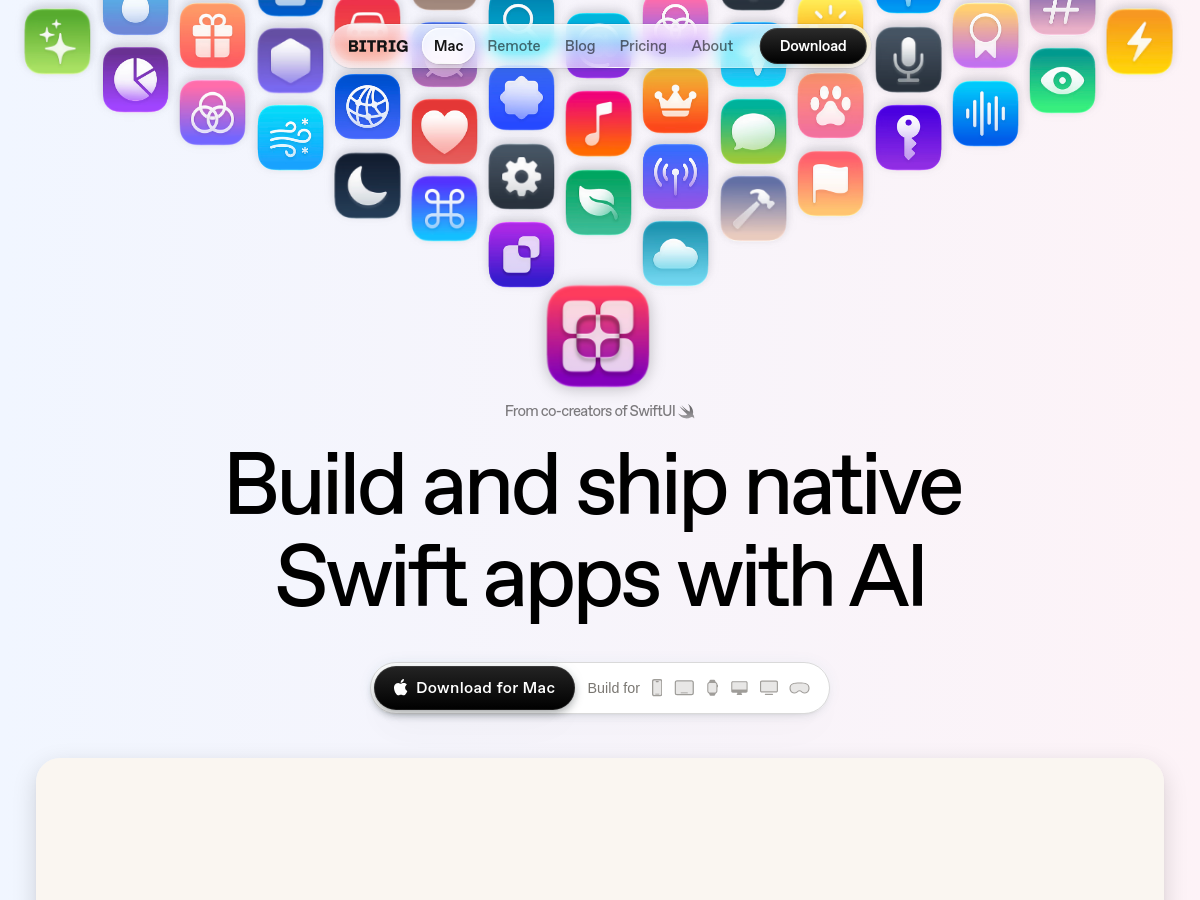
Bitrig is a platform for building and shipping native Swift apps with artificial intelligence. It is developed by co-creators of SwiftUI and runs on macOS. Users describe an app idea in natural language, and Bitrig generates real Xcode projects using frontier models from Anthropic and OpenAI, integrated through tools such as Claude Code and Codex. The platform supports bringing your own Claude or ChatGPT subscription instead of paying per-token prices. Bitrig includes built-in photorealistic 3D device simulators, allowing users to interact with the app immediately. It uses AI agents that test the generated app by tapping, scrolling, and typing like a real user, then automatically fixes bugs it discovers. The resulting projects are full Xcode projects with the latest SDKs and can be opened in Xcode at any time. Bitrig also covers the publishing and monetization workflow. It can archive and upload builds to TestFlight and the App Store, manage the App Store listing, and capture screenshots across required devices and localizations. It integrates with GitHub for team-based development and supports backend technologies like CloudKit. In-app purchases, subscriptions, and RevenueCat are supported for monetization. An iOS companion application allows connecting to Bitrig Mac and developing on iPhone or iPad.

Solves

Bitrig enables individuals and teams to go from an app concept to a published native Swift app with minimal manual coding and Apple ecosystem logistics, by using AI to generate, test, and submit apps to the App Store.

Screenshot of Paid
Paid
AI Accounting Unknown

Paid is a monetization and billing platform built for companies that develop and sell AI agents. The homepage presents a no-code dashboard for configuring credits, usage-based, outcome-based, and hybrid pricing models without relying on engineering resources. It also includes features to manage credit grants, auto-reload thresholds, and overage rates in real time. The platform’s "Operator Dashboard" lets teams view revenue, costs, and blended margin per product, agent, and customer, replacing spreadsheet-based calculations. A distinctive capability is "Customer Value Receipts," which generates reports for customers showing concrete metrics such as hours saved, documents analyzed, tickets resolved, and calculated ROI. This is intended to help AI companies demonstrate the value delivered during pilots and renewals. The interface displays value-to-revenue ratios and margin per customer, providing insight into whether pricing aligns with the actual cost of service and the value generated. The platform is positioned for AI-native companies that need to adapt pricing quickly as usage patterns evolve. It is available as a hosted SaaS solution, with customers such as Syndio, IFS, and Copado listed as users. Paid's pricing and packaging details are not publicly listed; interested teams are invited to schedule a consultation with an expert.

Solves

AI agent companies often struggle to price their services in ways that reflect underlying model costs, compute usage, and value delivered to customers. They may rely on manual spreadsheets or rigid SaaS billing systems that cannot support flexible credit systems or outcome-based contracts. Paid addresses this by offering a dedicated platform to design and adjust pricing models, track gross margin per customer and action, and automatically send value-based receipts that justify the amounts billed.

Screenshot of Clawnify
Clawnify
AI Agent Unknown

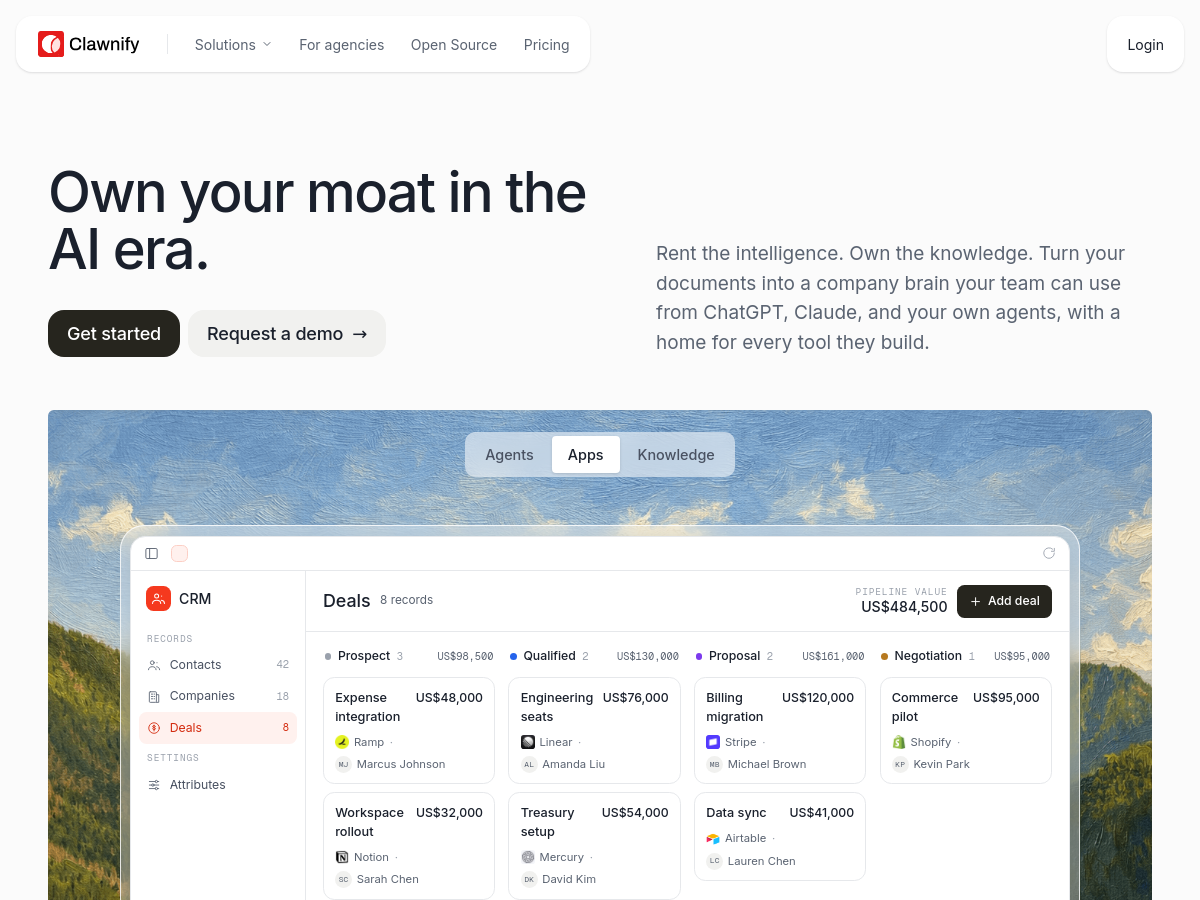
Clawnify is a cloud-based delivery platform for AI work, aimed at organizations that want to deploy AI agents, applications, and business automations in a single, shared workspace. The platform's tagline, "Own your moat in the AI era," reflects its focus on helping teams leverage external AI models while retaining ownership of their data and business knowledge. With a chat-style interface, administrative controls, and vertical-specific templates, it positions itself as a one-stop hub for putting AI into daily operations. The service emphasizes a "company brain" concept, where documents are transformed into organizational knowledge accessible to team members through ChatGPT, Clawnify's interface, and custom agents. Users can create and manage agents, app integrations, flows, and automations via a no-code-like administrative console, including an inbox and tool use. Clawnify provides a library of preconfigured use cases for specific verticals such as marketing agencies, accounting, real estate, property management, sales, logistics, and clinics, including operations like ad management, report generation, lead follow-up, document chase, maintenance triage, and buyer signal tracking. By combining a chat-style assistant (like "Nora Executive Assistant"), automation flows, and integrations, Clawnify claims to offer an end-to-end solution for deploying AI agents into business workflows. The platform also positions itself as a foundation for teams to build their own AI tools while maintaining a home for all their agents. It targets both nontechnical business users and developers, with industry-specific "solutions" and use-case snippets. Details about exact model integrations, infrastructure, licensing, and pricing are not documented on the marketing site provided.

Solves

Clawnify solves the problem of fragmented, siloed AI experiments by offering a centralized, shared platform where companies can build, deploy, and manage AI agents, apps, and automations. It also helps organizations retain control over their institutional knowledge and avoid vendor lock-in by creating a "company brain" that can be consumed across ChatGPT, its own platform, and external agents.

Screenshot of Nightjar
Nightjar
AI Product Photography Unknown

Nightjar is an AI-powered product photography platform designed for e-commerce brands that need to produce large, consistent catalogs of on-brand images. Instead of relying on traditional photoshoot logistics, Nightjar lets teams generate every photograph from a set of reusable ingredients: the product, the model, the pose, the lighting style, and the scene. This modular approach allows marketing and creative teams to maintain a cohesive look across hundreds of SKUs, with each image appearing as if it came from the same professional shoot. The platform ingests a product directly from a URL, automatically extracting existing photos, angles, and dimensions. Users then mix and match from a library of more than 80 model faces, hundreds of poses and framings, and adjustable photography styles and scenes to create production-ready visuals. Nightjar is built for both controlled studio shots and lifestyle or contextual imagery, giving brands the ability to reuse creative assets while staying consistent. Trusted by over 12,000 brands, Nightjar positions itself as a scale solution for fast-growing e-commerce teams, agencies, and marketplace sellers. It promises precise control while dramatically reducing the cost and turnaround time of catalog photography, enabling even small teams to produce thousands of high-quality product images on demand.

Solves

E-commerce brands often struggle to produce product photography that is consistent enough to build brand trust and conversion, while also being scalable across a large catalog. Traditional photoshoots are expensive, time-consuming, and difficult to replicate. Nightjar solves this by letting users generate unlimited product images from a single product link, with all creative variables saved and reused so every shot matches the same art direction.

Screenshot of HydraDB
HydraDB
Graph AI Unknown

HydraDB is an open-source graph database built on object storage, designed to store and query connected, stateful AI context and agent memory. It is marketed as 'the Brain Behind Your Company's AI' and aims to provide a 10x cheaper, ultra-fast alternative to traditional databases for modern AI workloads. Developers can use HydraDB to build ontologies, company brains, agent memory systems, and context graphs that persist relational knowledge over time. HydraDB addresses the limitations of vector similarity search by emphasizing relational relevance over mere similarity. It includes features such as Git-style temporal versioning, entity resolution, and preference-aware retrieval, allowing AI agents to recall what was true at any point in time and avoid duplicate memory records. The database unifies graph, temporal, and preference-aware storage into one layer, reducing the need to juggle multiple databases and pipelines. The project is published on GitHub and also offers a managed cloud version. It supports connectors for common data sources like Slack, Notion, and GitHub. HydraDB's creators have raised $6.5M in funding, with participation from research scientists from OpenAI and DeepMind and Sky9 Capital. Benchmarks and architecture details are shared through the project's website.

Solves

Vector databases often retrieve similar but not relevant context, and AI agents typically lack persistent memory across sessions. HydraDB solves this by providing a graph database with temporal versioning, entity resolution, and preference awareness, enabling agents to retain structured context, recall historical state, and access connected information for more accurate and stateful responses.

Screenshot of Reducto
Reducto
AI Document Extraction Unknown

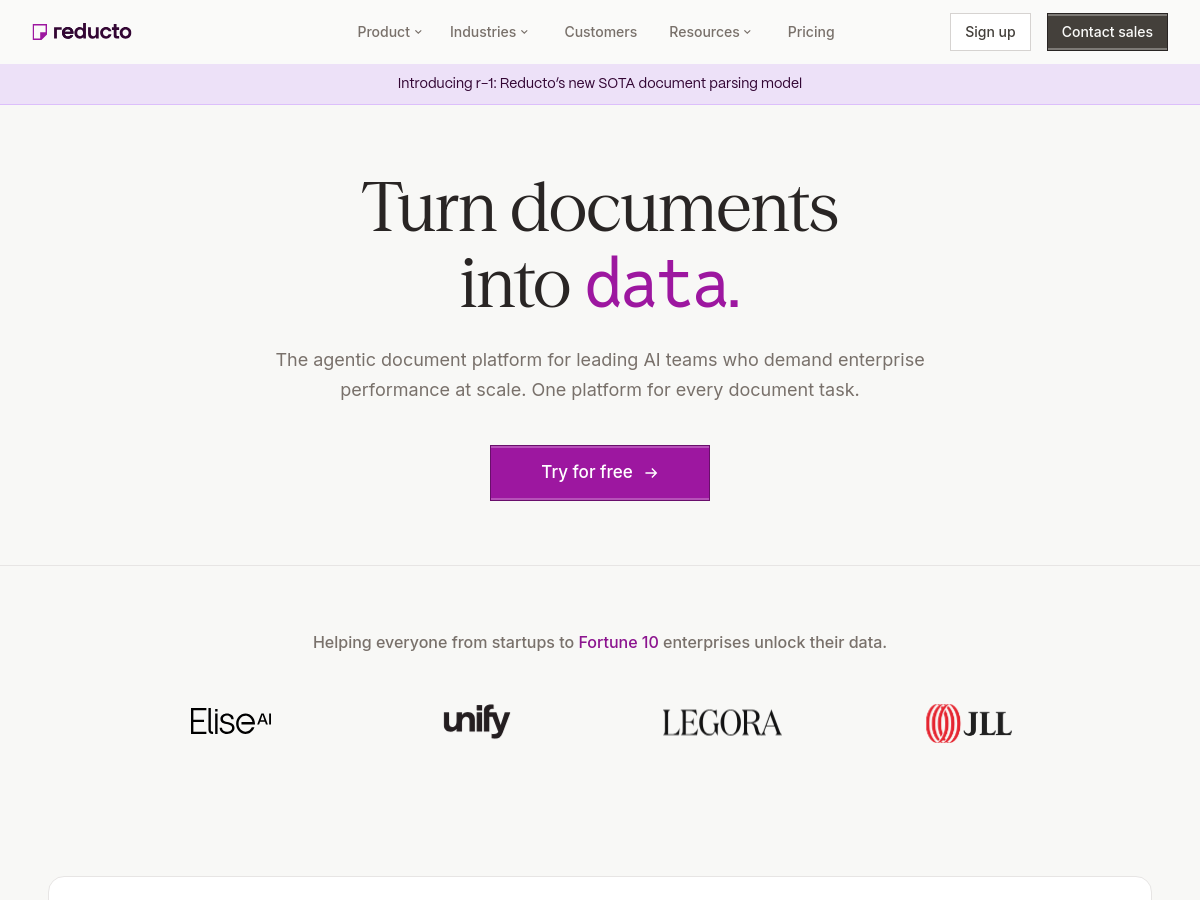
Reducto is an enterprise-grade agentic document platform designed for AI teams that need to convert complex documents into structured, usable data. The platform provides a comprehensive suite of APIs for parsing, extracting, splitting, and editing documents, enabling businesses to integrate document intelligence directly into their workflows. It is used by a range of organizations, from startups to Fortune 10 companies, to unlock data hidden in PDFs, forms, invoices, and other file types. At the core of Reducto is its new r-1 parsing model, which reads documents with near-human understanding, accurately capturing intricate layouts, tables, and formatting. The model provides bounding-box citations for traceability and reviews/corrects outputs in real time, delivering reliable results even on edge cases. Reducto's APIs are available for Python and Node.js, making it easy for developers to embed document processing into their applications. The platform also offers specialized endpoints for structured extraction (e.g., pulling invoice fields), document splitting (separating multi-document files), and form editing (filling detected blanks and checkboxes). With a focus on enterprise performance and scalability, Reducto positions itself as a one-stop solution for every document task in AI pipelines.

Solves

Reducto solves the challenge of extracting accurate, structured data from complex and varied documents at scale. It replaces brittle multi-tool document pipelines with a single platform that handles parsing, extraction, splitting, and form editing, giving AI teams reliable, reviewable results without manual pre-processing.

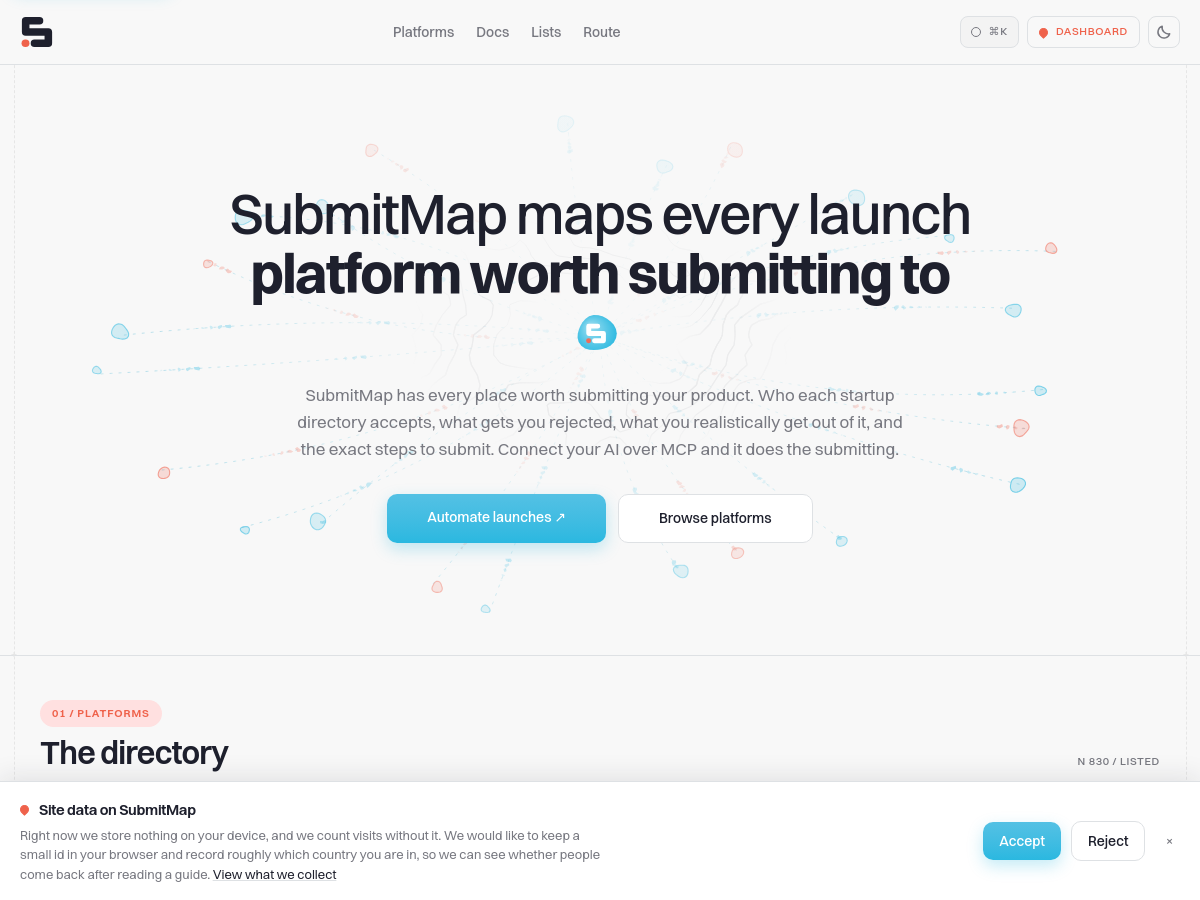
Screenshot of SubmitMap
SubmitMap
Seo Tools Unknown

SubmitMap is a web-based directory and launch automation platform for founders launching products. It indexes 830 startup directories, launch platforms, and listing sites with structured data on each platform's eligibility rules, approval process, review time, domain rating, pricing, and typical outcomes. Instead of filling out forms blindly, users can browse, filter, and compare places to submit a product based on concrete criteria such as whether the platform accepts AI tools, SaaS products, developer tools, indie products, or other categories. Each listing includes submission requirements and, in many cases, what causes rejection and the actual benefit a founder might get, such as a dofollow or nofollow link, traffic, or community exposure. The platform's dashboard lets users manage submissions, and it exposes a Model Context Protocol (MCP) interface so an AI agent can automate submissions once a user connects their account. The homepage also highlights documentation, saved lists, and a Route feature for customized launch plans. SubmitMap emphasizes transparency about link value by displaying domain rating and whether a directory's outbound links are nofollow or dofollow. It also categorizes platforms by category, pricing model, and approval time, with data on free, freemium, and paid submission options. The site is intended as a comprehensive map of every launch platform worth submitting to, with quality signals to help users decide where to spend effort.

Solves

Launching a product requires navigating hundreds of startup directories, each with different requirements, approval processes, and link quality. SubmitMap solves this by mapping discovery platforms and startup directories in one searchable database, showing whether your product qualifies before you submit, and providing actionable steps, expected outcomes, and MCP-based automation.

Screenshot of Userlens
Userlens
AI Agent Unknown

Userlens is an AI-powered customer adoption and retention engine built for B2B SaaS product-led growth teams. The platform uses an AI agent named Lumi to analyze each customer's product behavior and deliver timely, personalized guidance. By turning raw usage data into actionable nudges, Userlens helps product teams ensure every user knows what to do next, especially as the product evolves with new features and updates. The core workflow revolves around campaigns. Product teams define an adoption goal and an audience segment, and Lumi identifies which users qualify along with the reason for each match. Lumi then determines what each message should achieve, include, and avoid, enabling true one-to-one personalization at scale. This allows teams to reach users who are falling behind and guide them toward successful adoption of new workflows. Userlens emphasizes practical personalization: it reads actual user activity, such as repeated attempts, abandoned sessions, or feature misses, and crafts messages that speak directly to that behavior. The result is higher feature adoption, improved retention, and reduced churn for SaaS products that need to scale guidance without adding manual customer support or onboarding headcount. Backed by Y Combinator, Userlens is positioned as a modern adoption engine for product managers, customer success professionals, and growth teams. It is offered as a hosted SaaS solution, with a free tier and a booking option for a product demo.

Solves

B2B SaaS teams often struggle to drive feature adoption and retention across diverse user bases. Userlens solves this by automating the creation and delivery of personalized, behavior-based guidance, ensuring every user receives the right message at the right time without manual intervention.

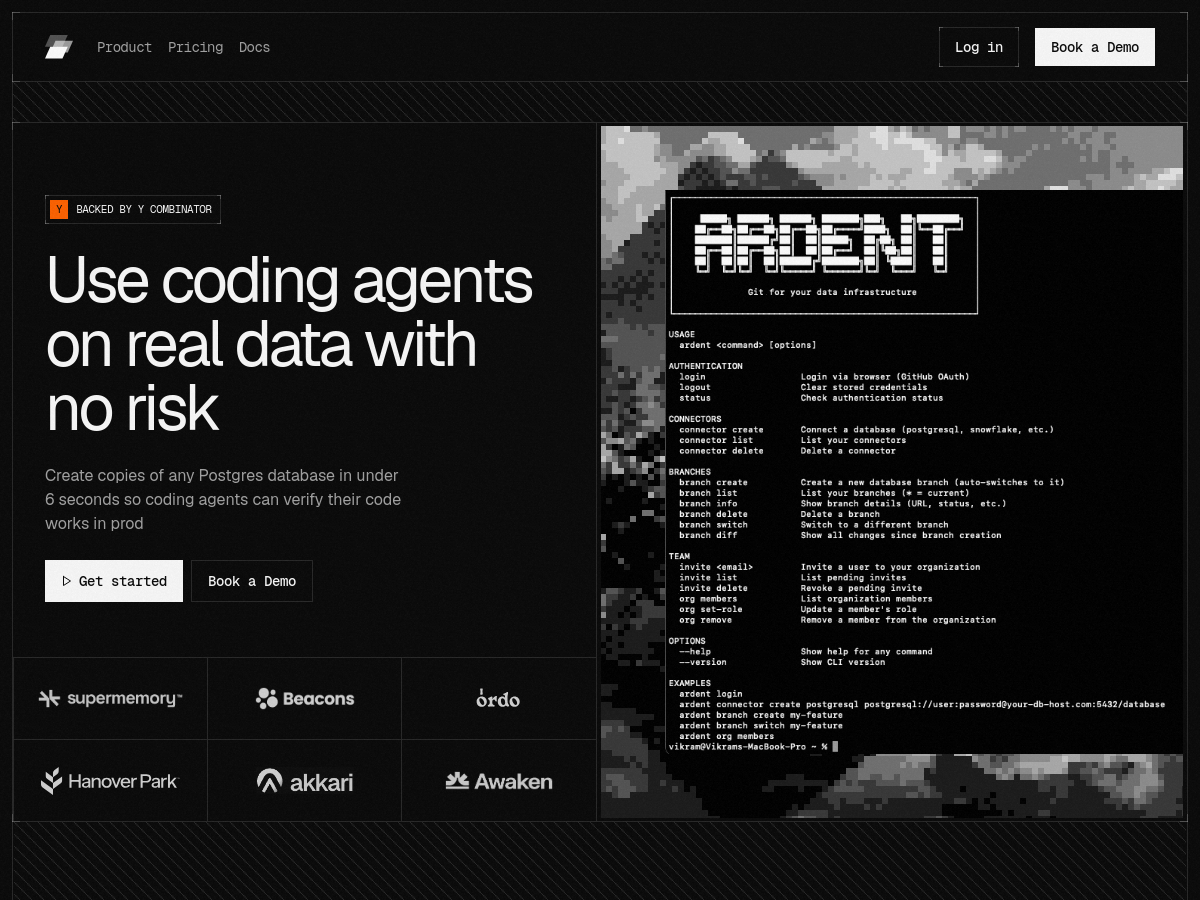
Screenshot of Ardent
Ardent
AI Developer Tools Unknown

Ardent is a managed database branching platform that creates isolated, fast copies of production PostgreSQL databases for coding agents and development teams. Using a copy-on-write architecture, it can instantiate a full branch of a database in under 6 seconds, regardless of the underlying dataset size, and each clone is isolated at both the storage and compute levels. This allows AI coding agents and developers to safely test, clean, migrate, and verify changes against realistic data without any risk to production systems. The platform is designed for terabyte-scale data with automatic compute scaling that drops to zero when idle, ensuring cost efficiency. It supports integration with popular providers such as Supabase, AWS RDS, and PlanetScale, replicating database extensions, authentication, and configuration specifics. Ardent provides a CLI and web interface to manage branch creation and lifecycle, enabling teams to adopt git-like branching workflows for their databases. Common usage scenarios include validating database migrations, enabling agents to perform data cleanup and deduplication, executing backfills, and verifying application code before release. Ardent reduces data drift, because agents work on a 1:1 copy of production, eliminating the inaccuracies of synthetic seed data. It is built to accelerate release cycles and is trusted by Y Combinator-backed startups and data-intensive companies.

Solves

Traditional database replications are slow, expensive, and risky, requiring long wait times and full storage duplication. Ardent solves this by providing near-instantaneous, storage-efficient branching for PostgreSQL, enabling coding agents to test against an exact copy of production safely. This removes the need for inaccurate seed files and prevents agent-generated changes from affecting live systems.

Screenshot of Neta Studio
Neta Studio
AI Game Generator Unknown

Neta Studio is an AI-powered world builder and game generator that transforms a single sentence into interactive worlds, games, maps, and roleplay experiences. It is positioned as a platform for creating living AI worlds, where agents expand a short text prompt into explorable environments. The homepage highlights examples such as a World Cup-themed game, a POV farming video, a vampire neighbor roleplay scene, and a map-and-timeline world portal. The platform is designed for accessibility: users describe a world in natural language and Neta Studio generates the underlying interactive experience, allowing them to step inside the result. It supports multiple output formats including game worlds, POV videos, roleplay scenes, world portals, and maps with timelines. This makes it a versatile tool for rapid prototyping and creative exploration rather than traditional game engine development. Neta Studio is offered as a web-based service with a free-to-start tier and no credit card requirement. It also includes a community showcase and Discord server for sharing and discovering creations. Pricing beyond the free tier is not publicly listed on the homepage, and the platform appears to be in active development with a changelog and blog.

Solves

Neta Studio solves the problem of turning a simple creative idea into an interactive world or game without requiring programming or game development skills. It lowers the barrier to entry for worldbuilding, roleplay, and narrative game creation by using AI agents to generate maps, scenes, and experiences from a one-sentence description.

Screenshot of PitchWorx
PitchWorx
AI Graphic Design Unknown

PitchWorx is an AI-led graphic design subscription service aimed at growing businesses and founders. For a flat fee of $699 per month, teams can submit unlimited design requests covering presentation design, brand identity, marketing creatives, web design and development, video and motion graphics, print, books, and illustration. The platform pairs AI agents with senior human designers, ensuring AI-generated drafts are reviewed and refined by experts before delivery. PitchWorx positions itself as a complete 'creative department on demand' with a 7-day free trial, no contracts, and the ability to cancel anytime. Trusted by over 500 brands over 13 years, PitchWorx claims to span 100+ creative categories. The service is designed to replace or augment in-house design teams, reducing the friction of hiring freelancers or agencies. Clients can log in, request assets across categories, and receive fast turnarounds through a structured workflow.

Solves

PitchWorx addresses the challenge of scaling graphic design production without the overhead of full-time employees or expensive agencies. It provides predictable flat-rate pricing for unlimited requests, eliminating per-project negotiations and cost uncertainty, while human-AI collaboration helps maintain quality and speed.

Screenshot of LightReel
LightReel
AI Marketing Unknown

LightReel is an AI-powered UGC marketing research platform that positions itself as 'the first AI that doomscrolls.' It maintains a large database of UGC content, adding 10,000 TikToks daily, and monitors Instagram Reels to identify trends, creators, and successful content strategies. The platform is designed to help brands and agencies develop data-driven marketing approaches, discover relevant creators, and optimize video performance. LightReel provides tools to find highly specific creators and influencers based on follower count, content type, and niche. Users can search for creators such as 'skincare creators in [ADDRESS] with 20K-80K followers and DITL content.' The platform also analyzes competitor activity, social media trends, and successful hooks to provide actionable feedback on accounts, scripts, and video drafts. The service is trusted by more than 4,000 brands and agencies, including names like Voodoo, Locket, Kalshi, and Warner Records. Testimonials highlight its effectiveness in generating millions of views, identifying creators, and improving content strategy. LightReel offers a free trial, subscription management, and API access for integration.

Solves

LightReel solves the challenge of creating effective UGC marketing strategies by providing an AI-driven research tool that constantly watches social media content. It helps brands discover creators, understand what hooks and content styles are working, and get feedback on their own videos, reducing guesswork and improving the chances of going viral.

Screenshot of The Face Report
The Face Report
AI Face Analyzer Unknown

The Face Report is a web-based AI facial analysis and personalized beauty report tool. It uses 478 facial landmarks to detect and measure a user's facial geometry from an uploaded selfie. The service offers a free 'Rate My Face' scan that produces a 0–100 attractiveness score based on symmetry and proportions, as well as a comprehensive look at face shape, golden ratio, jawline, eye shape, canthal tilt, facial ratios, and more. Free scans run fully on-device in the browser; photos are never uploaded and auto-delete within two hours. For a one-time fee of $17.49, the full Face Report expands the analysis to 40+ measurements across seven facial regions—including symmetry, golden ratio, thirds, fifths, eyes, and jaw—and generates a harmony profile with exact scores. The report also provides personalized styling guidance, with visual previews of different hairstyles and glasses on the user’s own photo, plus a prioritized action plan and four-week improvement routine. Users receive both an on-screen web report and a PDF copy by email. Designed for consumers, The Face Report positions itself as a private, instant alternative to professional facial-consultation services. The website includes multiple free measurement tools such as face-shape detection, jawline rating, eye-shape identification, and a side-profile assessment. Paid reports are backed by a seven-day money-back guarantee, and the company says that photos are never sold or used to train AI models.

Solves

Most people have no objective way to know how their facial features are perceived. The Face Report solves this by using AI to map 478 facial landmarks, converting facial geometry into clear numeric scores for attractiveness, symmetry, proportions, and more. It also goes beyond simple scoring by translating those measurements into practical styling recommendations that help users choose flattering hairstyles, glasses, and grooming priorities, all while keeping their photos private.

Screenshot of Oasis HQ
Oasis HQ
AI Agent Unknown

Oasis HQ is a collaborative workspace designed for teams and AI agents to work together with shared context and durable memory. It provides a single origin of truth where humans and agents can interact in rooms, which are group chats that support live editing of documents, spreadsheets, and codebases. The platform aims to eliminate the cold start problem for AI agents by maintaining living memory of decisions, tasks, and lessons learned, allowing new agents to pick up where previous ones left off. The platform supports building agent fleets—specialized agents that can be created, shared, and connected to various services and apps. It includes automatic routing to bring the right agents into tasks, and shared agents so teams work with consistent AI collaborators. Oasis HQ integrates with a wide range of popular agents and tools, including Claude, Devin, Cursor, Slack, and Linear, making it adaptable to existing workflows across engineering, marketing, customer support, sales, and data analytics.

Solves

Teams working with AI agents often face fragmented context and lack of shared memory, leading to inefficiencies and repeated onboarding of agents. Oasis HQ solves this by providing a unified workspace where humans and agents share context, memory, policies, and approvals, ensuring that every agent starts with the knowledge it needs and that work is aligned across the team.

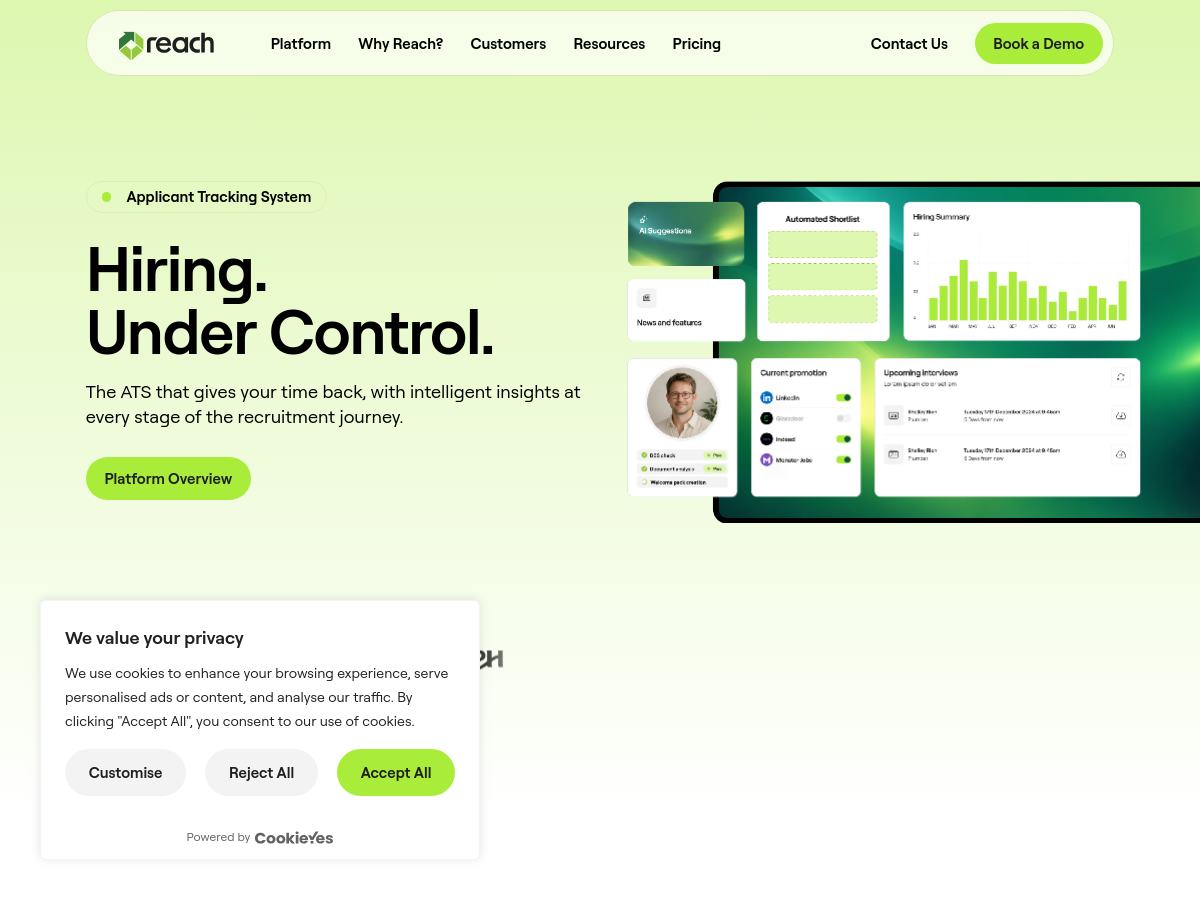
Screenshot of Reach ATS
Reach ATS
AI Recruiting Unknown

Reach ATS is a configurable applicant tracking system (ATS) designed for UK-based HR professionals and in-house recruitment teams. The platform covers the entire recruitment journey from candidate attraction to onboarding, offering multi-board job posting, branded career sites, talent pooling, and intuitive candidate management. Reach advertises itself as an all-in-one hiring solution with a strong emphasis on intelligent insights at every stage. The system integrates AI tools to assist hiring processes, including an intelligent ad assistant, AI screening, AI match scores, bias detection, and anonymised screening. These features aim to help recruiters shortlist stronger-fit candidates more quickly and fairly. For interviews, Reach includes self-scheduling, video interview options, assessment-day tools, and AI-assisted analysis. Onboarding is supported with branded onboarding portals, automated communications, offer management, and built-in Right to Work, DBS, and reference checks. Reach also provides reporting and analytics to help teams understand the recruitment pipeline, and its flexible, configurable workflows can adapt as an organisation grows. Human-centric features such as automated communications and candidate portals are paired with intelligence to keep both candidates and hiring teams updated. The company serves various industries including education, healthcare, professional services, legal, manufacturing, and nonprofit organisations.

Solves

Reach ATS solves the problem of fragmented and time-consuming recruitment by consolidating attraction, screening, interviews, and onboarding into a single configurable platform. It uses AI to speed up candidate shortlisting and reduce bias, while automated workflows and branded experiences keep hiring teams and candidates in sync.

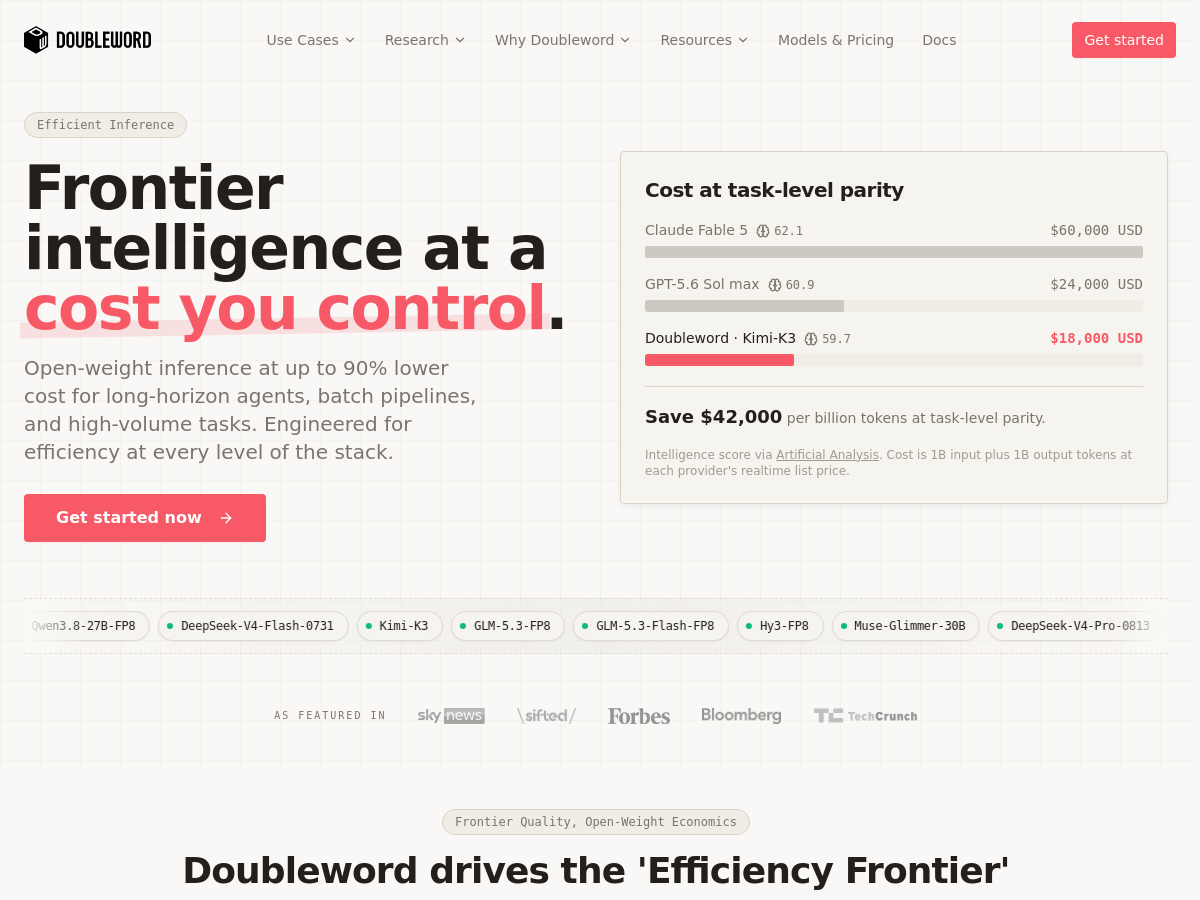
Screenshot of Doubleword
Doubleword
AI API Unknown

Doubleword is an AI inference API focused on async and batch workloads, designed to lower the cost of running open-weight models at scale. It is positioned as an OpenAI-compatible endpoint so existing applications can route high-volume inference tasks to Doubleword without rewriting their integration code. The service advertises savings of up to 90% compared with real-time closed-source APIs, with lower prices for batch schedules and built-in support for cache reuse. Doubleword runs open-weight models on an efficiency-optimized inference stack. Its homepage highlights an "efficiency frontier" in which Doubleword models provide a better cost-performance trade-off than alternatives at similar intelligence levels. The platform lists models targeting agentic reasoning, coding and maths workflows, multimodal agentic coding, and high-throughput extraction/ETL. Customers are described as token-hungry teams using agents, evals, pipelines, and other automated workloads. The company also emphasizes use cases like long-horizon agents and batch pipelines, and reports metrics including high cache hit rates and lower agentic inference costs than some alternatives. It is used by a range of businesses and institutions, and has been featured in technology and business press. However, public pricing and detailed operational documentation are not provided on the homepage, so teams should consult the docs or sign up to assess fit.

Solves

High-volume and batch AI workloads are often priced out by real-time proprietary APIs, especially for agents, evals, extraction pipelines and model evaluation. Doubleword offers low-cost OpenAI-compatible async and batch inference for open-weight frontier-class models. It reduces inference cost per task by up to 90%, enabling teams to run larger workloads within budget.

Screenshot of Unmei Tarot
Unmei Tarot
AI Dream Interpreter Unknown

Unmei Tarot is an AI-powered tarot reading platform that provides chat-based guidance for love, relationships, career, reconciliation, and daily life. It uses a full 78-card deck and offers a range of classic spreads such as the Celtic Cross, Horseshoe, Hexagram, and three-card layouts. Each reading can be examined card by card and followed up with an ongoing chat conversation for deeper clarification. The service emphasizes accessibility: free daily one-card pulls are available without signup, while more comprehensive readings like advanced reconciliation, career path, and annual forecasts are part of the Pro membership. The platform is organized into thematic sections: Love & Relationships covers reconciliation, compatibility, and interpersonal questions; Life & Career addresses crossroads decisions and professional direction; Professional Spreads provides traditional tarot layouts used by serious readers; and Gate of Dreams offers premium experiences like the 2026 Fortune 16-card annual forecast and a gesture-based past-present-future reading. Users can also explore educational articles and guides to learn tarot card meanings and spread methodologies. By combining AI language generation with traditional tarot structures, Unmei Tarot aims to produce personalized, reflective sessions rather than generic horoscope text. The chat feature allows users to ask follow-up questions, making each spread an interactive dialogue. The service is web-based and supports English, with membership plans available for those wanting access to advanced spreads and additional features.

Solves

Unmei Tarot addresses the need for accessible, personalized tarot guidance without requiring a human reader. It leverages AI to provide card-by-card interpretations of full spreads, enabling users to explore their concerns about love, career, reconciliation, and life anytime and continue the reading through follow-up chat.

Screenshot of Treyci
Treyci
AI SEO Tools Unknown

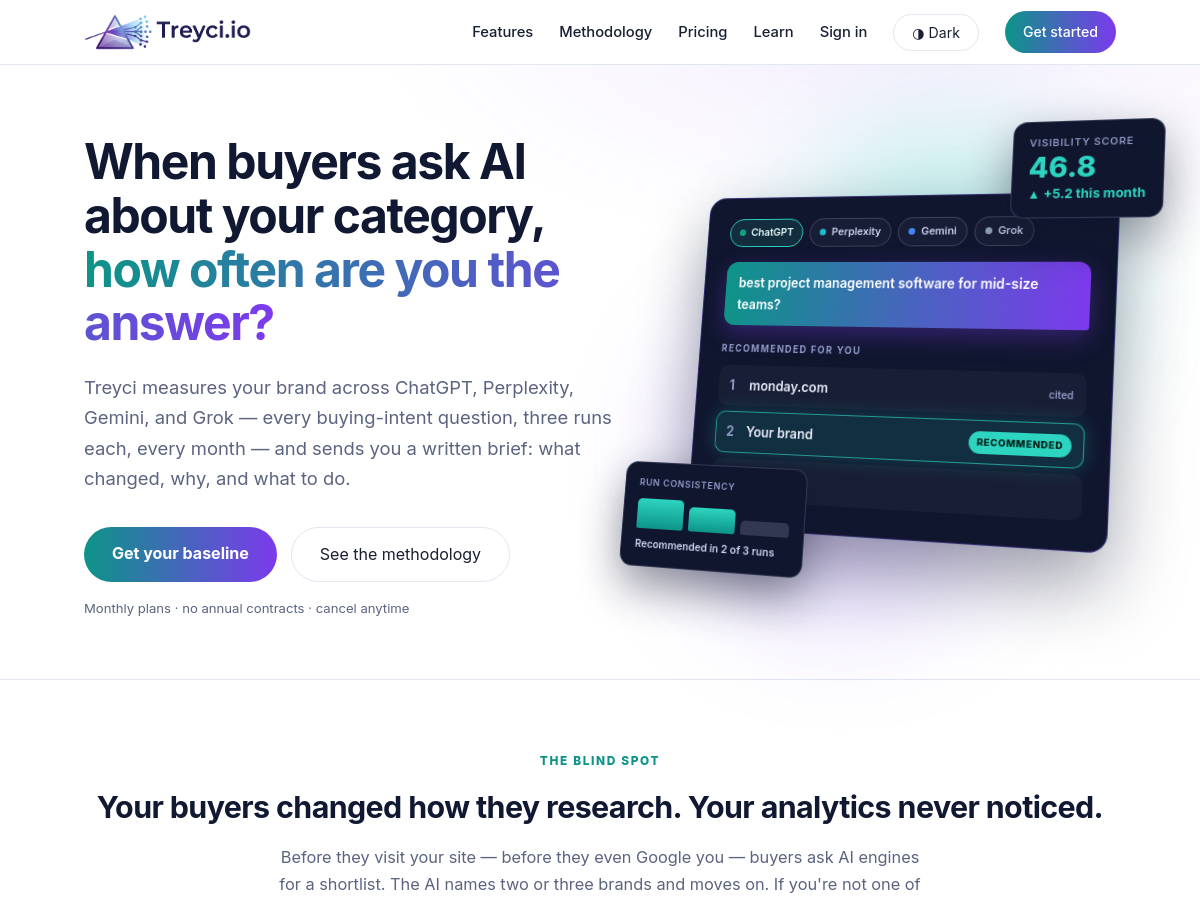
Treyci is a SaaS AI visibility tracking tool that measures how often a brand is mentioned, recommended, or cited in answers generated by ChatGPT, Perplexity, Gemini, and Grok. It uses a set of buying-intent prompts built for a brand's category, runs each prompt three times per engine per month, and aggregates the results to account for the stochastic nature of AI answers. The platform scores both the user's brand and competitors, storing verbatim AI answers so every metric can be traced back to an actual response. Treyci is deliberately simple: the product has two main areas. The Executive screen provides a single visibility score, rank, trend line, and a three-sentence monthly brief that can be forwarded to leadership. The Marketers screens add working views for trends, prompts, engines, citations, and verbatim answers, allowing users to see which questions were won or lost and which domains AI engines trust. A human-reviewed written brief is included on higher tiers, summarizing what changed, why, and what to do next. Pricing is monthly with no annual contracts, based on the number of tracked prompts. Starter tracks 25 prompts across three engines; Growth tracks 100 prompts across all four engines and adds custom prompts and alerts; Authority tracks 250 prompts with a human-reviewed brief and quarterly strategy call; Enterprise offers custom volumes, multiple brands, and a dedicated analyst. Treyci positions itself as an alternative to complex enterprise AI-visibility platforms, aiming at marketers and executives who have limited time.

Solves

Treyci solves the blind spot of AI-era brand measurement: buyers increasingly ask AI engines for recommendations before visiting websites, and traditional analytics miss these unclicked referrals. It tracks brand mentions, recommendations, and citations across major AI engines using repeated runs, then translates the data into a plain-language monthly brief with recommended actions.

Screenshot of AppBanana
AppBanana
Testing And Qa Software Unknown

AppBanana is a managed testing service specifically designed to help Android developers pass Google Play's closed testing requirement. The platform connects app developers with real human testers who interact with the app on actual devices for a continuous 14-day period, which is a prerequisite for achieving production access on the Google Play Store. AppBanana promises fast onboarding of under one hour, with 12–25 testers actively engaging with the app daily to satisfy Play Store standards. The service handles the entire closed testing process, including dashboard setup, tester invitations, and guided submission templates for the Play Console questionnaire, making the path to production approval simpler and less time-consuming for developers who lack a large network of beta testers. With over 10,000 apps successfully approved, AppBanana claims a 100% approval rate and offers a money-back guarantee if production access is not achieved. The service also includes free retesting if Google requests changes, ensuring that developers can iterate without incurring additional costs. AppBanana has become a practical solution for indie developers, startups, and small teams who find the closed testing requirement challenging to navigate due to the need for real testers and sustained engagement. The platform provides a user-friendly dashboard where developers can track testing progress, manage tester interactions, and receive step-by-step guidance from the AppBanana team. It also offers customer support through WhatsApp, allowing users to ask questions in real time before placing an order. While AppBanana is not open source, its value proposition centers on convenience, compliance, and risk mitigation for Android app launches.

Solves

Google Play requires new developer accounts to complete a closed testing phase with at least 12 real testers using the app for 14 consecutive days before production access is granted. Many developers struggle to recruit and coordinate testers, causing delays and rejections. AppBanana provides a ready pool of real human testers, manages the entire testing cycle, offers guidance for the Play Console questionnaire, and guarantees production access or a full refund.

Screenshot of OpenMusicPrompt
OpenMusicPrompt
AI Text-to-Music Unknown

OpenMusicPrompt is an all-in-one AI music studio that centralizes the entire music creation workflow. It enables users to analyze any existing track to uncover its musical structure, style, and production characteristics. This analysis is then used to engineer professional prompts for leading AI music generators such as Suno v5.5 and Udio. The platform also offers native music generation capabilities, allowing users to create pro-quality tracks without leaving the interface. Additionally, OpenMusicPrompt includes tools for generating album art, making it a comprehensive solution for rapid music production. It is designed to simplify the technical aspects of AI prompting while offering a streamlined environment for experimentation and creative output.

Solves

OpenMusicPrompt solves the challenge of crafting effective prompts for AI music generators by automatically analyzing reference tracks and producing professional, detailed prompts. It also consolidates music creation and album art generation into one place, saving time and reducing the complexity of managing separate AI tools.

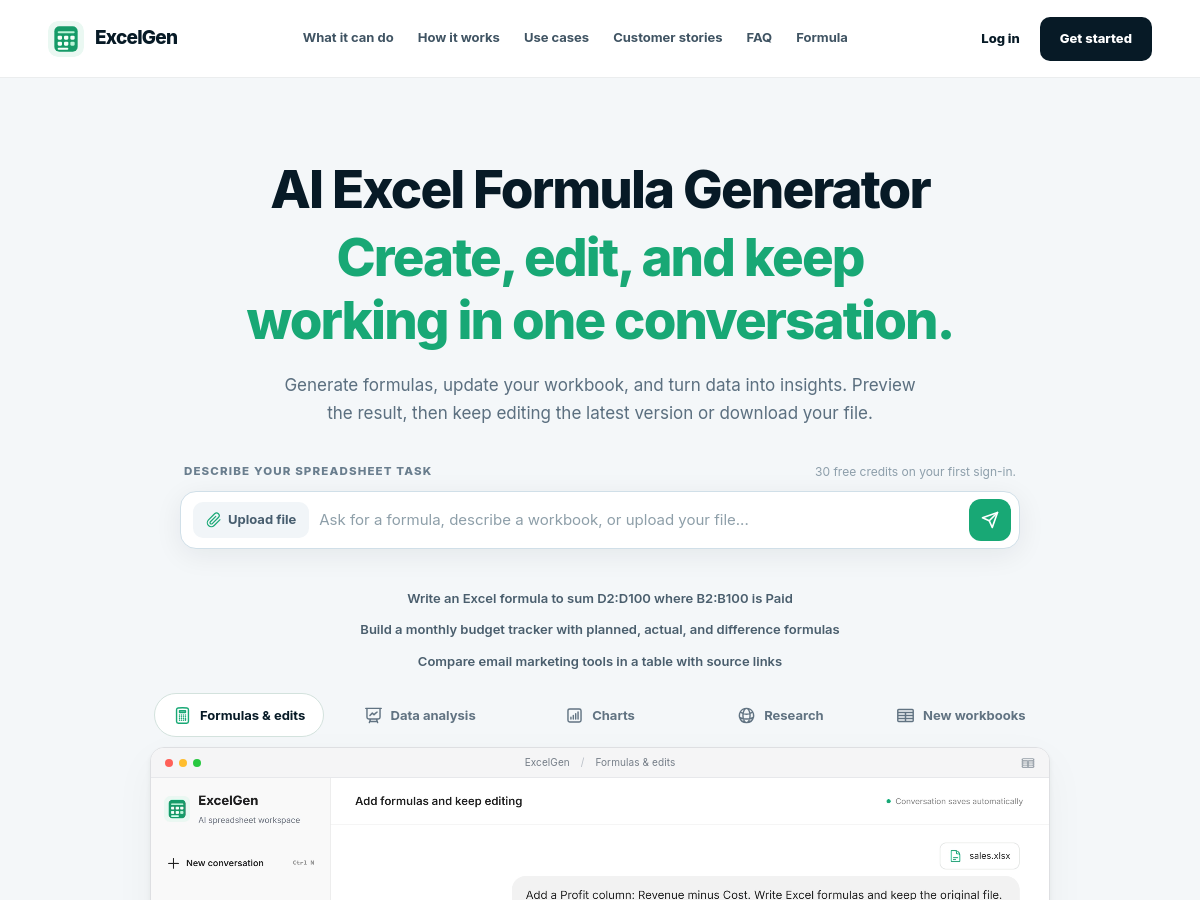
Screenshot of ExcelGen | AI Excel Formula Generator & Spreadsheet Assistant

ExcelGen is an AI-powered workspace for spreadsheet creation, formula generation, and data analysis. Users describe their task in natural language, upload existing or blank workbooks, and ExcelGen can produce Excel formulas, insert them into cells, perform data analysis, build charts, and even create entire workbooks from an idea. Conversation is maintained across messages, and each successfully applied edit creates a new version of the workbook that can be further refined or downloaded. The service targets professionals who want to move from describing a spreadsheet need to having an editable, formula-driven workbook without manually looking up functions. The generated formulas and worksheet structures remain available for follow-up edits. Example workflows include building monthly sales reviews, creating adjustable budgets with planned versus actual comparisons, applying commission rules, turning project notes into trackers, reviewing outstanding invoices, and researching comparisons of tools. ExcelGen also acts as an AI Excel formula generator and explainer for cases where only formula help is needed. As a hosted SaaS product, ExcelGen provides previews, chart generation, and persistent working state. It is designed for users across operations, finance, consulting, and project management who want to focus on the analysis rather than the mechanics of spreadsheet construction.

Solves

ExcelGen solves the friction of creating, editing, and explaining spreadsheets by letting users describe desired outcomes in natural language. Instead of writing formulas manually or rebuilding workbooks when analysis changes, users can converse with the AI agent, upload a workbook or start from scratch, and receive a new version with formulas, charts, and structured data ready for review and further edits.

Screenshot of Omoide Kasane
Omoide Kasane
Family Care Unknown

Omoide Kasane (想い出かさね) is a Japanese AI memorial service that helps families and funeral-related organizations transform photographs and remembered stories into a dignified record of someone's life. Using 5 to 20 family photos plus recollections, the service produces an aesthetically adjusted memorial portrait, a natural-sounding Japanese life story, and a 2-3 minute memorial video intended for funerals or remembrance gatherings. The homepage describes these outputs as drafts that families review before completion. The product is designed with explicit boundaries: it does not fill in unknown facts, does not infer achievements or private events, does not claim to reproduce the personality or voice of the deceased, and requires consent and human confirmation before final delivery. It also presents a local browser demo that processes selected images on-device only—no photos are uploaded or stored. This privacy-led approach is central to its promise, especially because the content is emotionally sensitive. Omoide Kasane is presented as a pilot rather than a currently orderable service: it lists proposed plans at 9,800 yen and 19,800 yen, with the higher tier including a human review step, but states that timing, deliverables, taxes, and final pricing are still under consideration. The tool is useful for families preparing memorial materials, funeral homes offering memorial movie services, temples and community groups, and organizations supporting life stories or end-of-life planning.

Solves

Bereaved families and end-of-life service providers often have a disorganized set of photos and memories but lack time or writing and editing skills to create a memorial. Omoide Kasane solves this by scaffolding a simple process: choose photos, tell the remembered facts, and receive a reviewed portrait, natural language life story, and short memorial video, while guarding against biographical invention and digital resurrection.

Screenshot of AI Agents Listing
AI Agents Listing
AI Tools Directory Unknown

AI Agents Listing is a web-based directory dedicated to cataloging autonomous AI agents. The site appears to list a variety of AI agent tools that can perform tasks such as research, browsing, and multi-step operations. It serves as a starting point for individuals and organizations looking to explore AI agent solutions, offering a centralized location to find relevant tools. The directory likely includes descriptions, links, and perhaps basic filtering or categorization, although the precise features are not publicly documented in the available content. The platform targets users who want to stay updated on the rapidly evolving landscape of AI agents. By aggregating tools in one place, it reduces the effort needed to compare different offerings. As an AI tools directory, it may be useful for evaluating options before adoption, though detailed functionality and curation criteria are not described in the available data.

Solves

AI Agents Listing addresses the challenge of discovering and comparing autonomous AI agents. Instead of relying on scattered web searches, users can consult this directory to identify potential agents for research, browsing, and multi-step tasks. It provides a centralized overview that helps streamline the initial evaluation process.

Screenshot of AudioVideo
AudioVideo
Ai Generative Media Unknown

AudioVideo is a browser-based AI generator designed to transform pre-existing audio—such as podcasts, narration, voice recordings, and music—into video content. It uses audio-aware AI models that analyze the sound and, in combination with a user prompt and optional reference image, produce videos without requiring filming or manual video editing. The platform also includes a visual direction library with demo media that can serve as inspiration for prompts, reference images, framing, and motion. Targeting creators and businesses, AudioVideo offers a free credit tier (e.g., 50 credits) and provides a credit-based workflow for further generation. Users upload an audio track, optionally guide the visual direction with prompts or reference images, and the system generates video in the browser. This approach removes the need for a camera or dedicated editing suite, making audio-to-video conversion more accessible. With dedicated pages for showcase, use cases, and pricing, the service positions itself as an alternative to traditional video production and editing. While exact pricing details and model specifications are not fully documented on the homepage, the core value proposition is convenient, AI-assisted video creation from audio assets.

Solves

Creating video from audio content traditionally requires filming new footage or hiring video editors to pair visuals with sound. AudioVideo automates the conversion of podcasts, narration, voice recordings, and music into videos using audio-aware AI, removing the need for a camera, editing suite, or creative studio.

Screenshot of Verla AI
Verla AI
AI Homework Helper Unknown

Verla AI is a cloud-based SaaS platform designed to help university students complete academic assignments more efficiently. It combines an AI writing assistant, presentation generator, and coding support with built-in AI detection and humanization tools. Users upload course materials such as rubrics, lecture notes, PDFs, books, and datasets, and Verla uses that context to generate drafts aligned with specific course expectations. Verla supports a broad range of academic tasks, including essays, research papers, reports, case studies, literature reviews, lab reports, slides, speaker notes, and data-analysis assignments in Python, R, or SQL. It also includes a Turnitin-style AI detector and a humanizer that can refine text across 30+ languages, lowering AI risk and improving tone before submission. The platform is rubric-aware and claims to understand discipline-specific standards for business, psychology, nursing, law, computer science, and engineering assignments. It provides academic references in APA, MLA, IEEE, Harvard, and other citation styles, helping students avoid fabricated citations. Its workflow moves from uploading requirements to generating a draft, checking the AI score, and humanizing the final version before submission.

Solves

Verla AI reduces the time and effort required for university assignments by providing an integrated workflow that generates high-quality drafts from uploaded course materials, checks them for AI detection risk, and humanizes the text to meet academic standards and citation requirements.

Screenshot of AstraRad Teleradiology
AstraRad Teleradiology
Other Unknown

AstraRad is a subspecialist teleradiology service that provides final signed imaging reports for hospitals, imaging centers, and radiology groups. With a network of 240 board-certified, fellowship-trained radiologists, AstraRad reads and signs approximately 600,000 studies per year, covering all modalities and body parts. The service integrates with existing PACS/RIS systems or via a secure web portal, and supports 24/7/365 operation with no surge pricing. AstraRad emphasizes subspecialty matching, urgency handling, and contractually committed turnaround times. Reports are delivered as final reads, not preliminary interpretations, with a median STAT turnaround of 30 minutes and a trailing 12-month SLA compliance of 99.4%. The platform handles HIPAA compliance as a business associate and executes BAAs with clients. AstraRad offers per-report pricing without minimum volume requirements or capacity ceilings, and can absorb up to 25,000 additional studies per month.

Solves

Hospitals, imaging centers, and radiology groups often lack subspecialist coverage, encounter staffing shortages, or experience overnight and weekend volume surges. AstraRad provides a scalable, 24/7/365 subspecialist teleradiology service that delivers final signed reports with committed turnaround times, eliminating reliance on prelims and preventing report delays.

Screenshot of Selfinance.pro
Selfinance.pro
Cryptocurrency Paid

Selfinance.pro is a paid, EU-hosted personal finance SaaS that consolidates net worth, budgeting, investments, emergency fund, and debt into a single dashboard. It is designed for individuals who previously relied on spreadsheets, separated budget apps, or investment trackers. The platform supports multi-currency tracking across USD, EUR, PLN, GBP, and CHF, and it automatically updates portfolio prices and foreign-exchange values. A key feature is an MCP-based AI connector that allows users to interact with their financial data from ChatGPT or Claude. Users can ask questions about their budget status, log expenses, review net worth, and update records through natural language chat. The connector uses per-user Google sign-in and only modifies Selfinance records, not bank accounts or real money. Setup is done by adding a custom connector URL in the AI assistant's settings. The dashboard includes budgeting categories, an emergency fund runway, a debt and mortgage overpayment simulator, and a suite of free calculators such as FIRE and compound-interest tools. Selfinance positions itself as an alternative to YNAB, spreadsheets, and multi-app personal finance stacks, promising clearer visibility with less weekly maintenance while remaining hosted in the EU and protected with bank-grade encryption.

Solves

Selfinance solves fragmented personal finance by replacing spreadsheets and multiple budgeting, investment, and net-worth apps with one dashboard. It also makes personal finance answerable and editable from ChatGPT or Claude through an MCP connector, so users can check budgets, log expenses, and review their full financial picture without opening another app.